|
The
Need for a Science of Everything--Omnology
Seeing the patterns
that emerge when one views all the sciences and the arts at once read
more
|
|
History
of the Theory of Evolution read
more
|
|
Truth
is Beauty, Beauty Truth, That is All We Need to Know
read
more
|
|
Oscillation,
the Primordial Pulse
read more
|
|
The
Infinitely Networked Universe read
more
|
|
Bacterial
Empires--Far Older Than Humanity
read more
|
|
Bloodbaths
and Utopias read
more
|
|
Lighting
the Caverns of the Beast Within in Order to Reach the Soul
read
more
|
| The
Universe is a Computer-Wolfram, etc.
read
more
|
|
Soul,
Emotion, Music, Math and Cosmos, Why Do They Relate?
read
more
|
|
Is
This An Unjust Universe?
read
more
|
| Why
Emotions are Contagious read
more
|
|
Conformists
and Eccentrics-How the Two Work Hand in Hand-Insiders vs. Outriders-Homesteaders
vs. Explorers--Freaks, Geeks, and Rebels: The Evolutionary Power of the
Odd read
more
|
|
History
of Science read
more
|
|
Entertainment:
A Clue to Our Wiring
read more
|
|
Emotional
Memory and Emotional Imperviousness - How the Mass Minds of Men and Women
Integrate
read
more
|
|
Will
The Real Scientist Please Stand Up? - Just What is a Scientist, Anyway?
read
more
|
|
Ten
Most Important Records of the 20th Century
read
more
|
|
Why
Do We Make War?
read
more
|
|
Geniuses
of Evil-Hitler, Lenin, Stalin, and Mussolini read
more
|
|
Why
science Must Study Religion
read
more
|
|
ANTS
read more
|
|
Internet
Subcultures, the Miracle of Trans-Geography
read
more
|
|
The
Value of illness read
more
|
|
Michael
Jackson-The Story of a Saint Dragged Down to Hell
read
more
|
|
The
Impact of 9/11 read
more
|
(Postings here by Paul Werbos
do not represent any views of the National Science Foundation)
|
 The
Need For a Science of Everything--Omnology The
Need For a Science of Everything--Omnology
"Intellectual
hedonism"--termed coined by intellectual and business networker (and
author) Richard Saul Werman (spelling probably wrong)
Omnology,
promiscuous research
See
if you can give me advice on the following. Below is a
manifesto for a new discipline, omnology. I've already got one
student who needs to have a valid area into which he can say
his omnivorous hunger for knowledge fits. There are many others
out there. They should be encouraged by academia, not
disenfranchised by it. Hence the new discipline. How does one go
about getting a new field recognized in academe?
"Omnology"-"an
academic base for the promiscuously curious, a discipline that concentrates
on seeing the patterns that emerge when one views all the sciences and
the arts at once."
The
Omnologist Manifesto
We are blessed with a richness of specializations, but cursed with a paucity
of panoptic disciplines-categories of knowledge that concentrate on seeing
the pattern which emerges when one views all the sciences at once. Hence
we need a field dedicated to the panoramic, an academic base for the promiscuously
curious, a discipline whose mandate is best summed up in a paraphrase
of the poet Andrew Marvel: "Let us roll all our strength and all
Our knowledge up into one ball, And tear our visions with rough strife
Thorough the iron gates of life."
Omnology
is a science, but one dedicated to the biggest picture conceivable by
the minds of its practitioners. Omnology will use every conceptual tool
available-and some not yet invented but inventible-to leapfrog over disciplinary
barriers, stitching together the patchwork quilt of science and all the
rest that humans can yet know. If one omnologist is able to perceive the
relationship between pop songs, ancient Egyptian graffiti, Shirley MacLaine's
mysticism, neurobiology, and the origins of the cosmos, so be it. If another
uses mathematics to probe traffic patterns, the behavior of insect colonies,
and the manner in which galaxies cluster in swarms, wonderful. And if
another uses introspection to uncover hidden passions and relate them
to research in chemistry, anthropology, psychology, history, and the arts,
she, too, has a treasured place on the wild frontiers of scientific truth-the
terra incognita in the heartland of omnology.
Let
me close with the words of yet another poet, William Blake, on the ultimate
goal of omnology:
To see a World in a Grain of Sand
And a Heaven in a Wild Flower,
Hold Infinity in the palm of your hand
And Eternity in an hour.
Copyright
2001 Howard Bloom
________
why we need omnology-
In a message dated 1/16/2003 1:43:32 PM Eastern Standard Time, MLsmolens
writes: By the way, this is one of my favorite magazines hb: mine too.
ms: for its wonderful variety of new technology and excellent writing.
In his intro to the main feature of the magazine taking about the 10 technologies
to look for it the future - he mentions ... "Our biggest challenge
in stimulating a creative culture is finding ways to encourage multiple
points of views. Many engineering deadlocks have been broken by people
who are not engineers at all. This is simply because perspective is more
important than IQ. hb: a superb observation. nn: The irony is that perspective
will not get kids into college, nor does it help them thrive there. Academia
rewards depth. Expertise is bred by experts who work with their own kind.
Departments and labs focus on fields and subfields, now and then adding
or subtracting a domain. Graduate degrees, not to mention tenure, depend
upon tunneling into truths and illuminating ideas in narrow areas. The
antidote to such canalization and compartmentalization is being interdisciplinary,
a term that is at once utterly banal and, in advanced studies, describes
an almost impossible goal. Interdisciplinary labs and projects emerged
in the 1960s to address big problems spanning the frontiers of the physical
and social sciences, engineering, and the arts. The idea was to unite
complementary bodies of knowledge to address issues that transcended any
one skill set. Fine. Only recently, however, have people realized that
interdisciplinary approaches can bring enormous value to some very small
problems and that interdisciplinary environments also stimulate creativity.
In maximizing the differences in backgrounds, cultures, ages, and the
like, we increase the likelihood that the results will not be what we
had imagined. see full text at http://www.technologyreview.com/articles/negroponte0203.asp
|
|
The
History of the Theory of Evolution
In
a message dated 6/19/02 10:10:09 AM Eastern Daylight Time, writes: The
word "evolution" was used first 1622 (Merriam-Webster). Does
not this predate Darwin? hb: good point, Hannes. But in those days the
term had a radically different meaning. Darwin's amazing campaign of self-promotion
utterly altered the denotations and connotations of the word Here's what
the Oxford English Dictionary says on the subject: Evolution I. The process
of unrolling, opening out, or disengaging from an envelope. 1. The opening
out or unfolding of what is wrapped up (e.g. a roll, a bud, etc.); fig.
the spreading out before the mental vision (of a series of objects); the
appearance in orderly succession of a long train of events. Also concr.
'the series of things unfolded or unrolled' (J.). 1647 H. More Poems 150
Evolution Of outward forms spread in the worlds vast spright. 1667 I Div.
Dial. i. §15 The whole evolution of+ages, from everlasting to everlasting,
is+represented to God at once. 1678 Cudworth Intell. Syst. 878 The Periods
of Divine Providence, here in this World, are commonly Longer, and the
Evolutions thereof Slower. 1742 Young Nt. Th. iv. 510 Beyond long ages,
yet roll'd up in shades+What evolutions of surprising fate! 1762 I Resignation
ii. xxxvi, Flowers+When ev'ning damps and shades descend, Their evolutions
close. 1759 Johnson Idler No 70 311 He whose task is to reap and thresh
will not be contented without examining the evolution of the seed. 1843
G. S. Faber Sacred Cal. Proph. (1844) I. p. xv, The evolution of time
has served only to confirm me in+the honest
________
Val--Many thanks for the kind words. Yes, Lamarck is a an extremely interesting
figure. He generated so much intriguing material. It's a shame we were
all raised to shun him like the plague. However Eshel's viewpoint impresses
me as taking the best aspects of LaMarck and combining them with the mechanistic
approach of the NeoDarwinians so we end up with a new synthesis. The cybernetic,
cooperative evolutionary viewpoint, which I've also been working on for
twenty years from a different data-set than Eshel's, reintroduces what
Peter Corning and others have called "teleonomy"--directionality
to the universe. Stephen Jay Gould would HATE it. On the other hand, my
own material either supports it or it supports my own material or something.
Maybe it's just synergy. Howard
P.S.
Speaking of things I left out, I didn't find room to mention that Erasmus
Darwin had actually come up the idea of adaptation to environmental conditions
as an evolutionary driver--though Lamarck may have beaten him if he published
something on the subject before the grand airing of his theories in his
1781 _Systeme des Animaux Sans Verterbres_. (Erasmus' Zoonomia had come
out five years earlier.) P.P.S. the following is very neatly put <<Lamark
put the multiple creation (archtypes + decay) with successive eliminations
by God and re-creation on its head: species are not created and decay
into greater variation, heading towards extinction, but evolve from lesser
to higher complexity striving to adapt to their environments. ---------------------
Subj: Re: entropy, gravity and bacteria Date: 98-03-28 20:33:02 EST From:
(Valerius & Renate Geist) To:
Howard,
Very beautifully explained! A masterpiece of good writing. By the way,
Konrad Lorenz roared out that "life eats entropy!" Anyway, nice
to know that entropy may not apply in this universe and that poor Lamark
is about to return from the grave. You overdid it a bit on Erasmus Darwin,
and did not note that Lamark put the multiple creation (archtypes + decay)
with successive eliminations by God and re-creation on its head: species
are not created and decay into greater variation, heading towards extinction,
but evolve from lesser to higher complexity striving to adapt to their
environments. That's why Soren Lovtrup points to Lamark as the father
of evolution. What courage it took to make that pronouncement! Cheers,
Val Geist
________
Subj: Re: entropy, gravity and bacteria Date: 98-03-29 19:38:53 EST From:
(John Wilkins) Sender:
Darwin
himself announced that Lamarck was the founder of modern evolution in
the "Historical Sketch" of the 4th edition and on. Darwin said
that he never claimed to have come up with the idea of evolution and it
is sheer revisionism and strawman construction to make out that he did.
In the 1830s, as Adrian Desmond has shown, evolution was rife, especially
in Edinburgh and Paris, and tied to radical social movements (eg, Chartism)
(Desmond 1989)
Refs
Desmond,
A 1989. The Politics of Evolution: Morphology, medicine, and reform in
radical London, University of Chicago Press.
Jablonka
E and Lamb MJ 1995. Epigenetic Inheritance and Evolution: The Lamarckian
Dimension, Oxford UP.
L°vtrup,
S. (1987). Darwinism: the refutation of a myth. London, Croom Helm.
Nitecki
M H (ed.) 1988 Evolutionary progress U Chicago P
|
Truth
is Beauty, Beauty Truth, That is All We Need to Know
"In my entire scientific life…the most shattering experience has
been the realization that an exact solution of Einstein's equations of general
relativity, discovered by the New Zealand mathematician Roy Kerr, provides
the absolutely exact representation of untold numbers of massive black holes
that populate the Universe. This 'shuddering before the beautiful,' this
incredible fact that a discovery motivated by a search after the beautiful
in mathematics should find its exact replica in Nature, persuades me to
say that beauty is that to which the human mind responds at its deepest
and most profound." Chandrasekhar ("Chandra") 1975 (Martin
Rees. Before the Beginning: Our Universe and Others (1997). Reading, Massachusetts:
Perseus Books: 96-see this book for the ways in which Einstein's math panned
out in reality generations after the completion of the Theory of Relativity)
_______________________________
the
more "truth" a structure encapsulates, the greater that structure's
fit with reality (meaning with future events) and the larger or more influential
it will grow. hb
________
"the linguist Noam Chomsky of the Massachusetts Institute of Technology.
Chomsky showed that much of the human capacity for grammar, rather than
being learned, arises from a complex inborn structure in the brain. Furthermore,
that inborn "universal grammar" probably did not evolve in the
usual way, the way that fins or wings did; instead, universal grammar
has somehow been an intrinsic part of the structure of matter ever since
the big bang, or possibly even a necessary part of the eternal Platonic
world of logic and mathematics, constraining matter whenever it is configured
into a mechanism capable of language." No Easy Way Out Sciences;
New York; Spring 2001; Stevan Harnad; Volume: 41 Issue: 2 Start Page:
36-42
_______________________________
A few years ago, Eshel Ben-Jacob posed a question: "what is
information." Eshel felt that a new definition would provide a
new way of understanding this universe. I answered that
information is a signal passed between two objects, entities, or
beings which the receiver was able to decipher. A gravitational
cue, for example, is a signal sent by one body to another and
interpreted as an impulse to approach. Electromagnetic
charges can be interpreted by similarly charged bodies as
repulsion and by bodies with an opposite charge as repulsion.
Now Samuel Bonasso has postulated that:
"Information, at various levels of probability and quality, allows
energy to self organize and condense into its various contracted
structural forms and to separate and re-expand into the general
field."
which leads to the following thoughts: the more "truth"
encapsulated in a structure, the greater that structure's fit with
reality (meaning with future events) and the larger or more
influential it will grow. So information is not just what a sender
sends to a receiver, it is also a signal in a one-way
transmission-from the past to the future. Transmission between
two objects existing simultaneously takes place via attraction
and repulsion cues. One-way transmission from past to future
takes place between the structure that was and the new
arrangement that will be. It takes place via survival, accretion,
and dissolution. Successful structures are those which manage to
attract the greatest number of successive survival or accretion
cues. They stick around. Those which anticipate the future
poorly are dissolved by it when it arrives. Information builds up
over time. Since it is constantly chiseled by the future it must
anticipate, by hauling its past lessons from one time frame to
another, it encapsulates and anticipates an increasing number
of future possibilities. Where does a proton fit into this? Protons
manage to anticipate the future magnificently. They survive
and survive the many changes of a universe tumbling through
the evolution of new forms and functions, new ways of being and
of doing, over time.
Two
corollaries of this overly abstract notion:
The
universe is constantly honing its constituents via their
interactions and is constantly building more data on past and
future into its constituent entities. Billions of years of inanimat
evolution are built into an iron atom--which carries within it the
evolution of the quark, the joining of quarks into neutrons and
protons, the joining of neutrons and protons into stable foursomes,
then, 300,000 years later, the sudden ability of these quartets to
attract and hold the attention of electrons in the embrace we
call an atom. But that's not the end of it. An iron atom also
contains the aggregation of galaxies, the birth of stars, and their
death--for it is in the death of stars that iron atoms are formed.
Each of the constituents of an iron atom has been honed by
natural selection--sharpened by its need to survive changes on
vast scales of explosive energy, the expansion of space, the
contraction of gravity, the swirling of mass vortices of form, and
the planck-instant microsecond alterations of arrangement we
call time.
corolllary
two--we contain within us twelve to seventeen billion
years of this cosmos' history. billlions and billions of years of stored
experience and stored prediction of possibilities. we say that
beauty is truth and truth is beauty, and that sounds like the idlest
form of poetry. but that which is not truthful to the future does
not survive. when our minds seek symmetry and other forms of
gorgeousness, are we seeking our most primal sense of what is
true and right--of a vast inner past feeling out the future
perfectly? Howard
Howard
Bloom wrote:
>In
a message dated 98?01?31 10:26:06 EST, Joa Sousa writes: > ><<
We have the impression that our decision > was taken thanks to "free"
will and we would like to believe that this is > really free, "we
have decided by ourselves", but this impression is an > illusion,
something comparable to a psychotic delirium or a dream. > If you ask
Dennett and Dawkins they will tell you exactly the same. >> >
>An interesting point of view, but it doesn't feel right intuitively,
for >whatever that's worth. However though Dennett is popular and Dawkins
is >utterly fascinating, the two of them have a very strong tendency
to go off on >the wrong track from time to time (don't we all?). Howard
Howard,
surely the key point is that it would be distinctly maladaptive if Joao's
suggestion felt intuitively correct. After all, we look somewhat askance
at folks who hear detached voices telling them what to do. In your other
posting you supplied most of the basic data that should enable us to get
an "undewy?eyed" handle on both free will and consciousness.
As you made clear, it has been shown over and over again that what we
call consciousness is a post hoc rationaliser, forced to come up with
explanations ? not infrequently wrong ? for decisions already taken elsewhere
in the brain, and always with the objective of falsely maintaining your
intuitive sense that it's in charge.
As
we can also have a good stab at determining where the sense of self, central
to consciousness, peters out in the animal kingdom ? experiments with
mirrors suggest that chimps have it whereas macaques don't ? it seems
almost certain that it is no more than an essential function of a novel?problem?solving
unit, at its most developed in us. It is almost certainly of very recent
evolutionarily origin, and even without the clear evidence that this has
not happened, it would seen highly unlikely that such a Johnny?come?lately
would rapidly supplant whatever it was that so successfully managed the
ancestral organisms over the preceding aeons.
Where
then does this leave free?will and the questions raised by Lyle Steadman?
Well, free will certainly cannot be truly free if it resides exclusively
in the conscious mind. The best that can offer is a non?binding, advisory
role to decision making devices located elsewhere. Does it then actually
lie, cheek by jowl, with those brain centres which actually call the shots?
Perhaps, but if so, there is not much comfort for those wedded to strong
notions of freedom of action. The reason the true decision centres "need"
consciousness is because it alone can actually manipulate information
and review it from a number of perspectives. It alone has the capacity
for what we would call choice. But subsequent processing, once input data
has left consciousness, seems to me almost certainly to be by means of
high?speed, rule?bound algorithmic devices. And it is these which actual
determine what "we" do. This leads me to assume that once a
given data set is feed into one of these, the outcome is a foregone conclusion.
Why
then can we not predict with unerring accuracy what an individual will
do? Perhaps principally because we cannot predict with certainty what
consciousness will feed into the decision?taking algorithms. However,
according to this model, the fact that you cannot tell what I will do
next, does not mean that I have free will. Sadly, I'm as much in the dark
as you are!
Mike makes a very strong point here about free will. If my rough theory
of consciousness is correct, consciousness is an afterthought rationalizer
(Gazzaniga's concept) which then feeds back its convictions and its fancies
to lower levels of the brain. Those lower levels are where decisions are
really made. So conscious will deludes itself when it thinks its in charge
of moment-to-moment decisions. Yet there's a reality hidden in the illusion,
too. If the feedback from the conscious will is shoved downward with enough
conviction and peristence, it can train the actual decision-makers to
follow the guidelines will has picked. Which means free will does not
exist in consciousness entirely but in the lower levels of the brain where
decisions are actually made. I say "not entirely" because the
consciousness DOES participate indirectly in decision making though the
concepts and distillations of them into actions which it fixes on as a
worldview or a sense of self or a determined commitment to values. These
it sends back and implants in the non?verbal brain for use in later processing
and decision making. To that extent the conscious mind IS involved in
choice.
However
since the instant of choice takes place in the non?verbal brain, and since
this is not deterministic, then there's a good chance that even a non?verbal
and non?cerebral organism like a bacterium which makes a not?totally deterministic
choice may well have "free?will" too. But, again, let's distinguish
between "free will"??the ability to make a non?deterministic
choice through the use of whatever physical mechanism one uses to decide
whether to make a right turn or a left??and what we humans call "will"??that
powerful sense of conviction which can drive us in a Nietzschean manner
to accomplish the impossible. Will is something we still have not located
or explained.
As
for Joa Sousa's arguments that everything in a physical mechanism is determined
in a LaPlaceian manner, this just doesn't seem to be so. LaPlace hasn't
ever been shown to work out on the level of macro, or even micro and quantum
entities. Photons and electrons have this annoying ability to jump around
and be in two places at once, two states at once. Or so it appears using
the primitive tools of our technology and of our current concepts. Who
knows what it will look like in a hundred years? Still, LaPlace's Newtonian
billiard ball model has been pretty well trashed, not because it is old
and out?of?fashion, but because it simply doesn't apply to very much at
all in the phenomenal, the empirical, the "real" world.
In
a message dated 98?02?01 10:21:46 EST,
<<
it has been shown over and over again that what we call consciousness
is a post hoc rationaliser, forced to come up with explanations ? not
infrequently wrong ? for decisions already taken elsewhere in the brain,
and always with the objective of falsely maintaining your intuitive sense
that it's in charge. << As we can also have a good stab at determining
where the sense of self, central to consciousness, peters out in the animal
kingdom ? experiments with mirrors suggest that chimps have it whereas
macaques don't ? it seems almost certain that it is no more than an essential
function of a novel?problem?solving unit, at its most developed in us.
It is almost certainly of very recent evolutionarily origin, and even
without the clear evidence that this has not happened, it would seen highly
unlikely that such a Johnny?come?lately would rapidly supplant whatever
it was that so successfully managed the ancestral organisms over the preceding
aeons. <<Where then does this leave free?will and the questions
raised by Lyle Steadman? Well, free will certainly cannot be truly free
if it resides exclusively in the conscious mind. The best that can offer
is a non?binding, advisory role to decision making devices located elsewhere.
Does it then actually lie, cheek by jowl, with those brain centres which
actually call the shots? >>
Then
Mike goes on to write:
<<The
reason the true decision centres "need" consciousness is because
it alone can actually manipulate information and review it from a number
of perspectives. It alone has the capacity for what we would call choice.
But subsequent processing, once input data has left consciousness, seems
to me almost certainly to be by means of high?speed, rule?bound algorithmic
devices. And it is these which actual determine what "we" do.
This leads me to assume that once a given data set is feed into one of
these, the outcome is a foregone conclusion.
hb:
this seems an interesting idea, but I do strongly suspect that there is
a stochastic element, an element of unpredictability, of choice, even
in the physical processing modules, whatever they may be, of bacteria
when they hit critical choice points (and they frequently do??the "decision"
they make may be right or wrong and their lives may depend on its accuracy
in modelling future events to avoid a phagocyte or to find an opening
in a cell wall that offers opportunity??sperm are up against the same
problem, and very few have the right stuff, the physical makeup and the
correct decision making machinery to accomplish their goal, insemination
of the ovum; which means even sperm have to carry some rough future generation
module within them to make their long and complex trek to the spot where
an ovum awaits them, then to out?compete their fellow sperm swarming around
that ovum and to do whatever it takes to seduce the ovum??which also has
choice??into "deciding" that their serenade of chemicals, tactile
stimuli [a "mating dance"], or whatever sperm courtship consists
of??means they are "Mr. Right"). So I seem to be positing that
even bacteria have a future?generation module of some kind. An internal
"corollary generator," to revert to my corollary generation
theory. This, it is easy to suspect, is one of the primal elements of
consciousness. An infant has such future generation and decision modules
as well, though they are instantiated in a rapidly developing and changing
brain, an organ which the sperm or bacterium do not possess. And perhaps
some of the baby's choice?making machinery, its future?generation modules,
are located outside the brain??in the vagal "second brain" which
exists in the solar plexus, or in the adrenal system, which feeds its
guesses via roughly thirty different cortical chemicals throughout the
body and targets them to the thyroid, pituitary, and pineal gland in the
brain, and to other outside?brain decision centers like the thymus in
the upper chest, the pancreas, the testes, and the ovaries, all of which,
I suspect, must have their forms of future generators so they can make
correct decisions too.
This
leaves us with the radical difference between "free will," which
apparently does not need consciousness to exist, and "will"
of the Nietzschean variety, which involves consciousness quite heavily.
Yes, Mike, I think you are right. Will and consciousness are decision
refining mechanisms. Will and consciousness are future generators, corollary
generators, of far greater power than those available to an infant, a
bacterium, an adrenal gland, or a sperm. In fact, will and consciousness
can picture futures vigorously, "believe" in them fervently,
and send their conviction back to the non?verbal brain centers for participation
in future non?verbal decision making. So the non?verbal brain has "free
will." But only the story?telling, worldview making, vision?generating,
metaphor?maninpulating consciousness can participate in "will"
itself. And it does it precisely, I'd suspect, by generating complex pictures
of the future based on cultural premises and "conscious" choice
between differing views offered by various subcultures. Such subcultures
exist even in such primitive social groups as tribes, where clans and
moities insure a choice of worldviews and conscious attitudes??the stuff
of which will is made. Thus will is partly a choice maker between the
variety of worldviews available within a culture. It also sifts through
worldviews available from outside the culture, as when Paul Okami, a Californian
member of the Human Behavior and Evolution Society, rejects standard western
models and takes on the models offerered by the Japanese worldview of
Zen. And will picks between points of view promoted by exceptional individuals,
those quirky souls who generate amalgams of previous notions, corollary-mashes
with new properties, emergent properties never seen before. All these
interactions of the individual and society, the personal consciousness
and the subcultural mix, the visionary's tendency to tap, blend and reinterpret
forgotten culture models to create new visions, all are future generation
mechanisms, corollary generators, with a sweep and power unavailable to
a lone myxobacteria attempting to make its way through its watery world.
Or even to a myxobacteria attempting to participate, as myxobacteria do,
in a pack attack on a potential source of food. That individual myxobacteria,
part of a larger social entity, needs to generate future possibilities
and act on them in the hope of getting some of the spoils if the group
manages to make its kill, or, if it is in the vanguard, to make sure the
struggle against a fish that's trying to escape, a seafood platter exercising
its own future?generation and decision making powers in a desperate struggle
to survive attack, becomes a meal and doesn't get away. Does this seem
to take us anywhere?
<<Why then can we not predict with unerring accuracy what an individual
will do? Perhaps principally because we cannot predict with certainty
what consciousness will feed into the decision?taking algorithms. However,
according to this model, the fact that you cannot tell what I will do
next, does not mean that I have free will.
hb??I
think you have made a magnificent contribution with your model. And, Mike,
I do think what you say means you DO have free will. Howard
|
|
Oscillation,
the primordial pulse
re:
sounds like habit hb: Yup, it sure does. We grasp at a novelty like roller-skating,
take a few weeks to learn it, fall, make fools of ourselves, then begin
to get the hang of it, rollerskate for a year or two in the local park
with great gusto, then get bored and look for something new to add to
our kit of habits and skills. We take up the tango and make fools of ourselves
all over again, then, once we've mastered it, it eventually grow bored
and look for some other novelty--white water rafting, camping in Alaska,
rock-climbing, snowboarding. What do we do with the kit of skills we assemble
in this way. Is all play really a form of practice for the everyday...and
for emergencies too? When we enter a conference room, do we see the problems
tossed our way in terms of roller-skating, tango dancing, white water
rafting, or rock climbing? Once we've got a big kit of skills, do we see
problems and opportunities in terms of all of these tricks we've learned
to perform? Do these muscular habits give us tools of comprehension, new
forms of metaphor? Boredom and the lust for novelty add to what we feel
and know...but how does that show up in everyday life? Howard In a message
dated 5/16/2003 9:02:31 PM Eastern Daylight Time, writes: It also sounds
a lot like habit. "There is a law in this succession of ideas. We
may roughly say it is the law of habit. It is the great 'Law of Association
of Ideas,' the one law of all psychical action." - Charles Sanders
Peirce At 12:57 AM 5/16/03 -0400, wrote: bite, chew, digest, use up, get
hungry, bite, chew, digest, use up, get hungry-this is the basic oscillitory
pattern of the cosmos.
_________
amazing, thanks. Howard In a message dated 1/3/2003 2:53:45 PM Eastern
Standard Time, writes: At 1/3/2003 01:55 AM, you wrote: gb: In a linear
system, these forces would be in a stable equilibrium. In a nonlinear
system, ie the brain, turning up the gain might result in bistable behavior,
with apparently sudden shifts between the two states. hb: after decades
of building radios and operating oscilliscopes, it is time for me to finally
reveal my ignorance. What does turn up the gain mean? Turn up the amplification
of random bits that may make sense...or that may crash the system with
their incoherence? If that were the case, turning up the gain would be
exploration and novelty testing. Turning the gain down to exclude the
fuzz and buzz of possible discoveries, to focus only on what's tried and
true, would be the equivalent of the k phase, the conservative phase,
digestion and consolidation. gb: In neural systems, gain refers to the
steepness of an S-shaped input-output function. This is typically used
to model neural functions in which there is a floor effect, eg once you
inhibit a cell, it's pretty much quiescent and doesn't have negative firing
rate, and with excitatory inputs, you eventually reach a saturation effect
where no matter how much more you drive the cell it doesn't fire any faster.
The gain describes how sharp the transition is between these two extremes.
Increasing the gain is equivalent to increasing the signal-to-noise ratio,
and in the extreme is equivalent to a thresholding function (on or off).
very interesting behavior occurs when you connect two neurons like this
in which they inhibit each other. If the gain (steepness) is not particularly
great, then the system behaves linearly (as one goes up the other goes
down). If the gain is large, however, then you observe bistable behavior,
where one neuron is completely on and the other is off -- no in between.
g
________
Hmmm, so ants create order using lateral inhibition of precisely the same
kind that sweeps the debris from between batches of matter competing to
become stars. Ants use oscillation to produce the architecture of a burial
place. Termites use a similar "local activation and long-range inhitition"
to create the pillars, arches, walls, and architecture of their mounds.
There's many a form of ebb and tide, of crest and trough, of primal wave,
in the way this universe is made. Howard
Orderly Ant Corpses NYT July 23, 2002 By HENRY FOUNTAIN [What are the
human analogies?] When it comes to planned communities, there is none
more planned than a graveyard. To ensure that the departed truly rest
in peace, many cemeteries have regulations to govern plot location and
size, maintenance, placing of flowers and wreaths and even access. (In
addition to being planned, most cemeteries are gated communities, too.)
Some ants keep their cemeteries just as well organized. Ants will move
a corpse and pile it up with others to create a tidy final resting place.
There are no rules and regulations, of course, but as researchers from
France, Belgium and Spain have discovered, there are some principles at
work. The researchers conducted experiments on ant colonies, distributing
corpses around the edge of a circular arena and then watching as worker
ants tended to the dead. After six or more hours, the ants had moved the
corpses into a stable pattern of piles of roughly equal size. Out of the
initial chaos and without communicating, the workers had created order.
Writing in The Proceedings of the National Academy of Sciences, the researchers
noted that the pattern was produced by application of two simple rules.
First, ants are more likely to put a corpse where there already are a
bunch of corpses. Second, the growth of any one pile is slowed as the
supply of nearby corpses is reduced. Fans of the mathematician Alan Turing
may recognize that this is a demonstration of a process that he first
described, hypothetically, in 1952 to account for patterns in nature like
a zebra's stripes or a leopard's spots. The process is called local activation
and long-range inhibition. In the ant experiments, pile growth involves
local activation (a growing pile induces more growth of the pile) and
long-range inhibition (a growing pile means that there will be fewer corpses
elsewhere). The researchers, using a mathematical model, say it is one
of the first demonstrations of this kind of self-organized behavior in
a biological system. Signals From Cells When a single cell within an organism
dies, it isn't buried or tossed on a pile. It's eaten, consumed by another
type of cell called a phagocyte. But just how does a phagocyte know not
to eat a healthy cell? Scientists have long thought that in apoptosis,
the programmed death of cells that occurs, for instance, as an embryo
develops, the dying cells produce a chemical signal that tells phagocytes
that there is prey around. But a new study by scientists at two British
universities shows that another pathway may be at work, one that involves
the removal of an existing signal. Writing in the journal Nature, the
researchers described their experiments with healthy and dying white blood
cells. They found that these cells and the phagocytes that consume them
both have a protein, called CD31, that binds them together. If a blood
cell is healthy, the phagocyte stays bound to it only briefly, detaching
after getting a "repulsion" signal through the protein. But
if the cell is dying, the signal is blocked, so the phagocyte stays locked
to it and does its dirty work. Exactly what the signal consists of is
a subject for further research. Pterosaur's Dining Habits The fossilized
skull of a new pterosaur species has been discovered in Brazil, and the
finding shows that this flying reptile had an odd way of eating: it skimmed
along the surface of a lake or ocean looking for food. Pterosaurs lived
in the time of the dinosaurs, but little is known about them. The fossil,
discovered by two scientists affiliated with the American Museum of Natural
History, shows that this pterosaur, at least, had long jawbones that the
researchers suggest are similar to those of skimming birds. Writing in
Science, the researchers say the pterosaur, with a wingspan over 12 feet,
probably glided along the water and dipped its head when it ran into food.
http://www.nytimes.com/2002/07/23/science/23OBSE.html?ex=1028626354&ei=1&en=a78923b45dd233e9
________
even matter has a waveform. It is like a wave stuck in a repetition of
just one position. Stable as it seems, it's a balancing act, a frozen
struggle between attraction and repulsion-or a heap of zillions of these
whimp/whomp tugs between the need to squeeze together and the need to
separate. Shoot two buckyballs-each 60 atoms in size-through a slit screen
and you get…interference patterns-the tell-tale stripes created by
the whimps and woggles of two waves. (Formally this is known as double-slit
interference experiment.) Hb (see Retrieved December 30, 2001, from the
World Wide Web <http://proquest.umi.com/pqdweb?Did=000000066652527&Fmt=3&Deli=1&Mtd=1&Idx=1&Sid=1&RQT=309>
100 years of quantum mysteries Scientific American; New York; Feb 2001;
Max Tegmark; John Archibald Wheeler; Volume: 284 Issue: 2 Start Page:
68-75 \text\<..\teXT\phySICS> to check this out further, see <http://www.colorado.edu/physics/2000/index.pl>
corpse where there already are a bunch of corpses. Second, the growth
of any one pile is slowed as the supply of nearby corpses is reduced.
Fans of the mathematician Alan Turing may recognize that this is a demonstration
of a process that he first described, hypothetically, in 1952 to account
for patterns in nature like a zebra's stripes or a leopard's spots. The
process is called local activation and long-range inhibition. In the ant
experiments, pile growth involves local activation (a growing pile induces
more growth of the pile) and long-range inhibition (a growing pile means
that there will be fewer corpses elsewhere). The researchers, using a
mathematical model, say it is one of the first demonstrations of this
kind of self-organized behavior in a biological system. Signals From Cells
When a single cell within an organism dies, it isn't buried or tossed
on a pile. It's eaten, consumed by another type of cell called a phagocyte.
But just how does a phagocyte know not to eat a healthy cell? Scientists
have long thought that in apoptosis, the programmed death of cells that
occurs, for instance, as an embryo develops, the dying cells produce a
chemical signal that tells phagocytes that there is prey around. But a
new study by scientists at two British universities shows that another
pathway may be at work, one that involves the removal of an existing signal.
Writing in the journal Nature, the researchers described their experiments
with healthy and dying white blood cells. They found that these cells
and the phagocytes that consume them both have a protein, called CD31,
that binds them together. If a blood cell is healthy, the phagocyte stays
bound to it only briefly, detaching after getting a "repulsion"
signal through the protein. But if the cell is dying, the signal is blocked,
so the phagocyte stays locked to it and does its dirty work. Exactly what
the signal consists of is a subject for further research. Pterosaur's
Dining Habits The fossilized skull of a new pterosaur species has been
discovered in Brazil, and the finding shows that this flying reptile had
an odd way of eating: it skimmed along the surface of a lake or ocean
looking for food. Pterosaurs lived in the time of the dinosaurs, but little
is known about them. The fossil, discovered by two scientists affiliated
with the American Museum of Natural History, shows that this pterosaur,
at least, had long jawbones that the researchers suggest are similar to
those of skimming birds. Writing in Science, the researchers say the pterosaur,
with a wingspan over 12 feet, probably glided along the water and dipped
its head when it ran into food. http://www.nytimes.com/2002/07/23/science/23OBSE.html?ex=1028626354&ei=1&en=a78923b45dd233e9
________
even matter has a waveform. It is like a wave stuck in a repetition of
just one position. Stable as it seems, it's a balancing act, a frozen
struggle between attraction and repulsion-or a heap of zillions of these
whimp/whomp tugs between the need to squeeze together and the need to
separate. Shoot two buckyballs-each 60 atoms in size-through a slit screen
and you get…interference patterns-the tell-tale stripes created by
the whimps and woggles of two waves. (Formally this is known as double-slit
interference experiment.) Hb (see Retrieved December 30, 2001, from the
World Wide Web <http://proquest.umi.com/pqdweb?Did=000000066652527&Fmt=3&Deli=1&Mtd=1&Idx=1&Sid=1&RQT=309>
100 years of quantum mysteries Scientific American; New York; Feb 2001;
Max Tegmark; John Archibald Wheeler; Volume: 284 Issue: 2 Start Page:
68-75 \text\<..\teXT\phySICS> to check this out further, see <http://www.colorado.edu/physics/2000/index.pl>
________
Here's a bit of maniacal thinking with consequences that could prove powerful.
Take a look and see if how daft and delusional it looks to you.
Physicists believe that this cosmos is addicted to symmetries. Symmetrical
obsession, in fact, is one of the reasons the human aesthetic sensibility
so often comes up with fantasies that turn out later to reflect realities.
Einstein and many other physicists have cooked up with abstract mathematical
systems that seemed to describe the "proven facts" of their
day. But there was often something wrong-a fly in the aesthetic ointment.
The equations worked right but didn't FEEL right. They weren't "beautiful"-usually
because they were off kilter, their symmetry wasn't perfect.
Time after time, a mathematical physicist has cheated and re-tweaked the
equations to wipe out the imbalance and create a factually inaccurate,
but gorgeous result. Then, voila, some years or decades down the road,
the fudge factors tossed in to satisfy the physicist's artistic sense
have accounted for new data pouring in from new scientific eyes and ears
like the Hubble Space Telescope. The cheating turned out to be an unrecognized
form of prescience. Why? Usually the answer has been symmetry.
With symmetry in mind, try this necklace of connections on for size. I've
been blabbering for years about the universe's propensity to work in paradoxes,
and have repeated what may be an utterly fallacious phrase of my own devising:
"opposites are joined at the hip." Then there's another thought
Martin Rees' book Before the Beginning and this group's five years of
discussion of entropy have triggered in the last few days-the universe
abhors a stasis; a sit-in-the-middle-and-do-nothing or a wandering-around-aimlessly-ness.
Or, to put it differently, the universe abhors a thermodynamic equilibrium-the
state of ultimate randomness toward which Second Law of Thermodynamics
Fans claim we are constantly drifting.
Add in yet another thought-the notion that there's oscillation no matter
where you turn in the universe--
-in the pressure waves ringing the post-Big Bang like a gong
-in the rippling waves of electromagnetic rays traveling in straight lines
-in the waveforms of electrons circling an atomic nucleus
-in the lateral inhibition that sets up crests and valleys between photoreceptors
in the iris
-and in the cultural oscillations of fads, fashions, conservatisms and
radical rebellions.
Sounds like an agenda of babbling topics for a convention of madmen, right?
OK, now look at a key finding of the article below. What happens when
you get one learning machine, one neural net, to train another? The two
become alike. They meet, says the article, at a common point in their
center. So far, so good. Studies done in the 1950s and 1960s of patients
in therapy showed something similar. Put a patient and a psychotherapist
together and the therapist will say that the patient is moving toward
a cure once the patient begins talking like the therapist. Or look at
the studies done by Condon and others in the Edward Hall school of anthropology-put
two people in a room, let them talk, and the pair will begin to synchronize
their body language and rhythms, and will enter into a non-verbal duet.
The odd thing in the piece below is the appearance of an ordinary, everyday
cliché. When neural nets train each other, they become mirror images
of each other-"equal but opposite." Equal but opposite? What
a bizarre concept. How can two things be equal yet opposite. How can they
be utterly alike AND totally opposed? The answer is symmetry.
So what does symmetry produce? Opposite ends of paradoxes joined at the
hip-good and evil, day and night, boom and bust, depression and elation,
convergence and dissipation, attraction and repulsion, wrong and right.
And what is oscillation? A wavering between two opposite (but equal) poles
of this sort.
Symmetry=opposites=equals=paradox=oscillation. What's more, oscillation=music=math=the
rules of the cosmos. And music=emotion. Which, if there's anything more
than gibberish to this, might mean that there's more than meets the eye
to the connection between the human emotions and the cosmos, between anthropos
and the universe, and between anthropomorphism and the inanimate form
of morphing we call evolution. Or, to put it differently, nature may abhor
a stasis and a thermodynamic equilibrium, but she's drunk on generating
opposites and symmetries, then on twisting and jumping from one end of
a symmetry to the other. We call this dance craze of mother nature an
oscillation, a wave form.
See, I told you it would sound crazy. Howard
________
Don--Thoroughly agreed and wonderfully put. No matter how much you homogenize,
hegemonize, or globalize, humans are simultaneously drawn to aggregation
and separation, to intimacy and the need to avoid being smothered, and
above all else to squabbling--finding minor differences and making a big
deal over them. Peter Richerson would say that though we are going global,
we still need to satisfy our old family and tribe instincts by congregating
in small, contentious subgroups. He'd be right. So would your meme-stack
predictions. No matter where you look in this cosmos, attraction and repulsion
are paired and keep us literally throbbing with lateral inhibition, the
constant creation of what Darwin called variation and what some call creativity.
Even some of the microbits suspended in water I just wrote about to Greg
Bear often pull together then push apart in a constant pulse. So do the
convection cells Dorion Sagan has described so vividly.
Another note: your statement of the need for horizontal and vertical dimension
viewed simultaneously is a good one. But I suspect we need to add a fifth
dimension to our thinking. And here I'm speaking literally. It's late,
and once again I'll have to end before I can explain exactly what I mean.
Howard
We pulse upward with fracticality. That's the Spiral Dynamic theme. From
the smallest hint of things come vast and strange unravellings.
In a message dated 3/28/02 9:28:00 PM Eastern Standard Time, writes:
Yes, Howard, and we are also engaged in meme swapping at a rapid rate.
It should be clear, however, we are not melting into a primal soup-of-sorts
that dissolve unique human differences into a glob of tasteless uniformity.
Rather, the magnetic pull in our vMeme stacks provide a cohesion principle
and process that maintains the real diversities in our mass mind. While
we often curse clans, tribes, empires, holy orders, enterprises, communes
and natural meshworks, these are the essential pillars that support and
facilitate the evolution of our kind. They provide the foundation stones;
the organizing principles; the developmental tracks, and the game board
for your intergroup tournaments. Flatlanders can't play on these board
because they lack the three dimensional depth-of-vision to enable them
to play both on the horizontal and the vertical trajectories simultaneously.
It takes both the horizontal and the vertical insights and actions to
keep us slightly ahead in our struggle with microbes.
This is the memome's way of making the great escape.
________
<http://www.newscientist.com/news/print.jsp?id=ns99992067> newscientist.com
Neural network 'in-jokes' could pass secrets 19:10 23 March 02 Charles
Choi, New York Artificial brains could use "in-jokes" to deliver
secret messages, according to computer scientists. The technique relies
on neural networks, computer systems designed to mimic the brain. Just
as the brain's nerve cells are wired together in a complex mesh, neural
nets consist of a web of electrical switches, or a computer simulation
of these connections. When neural networks tackle a problem, connections
that are ultimately successful become stronger than those that give a
wrong answer. The more lessons a network trains with, the better it learns
which pathways to follow to find the right answers. What happens, then,
when two different neural networks are used to train each other? Wolfgang
Kinzel of the Institute for Theoretical Physics in Wurzburg, Germany,
and Ido Kanter of the Minerva Center in Ramat-Gan, Israel, tried it with
old-fashioned hardware networks, and found that the two met in the middle,
becoming mirror images. Equal and opposite In each lesson, the scientists
asked the computers to categorise unique, random pieces of information
with the aim of getting the same answer as their partner. After each round,
they compared each other's results. In a surprisingly short time, the
two networks became aligned so that their properties are equal and opposite
at every point. Connections that flowed one way in one network went in
the opposite direction in its partner. From there, it is a simple step
for one of the pair to reverse all its weightings so the two networks
end up identical. They would have the same weightings, without ever having
told each other what they were. The researchers realised that this phenomenon
could be useful in cryptography. At present, computers that need to exchange
information securely use codes or "keys" based on huge numbers.
But one weakness of this system is that the sender has to secretly tell
the receiver what the key is before they can start exchanging messages.
An eavesdropper who hears the key will be able to decode any subsequent
communications. But synchronised neural networks could use their hidden
weightings as the key. Jumping to conclusions Imagine two friends talking
in public surrounded by eavesdroppers. If the friends share an in-joke,
the spies - not having shared the same unique experiences - will have
a hard time figuring out what is going on. Similarly, synchronised networks
will jump to the same conclusion, given the same limited information.
Immediate applications might include anything that needs to send information
rapidly and securely, such as mobile phones, video conferencing and Internet
communication. Kinzel even speculates that living organisms might be using
the same principle to transfer information between different parts of
the nervous system. The technique could be quite powerful, says computer
engineer Don Wunsch at the University of Missouri in Rolla. "I could
see it becoming an alternative when users need to create a cheap and fast
encryption with a minimum of shared communication, when security is of
moderate, but not life-and-death, concern." 19:10 23 March 02 Return
to news story © Copyright Reed Business Information Ltd.
_______________________________
why do photons pulsate? Why do they grow larger, then smaller as they
travel? This seems like something one would expect of organisms--which
use pulsation for numerous purposes, from searching the opportunities
and hazards of their environment to taking in nutrients and expelling
wastes. But that a basic particle should pulsate? This means that the
conjoined opposites of shrinkage and growth were operating when the first
leptons made their grab for the big time--which means during roughly the
first 10(-32) second of the Big Bang. Interesting. So we had not just
repulsion and attraction, but their cousin, oscillation, from the first
instant of all that ever was in this particular universe. And it's now
complexifying via iterative processes into what will come next and the
nextnesses beyond imagining. Howard
________
Alex Burns and hb 1130-01 >hb: I noticed that. The manifestos of goth
culture and of rave and >ecstasy cultures are resurrections of what
I went through in the >sixties. they appeal to me hugely. Your observation
of pop culture's >fracticality is brilliant. ab: Actually, there's
a key idea here, called Dark Renaissance, that Richard and I have been
kicking around. The idea was first expressed on an alt.satanism group
posting, so I mapped out the cultural dynamics and added a lot of depth.
It might be part of a Masters/PhD proposal, if I get faculty approval.
hb: sounds neat, and it also sounds isomorphic to the material in the
Bloom Grand Unified Theory of Everything in the Universe including the
human soul on the fracticality and oscilatory patter of generation gaps
and how those reflect more basic patterns from the big bang on up. This
universe is simply nuts about oscillation--put another way, it has a jones
for self-contradiction.
_______________________________
Van Philpot and I were discussing the universality of liquid patterns
of pulsation, turbulence, and vortex-like movement in the universe a few
weeks ago on the phone. Van has developed some ideas about the connections
between the patterns of those masses of membrane-bound liquids which we
call our bodies and the flows of form in the cosmos. At first glance,
this sounds like a very far stretch indeed. But when one examines such
books as Philip Ball's The Self-Made Tapestry: Pattern Formation in Nature.
(New York: Oxford University Press, 1999), one realizes that there are
fundamental cycles of self-organization in this cosmos which repeat on
numerous levels of complexity.
Physicist Lee Smolin proposes that galaxies are very much like evolving
ecosystems--interlinked meshes of entities repeating large and small scale
patterns whose iteration yanks them ever-so-slowly up a ladder of complexity.
Those patterns are partially governed by the same rules which shape the
swirls of cream in a coffee cup. The pulsations of the sun are driven
by many of the same rules--convection, for example. So when the authors
of an article like the one below about new rhythmic swirls discovered
in the sun's center compare solar rhythms to a heartbeat, they may be
utilizing more than anthropomorphic metaphor. They may be hinting at the
patterns of self organization genes must harness to create a regularly
beating circulator of liquids like the heart. Or they may not. But looking
for these basic patterns could be highly important to the science of the
new millennium. The SCIENCE of the new millennium, not its superstitions.
This is one reason that the move of physicists like Eshel Ben-Jacob into
biology may signal a turning point in the way we understand the continuities
between inanimate matter and life. If we are lucky, comprehending these
continuities may help us tackle an even larger mystery--the jump from
that which is not alive to life, and beyond that, the leap from non-conscious
life forms to those with that internal cosmos we call consciousness. Howard
P.S. Spending a month researching Pythagoras for Global Brain, it seems
at first glance, may have shredded what little sanity I had left. Pythagoras
saw a continuity between mathematics, music, man, and the spheres. But
another ancient Greek philosopher, Democritus had an equally nutty idea--that
matter was made up of invisible particles called atoms. Old ideas in the
light of new findings sometimes turn out to have a validity of a sort
their originators could never have imagined.
---------
Source: National Science Foundation (http://www.nsf.gov) Date: Posted
3/31/2000 Solar "Heartbeat" Discovered: The Beat Goes On --
Inside The Sun Astronomers from the National Science Foundation's National
Solar Observatory (NSO) have discovered a solar "heartbeat"
in the motion of layers of gas circulating beneath the sun's surface.
Their research shows that some layers speed up and slow down about every
16 months. This internal motion provides clues to understanding the cycle
of activity observed on the surface. Understanding the solar cycle is
a fundamental objective of solar astronomy. Every 11 years, the normally
quiet sun exhibits a high level of activity in the form of sunspots, solar
flares and coronal mass ejections. These eruptions can affect cellular
phones, power distribution systems, satellites and other sensitive technology.
Rachel Howe, Frank Hill and Rudi Komm of the NSO in Tucson, Ariz., and
their colleagues analyzed more than four years of observations from the
Global Oscillation Network Group (GONG), a worldwide network of solar
telescopes, to detect and model motion inside the sun. They report their
results in the March 31 issue of Science. The sun is made up of layers
of gas. Scientists probe these layers by using helioseismic methods to
analyze sound waves traveling through the sun's interior. The techniques
are similar to the seismic techniques used to study earthquakes. Howe's
team examined layers extending almost halfway to the solar core and measured
the speed of movement at different depths. They believe the patterns in
these movements are connected to the cycle of eruptions seen on the surface.
"We listen to the sun's 'heartbeat' to understand what is happening
in its core," explains Hill. Unlike the earth, all points on the
solar surface do not rotate at the same rate. The solar equator rotates
once every 27 days, while the rotation rate at the sun's poles slows to
once every 35 days. This "differential" rotation, long a mystery
of solar physics, extends through the sun's turbulent convective layer,
located about 210,000 kilometers below the surface -- nearly one-third
of the distance to the solar core. Below this layer, the differential
rotation vanishes. At the edge of the convective layer, Howe and her colleagues
used GONG data to determine that the rotation rate varies periodically,
completing a cycle about every 15-16 months. The team used data from the
NASA and European Space Agency's Solar and Heliospheric Observatory (SOHO)
spacecraft to confirm the pattern of these variations. "At first
we were skeptical of the pattern. Knowing the complexity of models used
to explain the solar magnetic field and its connection to observed solar
activity, we were expecting nothing, or chaos, in our observations at
that location," said Howe. The GONG network (http://www.gong.noao.edu/sites/sites.html)
is an international project led by the National Science Foundation. It
provides continuous observations of the sun, monitoring the surface and
tracking its tiny oscillations 24 hours a day. These oscillations are
visual evidence of the sound waves traveling through the sun's interior.
-NSF- Editors: Images and video are available at http://www.nso.noao.edu/press/tach/
Also see http://www.gong.noao.edu Editor's Note: The original news release
can be found at http://www.nsf.gov/od/lpa/news/press/00/pr0015.htm Note:
_______________________________
The previous rant on the relationship between viscous flows of galactic
material, solar plasmas, and those which DNA orchestrates to construct
and maintain an organism was inspired by the following article submitted
by David Schwaderer. We now have a field called astrobiology, reports
this piece. Which means that the link between life and the cosmos has
been posited in one direction-that there may be life on other planets
or moons. Now to see the connection pursued in the opposite directions-how
do the rules which give form to the cosmos show up in the formation of
life? What elemental algorithms of self-organization are choreographed
to create not just the massive motet of a star but the micro-symphony
of a human being? Howard
-----------------
This artist's conception shows a proposed ice-penetrating cryobot and
a submersible hydrobot that could be used to explore a hidden body of
Antarctic water known as Lake Vostok as well as what appears to be an
ice-covered ocean on Europa, a moon of Jupiter. Astrobiology: A down-to-earth
view The search for life in the universe begins in your back yard By Alan
Boyle MSNBC SEATTLE, March 31 - The word "astrobiology" may
summon up images of boldly going in search of Vulcans or even more exotic
aliens. You might think it has to do primarily with Mars, or Europa, or
planets around other suns. But the fact is, Topic A in the rapidly growing
field of astrobiology is good old Planet Earth. THE EMPHASIS on Earth
comes through loud and clear in the agenda for NASA's Astrobiology Science
Conference, scheduled April 3-5 at Ames Research Center in California.
More than half of the 51 presentations on the schedule focus on life on
Earth - how it arose in the distant past, how it endures in extreme environments,
how it can be affected by climate and chemistry. "We define astrobiology
in the broadest way as the study of life in the universe," said David
Morrison, who heads Ames' astrobiology and space research directorate.
And since Earth is the only place in the universe where we know life exists,
"we have to start with what we know," he said. "One of
the fascinating aspects of astrobiology is that it's asking the same questions
that mankind has been asking for thousands of years," said Lynn Rothschild,
a NASA evolutionary biologist who chairs the conference's local organizing
committee. "We tend to be a very self-centered species." IN
THE CLASSROOM There are many strategies in the search for extraterrestrial
life. Which do you think could be the most fruitful? Looking for traces
of ancient life on Mars. Exploring the moons of Jupiter and Saturn. Listening
for faraway radio signals. Investigating distant Earthlike planets. None
of the above (discuss on Space News BBS). Vote to see results Earthly
matters also figure prominently at the University of Washington's astrobiology
program in Seattle, where graduate students in such fields as oceanography,
atmospheric science, astronomy, geology, chemistry and mathematics pore
through scientific papers and classroom seminars about life's place in
the universe. It's considered the nation's first doctoral program in astrobiology,
supported by a five-year, $2 million grant from the National Science Foundation's
Integrative Graduate Education and Research Traineeship Program. Eight
students were selected for this first year of the program. The topic for
a recent class was the Snowball Earth theory, which proposes that our
planet went through a global deep-freeze hundreds of millions of years
ago. In some ways, the "ice-covered Earth was similar to an ice-free
Mars," suggested University of Chicago geophysicist Raymond Pierrehumbert,
the guest speaker for the day. The discussion ranged from the roles that
clouds, volcanoes and carbon dioxide levels play in determining a planet's
climate ... to different models for photosynthesis ... to plate tectonics
... to the latest findings from Mars Global Surveyor ... to the potential
traces of ancient life left behind in fossil formations known as stromatolites.
That kind of scientific cross-pollination may sound dizzying, but it's
just what the students were looking for. "I like the way different
disciplines interrelate with each other," said Craig Brown, a first-year
graduate student in atmospheric sciences. The instructors like it, too.
"Four years ago, you couldn't get an oceanographer to listen to you
for five minutes about planets," recalled Conway Leovy, an atmospheric
sciences professor who is a co-investigator in the astrobiology program.
Since then, scientists have become increasingly interested in the potential
parallels between the hydrothermal vents at the bottom of Earth's oceans
and the conditions that may exist beneath the surface ice on Europa, one
of Jupiter's moons. TO BE OR NOT TO BE? Biologists have been surprised
to find life enduring at the volcanic vents, within polar ice and in rock
miles beneath Earth's crust. At the same time, revelations about water
beyond Earth and planets beyond our solar system have led astronomers
to wonder whether life might have gained similar footholds in otherworldly
environments. Advertisement Rare Earth: Why Complex Life Is Uncommon in
the Universe by Peter D. Ward and Donald Brownlee Scientists say the quest
is worth taking on, even if it turns out that life is unique to Earth.
If astrobiologists find no signs of life in extraterrestrial environments
that are similar to Earth's, "it's equally important for us to know
... why not?" Rothschild said. Whether or not there's life out there,
it's essential to take a closer look at life down here, Morrison said.
He voiced particular interest in Earth's extreme environments and the
largely undiscovered world of microscopic organisms. "If you dug
up a bucket of dirt in your back yard, you'd find more microbes in there
than there are stars in the galaxy, and 99 percent of them are unknown,"
he said. That's why some of the presentations at the astrobiology conference
focus on microscopic organisms found within Arctic sea ice, or within
the hot springs of Yellowstone National Park, or within boiling-hot sulfide
chimneys on the bottom of the Pacific. Such organisms seem to be the most
likely suspects in the search for life beyond Earth. Advertisement In
fact, two University of Washington researchers argue that microbes might
well be the only kind of life that scientists could ever expect to find
out there. In the book "Rare Earth," paleontologist Peter Ward
and astronomer Donald Brownlee say Earth benefited from a hard-to-match
combination of fortunate factors - ranging from its position in the solar
system and the Milky Way galaxy to global climate changes and the timing
of asteroid and comet impacts. "This may be as good as it gets in
terms of diversity," Ward said. Ward and a colleague, astronomer
Guillermo Gonzalez, are now looking into whether supernovae or other cosmic
factors may have played a role in winnowing down Earth's species. "We
still have a bunch of mass extinctions that have no (apparent) cause,
but certainly we know that something caused them," Ward said. Some
evolutionary theorists argue that the development of complex life was
driven by close shaves that required organisms to adapt or die - a cosmic
manifestation of the saying, "That which does not kill us makes us
stronger." If that's the case, then the path toward higher species
traced a narrow line between the torpor of unconsciousness and the terror
of extinction. Even researchers involved in the search for radio signals
from extraterrestrial civilizations acknowledge that intelligent life
must be far rarer than mute microbes. Otherwise, the galaxy would be busier
than the alien-filled cantina in the movie "Star Wars." But
they contend that even if complex life is exceedingly rare, the vast number
of stellar systems in our galaxy evens out the odds. Ward admits he's
had some healthy debates with SETI researchers and calls them "first-class"
scientists - who happen to hold a different point of view. "We really
have to agree to disagree on some of these unknowable questions,"
he said.
_______________________________
Steve Goldberg refers to a New York Times article on string theory and
asks, "doesn't the theory strike other readers as a _tad_ ad hoc?
"
Steve--I've enclosed the article you mentioned below. Why does string
theory sound ad hoc? Yes, it does sound like it may be a mathematical
widget of the type used by Copernicans to shore up their shredding theory
of the universe back in 1500 or so. But on another level, like all mathematical
systems, it's its own self-consistent universe. It may or may not resemble
reality, but it has a sort of Platonic reality all its own. Or, to put
it differently, it is a rigorous fantasy guided by rules based on axiomatic
premises which are possible in this world of conceivable multiverses,
but which may never sneak from possibility into solidity. So, yes, it
does have the feel of a quick-fix patch on a leaking inner tube.
When one looks at the history of physics, one realizes how leaky that
inner tube might be. It is still trying to incorporate laws derived early
in the 19th century. Even the Theory of Relativity was an attempt to get
these antique concepts to segue smoothly with the new observations which
had accumulated since the days of Maxwell and Faraday.
In this sense, all the current efforts to find a GUT, a grand unified
theory of physics, seem a bit creaky. All incorporate approaches which
may have outlived their time. Physics seems to ache for a new paradigm
which will remove the mess of patchwork complexities added to keep the
rickety old machine operating--a paradigm which will satisfy the demands
of Occam's razor and dazzle us all with its simplicity.
One thing that strikes me is the manner in which string theory and many
of the other approaches of modern physics are consistently described as
musical. George Johnson, in the piece below, says the string theory he
describes would unify "all the forces ...into one.. -- as a kind
of mathematical music played by an orchestra of tiny vibrating strings.
Each note in this cosmic symphony would represent one of the many different
kinds of particles that make up matter and energy."
Schrodinger's equations for quantum wave mechanics were based on mathematical
descriptions of the vibration patterns of stringed instruments and drums.
(Sternglass: 28-29.) This isn't surprising when one considers that sound
is a pattern of waves, and music a subset of this form of oscillation.
The music of the universe--an old Pythagorean concept--comes up in astrophysics
as well. One of its latest manifestations is the notion that for its first
300,000 years of existence, the universe rang like a huge gong. The plasma
of proton-neutron clusters colliding at superspeed with was more like
a thick, hyperactive soup than like the gaping black space with which
we're familiar. Dip a spoon in a soup and you get ripples--pressure waves--yet
another equivalent of the pressure waves in air which our ears decipher
as sound.
Making things all the more Pythagorean is the fact that according to former
head of the Apollo Lunar Station Program at Westinghouse Research Laboratories,
Ernest J. Sternglass, Einstein was insistent on taming the wildly abstract
quantum mechanics of his day and turning it into a visualizable, geometric
system with its probabilistic uncertainties resolved into hard and fast
predictabilities. Sternglass had the privilege of a bit of time with Einstein,
so may know whereof he speaks.
Once you reduce the universe to music, you reduce it to oscillations and
begin moving in the direction of some very strange things indeed. We can
see the fractal repetition of oscillating patterns all over the place.
Aside from the aforementioned first 300,000 years, when the universe chimed
like a bell, the sun has a beat, a rhythmic pulse, that in many ways is
like the pulse of the human heart. Then there are human things like romance,
which pulse back and forth like the sun or like the masses of matter which
collect in galactic whorls. Humans fall in love with someone distant whom
they'd love to get close to. Once they gotten close, they panic and run.
Commitment phobia hits women as well as men. So in a romance, men and
women move together, then apart as regularly as the beat of the heart
The music of the spheres is alive in the way we love each other.
Then there are our intellectual cycles, wavering back and forth between
holism and reductionism but raising the same questions in 2000 as were
raised in 1830 by the holists Goethe inspired or in 1848 by the reductionists
who were rebelling against Goethe's influence. Just as the ringing of
the early universe helped move it forward in degrees of complexity, our
oscillations from left-brain micro-slicing to right brain piecing together
of big pictures and back again produces continuous movement upward. The
old questions take on new dimensions when they're asked in a medium thick
with new and as-yet-incompletely digested ideas and discoveries. So we
thinkers, too, oscillate like a plasma ringing with pressure waves.
It would seem that our curiosities, our passions, our music, the sun,
and the Big Bang are all linked. This makes sense if one believes in a
fractally unfolding universe. Fractal unfoldings oscillate back and forth
between fresh wonders of intricacy and the reemergence of the old patterns
on which they were initially based. We may be mere manifestations of an
ancient algorithm, a basic cosmic rule. infinitely superimposed and retraced.
Howard
In a message dated 4/8/00 1:04:01 PM Eastern Daylight Time, writes:
The
NY Times Tuesday Science Section had a lead article on string theory
(which now introduces "branes" to overcome problems of mathematics
and
explanatory power).
I'm
sorry T can't provide the article; I don't have a scanner (keep meaning
to get one). However, it was no doubt reprinted in other papers and is,
I
imagine, available on the Times web site.
Question:
I don't doubt that the theory is mathematically beautiful, even if,
to this point, entirely untested and, possibly, intestable in practice.
But
doesn't the theory strike other readers as a _tad_ ad hoc?
Best,
Steve Goldberg
>>
New York Times April 4, 2000, Physicists Finally Find a Way to Test Superstring
Theory By GEORGE JOHNSON For a quarter of a century, superstring theory
has promised that the universe could be understood more deeply than ever
before, with all the forces unified into one, if it were seen in a startling
new light -- as a kind of mathematical music played by an orchestra of
tiny vibrating strings. Each note in this cosmic symphony would represent
one of the many different kinds of particles that make up matter and energy.
But despite heroic efforts to keep this strange vision alive, with one
mathematical embellishment after another, a seemingly fatal credibility
problem has remained: no one has been able to figure out how to test the
idea with experiments. To give the strings enough wiggle room to carry
out their virtuoso performance, theorists have had to supplement the familiar
three dimensions of space with six more -- curled up so tiny that they
would be explorable only with absurdly high-powered particle accelerators
the size of an entire galaxy. It's a fact of life on the subatomic realm
that smaller and smaller distances take higher and higher energies to
probe. In the last few months, however, new ideas emerging from the theoretical
workshops offer some hope of connecting the airy speculations to reality.
Physicists are proposing a revised view in which at least one of the extra
dimensions is vastly larger -- large enough perhaps to be indirectly detected
with existing accelerators. "This is a field day for the experimenters,"
said Dr. Joseph Lykken, a theoretical physicist at Fermi National Accelerator
Laboratory in Batavia, Ill. "Now there are all these things they
can look for." In fact, he ventured, it is conceivable that experimenters
have already found subtle hints of other dimensions. They just have had
no way of appreciating what they were seeing. Though human brains are
not wired to picture a world beyond the familiar three dimensions of space,
one can begin to overcome this myopia by pretending to be antlike creatures
in a two-dimensional fantasy world like the one in Edwin A. Abbott's story
"Flatland." Confined to the surface of a plane, the Flatlanders
can move left and right or forward or backward, but the idea of up and
down is inconceivable to them. Now suppose this two-dimensional world
were rolled into a long tube. The Flatlanders could still move in only
two directions -- along or around the outside surface of their soda straw
universe. But if the diameter of the straw were made extremely tiny, this
second, curled-up dimension would essentially disappear. It has long been
assumed that if, as required by superstring theory, our own world is accompanied
by additional dimensions, they too would have to be extremely tiny, curled
up smaller than what physicists call the Planck length, which is a hundred
million trillion times smaller than the width of a proton. To every point
in space would be attached a vanishingly tiny six-dimensional ball. But
the price for curling up the extra dimensions and tucking them out of
sight has been rendering superstring theory untestable. The subatomic
realm is explored by smashing together particles with powerful accelerators
and then studying the debris. Peeking below the Planck scale would require
collisions of unimaginable energies. "For the first 25 years, the
thinking has been that superstring theory is so difficult to see experimentally
that you have to figure it out by its own mathematical consistency and
beauty," Dr. Lykken said. "Now that's completely changed. If
this new picture is true, it makes everything we've been talking about
testable." But the result is a picture of reality that is no less
weird than before. Imagine again the two-dimensional realm of Flatland.
Suppose now that it is surrounded by an infinitely large, three-dimensional
"hyperspace." And maybe there are also other Flatlands floating
around inside the third dimension -- parallel universes separated by what
to these two-dimensional denizens would be an uncrossable void. Take this
vision and move up an extra dimension and you arrive at the theory that
is currently causing all the intellectual commotion. Dr. Lisa Randall
of Princeton University and Dr. Raman Sundrum of Stanford University suggest
that what we think of as The Universe may be just one of many islands
-- three-dimensional versions of Flatland -- floating inside a surrounding
megaverse with four spatial dimensions. Each ruled by different laws of
physics, the various island universes would be inaccessible to one another.
But the tantalizing prospect exists that each would be able to barely
sense the other's presence through the weak tug of its gravitational pull.
The idea may be easy to dismiss as absurd. But in return for a suspension
of disbelief, the new theories suggest answers to some of the biggest
riddles of physics. Cosmologists have inferred that as much as 90 percent
of the universe must be made from invisible matter that emits or absorbs
no light, that is evident only through its gravity. But what is the source
of this mysterious dark matter? Maybe it is just ordinary matter trapped
on another island universe, with its gravity but not its light able to
cross the fourth-dimensional divide. Most significant of all, the new
theory could be a step toward the goal of embracing all of physics with
one grand picture -- a vision that unites the reigning theory of gravity,
Einstein's general relativity, with the Standard Model, which describes
electromagnetism and the strong and weak nuclear forces. Theorists have
discovered that it is possible to bring about this merger -- on paper,
anyway -- if each kind of particle making up the universe is described
as a different note produced by tiny superstrings vibrating in nine-dimensional
space. This picture includes matter-making particles like the proton and
neutron (components of the cores of atoms) and force-carrying particles
like the photon (the conveyor of light) and the graviton (the conveyor
of gravity). As the unification quest has forged ahead, physicists have
found it necessary to expand superstring theory to include vibrating membranes
-- called branes for short. These are not just two-dimensional surfaces,
like the skin of a drum or the world of the Flatlanders. Hard as it may
be to picture, there can be branes with three, four, five or more dimensions.
These "surfaces" can be tiny like the strings but they can also
span across light-years. What this additional filigree offers is a novel
way to hide extra dimensions without making them extremely small. Suppose
that our entire universe is a three-dimensional brane (think of it as
a bubble) floating inside the four-dimensional megaverse. The reason we
cannot explore the surroundings of hyperspace or even sense its existence
is that the strings that make up everything in our own world are stuck
solidly to the surface of the gargantuan home brane, like ants on a sheet
of paper confined to move in only a limited number of directions. We cannot
peer into the extra dimension because photons, the carriers of light,
are also anchored solidly to our home brane. Several people had toyed
with this idea, but they kept running into an obstacle: there did not
appear to be any way to get gravitons to stick to the brane. That would
create a big problem: It can be shown mathematically that if gravity were
allowed to roam throughout all four dimensions, it would be much stronger
than the gravity experienced in this three-dimensional realm. "This
would clash with everything we've observed, from the motion of the planets
to that of climbers falling off cliffs," said Dr. Steve Giddings,
a theorist at the University of California at Santa Barbara. Dr. Randall
and Dr. Sundrum's theoretical coup was to show that if the hyperspace
was curved in just the right manner, the gravitons could be kept from
escaping and becoming unreasonably strong. With that hole plugged, the
possibility arises that there are other brane worlds floating out there
too, neighboring islands separated by this higher dimensional void. And
that suggests how dark matter could simply be regular matter waving to
us from another brane. While its photons could move only along the surface
of the foreign brane, the gravitons would not be so tightly confined.
They could seep across the fourth-dimensional divide. Thus we could dimly
feel the matter's gravity without being able to see its light. The theory
also suggests why dark matter tends to be found in the halos around galaxies.
Because of gravitational attraction, large masses on the other brane would
tend to line up with large masses on our home brane. Sitting behind a
galaxy in this universe, separated by the void of hyperspace, would be
a dark galaxy in the other brane world. Because most of it would be occluded,
its gravity would be apparent only around the edges. Conversely, luminous
matter on this brane would be dark to observers in the other universe.
"We'd look mutually dark to each other," Dr. Sundrum said. "We
could only talk through the gravitational force." That would require
signaling somehow with gravity waves. Unlike many of physics' far-out
theories, the idea of a large extra dimension may be possible to test
indirectly. Since gravitons are not so tightly confined as the other particles,
sometimes they will stray into the surrounding hyperspace, becoming heavier
than the ordinary variety. According to the theorists' calculations, it
just may be possible to create momentarily these denizens of the fourth
dimension using the Tevatron accelerator at Fermilab, where protons are
slammed into antiprotons to produce energies measured in trillions of
electron-volts. Physicists would not be able to detect heavy gravitons
directly -- they would immediately fly off into the higher dimension --
but their existence might be inferred. Energy going into a particle collision
must equal the energy coming out. If some is missing and all other possibilities
are accounted for, physicists could surmise that the energy was spirited
away by the heavy gravitons, carried off into hyperspace. In fact, it
might be possible to concentrate so many heavy gravitons into a tiny volume
of space that they would collapse in on themselves and create miniature
black holes, those cosmic sinkholes from which nothing can escape. Experiments
like this will be on the agenda when the Large Hadron Collider begins
operation in five or six years at the CERN accelerator center in Geneva.
"These black holes should be quite safe," Dr. Giddings said,
for they would rapidly evaporate. The intellectual fun may be only beginning.
Combining the Randall and Sundrum theory with a conjecture made a couple
of years ago by a young Argentinian physicist, Dr. Juan Maldacena, yields
the latest big idea: the physics governing the particles stuck to this
brane might be a kind of shadow of a more fundamental physics prevailing
in the surrounding megaverse. In laser holography, a three-dimensional
image is encoded onto a two-dimensional surface. Viewed at the proper
angle, the third dimension seems magically to pop out. So think of each
separate brane world as a hologram carrying a flattened version of the
Truly Universal Laws. Each would capture the view from a slightly different
perspective, resulting in different universes ruled by different laws
of physics. What denizens of this universe call the Standard Model would
not be standard at all, but more like a book of local traffic laws. Viewed
from the fourth dimension, however, universality would prevail. If they
were clever enough, scientists on each brane world could deduce the same
overarching law of gravity, the lingua franca of the megaverse. As they
await the data that will provide a reality check, the physicists on this
brane are enjoying their new intellectual toy. "We can look at any
question we were previously mystified by and get a new handle on it,"
Dr. Lykken said. "That doesn't mean this is right, but it makes theorists
very happy." Copyright 2000 The New York Times Company
**
the sun. Then MAP will settle down to capturing microwave photons that
have been traveling for about 13 billion years, almost since the beginning
of time. For its first 300,000 years, the universe was a hot cauldron
ofprotons, electrons, and other charged particles. Light coul&t travel
far in this boiling subatomic stew before it bounced off some electron,
just as light inside a cloud scatters off droplets of water. The early
universe would have looked rather like a thick fog bank-opaque. But after
300,000 years, it cooled off enough to undergo a profound change: Electrons
settled down and combined with protons to form hydrogen, which is transparent.
Once the fog dispersed, photons traveled freely throughout the universe.
Those photons -light from the dawn of creation-bathe us here on Earth;
about 400 of them fill every cubic centimeter. If you use an antenna for
television reception instead of cable, photons from the cosmic microwave
background cause some of the snow on your television screen. Lyman Page
likes to call that radiation "the universe's baby picture."
m" will study that image in unprecedented detail. For its Survey,
COBF divided the sky into about 6,ooo patches, each about as large as
400 fiffl moons. mAp will look at more than 3 million patches, each less
than a quarter the size of moon. If coBE glimpsed God, mAp will see the
deity's fmg!e@- prints. Cosmologists expect many of their answers to come
from an echo frozen in the microwave background. As strange as it may
seem, cosmologists believe that before the primbr- dial fog cleared, before
light could travel unhindered throli& space, sound waves reverberated
freely throughout the universe. The sound waves may have originated in
the first instant of the universe's life, when the cosmos underwent an
extra- ordinary expansion. In fact, some astronomers would rather call
the Big Bang the "Big Stretch." Within a billionth of a billionth
of a billionth of a second, a region of space smaller than a proton is
thought to have ballooned to the size of Earth. Cosmologists refer to
this extraordinary growth as inflation. No one really knows what drove
it, but by stretch- ing the very fabric of space, it magnified a weird
subatomic phenomenon that is today detectable only in the careful ex-
periments of particle physicists: the spontaneous material- ization of
particles from a complete vacuum. Vacuum-spawned particles are constantly
flickering in and out of existence around us, arising from and sinking
back into the void. During inflation, this process, Uc everything else
in the universe, was magnified mmendously.'Me rapidly expanding early
universe imparted enough energy to these particle wannabes that instead
of quickly subsiding into the vacuum, they remained in the real world.
The sudden influx of countless particles from the vacuum was like a stone
thrown into the dense particle pond of the early universe, sending out
ripples -pressure waves. And pressure waves through a gas are nothing
more than sound waves. The en- Ltire universe rang like a bell. THOSE
REVERBERATIONS WERE ABRUPTLY SILENCED 13 billion years ago, when the universe
became transpar- ent. Once photons were traveling freely through space,
there was no longer enough pressure to support the sound waves. But before
fading forever, those echoes of creation had left their mark on the cosmic
microwave background. When sound waves were still spreading through the
uni- verse, they compressed the particle soup in some regions of the cosmos
and rarefied it in others. Pressure changes cause temperature changes
-increase the pressure in a gas and the temperature increases. Microwave
photons com- ing from these various regions have slightly different tem-
peratures. By looking at temperature patterns in the microwave background,
MAP Will give researchers the in- formation needed to reconstruct the
precise size and shape of the primordial sound waves. The temperature
patterns show the universe just as it was when the particle fog- and the
sound waves -vanished. "It's almost like you had waves propagating
in a pond, and all of a sudden the pond froze and the pattern ofwaves
stayed there says Hinshaw. "We're capturing that-' a snapshot of
the time when the universe became transparent." The single most important
thing the sound waves will re- veal is the amount of matter present in
the universe. If there is a Holy Grail for cosmologists, this is it. Whether
the uni- verse will expand forever, or collapse back onto itself in a
fiery "Big Crunch," depends on how much matter it holds. With
sufficient matter, gravity could slow down or even re- verse the expansion.
With too little matter, and thus too lit- tle gravity, the expansion will
never end; galaxies will gradually sputter out until the entire universe
darkens. Robert Frost wrote, "Some say the world will end in fire,
/ Some say in ice." mAp could settle the issue. Cosmologists have
struggled for decades to measure the matter in the universe. They've tried
to infer it by carefully studying the motions of galaxies and calculating
how much matter and gravity would be necessary to produce the ob- served
movements. Their calculations show that visible mat- ter- stars and galaxies
- accounts for less than zo percent of the required gravity. The rest
is attributed to an unknown entity that cosmologists call dark matter.
MAP will discover not only the total amount of matter but how much of
it is in the form of dark matter. One of the paradoxes of the early universe,*that
it is so easy to describe, says Charles Bennett. Si@@ the physics of sound
waves are very well understood, cosmologists don't need much more than
freshman phocs to model the phe- nomena mAp will be studying.just as a
wave traveling through viscous oil will have a different size and shape
than one mov- ing through water, so will the composition of the early
uni- verse strictly define the size and shape of the sound waves measured
by mAp. Bylooking at the shape of the waves, cos- mologists will know
how much matter the universe contains, and thus its fate -fire or ice.
mAp should also give cosmologists their best v@lues for a number of other
quantities, including the Ifubble constant, which indicates how fast the
universe is expanding. An accu- rate fix on the expansion rate will make
it possible to gauge how long it took the universe to reach its present
size. Know- ing the expansion rate and matter density will allow them
to establish the age of the universe. Of course, there's always the possibility
that mAp won@t find the evidence they expect to find of sound waves, meaning
the theory cosmologists have relied on for the past few decades to explain
the universe- inflation- is somehow wrong. "It may be that the universe
will have the last laugh and that none of the models will come close to
fitting the MAP data," says Neil Cornish, a 32-year-old cosmologist
at Mon- tana State University in Bozeman. 'Then we'll be back to the drawing
board." The odds, however, are better than even that mAp will detect
the sound waves. In fact, Page and his colleague Aluk Devlin reported
last fall that they had already found some tantalizing traces in ground-based
observations. The string of MAPs potential discoveries will satisfy most
cosmologists, but not a team of three astrophysicists and one mathematician.
The four men, only one of whom is of- ficiaffy on the mAp team, have devised
a scheme to use MAPs data to work out the overall geometric shape of the
universe. ON THE DOOR OF DAVID SPERGEUS OFFICE AT PRINCETON, a cartoon
clipped from The New Yorker shows a close-up of a city sidewalk, with
a fire hydrant and sewer grating. The caption reads: "The MilkyWay
(Detail)." Spergel, who has just returned from dropping his son off
at school, is ex- plaining why he has problems with an infinite universe.
"In an infinite volume, eventually I can find a patch in which the
atoms are arranged just the way we see them here in my office. We could
be having this conversation an infuiite num- ber of times. So a truly
infinite universe is strange." The alternative is no less strange.
"In a finite universe," article on Big Bang and new space probe
designed to explore it DISCOVER MAY 2000 49
_______________________________
Frank Fox has provided the following remarkable example of a diversity
generator at work. This one, in which flashy males bunting finches elbow
out their competitors-birds almost as spiffy as they are but not quite.
Instead the dominant males, the ones with the most splendid feathers,
make room for downright schlumpfy males as their neighbors. Then they
do a bit of hanky pankying with the females of the scruffy birds next
door.
Setting the sexual aspect aside, we've got a perfect example here of lateral
inhibition, a phenomenon which shows up in mass behavior from the level
of humans to that of populations of sensory neurons and even in the evolution
of galactic and solar systems. In humans, those who go for power tend
to attack most savagely their direct competitors-the folks most similar
to them in style and substance. Marx levelled his most ferocious salvos
against fellow socialists. Lenin was more intent on demolishing Marxists
from rival groups-such as the Social Democrats-than he was on exterminating
the capitalists. Stalin was the same. Trotsky was a greater threat to
him than Hitler or Churchill, despite the fact that Hitler's platform
promised the extirpation of socialism. Stalin also took Lenin's hatred
of Marxist Social Democrats to a greater level of ferocity than even Lenin
had-not an easy thing to accomplish, given Lenin's skill at mass murder.
Stalin called for the utter annihilation of Social Democrats, the death
of every last one. Global Brain calls this "creative bickering."
It increases the number of alternative hypotheses available in the group
mind.
In the inanimate world, would-be galactic masses appear to compete for
the loose matter of an expanding universe. Those which seduce scraps and
bits of dust and rock into joining them gain more gravitational pull and
are able to scarf up yet more of the debris in their vicinity. Micro gravitational
centers grow to macro size. Macro scraps like asteroids pull yet more
to their bosoms and race toward larger scale. Meanwhile the competing
bits clean out the spaces in between themselves, preventing their inanimate
competitors from acquiring yet more. Most, however, are in turm acquired
by yet more successful gravitational attractors. Those which succeed big
time swirl the junk they've collected around themselves in the familiar
galactic whorl. Meanwhile, lesser competitors circling in thrall to these
cental masters also compete and clean out the space between them, inhibiting
the further growth of those most like them and those competing in the
same geographic (or is that astrographic?) territory. The central dancemasters
of material substance are galactic nuclei-most of of which become black
holes. Their lesser subjects ignite as suns. The next rank of winners
in the gravitational game consolidate as planets. Planets like our earth
continue the practice of impoverishing the space between them by scooping
up loose bits of the junk-which-might-have-once-aspired to something grander.
Our atmosphere absorbs meteorites from the size of a speck to that of
a car on a daily basis. Lateral inhibition at work.
Sensory cells do much the same. Those which seize on a clue to the presence
of the important target of the moment (a female once mating season primes
the sensory system to seek sexual opportunity; a bit of food or a predator
on the pounce during more normal times) hush the sensory cells around
them and take over the perceptual process. To understand a self-organizing
universe, it's critical to recognize its key strategies, the master algorithms
whose repetition iterations at numerous levels of emergence yank new complexities,
wonders, nightmares, and possibilities from what was once a rush of nothingness.
Lateral inhibition appears to be one of those master patterns. Howard
Birds of bright feathers flock with dull boys
USA TODAY, DATE: 10/26/00
By Tim Friend
Scientists have discovered an unusual form of cooperation among lazuli
bunting finches that allows the most handsome and the least attractive
males
to share the top neighborhoods and have the best chance of mating.
The study, in today's Nature, illustrates a rarely observed phenomenon
called
''disruptive selection,'' in which nature favors extreme traits at both
ends
of the spectrum at the expense of moderate ones, experts say.
Normally, the forces of natural selection and sexual selection nudge a
species' sexual attractiveness (usually in males) in a direction that
ultimately exaggerates the desirable traits. The male peacock's tail is
a
classic example. The most brightly colored or ornamented males are known
as
''hotshots.''
Male lazuli buntings, which vary widely in the brightness of their plumage,
ordinarily appear to follow the standard rules, at least anecdotally,
when
their favored habitat of dense bushes or shrubs is plentiful. The dominant
males, which have the brightest feathers, have their pick of territories
and
are most successful at attracting females, which are mostly brown.
So the researchers, led by Erick Greene from the University of Montana
in
Missoula, were surprised when they discovered that the dullest males in
a
lazuli population were mating successfully and living unchallenged in
the
best shrubs as neighbors with the hotshots. Meanwhile, the hotshots forced
moderately colored males to settle for scrubby bushes, where they had
a
tougher time attracting mates.
The reason for the disruptive selection, in which the dullest males were
sharing at least some of the successes of the dominant males, is probably
explained by a shortage of good housing, researcher Bruce Lyon says.
The area where the disruptive selection was found had a patchy habitat
with
fewer available shrubs. Those conditions would intensify the competition
for
habitat and females.
But why would the hotshots be so generous to their dull buddies in such
circumstances? The answer appears downright Machiavellian.
''For the dullest males, it may be a bit like making a bargain with the
devil,'' Lyon says.
Equipped with a nice shrub, the dull boys, which appear to ''suck up''
to the
dominant males by hanging out with them on branches, easily attract mates.
That means the hotshots have lots of female neighbors, which accept less
attractive mates to get a good home.
The species is socially monogamous, which means females select one nestmate,
but being socially monogamous does not equal sexual monogamy. DNA testing
found that half the eggs in the nests of the dull dads belonged to other
males. So even though the dull boys get to offer their mates good homes,
the
females can't resist the hotshots next door and the chance to pass those
genes along to their offspring.
The trade-off is that the dull and subordinate males, which ordinarily
have
difficulty obtaining choice territory and mates, get a nice home and a
mate.
The hotshots, for their apparent generosity, fill the neighborhood with
females that find them more sexually attractive than their own mates,
Lyon
says.
GNviaNewsEDGE
Copyright (c) 2000 Gannett/USA TODAY Electronic News
Received by NewsEDGE/LAN: 10/26/2000 4:15 AM
______________________________________________________________
Fractals, fractals everywhere and nary a drop to drink. Lateral inhibition
is one of those basic principles of nature which shows up on so many levels
that one could swear the propulsive and creative powers shoving this universe
into creativity are habitual stutterers. Starting from the top and working
our way down, lateral inhibition appears in the competition between large
social clusters--ethnic groups, for instance. You know you've got a severe
case of lateral inhibition on your hands when two almost identical gangs
fight each other more viciously than they fight outsiders. Ireland's continuing
war between the Protestants and the Catholics of Ulster is one example.
The Palestinians' perpetual war against Israel is another. In the first
case the irony is that Irishmen are creating a greater distance between
themselves and other Irishmen than the two together have generated against
the traditional Irish enemy, England. In the instance of the Palestinian
Arabs and the Jews of Israel, each bunch is semitic, each group speaks
a language far closer to that of the other than to such tongues as English,
each has peoples with an unusual predominance of curly hair and oversized
noses (my nose and hair fit this pattern) and both trace their mythic
roots to a common ancestor, Abraham, and their religion to a common source--the
word of El (Hebrew for God) or Allah (Arabic for the very same deity)
as handed down to Moses and the prophets.
We'll leave the reason nearly identical groups fight each other with more
ferocity than they fight predators or more obviously different and dangerous
folk for another occasion. It's covered in Global Brain under the rubric
of "creative bickering" and proves to have its evolutionary
advantages--getting a group to diverge and seek out as many niches as
is humanly (or fishily in the case of cichlids, which are adept at the
trick of creative acrimony; or even anemonily in the case of sea anemone
colonies, which perpetually make war with the colonies of sea anemones
next door) possible. Thus does the gene team of a species manage to penetrate
as many nooks and crannies as possible before the next disaster comes
along.
But I digress. Lateral inhibition is critical to the operation of other
sorts of groups as well--crowds of neurons for example. Neurons in the
retina get the right to shoosh the neurons next door in order to get a
clear bead on what seems to be an image. I suspect that lateral inhibition
even plays a role in creating the large patches of empty space between
galaxies. Two neighboring galaxies use their gravity to suck the space
between them clean of the galactic building substance known as cosmic
debris. The more loose dust and other detritus each galaxy can snatch
from the potential grasp of a rival, the larger grows its collective gravity
and the more powerful it can become in this competition between inanimately
evolving whorls. Yes, galaxies are greedy swirls continually differentiating
themselves from the gluttinous whorls next door.
Hmmm, I seem to have digressed again. But digression and redundancy--repeating
the same old thing in brand new ways--is what fractal iteration is all
about. Come to think of it, lateral inhibition may be one of the ways
that each repetition manages to distinguish itself from its brethren.
Is the differentiation between levels of emergent properties-- the generative
hiccup we call a phase transition.--just another case of lateral inhibition?
Is the chaos which Ilya Prigogine says separates one form of meta-order
from another caused by the manner in which each form of structure hungrily
hugs its elements to itself and distinguishes the principles and parts
it has captured from the form they took in their highly similar predecessors?
If so, how could lateral inhibition take place in time? How could the
past exert a tug which counterbalances that of the future? New forms grab
the fragments of the old and reknit them. But to have true lateral inhibtion,
the past would have to seize hold of all it could retain or attract. Does
this form of absurdity occur? Yes. Old forms vigorously grab for all they
can retain or attract. When they do so, we call them regressive or conservative
tendencies. Life comes from inanimate form, then sinks back into inanimate
form again. From ashes to ashes and dust to dust. Animation pulls in one
direction. Death and dissolution tug in the other. The boundary between
life and death is sharp and absolute. Lateral inhibition. Similarly stars
eventually succumb to the pull of the chaos from which they came--but
make a new form of chaos in the process. From that clutter emerges a second
generation star with new emergent properties. The old fights the new and
the dividing line between them is absolute.
Yoiks, I've iteratively digressed again. When describing a universe which
stutters and hiccups, one becomes prone to this kind of thing. My point
is to reveal a bit of arcana exposed by cell biologist Gilbert Ling. There
is lateral inhibition in the competition between enzymes. Yes, enzymes,
the smaller members of that impressive family I like to think of as smart
molecules--molecules capable of carrying out complex tasks. Dr. Ling is
speaking of the action of potassium ions, busy little buggers which scoop
up things in their vicinity as avidly as do galaxies. Potassium ions,
however, do not use the snare of gravity but take advantage of the hooking
force of electromagnetism. My suspicion is that potassium ions gather
in crowds to pull off this act of electrochemical kidnapping. Dr. Ling
speaks of potassiums imperialistic tendency as an act of adsorption--the
attraction of atoms or molecules to the outer perimeter of the mob of
molecules known as a solid or a gas. (Here's a quick and handy take on
adsorption from Lycos' online version of Funk and Wagnalls Encyclopedia:
"the taking up by the surface of a solid or liquid (adsorbent) of
the atoms, ions, or molecules of a gas or other liquid {adsorbate}."
http://versaware.kidsreference.lycos.com/getpage.asp?book=FWENCOnline&abspage=/articles/001000a/001000351.asp,
12/2000)
How did enzymes elbow their way into this picture? When Dr. Ling plots
the activity of two competing populations of potassium on a graph, he
gets a "double reciprocal plot", which he explains is "a
familiar feature of _competitive inhibition_ in enzyme kinetics."
Dr. Ling assumes we all know what competitive inhibition in enzyme kinetics
is. Most of us don't.
However very few men on this planet have mastered chemistry, physics,
and biology, much less made breakthrough theories from this mixture. Dr.
Ling, in fact, may be the only one. So I hope he pardons those like me
who look with wonder at his achievement but sometimes must struggle to
keep up with him. If he doesn't, would that constitute another act of
reciprocal inhibition--two relatively smart people getting into a fracas
over something only relatively smart people could hope to comprehend,
thus ignoring all the lowbrow ignoramuses who occasionally get their kicks
by declaring intellectuals the scourge of the universe and attempting
to eradicate everyone in sight with an IQ over 110? Howard
-------
Gilbert Ling. Life at the Cell and Below-Cell Level: The Hidden History
of a Fundamental Revolution in Biology. Pacific Press--in preparation.
p. 34
_______________________________
quarks cannot stand alone, neutrons, protons and electrons cannot stand
alone, bacteria cannot stand alone, humans cannot stand alone, 'tis nature's
way--to make us incomplete and interdependent and ever-growing in our
inter-lacery. So being unable to stand alone proves that you are barking
up the wrong squirrel. You've just taken another step toward proving something
I've never claimed until you forced me to it--that machinery is natural!
<<or hop or skip or jump or even
bat their mechanical eyes when their batteries run down.
A magical phrase. One of the million reasons I called Michael Mendizza,
the man who made two of your Krishnamurti tapes, and begged him to recruit
you to write for his mini-publication Touch the Future. You'll like Michael.
His real-life-in-person mentor was David Boehm.
<<heteropoiesis as opposed to autopoiesis
No time to use my dictionary. I'm a long-time believer in autopoeisis
(there's a Shambala book on the subject you'd like, but I haven't got
time to run to my library--which has taken over most of the house--and
find its name for you). And if heteropoesis means the creation of one
thing through the agency of another, I believe in that too. Lizzy, I know
with 100% certainty that you are as ecumenical in your beliefs as I...perhaps
even more so. Why do you insist on seeing opposites when in fact what
APPEAR to be opposites are usually complimentary facets of a common whole?
Yes, we all set up strawmen. It is a useful way to prod our brains. But
I so seldom find a belief in either/or to be credible. And I know you.
If I take tails, you will take heads and fight like a lovely siamese to
convince me that heads is IT. But if I were to take heads, you would take
tails. Because the two are inseparable. This is one of the things which
makes us yin yang and makes your exquisite sailing poem so resonant not
only of the universe, but of you and me as Platonic lovers/siamese (not
the cat in this case) twins. <<Machines do NOT self-reference or
grow on trees or out of the ground or
hatch out of eggs or rub up against each other to trade DNA.
Ma chere Elisabeta, thou who wouldst starve me to death (it is now 10:10
PM). You have not been following genetic algorithms and artificial life.
Steven Levy has an extremely good book out on the topic. In paperback
no less. YOU MUST READ IT. With a stratospheric intellect/cum emotional
sensibility (the only kind of intellect that really works) like yours,
you cannot afford to get so far behind.
OK, I have not gotten even 10% of the way through your letter. But if
I don't begin my half-hour pre-dinner ritual, the jig will be up with
me.
HB e-mail 3/14/97
_______________________________
Subj: RE: the empires of the steppes Date: 8/22/01 2:02:20 AM Eastern
Daylight Time From: (Richerson, Peter J) To: ('Howard Bloom') Howard,
The trick, I think, is to account for the unstable outbreak dynamics of
pastoral conquest. Why does it come in concentrated events and then fall
apart, only to break out again centuries or millennia later? hb: excellent,
excellent question. in several theories of self-organization--including
mine, Ilya Prigogine's, and Koen DePryck's--forms grow until they reach
a godelian point of paradox, then fragment and reform in grander, more
complex ways. In material E. O. Wilson cites in his book Sociobiology
implies that groups grow, suppress intragroup squabbles, become successful,
master other groups, then fragment as the subgroups within the victorious
superorganism compete to grab the spoils. This happened, for example,
with the Mongols once their conquest was assured. They fragmented and
fought for superiority within the Mongol Empire...thus cutting that empire
in pieces and eventually destroying it. Adolescent langurs gather in pack,
oust a head honcho from his harem, take over, then battle among themselves
to see who will be the one langur to dominate. The winner takes over the
harem and ousts his allies. Machiavelli outlined the same plan for coups
in The Prince--gather allies, topple the top man, take over his position,
then eliminate your allies. Why? Because they've been your equals and
are likely to try to topple you. Another example. I was asked yesterday
by the Toronto Star why Michael Jackson was ousted from his position as
top dog in the music world, then, ten years later, revived as a hero again.
The answer: when his solo career was starting and he was breaking down
the race barriers of radio and mtv, he vicariously lived out the desires
of his fans. He represented the group soul for those who loved him. He
began as an underdog--shunned by white radio and tv. Many of those in
the public--especially the teens who buy and embrace music--could identify.
Teens, too, are underdogs about to embark on the attempt to carve out
an identity in an adult culture in which they are outsiders. it is a difficult
process that usually does not end until people reach roughly the age of
thirty. As Michael Jackson rose in the 1980s, his fans rose with him.
They rose vicariously. More important, they felt that their enthusiasm
was the force that was turning him into a superstar. Their egos, their
sense of power and control, were fed by his success. Why? Because they
felt they had made it happen. They had felt it, not articulated it. The
feeling was emotional, not verbal. But emotional feelings are the most
powerful of all. Once Michael was ensconced as the king of pop, he ceased
to be an underdog. He was no longer a lifter of the souls of those who
loved him, but an overdog, an established aristocrat of pop. His power
no longer gave his fans a sense of control. His success was self-sustaining.
He didn't need his adherents anymore. In other words he was an alpha male,
an oppressor. How could those who had championed him show control? Especially
those who had in the press who had aided his rise? By tearing him down.
And this they proceeded to do--for a decade. Today he is an underdog,
and the public and press can once again demonstrate their power--their
control over another's destiny, by rebuilding him. This, in fact, is what
they are doing. As someone who did 20 years of fieldwork in mass culture
and worked with Michael Jackson, I've been able to study this phenomenon
from a privleged position--from the inside. But here's the bottom line.
Oscillation underlies most things in this universe. Social organization
is no exception to the rule. pr: Nomad life makes for pretty independent
sorts who can move at a whim with their livestock. In East Africa, pastoralists
compared to farmers tend to be low on respect for authority and low on
belief in witchcraft. Farmers tend to be high on witchcraft belief, people
suppose, because sedentary lifestyle leads to festering disputes with
neighbors, whereas pastoralists just move away from trouble. The political
problem of nomadism is that it can lead to lots of conflict at quite small
scales. Remember Lawrence of Arabia's bitter speech about the Arabs being
"small people" after the Bedouin character played by Omar Sherif
kills his guide for trespass on his tribe's well. hb: this is excellent
thinking, Pete. If you look at T.E. Lawrence's book, this killing plays
an even more important role than in the film. pr: If so, pastoral life
is very insecure, and the pastoralists involved are liable to be subjugated
by enamoring agrarian states or even oasis city-states. However, the latent
political power of pastoral nomads is enormous. Mobile, tough, experienced,
fighters, they are hell on the hoof hb: brilliant phrase. pr: if put together
in sufficient numbers. Eurasian pastoralists developed political institutions
that generated rather highly organized tribes. They became pretty effective
coalition building politicians. Tribes, tribal confederations, and alliances
could presumably secure more domestic tranquility, conduct more efficient
long-distance trade (another specialty of nomads), and deal from a position
of some strength with other tribes, states and cities. Sometimes, such
tribal leaders could make minor conquests of city states or insert themselves
into the politics of agrarian states, often via service as auxiliaries
in the states army. Gothic leaders came to play a big role in late Roman
politics via Roman military service. Ibn Kaldun, the mediaeval Islamic
geographer, has a nice model of the relationship between city-states and
small states in N. Africa and Iberia and the pastoral nomads in the North
African hinterland. hb: I'd love it if you could expand on your interpretation
of this, I've read Ibn Khaldun, and you've seen something in him I failed
to spot. Which means you saw a Richersonian meaning I'd love to know.
pr: If a charismatic leader could organize a sufficiently large confederation
of tribes then he could embark on major conquests. My image is that once
a confederation gets so big, no coalition of other tribes can resist it.
Agrarian statesmen with a nomad frontier are themselves usually pretty
sophisticated players of balance-of-power politics and manage to play
one pastoral polity off against the others to forestall threatening superconfederations.
Once in awhile, the stars line up just right, and one escapes this control.
hb: In the relations of the Chinese to their nomadic neighbors, the Chinese
frequently picked an underdog, armed and trained its warriors, and used
them to harrass the overdog nomads who threatened China's borderlands,
and sometimes threatened to take over all of China. By arming the enemies
of their enemies, they often strengthened the underdogs so substantially
that the nomads they'd armed overwhelmed the old nomadic empire, then
invaded and took over China itself. China tried this strategy once again
in the 1980s and 90s when it worked with us to arm and train the mujahdeen
fighting the Russians in Afghanistan. Now those very mujahadeen--Osama
bin Laden and his buddies--threaten both us and the Chinese. The growing
superconfederation offers death to pastoral tribes that oppose it, but
a share of the booty of conquest if they join up. Naturally, all but the
pathologically intransigent join up. Then the conquest takes off, or at
least becomes a real possibility. Probably a whole lot of thing have to
go just right for a super-confederacy to take off, ranging from extra-ordinary
political skills on the nomad side, blunders on the agrarian side, economic
weakness on the agrarian side, a surplus of horses on the nomad side,
etc., etc. Something, at any rate, needs to keep the triggering events
fairly rare, as the outbreaks are isolated in time, tho the politics of
state-nomad interaction are routinely conflictual. Likely every outbreak
differs from every other in detail too. As far as I can see, the historical
records are too scanty to support much besides speculation as to these
details. In the aftermath of conquest, pastoral empires are unable to
sustain charisma by personal means and have trouble institutionalizing
it a la Max Weber. They often employ institutions modeled on those of
their Roman, Chinese, etc. victims, but these are not very well suited
to governing nomads. So the confederacy fragments, the states, perhaps
now ruled by a nomad dynasty, return to successful balance of power politics,
and the cycle is complete. (No doubt to call it a cycle oversimplifies
greatly). I suppose the reason that state level institutions generally
did not persist in nomad country is that nomads are more costly to supervise
than peasants but are generally less productive. I read a neat analysis
of the Roman conquest of Britain. The argument was that the reason the
conquest couldn't be extended to Scotland (and by extrapolation Ireland,
Germany, and other similar frontiers) was that the farm population and
its surpluses were too small to support a network of legions and their
towns sufficient to police the area. Presumably other low productivity
farming areas with a history of fractious independence, such as Switzerland,
Afghanistan, Caucasia, and most of sub-Sahara Africa obeyed a similar
logic. Pastoral nomads are analogous to poor mountain farmers, except
that in Central Eurasia taken all together there were an awful lot of
them and their whole economy, not just their fighting force, is extra-ordinarily
mobile.. In the early modern period, innovations in arms plus greater
economic power and rising populations led the most affected states, Russia
and China, to bear the cost of pacifying their neighboring nomads. One
can't guarantee that we've see the last of the nomads. Russia's controls
have at least temporarily lapsed, with even one mountain farming outfit,
the Chechens, tying their military in knots. The Chinese are still quite
firm. But the Oigur Turks are said to be restive, and certainly the Tibetans
would strike for independence if they thought they could succeed. Perhaps
the "cycle" will continue. Of course, if economic modernization
does raise productivity on the steppes enough to support a state, then
the peculiar dynamics of nomad conquest may disappear, depending as it
does on relatively great military power on the part of relatively poor
people. Did I recommended Anatoly Khazanov's Nomads and the Outside World
(U. Wisconsin 1994) to you? He is a Russian expat specialist on nomads,
with a number of keen insights. hb: this sounds extremely helpful. All
thanks. Another thing--you have put together an extraordinary train of
thought. Howard -----Original Message----- From: Howard Bloom [mailto:]
Sent: Tuesday, August 21, 2001 5:17 PM To: Peter Richerson; Subject: re:
the empires of the steppes Peter--rereading this brought to mind one of
the most successful conquests by steppe people's of all times--the Indo-European
conquests of India, the Middle East, Greece, and seemingly of much of
Europe in the second millennium bc. Later known as Mycenaeans, Greeks,
Brahmins, Hittites, and Aryans, these folks from north of the Black Sea
pulled of some rather amazing feats. What do you think accounts for the
periodic coalition of steppe nomads into brilliantly organized mass cohorts?
Howard In a message dated 8/14/01 4:47:10 PM Eastern Daylight Time, writes:
The Ottoman Empire is only a late exemplar in an ancient string of large-scale
states operated by Turkic speakers and other East and Central Asians ethnic
groups. A French historian Rene Grousett wrote a thick book translated
into English as The Empire of the Steppes outlining their nature. Given
the rather hostile environment of the steppes, and the fractious nature
of the pastoral nomads that dominated them, Turkish (and Mongol, etc.)
statecraft is not to be sneezed at. Of course, the steppe people absorbed
a lot from the Chinese and other agrarian states on the better-watered
margins of Eurasia. They were able to maintain their independence throughout
most of the historical period and of course conquered the more "advanced"
agrarians from time to time. _______________________________
The following comes from Eric Shinn, entertainment reporter of the Toronto
Star, to whom I forwarded our correspondence on the empires of the steppes--and
michael jackson. Subj: RE: the empires of the steppes--and michael jackson
Date: 8/23/01 2:13:31 AM Eastern Daylight Time From: (Shinn, Eric) To:
('Howard Bloom') Thanks for the forward, Howard! There's a really good
article in the current Wired magazine about the Japanese communications
company DoCoMo, which has built its business model around providing a
content-neutral platform upon which independent parties can offer wireless
services to cellphone clients. hb: Docomo posted good earnings today while
more traditional Japanese communications companies showed downturns. You
may have explained why this occurred. es: This company is doing tremendously
well, and in light of your conversation with pjricherson, I think it has
a lot to do with the manner in which they formalized a process in which
the nomadic adaptibility of user demands fulfilled by flocking independent
parties can be maintained within a larger empire run by their neutral
tech. hb: this is a standard oscillatory pattern in the record and film
business. The major corporations lock into a proven formula and repeat
it until it bores the public silly. meanwhile small, independent production
companies or record companies put out the music and films of rebels, those
who dare create new formulae. Public interests shift from the films and
music of the majors to the film and music of the rebellious intruders.
Eventually the majors get the message and either immitate the indies or
buy them out and incorporate the creatives in their stable--often keeping
the indie presidents in place. What was indie eventually becomes mainstream,
the public gets overdosed on the new formulae, new rebels arise on the
fringes, and the process happens all over again. Film rebels I've worked
with include Harvey and Bob Weinstein (Miramax), Bob Shea (New Line),
and Chris Blackwell, (Island). Two out of these three were outsiders in
the 1980s and are the mainstream today. The list of music outsiders I've
helped bring into the mainstream--or have brought the mainstream to--is
too long to mention. But helping cultural and subcultural invaders succeed--something
I specialized in during my years of fieldwork--provides many insights
into the intricacies of cultural evolution. es: If only DoCoMo commanded
the Mongols, what would Asia look like today? Hmmmm...... So here's my
current dilemma: My roommate Chris (aka DJ C-Rat) and I are both heavily
into jungle music. (I know you said you're a relative techno music novice,
so suffice it to say this is a style of music with the ritual and rhythm
of Carribean reggae soundclash culture hybridized with european techno
production aesthetic. hb: it sounds neat. es: It's quite good! I write
about it for www.torontojungle.com, and if you're curious, you should
check the site out!) hb: I turned off Mendelsohn (some political music
of the 1800s) to pull up the site and listen. So far I've heard the sound
intro, which is good, but the main screen is coming up slowly--which may
be because I'm running 14 computer screens simultaneously. I'll be getting
a bigger microprocessor (this one's only 450 mhz) in the next two days.
es: The Toronto scene is essentially run by one particular crew, called
Vinyl Syndicate. They used to be the underdog, and they're damn good,
but they've become rather stagnant in their taste, and many fragmented
crews have gained increasing respect around them over time. hb: aha. the
typical electronic age pop cycle at work. by the way, the same pattern
also operates at the level of sensors on a cell membrane. they're very
much a mob with a mob "mentality." A few outsiders find something
interesting, and broadcast the message to the rest of the sensor community.
The other sensors take it up, it becomes all the rage, then gradually
it ceases to seem shiny and new. Then, once again, unconventional sensors
find some new molecule with a clever hook or twist. They broadcast its
novelty, gradually win over the masses, and the outré becomes mainstream.
Fractal patterns in this cosmos tend to repeat on many levels of emergence.
es: Chris and I would like to figure out a way to connect the suppressed
crews all over our province in such a consolidated front that Vinyl Syndicate
will crumble pathetically, or realize that they must adapt to survive.
Our concern is, of course, how to maintain our tribal underground functionality
while essentially achieving market domination. hb: a tricky proposition.
Call me some night between 7pm and 8pm when I'm free (what night that
may be I don't know, since I get booked up quickly) and we'll talk about
it. Howard -----Original Message-----
From: Howard Bloom [] Sent: Wednesday, August 22, 2001 3:58 AM To: Peter
Richerson; ; Eric Shinn; Aaron Hicklin; Ilya Marritz; Chris Campion; Alan
Edwards Subject: re: the empires of the steppes--and michael jackson Subj:
RE: the empires of the steppes Date: 8/22/01 2:02:20 AM Eastern Daylight
Time From: (Richerson, Peter J) To: [email protected] ('Howard Bloom')
Howard, The trick, I think, is to account for the unstable outbreak dynamics
of pastoral conquest. Why does it come in concentrated events and then
fall apart, only to break out again centuries or millennia later? hb:
excellent, excellent question. in several theories of self-organization--including
mine, Ilya Prigogine's, and Koen DePryck's--forms grow until they reach
a godelian point of paradox, then fragment and reform in grander, more
complex ways. In material E. O. Wilson cites in his book Sociobiology
implies that groups grow, suppress intragroup squabbles, become successful,
master other groups, then fragment as the subgroups within the victorious
superorganism compete to grab the spoils. This happened, for example,
with the Mongols once their conquest was assured. They fragmented and
fought for superiority within the Mongol Empire...thus cutting that empire
in pieces and eventually destroying it. Adolescent langurs gather in pack,
oust a head honcho from his harem, take over, then battle among themselves
to see who will be the one langur to dominate. The winner takes over the
harem and ousts his allies. Machiavelli outlined the same plan for coups
in The Prince--gather allies, topple the top man, take over his position,
then eliminate your allies. Why? Because they've been your equals and
are likely to try to topple you. Another example. I was asked yesterday
by the Toronto Star why Michael Jackson was ousted from his position as
top dog in the music world, then, ten years later, revived as a hero again.
The answer: when his solo career was starting and he was breaking down
the race barriers of radio and mtv, he vicariously lived out the desires
of his fans. He represented the group soul for those who loved him. He
began as an underdog--shunned by white radio and tv. Many of those in
the public--especially the teens who buy and embrace music--could identify.
Teens, too, are underdogs about to embark on the attempt to carve out
an identity in an adult culture in which they are outsiders. it is a difficult
process that usually does not end until people reach roughly the age of
thirty. As Michael Jackson rose in the 1980s, his fans rose with him.
They rose vicariously. More important, they felt that their enthusiasm
was the force that was turning him into a superstar. Their egos, their
sense of power and control, were fed by his success. Why? Because they
felt they had made it happen. They had felt it, not articulated it. The
feeling was emotional, not verbal. But emotional feelings are the most
powerful of all. Once Michael was ensconced as the king of pop, he ceased
to be an underdog. He was no longer a lifter of the souls of those who
loved him, but an overdog, an established aristocrat of pop. His power
no longer gave his fans a sense of control. His success was self-sustaining.
He didn't need his adherents anymore. In other words he was an alpha male,
an oppressor. How could those who had championed him show control? Especially
those who had in the press who had aided his rise? By tearing him down.
And this they proceeded to do--for a decade. Today he is an underdog,
and the public and press can once again demonstrate their power--their
control over another's destiny, by rebuilding him. This, in fact, is what
they are doing. As someone who did 20 years of fieldwork in mass culture
and worked with Michael Jackson, I've been able to study this phenomenon
from a privleged position--from the inside. But here's the bottom line.
Oscillation underlies most things in this universe. Social organization
is no exception to the rule. pr: Nomad life makes for pretty independent
sorts who can move at a whim with their livestock. In East Africa, pastoralists
compared to farmers tend to be low on respect for authority and low on
belief in witchcraft. Farmers tend to be high on witchcraft belief, people
suppose, because sedentary lifestyle leads to festering disputes with
neighbors, whereas pastoralists just move away from trouble. The political
problem of nomadism is that it can lead to lots of conflict at quite small
scales. Remember Lawrence of Arabia's bitter speech about the Arabs being
"small people" after the Bedouin character played by Omar Sherif
kills his guide for trespass on his tribe's well. hb: this is excellent
thinking, Pete. If you look at T.E. Lawrence's book, this killing plays
an even more important role than in the film. pr: If so, pastoral life
is very insecure, and the pastoralists involved are liable to be subjugated
by enamoring agrarian states or even oasis city-states. However, the latent
political power of pastoral nomads is enormous. Mobile, tough, experienced,
fighters, they are hell on the hoof hb: brilliant phrase. pr: if put together
in sufficient numbers. Eurasian pastoralists developed political institutions
that generated rather highly organized tribes. They became pretty effective
coalition building politicians. Tribes, tribal confederations, and alliances
could presumably secure more domestic tranquility, conduct more efficient
long-distance trade (another specialty of nomads), and deal from a position
of some strength with other tribes, states and cities. Sometimes, such
tribal leaders could make minor conquests of city states or insert themselves
into the politics of agrarian states, often via service as auxiliaries
in the states army. Gothic leaders came to play a big role in late Roman
politics via Roman military service. Ibn Kaldun, the mediaeval Islamic
geographer, has a nice model of the relationship between city-states and
small states in N. Africa and Iberia and the pastoral nomads in the North
African hinterland. hb: I'd love it if you could expand on your interpretation
of this, I've read Ibn Khaldun, and you've seen something in him I failed
to spot. Which means you saw a Richersonian meaning I'd love to know.
pr: If a charismatic leader could organize a sufficiently large confederation
of tribes then he could embark on major conquests. My image is that once
a confederation gets so big, no coalition of other tribes can resist it.
Agrarian statesmen with a nomad frontier are themselves usually pretty
sophisticated players of balance-of-power politics and manage to play
one pastoral polity off against the others to forestall threatening superconfederations.
Once in awhile, the stars line up just right, and one escapes this control.
hb: In the relations of the Chinese to their nomadic neighbors, the Chinese
frequently picked an underdog, armed and trained its warriors, and used
them to harrass the overdog nomads who threatened China's borderlands,
and sometimes threatened to take over all of China. By arming the enemies
of their enemies, they often strengthened the underdogs so substantially
that the nomads they'd armed overwhelmed the old nomadic empire, then
invaded and took over China itself. China tried this strategy once again
in the 1980s and 90s when it worked with us to arm and train the mujahdeen
fighting the Russians in Afghanistan. Now those very mujahadeen--Osama
bin Laden and his buddies--threaten both us and the Chinese. The growing
superconfederation offers death to pastoral tribes that oppose it, but
a share of the booty of conquest if they join up. Naturally, all but the
pathologically intransigent join up. Then the conquest takes off, or at
least becomes a real possibility. Probably a whole lot of thing have to
go just right for a super-confederacy to take off, ranging from extra-ordinary
political skills on the nomad side, blunders on the agrarian side, economic
weakness on the agrarian side, a surplus of horses on the nomad side,
etc., etc. Something, at any rate, needs to keep the triggering events
fairly rare, as the outbreaks are isolated in time, tho the politics of
state-nomad interaction are routinely conflictual. Likely every outbreak
differs from every other in detail too. As far as I can see, the historical
records are too scanty to support much besides speculation as to these
details. In the aftermath of conquest, pastoral empires are unable to
sustain charisma by personal means and have trouble institutionalizing
it a la Max Weber. They often employ institutions modeled on those of
their Roman, Chinese, etc. victims, but these are not very well suited
to governing nomads. So the confederacy fragments, the states, perhaps
now ruled by a nomad dynasty, return to successful balance of power politics,
and the cycle is complete. (No doubt to call it a cycle oversimplifies
greatly). I suppose the reason that state level institutions generally
did not persist in nomad country is that nomads are more costly to supervise
than peasants but are generally less productive. I read a neat analysis
of the Roman conquest of Britain. The argument was that the reason the
conquest couldn't be extended to Scotland (and by extrapolation Ireland,
Germany, and other similar frontiers) was that the farm population and
its surpluses were too small to support a network of legions and their
towns sufficient to police the area. Presumably other low productivity
farming areas with a history of fractious independence, such as Switzerland,
Afghanistan, Caucasia, and most of sub-Sahara Africa obeyed a similar
logic. Pastoral nomads are analogous to poor mountain farmers, except
that in Central Eurasia taken all together there were an awful lot of
them and their whole economy, not just their fighting force, is extra-ordinarily
mobile.. In the early modern period, innovations in arms plus greater
economic power and rising populations led the most affected states, Russia
and China, to bear the cost of pacifying their neighboring nomads. One
can't guarantee that we've see the last of the nomads. Russia's controls
have at least temporarily lapsed, with even one mountain farming outfit,
the Chechens, tying their military in knots. The Chinese are still quite
firm. But the Oigur Turks are said to be restive, and certainly the Tibetans
would strike for independence if they thought they could succeed. Perhaps
the "cycle" will continue. Of course, if economic modernization
does raise productivity on the steppes enough to support a state, then
the peculiar dynamics of nomad conquest may disappear, depending as it
does on relatively great military power on the part of relatively poor
people. Did I recommended Anatoly Khazanov's Nomads and the Outside World
(U. Wisconsin 1994) to you? He is a Russian expat specialist on nomads,
with a number of keen insights. hb: this sounds extremely helpful. All
thanks. Another thing--you have put together an extraordinary train of
thought. Howard -----Original Message-----
From: Howard Bloom [mailto:] Sent: Tuesday, August 21, 2001 5:17 PM To:
Peter Richerson; Subject: re: the empires of the steppes Peter--rereading
this brought to mind one of the most successful conquests by steppe people's
of all times--the Indo-European conquests of India, the Middle East, Greece,
and seemingly of much of Europe in the second millennium bc. Later known
as Mycenaeans, Greeks, Brahmins, Hittites, and Aryans, these folks from
north of the Black Sea pulled of some rather amazing feats. What do you
think accounts for the periodic coalition of steppe nomads into brilliantly
organized mass cohorts? Howard In a message dated 8/14/01 4:47:10 PM Eastern
Daylight Time, writes: The Ottoman Empire is only a late exemplar in an
ancient string of large-scale states operated by Turkic speakers and other
East and Central Asians ethnic groups. A French historian Rene Grousett
wrote a thick book translated into English as The Empire of the Steppes
outlining their nature. Given the rather hostile environment of the steppes,
and the fractious nature of the pastoral nomads that dominated them, Turkish
(and Mongol, etc.) statecraft is not to be sneezed at. Of course, the
steppe people absorbed a lot from the Chinese and other agrarian states
on the better-watered margins of Eurasia. They were able to maintain their
independence throughout most of the historical period and of course conquered
the more "advanced" agrarians from time to time.
_______________________________
Those who can build a self-deceptive ego need the power to create their
own myth--the ability to conceive an autobiography that lifts them either
to greater achievement or to greater self-destruction. Self-destruction
arises if one merely dreams the myth but never attempts to live it. But
glorious deeds come from those who live their myth. howard
________
Irving--to the best of my knowledge, both what you say and what the chaos
researchers on cardiac rhythms say is true. We're talking about a continuum
here. Lack of chaos, on one end of the line, is unhealthy. A certain amount
of chaos, in the middle of the scale, is positive. Too much chaos (fibrillation)
on the far right hand end of the scale is deadly.
I keep talking about iterative principles in nature recurring as part
of the unfolding of corollaries from the handful of axioms implicit in
the initial vaccum ripple which precipitated the Big Bang (or at least
that's this year's theory of how things got started--it's called "inflationary
theory" and comes to us courtesy of physicist Alan Guth). You've
got one of these iterative algorithms by the tail. We might call it the
"golden mean" principle. A jolt of noradrenaline is a very helpful
thing indeed when we're in a situation which demands immediate mobilization
of our cognitive and motor abilties. But a longterm dose of noradrenaline
is extremely damaging to our system, ultimately crippling our perceptual
and motor abilities, not to mention eating away at portions of the hippocampus.
The same is true for the other stress hormones--corticosterone, cortisol,
cortisone, the remaining gluco-corticoids, endogenous opiates, etc. A
little is good. A chronic overdose is hideous. A radical underdose of
glucocorticoids and you have Addison's disease. The Golden Mean at work
once again.
I would suspect that the same principle applies to the chemical messages
used to mobilize bacterial colonies, ant colonies, etc. If anyone knows,
please tell me. And in a funny way you can see the same thing in the inanimate
world. A pleasant dose of gravity and you have planets. A heavier dose
and you have stars. An overdose and you have black holes. Or worse, you
have a collapse of the entire universe. An underdose and we go directly
from the Big Bang to a spray of fleeing molecules that never have the
privilege of meeting each other in the form of solar systems, Irving Wolfson
or even cosmic dust. Howard
[hb 12/17/01 oscillation keeps things swinging around the golden mean-seeking
out what "moderation" under a new circumstance might be. With
this universe, new circumstance is the name of the game. This cosmos is
one giant surprise after another, changing its nature only once in a while,
but then drastically. Meanwhile changing the petty details incessantly.]
In a message dated 98-01-23 15:55:30 EST, writes t hb:
<< "One of these is the heart, which degenerates in health
as its rhythms become less 'chaotic' and more predictable." Actually
the opposite is true. The more severe the arrhythmia, the less the heart
can perform its function as measured by cardiac output. With rapid rhythms
the return of blood to the heart is diminished per beat(less time for
cardiac filling) and the increase in rate is inadequate to compensate
for this, so that the output per minute is reduced, sometime enough to
cause syncope. With irregular rhythm(atrial fibrillation) output is also
reduced. And in completely chaotic rhythm(ventricular fibrillation) death
of heart and the whole organism results in a few miniutes. >>
_________
In a message dated 3/25/2003 9:09:58 AM Eastern Standard Time, writes:
At 01:54 AM 03/25/2003 -0500, wrote: Very interesting, and you're making
it increasingly accessible, which is quite an achievement. I've put in
a few comments way below. Howard ps by the way, it may just be my naivete,
but i still wonder what a field is and why it works. Let's take gravitational
force and Einstein's notion that something with gravity--a star, for example--creates
a dimple in space. Roll a marble toward the dimple made by a bowling ball
in a rubber sheet and the marble will be caught in in the dimple's downward
dip and increase its speed. But what, aside from the oversimplifications
made to satisfy relative simpletons like me, is the equivalent of the
gravity that makes the rubber sheet do it's trick when dimpled by the
bowling ball? Reminds me of many, many years ago... when 2 year old cousin...
John O'Mara... heard I was taking classes on what the whole world is made
of. "What is REALLY made of, Paul? What do they really think? Don't
say 'puppy dog tails' or stuff like that for babies... what is it really?"
(As best I recall, he WAS two. But maybe that part of teh memory got fuzzed.)
I said" Really, really? Well... they really think it is made of numbers."
"NUMBERS? Like a five over here and a four over there?" "Well,
maybe like three and a half and numbers like that, but basically, yes..."
We talk about "force fields," but then we say "field"
when we are more precise. So in Einstein's picture, all and everything
is made up of a finite number of "fields." A field is just a
mathematical function defined over space-time. So for example, there may
be a function phi(x,t)... a function which gives a REAL NUMBER at each
point x and t. It's not that this number DESCRIBES what is real. It **IS**
what is real. And a bunch of such numbers describes EVERYTHING. hb: description
is representation, not reality. It is translation from one frame of reference
to another, from one system to another. The fact that numerous systems
can be isomorphic and reflect each other is one of the things we examine
too infrequently. How does math map the cosmos? How does thought map math?
How do equations on paper equate with brain processes and the processes
that birthed a universe? Metaphor is one compression technique, one way
of representing "reality" in a more concise manner. Math is
another. Religion is yet a third. Poetry a fourth. But how do we manage
to convey the essence of something in so many ways? What quality of the
universe allows for this representation, this digestion down to something
more compact, something usable in entirely new ways, in ways that change
the cosmos as profoundly as the shift from atoms in streams of gas and
dust to the formation of galaxies? Yes, by representing things in new
frames of reference we piles of thinking quarks introduce new things into
the stream of cosmic evolution--space travel, physics, equations, visual
representations of nonlinear math, computers, cyberspace, and movies in
which we share our dreams. Compression and expansion, that's how the cosmos
reinvents itself. It is a cosmos whose profound fracticality explains
why brains and lines of paper can model the explosions of novas deep in
space. Patterns repeat on many levels because the repetition of things
on new levels is how this cosmos grows new patterns, processes, and things--from
singularity to a sheet of time-space expansion, from that sheet of hurried
departure from less than a single point to many points, to quarks, then
to nucleons, and onward 300,000 years later to atoms and straight-line-travelling
photons, then, 700,000 years down the road to galaxies, the ignition of
stars, and light. Now we take nearly infinitessimal streams of that light
and shift if from one frame of reference to another--from the tiny light-twitches
the human eye can't see to the twitching of electrons in a CCD sensor
to the image made by luminescent particles on a computer monitor, to the
pixels of an image, to the ink of wood pulp of a picture, to the mathematics
of an astrophysicist and from there to the technical language of a journal
article and the colloquial language of a press release. But that's not
the end of the condensations and translations from one from of reference
to another, not be any means. If the information officer in charge of
the press release makes just the right a bursts of electrons and photons
move on the telephone lines and rearranges the neurotransmissions in a
New York Times reporter's mind, the numerous translations of the twitch
of light can be reconstructed in the minds of millions as a vision of
a process that once occurred on the very edges (or at the very center)
of this spreading universe.
Then
prophets, preachers, and politicians can use the resulting genesis tale
to change the course of human history. Compression and expansion all over
the place. Representation and translation. Why does it all work? Because
the original ancestors of stars, of atoms, of photons, and of you and
me were a handful of rules that can be expanded and compressed iteratively--folded
over and under and upon themselves endlessly. Or endlessly until the positive
universe meets the anti-universe and they destroy each other, releasing
the energy that begins the spread of two new time-space manifolds, two
blank sheets on which a new anti and a new positive universe will write
themselves. At least this is the Bloomian view...the Big Bang Tango model.
However I don't dare put the Big Bagel into this book. It's treading in
territory I've been accustomed to since I was ten, but in which I have
never undergone the proper mathematical initiation. And without knowledge
of the math, I'm not allowed to be as sure as I actually am that there's
a good chance my toroidal compression of the cosmos is right. pw: The
modern quantum picture is not exactly the same as Einstein's picture...
though I personally think they can be reconciled with each other precisely...
and it is similar in flavor in any case. hb: my impression is that you've
shown a mathematical connection between the two that indicates the systems
are isomorphic--they are representations in different frames of reference
that represent a common reality. Your math, if I understand aright, has
shown that there is greater consistency between the two than the quantum
phyisicists of today would ever admit. And my impression is that your
math has said that the multiple outcomes of quantum dynamical math is
not the simultaneous alternative realities it's been interpreted to be.
Have I got it wrong? hb: Here's a simpleton's suggestion. The motive power
is...gravity. Take the bagel model I keep tossing around (or loxing up).
If both the anti-universe on the underside and the positive matter cosmos
on the upper side share a gravitational language--if they attract--then
the more an object like a sun dimples the space-time manifold on the upper
side, the closer it draws to the underside. If the underside has gravity,
too….the underside will attract stuff from the upper
side and that attraction will grow greater as the upper and underside
are brought together-whether they are brought together by dimples or by
the downward slide toward each other that attracts them to meet on the
bagel's outer rim. Talk about tautological, I've got gravity working because
of….gravity. But my blithering doesn't remove the fact that it seems
to me there's more than mathematical description needed to explain attraction
at a distance. Math can map the manner in which gravity works. But does
it tell us why force at a distance applies? pw: In Einstein's picture
(and mine, for the next generation), it doesn't. hb: aha! a very important
statement. you've just pointed to a horizon we have to go over to find
what strange frontier awaits on the other side. pw: Einstein certainly
talked a lot about the picture with gravity. An OBJECT at a distance can
influence another object millions of miles away... BY "BENDING"
the gravitational field in its OWN neighborhood, which propagates through
space to the neighborhood of the other object. Local interactions produce
global effects. hb: neat. any bend in the sheet alters its total topography.
the topology remains the same. the sheet is still a sheet. but one topographic
lump or dimple can influence all the rest? pw: If it takes objects to
generate a field, and it takes an intersect of fields to generate an object,
ummm, which came first, the chicken or the egg? And what is a photon-a
rippled, rapidly traveling intersect of electrical and magnetic fields?
pw: My opinion... is that electromagnetism is basically a collection of
four numbers (a "four vector") which vary over space and time.
One of the four numbers is basically just the level of "voltage"
hb: voltage=a sucking from one end of the trajectory and a push from the
other? If so, how does the trajectory exist before the photon has traveled
it? Does this bring us back to the short-term backwards causality you've
proposed? If a photon travels 13 billion miles, is there the a sucking
on one end of a 13-billion mile end straw and a push that comes from the
other? Doesn't that mean that future and past both influence the present
big time? 13.5 billion years is the age of the cosmos. And if this is
a 27-billion-light-year cosmos, as I suspect it is, and if we are at the
mid point, which I suspect we are, then this means the backward influence
of the future isn't short term at all. It's as long as the lifetime of
the universe. We are sucked forward by our future if this view is accurate.
But
two bizarre questions: 1) where is the wiggle room, the room for oddities
like free will? 2) I've defied the current wisdom, which says that even
if the universe is toroidal, we are very close to the beginning of things.
The meeting between branes is trillions of years in the future, or so
says Steinhardt. So are we being pulled by a future trillions of years
down the line? 3) We are sentient beings. We saddle and ride disasters
like Niagara Falls--we tame them and use their energy. Someday, if we
don't incinerate ourselves, we may tame the spurts of energy that flare
from black holes. And beyond that we may even tame and bend the saddle
curves of time and space. We are just one of many surprises this cosmos
has produced. What next? Will it have an ability to disaster-ride even
greater than we do? Will it harness the wild flail of entropy and turn
it into something useful, energy? Will that use reshape the cosmos? Will
the fifteenth step beyond sentient life become a race of brane riders
who can tell the cosmos not to end but instead can bend it up to any skyward
climb they choose? pw: free-floating in space. I personally believe that
there probably is no such thing as a"photon," really, as a distinct
object. Rather, there are quantized emitters and absorbers of electromagnetic
radiation. hb: hmmm--kurakin sees a photon as a range of possible transmissions
between sender and receiver. Which receiver gets the message is determined
by a process I haven't quite deciphered. Does this bring us back to mistaking
the limits of our observation for the limits of reality? A photon from
an early star 13.4 billion years away reaches the ccd of the Hubble, is
translated to electrons and beamed down to a community of astrophysicists
who decipher it--translate it into their math and into their conversations
made by tongues wobbling air over lunch. They publicize it and the news
gets to you, and later on to me. We are sinks and the star is source,
but is there really nothing in between? And how does that photon manage
its amplification--being translated into so many forms, being inserted
into the minds of so many human beings? You and I are not the only humans
who read the astrophysics news as it comes rolling in. The New York Times
makes sure this news excites (not sinks, but synchs) many, many a mind.
I'm sure there is something--call it a photon for the moment--that travels
the path of the trajectory. What is it? Is it a what at all? Is it a thing
or a process or both? Isn't every thing a process on a timescale too big
for us to see? So what, exactly, is a thing. I know darned well that on
the timescale of consciousness, it's distinctly different from a flow.
I say the timescale of consciousness because there are many "human"
timescales...most of them non-conscious. Right now 100 trillion cells
in me are loading phosphorus atoms onto molecules of adnenosine diphoshpate,
then passing the loaded molecules along to others that strip the phosphorus
from the backbone of the atp and extract a snip of energy. This is happening
at a speed my mere consciousness can only imagine--that is, represent
in another frame of reference. It's a timescale I can only grasp thanks
to the work of thousand of humans of generations that produced language,
culture, and science--generations working on another timescale I can only
represent but can't perceive. Are these inhuman timescales inhuman? No,
they're vital parts of what makes a human being.
But
still I can only comprehend them through imagination and representation,
through human-invented compressions, human uses of fracticality. pw: But
perhaps I might change my mind if the analysis of electroweak theory with
topological solitons points in a different direction. I am just going
by what I see in quantum optics. My ignorance is showing all over the
place, but sometimes it's worth asking naïve questions. Occasionally
we become so used to using words like "force" that we don't
recognize our ignorance anymore. It's like the doctor who feels he's explained
your stomach cramp when he tells you that you've got gastritis. Sorry,
you knew that before you walked in to his examining room. Gastritis is
Latin for irritation of the stomach. In other words, all your doctor has
done is parrot your question back at you in another tongue. You asked
why does my stomach ache and the doc has said because you have an ache
of the stomach. Howard pw: Don't worry. We are all ignorant. The problem
is to deal with the folks who don't KNOW how ignorant they are. hb: thanks,
Paul. Silly as it sounds, I needed that reassurance. You decoded the signals
of my insecurity very well. Limbic system shivers translated into subtext--more
shifting from one frame of reference to another, one more use of fracticality.
I needed your kindness. pw: which I have tried to explore. (As in arXiv.org/abs/patt-sol-9804003,
hb: yikes--tried to get the paper and arXiv says it's not there. Oops.
patt-sol/9804003. The archive can also be searched by author's name. hb:
bear with me. I'm inserting the abstract so everyone can see it. Indeed
you seem to have done it. If I read you correctly, you're saying that
that a photon IS a trajectory across time and space--and that it has room
for multifarcation--wiggle room. Rather an amazing proposition, Paul.
The more you can put it in English, the more minds you can blow--and the
more minds you can bing into thinking along new trajectories, thinking
along new lines. Ladies and gentlemen, Paul's abstract: Retrieved from
the World Wide WebMarch 26, 2003 http://arxiv.org/abs/patt-sol/9804003
Pattern Formation and Solitons, abstract patt-sol/9804003 From: Dr. Paul
J. Werbos <> Date: Wed, 8 Apr 1998 21:03:16 GMT (274kb) New Approaches
to Soliton Quantization and Existence for Particle Physics Authors: Paul
J. Werbos Comments: 60p., no figs, 200+ eqs. Companion to "Can 'soliton'
attractors exist in realistic 3+1-D Conservative Systems", Chaos
Solitons and Fractals, in press Subj-class: Pattern Formation and Solitons
This paper provides mathematical details related to another new paper
which suggests: (1) new approaches to the analysis of soliton stability;
(2) families of Lagrangian field theories where solitons might possibly
exist even without topological charge; (3) alternative approaches to quantizing
solitons, with testable nuclear implications. This paper evaluates the
possibility of strong energy-minimizing states in four families of systems,
two promising and two not promising. In these examples, it presents new
methods for second-order stability analysis, and analyzes persistent multifurcation.
Section 6 presents three alternative formalisms for quantizing solitons
(topological or nontopological), all of which have major implications
for the foundations of quantum theory: (1) the standard formalism, based
on functional integration, reinterpreted as an imaginary Markhov Random
Field (iMRF) across time and space, with parallels to fuzzy logic; (2)
two radically conservative formalisms, consistent with the core of Einstein's
vision, based on a true MRF model. Bell's Theorem, bosonization, time-symmetry
and macroscopic asymmetry are discussed, along with some testable alternative
possibilities and heresies, like nonDoppler redshift. Full-text: PDF only
References and citations for this submission: CiteBase (autonomous citation
navigation and analysis) Links to: arXiv, patt-sol, /find, /abs (-/+),
/9804, ?
pw:
Based on what I know, I would be VERY surprised if it weren't there. hb:
it's there. not to worry. hb: I suspect Witten went into superstring theory
because he saw it as one of many highways to the same place. Here's my
favorite Witten quote: "String Theory, as developed by the mid-eighties,
was characterized by the fact that there were five theories we knew about.
And that raised a rather curious question, that was always a little bit
embarrassing. If one of those theories describes our universe, then who
lives in the other four universes? We've come to understand that those
five theories we've been studying are all parts of a bigger picture. In
the last couple of years the picture has really changed to something which
is called Duality. Duality, is a relationship between two different theories
which isn't obvious. If it's obvious you don't dignify it by the name
duality. So, we have different pictures and it's not that one is correct
and the other isn't correct; one of them is more useful for answering
one set of questions, the other is more useful in other sets of questions.
And the power of theory comes largely from understanding that these different
points of view which sound like they're about different universes actually
work together in describing one model. So, those theories turn out to
all be one, so it's a big conceptual upheaval to understand that there's
only one theory, which is uncanny in nature." hb: Witten is saying
that you can view the cosmos through a variety of lenses. You can represent
it with a variety of translations from one frame of reference or language
to another. But all of these translations, these simple pictures, these
condensations of cosmic complexity, echo each other in ways that are hard
to grasp at first. The budding bubble of the Mandelbrot set repeats itself
in ways that at first seem very different. But if you look hard enough,
you'll the the ancestral patterns--the big bang or steady-state rules,
axioms, or commandments--reappearing. Five theories=one reality. Am I
wrong, or is this not an instance of iteration, of non-linear evolution,
of deconstruction, and re-evolution. Is it not a manifestation of fracticality?
pw: Here he was talking about different varieties of string or n-brane
theories. But in his paper in Chodos, he was talking about a totally different
TYPE of consistent theory. hb: aHA!!!! pw: Part of the problem is that
people were using topological soliton models mainly as a kind'of rough-and-ready
rule of thumb... in predicting practical nuclear experiments. (The sacred
Standard Model mostly can't be used for that purpose, because it is too
hard to use in making predictions. Thus mere experiments are studied using
a totally different flavor of model. MRS discuss that.) hb: this has amazing
implications. It undercuts the likelihood that Standard Theory is right.
It indicates that it's at best a very, very rough approximation of particle-level
reality. It's a convenient myth to see us through to the day when we can
cobble together something less primitive. Today's math always reminds
me of Olduwan stone tools--even if the formulae remain beyond my comprehension.
The oversimplifications it forces physicists to use are frighteningly
backward. And when you look at its history, it seems to have advanced
very little from the math of the 19th Century. I prefer the pretty pictures
of the Mandelbrot set. They resonate so much more to me. And I do demonstrations
when folks come here of the way the mandelbrot set is nearly identical
to the patterns seen in clusters of galaxies. I also can explain the mandelbrot
set in terms of attraction and repulsion, two things we know are basic
to this cosmos, two underlying fractal principles...principles that show
up on the level of elementary particles and on the level of the most complex
human problems--their bonding binges and battles...and their love affairs.
Remember, humans are piles of quarks. It shouldn't seem outlandish that
we repeat the ancient patterns of the stuff of which we're made.
pw:
The idea of using them to explain why electrons exist at all may simply
not have occurred to people. hb: aha--so electrons have been pulled in
here. Very interesting, Paul, since electon streams are the mistaken metaphor
from which the idea of source of sink, of voltage, is derived. But electrons
do not travel in currents. They merely bonk each other into motion. We've
agreed on that in past discussions. There is something wrong in the voltage
metaphor. It doesn't describe a trajectory. It describes a social transmission
of minimal motion from the electon shell of one atom to that of another.
I'm an idiot about these things, You know that. But isn't this an inconsistency?
Even a bit of a mystery? Let's run with it for a second. If a photon and
an electron work in a similar manner, then a photon is a tiny swirl that
bonks the next bit down the line into twirling too. Which brings us back
to the ether, something I believe Pavel Kurakin feels we shouldn't have
abandoned so hastily. Let's not call it the ether. Let's call it the space-time
manifold, Steinhardt's macro-brane, or Einstein's space-time sheet. If
a photon is a travelling ripple in the sheet--a bit of motion imparted
from one swirl to another, what are the swirlable twitches of which time-space
is made? What is the nature of time and space's weave? Let me propose
something. Suppose that nothing in this cosmos actually travels in straight
lines. Suppose that straight lines are an illusion, an emergent property
of curves and circles. What the heck do I mean. Download Rudy Rucker's
fractal program from http://www.mathcs.sjsu.edu/faculty/rucker/chaos.htm
. Watch a Mandelbrot set unfold. The set is based on two commandments--gather
around a common center, then rebel and bud. Attraction to a common center
makes a circle. Repulsion sends stuff fleeing beyond the circle's perimeter.
Attraction to a common center makes even the rebellious circle-breakers
make new circles of their own. Watch this pattern grow for a while. You'll
see it begins to make absolutely straight, straight lines. Now zoom in
on those lines and you discover that straightness is a matter of translation,
it's a matter of scale. On the microlevel those lines are made of fractal
bubbles and their rebels, fractal circles and their buds. Take your constrained
whirpool, your soliton. Let it pass its motion on. Let's imagine that
space is composed of swirlable, circular units on roughly the Planck scale.
A photon is a whirl around the center transmitted from one unit to another.
Or it's a cascade, a parallel surge of twists passed along from one phalanx
of top-like units to another. That's what an ocean wave is. A massive
series of parallel cascades, circular twists passing their twirl along.
Then what is the difference between a photon and an electron? Why does
a photon appear to go in straight lines.
Why
do electrons and nucleons have the freedom to wobble and bobble around?
Or do they? Is their motion very constrained? Electrons travel in straight
lines unless they're trapped in the enclosure of an atomic shell. Or,
like photons, they seem to travel in straight lines. If space is a weave
of twirlable bubbles, How does a sun assemble and move? A solar body works
on the basis of attraction to a common point, so its roughly circular,
fractally aping the atoms of which it's composed. But as it speeds around
the center of another circular attraction-whirl, a galaxy, how and what
is transmitted in the Planck weave of twirlable bubbles that in some way
stitches, knits, and nano-swirls all things? How is a galaxy woven on
the microloom? And how does it move on that fluid fabric, that nano-bubble
sea? See where working with metaphor instead of math will get you? Into
potential lunacy. (Thank God Einstein and Feynman worked primarily with
metaphor and secondarily with math or I'd be lost in space without an
oxygen tank.) hb: Paul, it sounds to me like you're probably the only
human with the ability to see this intersection, this new theoretical
approach, and to write it up. Which means that write it up you must. This
won't be the first time you've broken new ground and done something revolutionary.
For what it's worth, here's the latest email address I've got for Witten--.
pw: But then I remember of the time, back around 1972, when I tried to
recruit Minsky and Grossberg (and ...) to backpropagation.... pw: At some
level, the duty is real and important and life-and-death. hb: yes. the
first precept of science as I absorbed it at the age of ten was this:
The truth at any price including the price of your life. The truth you
see will someday die with you unless you write it up. By the way, the
second precept of the science I imbibed was this: Look at things everyone
takes for granted as if you've never seen them before, then work from
the awe and the questions thatnew view rouses in you. Hence the silly
questions I ask. And hence my gratitude that you let me get away with
it. pw: And it is really scary to neglect something so important. hb:
precisely. pw: But at another level, I DID mention some of these possible
directions (among others) in quant-ph 0202138 and the longer journal paper
that followed it up. That's probably not enough.. but.. I have to go with
the flow of what opportunities seem most likely to materialize in a real
way, hb: here's the bottom line--the one that neglects all the realities
of day to day life. You have a vision of what the work you've published
to date implies. No one has your unique experience and your mind. If you
don't write up what you see today, it may be gone tomorrow. Insights fade
and are replaced. Capturing them before they can get away is what computers
and paper are for. I have the same problem. My latest solution, which
isn't working yet--a tie-clip microphone I've gotten into the habit of
wearing every day. The wire is under my shirt, just as it is when TV crews
come in here and wire me up for sound. The wire goes to an amazingly tiny
digital voice recorder clipped to my belt. Then there's the part that
doesn't work--the voice recognition software that's supposed to transcribe
my brainstorming sessions or private mutterings into wordprocessor form.
I don't know whose language it understands, but so far it doesn't comprehend
mine. Things like this seem embarrassingly egomaniacal, but they're not.
Those thoughts that disappear so quickly, the insights that you have while
walking from one room to another and are so ridiculously important that
you know you'll never forget them,those insights melt before you can find
the time a day or two later to type them up or write them down. Let's
say only one out of ten of them is really meaningful, thought-changing,
solid and good. That could generate two culture-rearranging thoughts a
week or more. That's over a hundred minor culture-quake makers a year.
And, Paul, you are literally the only person I know who started seriously
in science earlier than I did, and who understands the variety of things
you do. So your cultural contribution is one of the rarest kinds, those
offered to humanity by only the rarest minds. pw: for the life-and-death
issues which have the greatest chance of emerging. _____ Howard Bloom
_________
In a message dated 3/26/2003 9:13:59 AM Eastern Standard Time, writes:
Is reality just numbers? We had a previous discussion: Howard replied:
hb: description is representation, not reality. It is translation from
one frame of reference to another, from one system to another. The fact
that numerous systems can be isomorphic and reflect each other is one
of the things we examine too infrequently. How does math map the cosmos?
How does thought map math? How do equations on paper equate with brain
processes and with the processes that birthed a universe? =================================================
Howard's reply reminds me very much of comments that Paul Prueitt has
made recently, accusing many people of "confusing description with
reality." The accusation seemed rather strange to me, but I realize
that there are some deep cultural divisions here that all are the deeper
for not being appreciated so clearly..... I strongly agree with Einstein's
bottom line in the Einstein/Heisenberg debate, and in many other real-world
debates they had. But as I said before... my cultural roots are really
more on the Heisenberg side. So I would try to respond to your point from
a philosophical starting point more like Heisenberg's. There is some real
irony here. Even though I disagree with the Copenhagen view of quantum
field theory (QFT), I would claim to fully understand it. Yet many of
the people who believe in it do not fully understand it, in part because
they do not fully understand or share the philosophical presuppositions.
(It is hard for people to understand something they do not believe in.
Possible but hard.) Crudely speaking, one might call this viewpoint "modern
German existentialism." Or a Pythagorean stream of it. And I suddenly
realize... some of the confusion in QFT today is that folks who try to
practice Copenhagen get messed up by the fact that they don't understand
what it really is. At some level... at the very most fundamental level..
the only REAL reality for any of us, as individuals, is the stream of
our sensory experience. Some of this is brutally clear, like the pain
when we stub our toe. Other inputs are subtle, and more easily ignored.
But in the end, that is all that we have. EVERYTHING else is just an internal
model or explanation that we use in order to predict or make sense of
that experience. hb: Whole heartedly agreed. Even sense data is nowhere
near as straightforward as it seems to be. If you study the system of
visual perception, you'll find that the body and mind translate the photons
falling on the visual receptors in the eye from one language to another
many, many times just to process a quick peek from behind a bush.
Here's
a description of the process from my second book, Global Brain. Note how
many different levels of coding, decoding, compression, expansion, recompression,
and translation the process uses. All of these mirror the many verbal,
written, mathematical, metaphoric, and pictorial shorthands we conscious,
culture-using humans whiffle through simply to have this conversation.
And all hint to me that this cosmos is profoundly fractal--the same patterns
show up on many many levels and can be forced to appear on many levels
more. Without further ado, here' visual perception as a multi-layered
cake of descriptions, representations, and reflections in new kinds of
mirrors: The image that we see is the product of slicing, dicing, coding,
compression, long-distance transmission, neural guesswork, and eventual
resplicing. The cut-and-paste begins at the frontier where our senses
meet the outer world--the eye, which edits and reshapes input rather than
faithfully recording just the plain facts of a sight. Cells in the retina
scrap 75% of the light which pours in through the lens of the eye. They
diddle mercilessly with what's left, transmogrifying the photons of which
light is made into pulses of electrons and bursts of unpronounceable chemicals
like prelumirhodopsin. They fiddle with the contrast, tamper with the
sense of space, and report not the location of what we're watching, but
where the retinal cells calculate it soon will be. Though we don't notice
it, the eye is constantly flicking back and forth. To pick shapes out
of the resulting blur, retinal photoreceptors take enormous liberties.
The ones which suspect they've got a handle on what needs to be perceived
clamp a blackout on the photoreceptors around them, and keep them from
reporting what they're witnessing. Then the domineering cells turn their
favored spot of mishmosh into the rough outlines of what we'll eventually
"see." Adding insult to injury, the eye crushes the information
it's already fuddled, compacting the landslide of data from 125 million
neurons down to a code able to squeeze through a cable--the optic nerve--a
mere one million neurons in size. On the way to the brain, the constricted
stream stops briefly in the thalamus, where it is mixed, matched and modified
with flows of input from ears, muscles, fingertips, and even sensors indicating
the tilt and trajectory of the head, hands, legs, and torso. The rearranged
gumbo is sent off to the visual cortex, where it is divvied up again.
Some
areas of the cortex pick out horizontal lines, others work on the vertical,
some sort out diagonals for processing, and edge-detectors carve out silhouettes.
Each resulting sliver of the visual signal is tucked into a separate storage
belt responsible for gleaning a different type of meaning. If you're twirling
in a swivel chair, one belt will grab the smear of color whipping past
your eyes and retouch it as a freeze-frame. Meanwhile neurons nooked and
crannied throughout the brain will sift the tidbits for interpretation.
For instance, cells which signal if an oncoming human is friend or foe
will add their best guess to the moving information flow. Finally a council
of representatives from the superior colliculus, the thalamus, the locus
coeruleus, the hypothalamus, and the occipital cortex pool their squabble
of conclusions and cast a vote on what the twinges of light impinging
on the retina might be. Not until they've agreed on an image do they send
it to the left cerebral hemisphere, presenting it to the conscious mind
as a panorama accompli. What we see is not the product of direct perception,
but a reconstruction bordering on collage artistry.
________
notes .. E.F. MacNichol Jr. "Retinal processing of visual data."
Proceedings of the National Academy of Sciences of the United States of
America, June 1966: 1331-44; C.R. Michael. "Retinal processing of
visual images." Scientific American, May 1969: 105-14; C. Wehrhahn,
D. Rapf. "ON- and OFF-pathways form separate neural substrates for
motion perception: psychophysical evidence." Journal of Neuroscience,
June 1992: 2247-50; S.M. Smirnakis, M.J. Berry, D.K. Warland, W. Bialek,
M. Meister. "Adaptation of retinal processing to image contrast and
spatial scale." Nature, March 6, 1997: 69-73; J.F. Briggs and F.D.
Peat. Turbulent Mirror: An illustrated guide to chaos theory and the science
of wholeness. New York: Harper & Row, 1989: 258; T.D. Shou, Y.F. Zhou.
"Orientation and direction sensitivity of cells in subcortical structures
of the visual system." Sheng Li Hsueh Pao, April 1996: 105-12. ..
Michael J. Berry II, Iman H. Brivanlou, Thomas A. Jordan & Markus
Meister. "Anticipation of moving stimuli by the retina." Nature,
25 March 1999: 334-338; Stelios M. Smirnakis, Michael J. Berry, David
K. Warland, William Bialek & Markus Meister. "Adaptation of retinal
processing to image contrast and spatial scale." Nature, March 6,
1997: 69-73; Sang?Hun Lee and Randolph Blake. "Visual Form Created
Solely from Temporal Structure." Science, 14 May 1999: 1165?1168.
.. T.N. Cornsweet. Visual Perception. New York: Academic Press, 1970.
K. Boff, L. Kaufman, and J.P. Thomas; The Handbook of Perception and Human
Performance, New York: Wiley, 1986. .. Dave Hubel. Eye, Brain and Vision.
New York: Methuen, 1986; Jeremy Wolfe. "Hidden Visual Processes."
Scientific American, February 1983: 72-85. .. S.A. Lytaev, V.I. Shostak.
"The thalamic integration of afferent flows in man during image recognition."
Zhurnal Vysshei Nervnoi Deiatelnosti Imeni I. P. Pavlova, January-February
1992: 12-20. .. Martin S. Banks, Krishna V. Shenoy, Richard A. Andersen,
and James A. Crowell. "Visual self?motion perception during head
turns." Nature Neuroscience, December 1998: 732?737. .. Before the
elements of a perception can reach the thalamus, rhythmic synchronization--pulsing
to a common beat--helps twine the disparate threads of a single impression
together. See: Wolf Singer. "Neurobiology: Striving for coherence."
Nature, 4 February 1999: 391-393; H. Wolfgang, R. Miltner, Christoph Braun,
Matthias Arnold, Herbert Witte, & Edward Taub. "Coherence of
gamma-band EEG activity as a basis for associative learning." Nature,
4 February 1999: 434-436; Eugenio Rodriguez, Nathalie George, Jean-Philippe
Lachaux, Jacques Martinerie, Bernard Renault, & Francisco J. Varela.
"Perception's shadow: long-distance synchronization of human brain
activity." Nature. 4 February 1999: 430-433. .. D.H. Hubel, T.N.
Wiesel. "Anatomical demonstration of columns in the monkey striate
cortex." Nature, February 22, 1969: 747-50; D.H. Hubel, T.N. Wiesel.
"Receptive fields and functional architecture of monkey striate cortex."
Journal of Physiology, March 1968: 215-43; V. Braitenberg, C. Braitenberg.
"Geometry of orientation columns in the visual cortex." Biological
Cybernetics, August 1979: 179-86; D.C. Burr, M.C. Morrone, D. Spinelli.
"Evidence for edge and bar detectors in human vision." Vision
Research, 29:4, 1989: 419-31; Michael Schneider. Understanding the Brain--A
New Look At Seeing: The Visual Cortex and Self-Organization. Projects
in Scientific Computing, 1995. Pittsburgh: Pittsburgh Supercomputing Center,
1995 and http://www.psc.edu/science/Miikkulainen/Miikkul-vis.html, May
1999; T.D. Shou, Y.F. Zhou. "Orientation and direction sensitivity
of cells in subcortical structures of the visual system." 105-12;
H. Sompolinsky, R. Shapley. "New perspectives on the mechanisms for
orientation selectivity." Current Opinion in Neurobiology, August
1997: 514-22; Aniruddha Das and Charles D. Gilbert. "Topography of
contextual modulations mediated by short-range interactions in primary
visual cortex." Nature, 17 June 1999: 655-661. .. J.J. Kulikowski,
T.R. Vidyasagar. "Space and spatial frequency: analysis and representation
in the macaque striate cortex." Experimental Brain Research, 64:1,
1986: 5-18. .. John McCrone. The Ape That Spoke: Language and the Evolution
of the Human Mind. New York: William Morrow, 1990: 52?58. .. E. Mellet,
L. Petit, B. Mazoyer, M. Denis, N. Tzourio. "Reopening the mental
imagery debate: lessons from functional anatomy." Neuroimage, August
1998: 129-39. .. I. Fried, K.A. MacDonald, C.L. Wilson. "Single neuron
activity in human hippocampus and amygdala during recognition of faces
and objects." Neuron, May 1997: 753-65; J. Duncan. "Converging
levels of analysis in the cognitive neuroscience of visual attention."
Philosophical Transactions of the Royal Society of London. Series B: Biological
Sciences, August 29, 1998: 1307-17; K. Yamatani, T. Ono, H. Nishijo, A.
Takaku. "Activity and distribution of learning-related neurons in
monkey (Macaca fuscata) prefrontal cortex." Behavioral Neuroscience,
August 1990: 503-31. .. For the location of the conscious "narrator"
we call "self" in the left cortical hemisphere, see: M.S. Gazzaniga.
"Organization of the human brain." Science, 1 September 1989:
947-52; M.S. Gazzaniga, J.C. Eliassen, L. Nisenson, C.M. Wessinger, R.
Fendrich, K. Baynes. "Collaboration between the hemispheres of a
callosotomy patient. Emerging right hemisphere speech and the left hemisphere
interpreter." Brain, August 1996 (Part 4): 1255-62; M.S. Gazzaniga.
"Brain and conscious experience." Advances in Neurology, 77
1998: 181-92; Michael S. Gazzaniga. Nature's Mind: The Biological Roots
of Thinking, Emotions, Sexuality, and Intelligence. New York: Basic Books,
1992: 121-137. .. David C. Bradley, Marsha Maxwell, Richard A. Andersen,
Martin S. Banks, Krishna V. Shenoy. "Mechanisms of Heading Perception
in Primate Visual Cortex." Science, 13 September 1996: 1544-1547;
Bruce Bower. "Cloudy memories, sunny predictions." Science News,
September 21, 1996: 184; Michael S. Gazzaniga. "Organization of the
Human Brain." Science, 1 September 1989: 947-952; Humberto R. Maturana
& Francisco J. Varela. The Tree of Knowledge: The Biological Roots
of Human Understanding: 162-163; Tim Appenzeller. "Undivided Attention."
The Sciences, November/December 1990: 6-7; John R. Skoyles. "Another
variety of vision." Trends in NeuroScience, 20 1997, 22?23--a version
with references is at http://www.users.globalnet.co.uk/~skoyles/tins.htm;
Christian Marendaz. "Nature and Dynamics of Reference Frames in Visual
Search For Orientation: Implications for Early Visual Processing."
Psychological Science, January 1998: 27-32; Jeremy M. Wolfe. "What
Can 1 Million Trials Tell Us About Visual Search?" Psychological
Science, January 1998: 33-39; Stephen J. DeArmond, Madeline M. Fusco,
Maynard M. Dewey. Structure of the Human Brain: a photographic atlas.
New York: Oxford University Press, 1989; S. Chenchal Rao, Gregor Rainer,
Earl K. Miller. "Integration of What and Where in the Primate Prefrontal
Cortex." Science, 2 May 1997: 821-824.
pw:
Even our notions of good and bad ultimately depend totally on EMOTIONAL
sensations or feelings which come to us directly -- hb: those emotional
sensations also involve translation through many layers of representation,
through many frames of reference. For example, the amygdala gives us our
jolt of fear and is first to get a crack at deciphering the emotional
meaning of the latest spurt from the incoming data-stream Then comes the
hippocampus, which gets its own crack at translation of the incoming signal,
a very different sort of interpretation. If the hippocampus' examination
of the incoming stream says everything's ok, that it all checks out with
what other parts of the brain (each with its own representational mechanisms)
feel comfortable with, then the hippocampus sums up its verdict in yet
another language, and sends a shut-up-already signal (an inhibitory signal)
back to the alarm-bells of the amygdala. Even the most elemental feeling
involves a whole mess of brain parts, each with it's own system of description
and interpretation, moving from a hub-bub to a general vote of agreement.
Here's the irony. Even consensus is a form of translation from the language
of the many to the seeming language of the one. So Bloom, in his idiocy,
asks why "reality" can be described, interpreted, symbolized,
or encoded in so many different ways. If Bloom were a Pribram-follower,
he'd say it's because of the holographic nature of things. Shatter a holograph
into a thousand pieces and you can still get the whole holographic image
out of each shard--though you'll pay with a bit of blurring for having
broken the merchandise. But that's the backwards way of saying things.
Nature starts with parts then builds up bigger or more complex structures
in which the shape of the parts reappears on scale after ascending scale,
over and over again. That's fracticality. Bloom, the dolt, says there's
a reason you can translate a reality into so many media, so many frames
of reference, so many different mixes of electrons, protons, chemicals,
photons, inks, papers, neural webs, computer settings, patterns of bits
and bytes, binary codes, hexadecimals, magnetic twitches of oxides, tribal
tapestries of ox hides, English, French, Russian, graphs, patterns of
phosphors on glass, and a good deal more.
The
cosmos began with a set of simple postulates, algorithms, rules, or commandments--call
them whatever you will. It's unfolded 13.5 billion years worth of the
implications hidden in those magic beans--13.5 billion years worth of
axiom-referential processes and things. That's iteration, non-linear processing,
fractals. And in a system of this kind, the same patterns peek out, poke
out, and pongle themselves together on nearly every side. pw: those are
the only real foundation we have. hb: yup, that's where we have to begin.
Though not really. We begin with a roughly 35,000 year accumulation of
cultural interpretations, a 3.85 billion year legacy of DNA and cell membrane
accomodations to experience, and with the interactions between these two
that we call "direct experience." We're already looking through
a thousand-layered glass the first time we ever open our eyes and attempt
to describe. pw: All the rest is deduced from there. (That's about what
I concluded at age 16, independently, in adolescent rebellion against
Anglo-Saxon metamathematics and logic, which had been my main culture
from age 8 up until then. But Heisenberg got it from his environment,
generally... though in the end, maybe he was more of a rebel in his thinking
and personality than I was... As I loook back, I would throw in some caveats,
based on what I have learned in the meantime about the mind, but let me
put those on hold.) And so... EVERYTHING in our head is just description.
That is all we are capable of. hb: in my humble opinion YOU HAVE SMACKED
THE NAIL ON ITS VERY HEAD. Yes, yup, si, oui, da, ja, I agree. pw: Some
descriptions fit experience better than others, but no description is
the reality itself. pw: Now here is the point: **IF** the description
is a good description, it is isomorphic to the reality. hb: agreed again,
mein herr. pw: In that case, there is nothing really there in the reality,
other than what is reflected in the description. hb: at first glance this
sounds very wrong. But if you fiddle with it, it sounds a bit better.
reality=what's reflected in description. Hence what's mirrored in description=reality.
And since we have many descriptions and could always generate lots more,
there must be a reality. So there's no real way of getting the reality
out of the equation. The more descriptions the more the isomorphisms pile
up. And the more strongly those isomorphisms point to a central locus,
something as real as a dust cloud's center of gravity. We may not be able
to see that center of gravity directly, but it is still a very compelling
reality. The first of these dust cloud centers roughly half a million
years after the big bang (or after one of Hoyle's leaks in space)--were
potent enough that eventually entire galaxies swung into shape around
them.
pw:
This is the key point. This is a lesson which physics learned most clearly
and most emphatically from what Einstein did to Maxwell's Laws and to
the "ether." In Maxwell's laws, of course, there are only equations.
And the equations predict the existence of waves. hb: very interesting.
pw: (The success of this purely theoretical prediction was one of the
great real-world empirical and technological successes of physics.) But
many people, using old common-sense views, said: "Hey, Maxwell's
Laws are just equations. Equations are just descriptions, not realities.
Of course, when there is a wave, there must be a motion of something.
There is not just the description, there is the thing itself which has
a wave in it. Let us call this thing 'the ether.'" And maybe Maxwell
himself went along, as he had to, to sell his heresy in a highly conservative
world. But there is no ether. We know that. hb: Pavel says this was a
hasty conclusion, and that we should step back and reexamine it. pw: But
again, let me be careful. Some people still believe there MIGHT be something
like an underlying fluid, solid or lattice. However, the real physicists
who study this theoretical possibility have thoroughly' assimilated the
modern viewpoint, which I also tend to take for granted. hb: remember,
priestly cults can go way off track. First they shelter behind indecipherable
languages (in this case, math). Then they develop their own self-consistent
worldviews. But the more insular the groups and their worldviews become,
the more they can stray from the realm of massive consensual validation
that keeps us on the path we call reality. Lord Kelvin told us that the
cosmos could not possibly be more than, I forget the exact figure, but
it was something in the range of 100,000 years old. A leading expert on
aerodynamics in the late 19th century proved conclusively that no heavier
than air machine could ever fly. (He also proved conclusively that bumblebees
couldn't fly either, by the way. Thank goodness the bees were never told
this news or we might not have bumblebees today.) And the entire community
of geologists knew with absolute certainty in roughly 1915 that the theory
of plate tectonics was crazed flapdoodle. The more isolated a community
of specialists becomes, the more likely it is to go offtrack. pw: The
view is that a model based on an alternative lattice would be JUST ANOTHER
MATHEMATICAL MODEL. In such a model, the electromagnetic waves would appear
as derived or approximate or emergent phenomena, in a universe governed
by yet another purely mathematical model. The model is credible as something
to talk about ONLY TO THE EXTENT that it can take that viewpoint. Why?
Because ONLY if it takes that viewpoint can it begin to promise different
predictions of SOMETHING measurable... something which has implications
for real experience. And so... talk about ethers and deeper levels is
"just heuristic half-baked rhetoric" until it becomes "real"
by being translated into an alternative mathematical theory. hb: Your
basic point is right. In science you have to somehow go eventually from
mere notions about things--like Democritus' loony notion of the atom--to
predictions you can test. I'm not very good at that in physics. My expertise
in prediction and validation is in the social and emotional terrain. But
there's a whoops or two.
Mathocentrism
rules out all the various languages your brain and body must use to do
math...the translation from what Einstein called "vision" to
a neuronal web-buzz that hints at an equation. The translation from that
web-buzz to a set of instructions the motor neurons can get a grip on.
The orders of outgoing nerve signals into which the motor neurons translate
that buzz so it can travel down your arms to your fingertips. The movement
of millions of muscle cells it takes to pick up a piece of chalk (assuming
chalk is still being used today) and to translate hand movement into a
coherent pattern that makes the chalk scrawl a bunch of Arabic numerals
and Greek letters onto a blackboard. Then there's the batch of nerve signals
sent down the efferent nervous system to muscles in nearly every part
of your body that swivels you around to address your colleagues without
tipping you over on your head. And the effort of the initial brain buzz
to translate itself into yet another set of signals that can be deciphered
by the motor neurons that move your mouth, your diaphragm, and tongue.
These nerve signals have to coordinate muscles in many locations to produce
the words that tens of thousands of years of humans have bequeathed you.
With that legacy, expressed in muscular control of breath, you manage
to explain what you've just done. Out of all those languages you use to
do math, you've picked just one. Or is it that the tangle of many, many
languages we call math has tricked us into thinking it's a single thing?
Another way of taking on the question. Remember my daft big bagel theory
of the cosmos? In Einsteinian terms, it needed no math to predict that
past a certain point the rush of matter away from a big bang center would
increase. That was implicit in the 5 dimensional picture of a torus with
a Klein's bottle twist that made the edge the center. The model was posited
in roughly 1959. Approximately 40 years later, surprise, surprise, the
acceleration it predicted showed up in our obsvervations of novas. Math
would have been helpful to predict WHERE the hump would be. But I doubt
it. Look at all the guys doing math who never anticipated the downslide
on the other side at all!!!!!!!!! pw: Einstein might not be happy with
German existentialism (though I am not so sure).. but I am sure that he
and Heisenberg would agree on this fundamental viewpoint. ====== By the
way, there are some corollaries. The Copenhagen viewpoint really requires
that QFT should be trying to provide a complete, well-defined, axiomatically
stateable prediction of what any individual person WILL SEE. Modern QFT
does not meet that standard. Most people DOING QFT do not even seem to
aspire to that standard any more. It often has the methodological flavor
of medieval theology more than of Heisenberg's point of reference. Let
alone Einstein's. hb: good point.
pw:
But... back to the task at hand. Putting the mathematical flesh (well,
bones) on a more modern and more complete view of the mind. (At least
in this case, there will be chapters by other people to take care of a
lot of the muscles.) hb: ") Actually, my aim is to do the opposite,
and you're helping me with it quite a bit. I have to go back where I began--to
cosmology, astrophysics, and the arts--to write The Big Bang Tango: Quarking
In the Social Cosmos--Notes Toward A Post-Newtonian Science. It's a book
that links the Big Bang and the history of the cosmos to corollary generator
theory (the idea that the cosmos started with a handful of axioms), fracticality,
oscillation, attraction and repulsion, compression and expansion, imagination,
creative inspiration, metaphor, math, and Einstein, Darwin, or T.S. Eliot's
forms of secular prophecy. You've helped me resume a train of thought
I abandoned at the age of sixteen when I went off on to find the dark
underbelly of mass emotion, from mysticism to mass fevers and mass-perceptions.
Now you're helping me explore something basic to The Big Bang Tango--how
the two ends of the spectrum--mass moodswings and mass perception on the
one hand and cosmology, astrobiology, and theoretical physics on the other--connect.
All thanks--Howard
_________
Very good and very helpful thoughts, Paul.
Comments below...
Paul Werbos
In a message dated 1/19/2003 5:14:06 PM Eastern Standard Time, writes:
At
12:53 AM 1/18/2003 -0500, wrote:
Paul--This is fascinating. To what extent do oscillations play a role
in adaptive optimization?
pw: In a way, the theme of oscillation recurs in different ways at even
more "sites" in the overall framework.
To one down in the trenches... the very first association which occurs
in my mind is Fourier transforms..
but, God help us, many colleagues would say Laplace transforms.
hb:
Paul--to once again reveal my ignorance, I've just looked up LaPlace and
Fourier Transforms, something I should have done long ago. I understand
math best when reducing it to one of its isomorphs--pictures. The pictures
illustrating Fourier Transforms and LaPlace Transforms both hint that
the two are both concerned with decomposing wave functions into component
forms, then recomposing an approximation of the original wave.
The bottom line is this: both these mathematical systems are all about
waves, which means, they are both all about oscillations. Am I anywhere
near understanding the reality of Fourier and LaPlace?
pw: Any linear time-invariant dynamical system is naturally analyzed in
terms of oscillations.
hb:
more of my lack of knowledge. A linear time-invariant dynamical system
is a system with an input and an output, right? How many sorts of things
on this planet and in this cosmos can be analyzed as linear time-invariant
dynamical systems? Meaning how many can be analyzed as simple input-output
systems? How many types of things in this universe and on (and in) this
globe can be analyzed using Fourier and LaPlace transforms--meaning how
many can be analyzed as waves and superpositions of waves?
For how many of empirical things do these various mathematical forms of
analysis apply--from the swing of an electron around a proton, the wave
of a photon in motion, the circle of stars around a galactic heart, the
cAMP pulsations of slime mold when they signal each other that food had
run out, the pulsations of the slimemold amoeba when they come together
and form something that looks like a crawling slug, the input and internal
signals that tell that sluge when to lift its head--its fruiting body--and
release its spores.
And in what cases would we be oversimplifying to the point of distortion
if we were to apply these forms of mathematical analysis?
pw: ("Time-invariant" does not mean that the STATE of the system
does not change -- only that laws
of the dynamics do not.)
hb: that helps, thanks. complex dynamical systems, the ones I play with,
change constantly. Are there unchanging dynamic laws that rule these change?
That's a question historians, cultural evolutionists, and paleopsychologists
have been asking for a long, long time. Ibn Khaldun, in roughly 1350 ad,
was the first mega-historian to say yes and to posit unchanging laws of
social change. His laws were a delight to read, but I suspect grossly
oversimplified, and wouldn't work in the world today.
However Osama bin Laden might beg to disagree. He's counting on the stability
of Ibn Khaldun's laws of social change. If they're right, Osama has a
good chance of doing what Allah has always willed--taking over the planet
for the purity of the one true religion, its one true god, and the laws
that god gave to his only unsullied prophet, Mohammed.
Am I getting of the point by hauling geopolitics and cultural evolution
into a discussion of Fourier Transforms? No, not at all. Culture-change
is cyclical. But each cycle changes the nature of the system. So each
cycle is very much like a many of those that have proceeded it, but also
very different. The system of all the societies on this globe is one that
is constantly changing itself.
But is the system of all cultures on this planet changing its laws? Or
is the pattern of periodical radical upgrade, invention, innovation, rearrangement,
and breakthrough a product of something like a Fourier or LaPlace wave
acting fractally? Is it a linear time-invariant dynamic system? Or is
it a linear time-invariant dynamic system that works upon itself orthoganally?
(I don't mean orthogonal in the mathematical sense, I mean it in the sense
of lifting above the dimension in which the Fourier Transforms are working,
what the dictionary calls, "involving right angles or perpendiculars".)
When it comes to mappings of mathematical systems onto the material I
study--everything from the Big Bang and the formation of protons (nucleogenesis),
atoms (nucleocosmochronology), galaxies, complex molecules, planets, life,
evolution, society, the brain, culture, and the mind--Mandelbrot's equation
seems to fit more than anything else I've seen.
However I am very mathematically naive.
pw: Thus almost any first-order approximation of the behavior of a
continuous system
look like oscillations. They occur at almost all levels of analysis.
hb:
great. fits neatly into the work I've been doing,
pw: And, of course, in nonlinear dynamical systems, there are often limit
cycles.
A major challenge in designing intelligent systems -- or even more mundane
control systems --
is to prevent the kind of oscillations one does not like. Like shaky cars.
Or positive feedback loops
in sound systems.
hb:
having but modest goals, I'm merely looking for the oscillatory patterns
that have helped build this cosmos from scratch and now manifest themselves
in mass emotion, thought, social floods and maelstroms, and calms within
these social-passion-and-aggression storms (all liquid turbulence metaphors,
and all presumably mathematecizable).
pw: One big difference between classical control approaches and more brain-like
modern approaches
is the acceptance of the fact that the best "controller" (even
for such things as aircraft control)
may not be one which damps out all change or movement in the world, but
rather, one which
converges to something like an optimal cycle or some other more complex
pattern of dynamics.
hb:
an optimal cycle wouldn't be good enough. or so I suspect. This cosmos
periodically settles down and optimizes, then it gets restless and pulls
itself up to a whole new level of suprise, a whole new toyland of reality,
then comes the optimization again--learning to play with the brand new
toys.
The mystery is in the saltation, the sudden jumps from a cosmos that has
never seen a "thing"--a particle--before to one that suddenly
has more than 10(89) of them; from a cosmos that has only seen particles
for 100,000 years to one that suddenly sees a whole new form of social
aggregation that we call the atom and the cornucopia of new opportunities
that open. Among other things, this cosmos had never seen the subtle attractive
force we know as gravity before atoms appeared on the scene. Then came
gravity wars between aggregations and we had the first matter--dust and
gas. Next cam huge gravity aggregations--dark swirls of enormous size--the
first galaxies.
This not a mere process of oscillation settling into a state of optimization.
There's a "wow" force periodically kicking this whole machine
up to whole new planes of being, whole new ways of mix-and-match-and-socializing.
Suns were a huge wow when they first appeared one million years after
the big bang.
Sun deaths in Nova crashes 100,000 years later were a totally unseen catastrophe.
The crunch of protons and neutrons in that fist of a dying star was another
big surprise. It gradually turned three forms of nuclei into four, then
five, then six, then 92.
Then
came complex carbon-based molecules forming in hot interstellar clouds
of gas, cold instersellar clouds, ice spicules, comets, and lord knows
what all else. Then came the frothing of complex molecules on this planet,
the evolution of just one life system, the system of DNA (shouldn't there
have really been at least six or seven life forms duking it out?), and
then came you and me.
Oscillation is everywhere in this genesis story. But what is the orthogonal
flipper? What is the generator of the jumps? What is the source of wow-power?
Right now I've got my eye on fracticality. But will the math of fractals
be enough to handle this cosmic creativity?
pw: Oscillation is a constant between the basic categories you outlined
below--hope and fear, emotion and reason-- plus a few that are related--bulls
and bears, conservatives and liberals, romanticism and classicism, war
parties and peace parties, short skirts and long skirts (I'm not kidding--the
anthropological literature on this mesure of mass mood is fascinating).
pw: The idea of oscillation is often used as a kind of placeholder for
more complex patterns of dynamics -- just
as Wiener himself may have slightly overstressed the thermostat or regulator
as a paradigm for
more complex decision and control systems. (Many followers went dangerously
overboard
on that particular simplification, perhaps causing overreaction in turn.)
Some of these "oscillations" could be cartoon-portrayed more
accurately as Hegel did,
as a kind of dialectic process for exploring a complex domain of ideas...
hb:
A good observation. I've taken that idea and run with it quite a distance
in my own work.
pw: Oscillation on some of these dimensions represents a kind of high-valence
inner struggle along
a certain dimension... which is ultimately resolved best by the system
identifying and paying real attention to
another dimension altogether, which relieves some of the ... systemic
tension...
This has various mathematical bases. For example, there is a kind of folk-theorem
I believe which says that
"there are no local minima when you allow for smooth changes in topology,
for new directions..."
Also, a lot of the vacillation has to do with "local forgetting effects,"
which turn out to have a direct relation
to that syncretism stuff I mentioned earlier.
hb:
I have vast amounts of empirical and theoretical material on these oscillations--but
I'm curious about the match between social reality and the math.
Oscillation between extremes shows up as a basic component in the behavior
of group-learning systems from bacterial colonies to brains (100 billion
neurons competing and agreeing) and from ant colonies to chimp tribes,
and to the history and mass culture of modern human beings.
pw: Again, THIS parallel has a lot to do with the power of Fourier analysis
as a first approximation to almost anything.
Anything except bits.
hb:
As for the question about fear, here are some excerpts from one of my
books, Global Brain: The Evolution Of Mass Mind from the Big Bang to the
21st Century:
From Open Hand to Social Fist--The Clenched Society
Turning and turning in the widening gyre
The falcon cannot hear the falconer;
Things fall apart; the centre cannot hold;
Mere anarchy is loosed upon the world,
The blood-dimmed tide is loosed, and everywhere
The ceremony of innocence is drowned;
The best lack all conviction, while the worst
Are full of passionate intensity.
That twenty centuries of stony sleep
Were vexed to nightmare by a rocking cradle,
And what rough beast, its hour come round at last,
Slouches towards Bethlehem to be born?
William Butler Yeats, "The Second Coming"
I occasionally wonder how far the insights of Yeats or of Eliot might
have gone,
really. Some of their outspoken friends were a tad amateurish in some
ways, but...
well... it's a segment of history I have not tracked as much as some others.
I sometimes wonder if their female friends may have been more insightful
than their male friends.
Lately I have been drawn more to curiosity about Bacon and Newton and
that segment..
but not such an active pursuit... back to field operators.
Best,
Paul
P.S. Am curious about what that friend of yours has decided to do.
"Frantic orthodoxy is never rooted in faith but in doubt. It is when
we are not sure that we are doubly sure." Reinhold Niebuhr
Groups
under threat constrict. They do it to gain leverage and force. Toss bacteria
onto a surface so hard that feeding becomes almost impossible, and they'll
abandon individual freedom, pull together their members, and form a tight-knit
phalanx which can, according to physicist/microbiologist Eshel Ben-Jacob,
carve through the obstacles around it like a blade. Human groups in times
of trouble stiffen up their unity, squelch ideas, rally 'round their leaders,
and spit out those who fail to ape the top dog faithfully. Group members
project their own forbidden emotions onto others, and in their ferocity
become enforcers for the group's norms. They spot the smallest sin among
their fellows and punish it intolerantly. In biology, emergency measures
like these have a tendency to cut two ways. In short jolts they produce
bursts of power. But used in the long run, they destroy. The oneness whic
h gives society the punch of a bayonet produces over the course of time
a paralyzing rigidity. Howard Bloom
-----------
references
.. Jamie Arndt, Jeff Greenberg, Tom Pyszczynski, and Sheldon Solomon.
"Subliminal Exposure to Death-Related Stimuli Increases Defense of
the Cultural Worldview." Psychological Science, September, 1997:
379?385; J. Krause. "Differential fitness returns in relation to
spatial position in groups." Biological Reviews of the Cambridge
Philosophical Society, May 1994: 187-206. Complex dynamical systems theory
and theories of self-organizing systems may shed light on why group constriction
in the face of threat is so universal in biology. The Grand Dragon of
self-organization, the Santa Fe Institute's Stuart Kauffman, observes
that perturbed systems, systems knocked from their normal moorings and
threatened with eradication, respond with their own form of reactionary
conservatism: "In order to compensate and achieve coordination, such
systems would be expected to shift deeper into ordered regime. There the
convergence in state space is stronger, and hence provides a buf fer against
exogenous noise." In other words, when a self-organizing system is
in danger of being ripped apart it bunches and seeks refuge in the strategy
it "knows" best. (Stuart Kauffman. "What is life: was Schrodinger
Right." In What is Life? The Next Fifty Years--Speculations on the
future of biology. Edited by Michael P. Murphy and Luke A.J. O'Neill.
Cambridge, UK: Cambridge University Press, 1995: 109.)
.. Eshel Ben-Jacob and Herbert Levine. "The Artistry of Microorganisms."
Scientific American, October, 1998: 82-87. http://www.sciam.com/1998/1098issue/1098levine.html,
November 1998 (web version); E. Ben-Jacob. "From Snowflake Formation
to the Growth of Bacterial Colonies. Part II. Cooperative formation of
complex colonial patterns." Contemporary Physics, 38 (1997): 205-241.
.. H.J. Rothgerber. "External intergroup threat as an antecedent
to perceptions of in-group and out-group homogeneity." Journal of
Personality and Social Psychology. December 1997: 1206-12; W.N. Morris,
S. Worchel, J.L. Bios, J.A. Pearson, C.A. Rountree, G.M. Samaha, J. Wachtler,
S.L. Wright. "Collective coping with stress: group reactions to fear,
anxiety, and ambiguity." Journal of Personality and Social Psychology,
June 1976: 674-9.
.. I.L. Janis. Victims of Groupthink: A Psychological Study of Foreign-policy
Decisions and Fiascos. Boston: Houghton-Mifflin, 1972; M.R. Callaway,
R.G. Marriott, J.K. Esser. "Effects of dominance on group decision
making: toward a stress-reduction explanation of groupthink." Journal
of Personality and Social Psychology, October 1985: 949-52.
.. S.E. Taylor, M. Lobel. "Social comparison activity under threat:
downward evaluation and upward contacts." Psychological Review, October
1989: 569-75.
.. L.S. Newman, K.J. Duff, R.F. Baumeister. "A new look at defensive
projection: thought suppression, accessibility, and biased person perception."
Journal of Personality and Social Psychology, May 1997: 980-1001; P. Laudedale,
P. Smith-Cunnien, J. Parker, J. Inverarity. "External threat and
the definition of deviance." Journal of Personality and Social Psychology,
May 1984: 1058-68; Howard Bloom. The Lucifer Principle: a scientific expedition
into the forces of history. New York: Atlantic Monthly Press, 1995: 73-96.
.. The tendency of short (acute) bursts of energizers to produce benefits,
and of those same energizers to do damage in lengthy (chronic) doses shows
up particularly among stress hormones, which prime the body for reaction
to a crisis but, if not packed away quickly, do enormous damage. (Neil
Greenberg. "Behavioral Endocrinology of Physiological Stress in a
Lizard." The Journal of Experimental Zoology Supplement. 4, 1990:
171-172; Neil Greenberg. "Ethologically informed design in husbandry
and research." In Health and Welfare of Captive Reptiles, edited
by Clifford Warwick, Fredric L. Frye, and James B. Murphy. London: Chapman
&Hall, 1995: 253; Neil Greenberg. "Central and Endocrine Aspects
of Tongue-Flicking and Exploratory Behavior in Anolis carolinensis."
Brain, Behavior, and Evolution, 41, 1993: 214-216; Cliff H. Summers and
Neil Greenberg. "Somatic Correlates of Adrenergic Activity during
Aggression in the Lizard, Anolis carolinensis." Hormones and Behavior,
28, 1994: 29-40; Robert M. Sapolsky. "Stress in the Wild." Scientific
American. January 1990: 116-123; M.R. Gunnar, K Tout, M. de Haan, S. Pierce,
K. Stansbury. "Temperament, social competence, and adrenocortical
activity in preschoolers." Developmental Psychobiology. July 1997:
65-85; Robert M. Sapolsky. Why Zebras Don't Get Ulcers : An Updated Guide
to Stress, Stress-Related Diseases, and Coping. New York: W H Freeman
&Co 1998; B. Moghaddam, M.L. Bolinao, B. Stein-Behrens, R. Sapolsky.
"Glucocorticoids mediate the stress-induced extracellular accumulation
of glutamate." Brain Research, August 1994: 251-4.) Strategies used
at one level of biology show up on numerous others. Hence it is not surprising
that the tendency of instant activators to become long-term poisons appears
not only within organisms, but within societies.
In
a message dated 1/17/2003 11:44:48 AM Eastern Standard Time, pwerbos writes:
>
>How does cybernetics deal with this issue of fear ... in theory and,
>perhaps more importantly just now, in practice?
>
>His question could be extended to other domains saying
>How does cybernetics, systems, information, organization, science,
>management, behavioral concern,... deal with this issue of fear ...
in
>theory and, perhaps more importantly just now, in practice?
This is a deep and subtle question.
I started to reply... then quit, because of lack of time... but really
should say
a LITTLE.
On one level ... the phenomenon of "fear," like "love"
or "creativity" or
"escaping from
local minima" (vicious cycles)... is really a diverse family of emergent
phenomena, which
are intrinsically not reducible to a quick unitary story. But there are
some interesting pieces...
For example...
There is a kind of ladder (or lattice) of designs for true intelligent
learning systems...
>From a computational viewpoint, all such designs are alternative ways
of
addressing the
general problem of how to optimize expected results over time over an
unknown environment....
All can be proven to converge, in time, to an optimal strategy of action,
if given enough time to learn....
But some are faster than others, exponentially faster when the environment
is complex...
as we rise up the ladder, the complexity of the learning system AND OF
the
environments
it can cope with effectively, both rise. (This is a quickie summary of
some
very complex stuff, with a huge amount of philosophical background I don't
have time to repeat just now.)
In my view, the very bottom of that ladder -- much lower than the learning
in the smallest mouse --
is class of designs I developed by 1972, which I call model-based adaptive
critic designs.
(But from an engineering viewpoint, they are a tad above the ladders they
usually teach people
about, ladders which don't quite reach all the way to basic intelligence.
The math is hard,
when one demands real convergence proofs. as in
arXiv.org/abs/adap-org/9810001. Real
cybernetics.)
The key to that kind of design is a type of neural network called a
"critic." The function of
a critic... is to learn hopes and fears.
In common English... the adaptive critic theory of intelligence is the
theory that our brain is
designed to learn hopes and fears -- more precisely, what to hope for
and
what to fear -- and
to respond to such hopes and fears in practical action.
More complex intelligent systems are more complex in how this works, but
the basic principle is
retained, in my view.
Engineering systems based on this principle have recently shown superior
ability to perform some
very important real-world tasks, like reducing NOx emissions from engines
and like keeping
generators up under disturbances three times as large as what the best
conventional power control
systems allow. (See the talk by Venayagamoorthy at
ebrains.la.asu.edu/~nsfadp for the latter.)
And so.. if hope and fear are hard-wired into our brains, and essential
to
their operation...
it makes no sense to think about trying to eliminate them IN GENERAL.
They
are givens of life.
I once heard a mystic say: "People should not try to eliminate or
repress
'negative emotions.'
Instead, they should work to channel them more constructively and
appropriately."
Thus if someone in a blue shirt or a person with black skin hurts us,
we
should not give in to
the temptation to hate all people wearing blue shirts or black skin. We
should try to engage in
more accurate "credit assignment." Our emotions and our intellect
need to
work together
in a more collaborative way -- the intellect providing awareness of the
real variables that cause
problems, and the emotions helping to warn the intellect when it is being
too simplistic.
Similar in some ways to the old idea of "alchemical marriage"
-- similar,
but not entirely the same.
Another key dimension of fear is the kind of thing Freud talked about,
regarding traumatic experiences.
There are new mathematical designs which begin to illustrate how this
kind
of thing works.
I referred briefly to "syncretism" in my paper in the 1977 General
Systems
Yearbook on intelligent systems -
and only now are people beginning to implement and understand a few pieces
of that.
But I don't have time right now to do full justice to that complex subject.
In fact... I probably should have written up
a lot more than I have for English-language publication. But my time is
ever more constrained.
(Emails are a lot easier and faster than journal articles, however.)
Best,
Paul W.
_______
Retrieved January 20, 2003, from the World Wide Web <http://www.yorvic.york.ac.uk/~cowtan/fourier/ftheory.html>
Fourier Transforms in Crystallography
What is a Fourier Transform? This question is best answered with the aid
of an example. A Fourier transform is a representation of some function
in terms of a set of sine-waves. The set of sine-waves of different frequencies
is orthogonal <http://www.yorvic.york.ac.uk/%7Ecowtan/fourier/ftortho.html>,
and it can be shown that any continuous function can be represented by
summing enough sine-waves of the appropriate frequency, amplitude and
phase.
Let us consider an imaginary one-dimensional crystal. There are three
atoms in the unit cell; two carbons and an oxygen. The electron density
in the unit cell looks like this:
:
Now
we will try and represent this function in terms of sine waves. The first
sine wave has a frequency of 2, that is there are two repeats of the wave
across the unit cell. One peak represents the oxygen, and the other the
two carbons:
The
second sine wave has a frequency of 3; three repeats of the wave across
the unit cell. It has a different phase, in other words we start at a
different place on the wave. The amplitude is also different:
Finally,
we introduce a sine wave with a frequency of 5. Two of the peaks of this
wave are lined up with the carbon atoms:
Now
we add them all together:
Note
that the sum of the three sine-waves is a good approximation to the original
unit cell. Thus we can see that the unit cell can be represented quite
well using only three sine-waves, given the correct choice of frequency,
amplitude and phase.
Now we will look at the Fourier Transform of the same unit cell. Note
that the result consists of a series of peaks, the largest of which are
at 2, 3 and 5 on the x-axis. These correspond exactly to the sine-wave
frequencies which we used to reconstruct the unit cell. If you look carefully
you will also see that the heights of the peaks correspond to the amplitudes
of the three waves:
The
smaller peaks in the Fourier transform correspond to additional smaller
waves which would have to be added to get a perfect fit to the original
density. Thus we can see that the Fourier Transform tells us what mixture
of sine-waves is required to make up any function.
Of course the sine-waves go on for ever, and so there will be lots more
copies of the unit cell beyond the pictures here. Also, the Fourier Transform
has some other features: it has values for both positive and negative
frequency, and the values are complex and not real. These features combine
to determine the phase of any particular sine-wave component.
A
set of functions is orthogonal if none of the functions can be made up
from linear combinations of the others. The set of sine-waves of different
frequencies is orthogonal.
A good analogy is with red, green, and blue light. However you vary the
quantities, you cannot make red from any mixture of green and blue. But
with all three colours, you can make any colour you like.
Similarly, by mixing sine-waves of every frequency in the right proportions,
we can construct any arbitrary function.
Retrieved
January 20, 2003, from the World Wide Web
http://staff.aes.rmit.edu.au/peter/LAPLACE.HTML
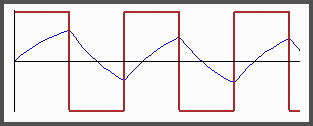
Retrieved
January 20, 2003, from the World Wide Web
http://www.efunda.com/math/laplace_transform/forward.cfm?FuncName=Graph
Encyclopædia
Britannica Article - http://www.britannica.com/eb/article?eu=48267
in mathematics, a particular integral transform. The Laplace transform
f(p), also denoted by L{F(t)} or Lap F(t), is defined by the integral
Involving
the exponential parameter p in the kernel K = e-pt. The linear Laplace
operator L thus transforms each function F(t) of a certain set of functions
into some function f(p). The inverse transform F(t) is written L-1{f(p)}
or Lap-1f(p). The Laplace transform has many applications, such as in
solution of linear differential equations with constant coefficients or
the study of boundary value problems. These problems often arise in connection
with calculations relating to physical systems. Notable early success
in solving this type of problem was achieved by the 19th-20th-century
British physicist-engineer Oliver Heaviside, who developed a procedure
called operational calculus. See also Fourier transform; integral transform.
integral transform Encyclopædia Britannica Article - http://www.britannica.com/eb/article?eu=43477
mathematical operator that produces a new function f(y) by integrating
the product of an existing function F(x) and a so-called kernel function
K(x, y) between suitable limits. The process, which is called transformation,
is symbolized by the equation f(y) = ò K(x, y)F(x)dx. Several transforms
are commonly named for the mathematicians who introduced them: in the
Laplace transform, the kernel is exp(-xy) and the limits of integration
are zero and plus infinity; in the Fourier transform, the kernel is (2
p )-1/2exp(-ixy) and the limits are minus and plus infinity. (See also
Fourier transform; Laplace transform.) The value of integral transforms
lies in the simplification that they bring about, most often in dealing
with differential equations subject to particular boundary conditions.
Proper choice of the class of transformation usually makes it possible
to convert not only the derivatives in an intractable differential equation,
but the boundary values, as well, into terms of an algebraic equation
that can be easily solved. The solution obtained is, of course, the transform
of the solution of the original differential equation, and it is necessary
to invert this transform to complete the operation. For the common transformations,
tables are available that list many functions and their transforms.
Retrieved January 20, 2003, from the World Wide Web
http://www.enm.bris.ac.uk/teaching/projects/2000_01/tg7360/Limit%20Cycles.htm
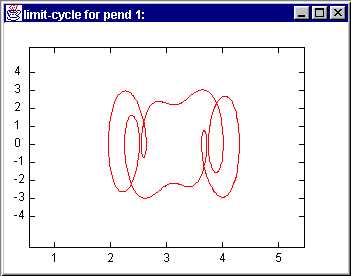
Fig 2.7 A Limit-Cycle
graph for the inverted single pendulum, being oscillated with a/l=0.33
and w=10(g/l)1/2, obtained form an initial condition theta = Pi and angular
velocity = 2.6(g/l)1/2 at t=0, note that the corresponding Phase-plot
diagram is Fig 2.6
In a message dated 1/21/2003 9:32:23 AM Eastern Standard Time, pwerbos
writes: By the way, I wonder what happened with your friend, Skoyles...
is there something in motion, or pending, or...? hb: I wonder, too. John
is a very close friend and an extraordinary scholar and thinker. But he's
been depressed recently and I'm having a hard time reaching him. Since
email isn't working, I'll ask my assistant to track him down by phone
and see what's going on. >>To one down in the trenches... the very
first association which occurs in >>my mind is Fourier transforms..
>>but, God help us, many colleagues would say Laplace transforms.
> > >hb: Paul--to once again reveal my ignorance, I've just looked
up LaPlace >and Fourier Transforms, something I should have done long
ago. I >understand math best when reducing it to one of its >isomorphs--pictures.
The pictures illustrating Fourier Transforms and >LaPlace Transforms
both hint that the two are both concerned with >decomposing wave functions
into component forms, then recomposing an >approximation of the original
wave. > >The bottom line is this: both these mathematical systems
are all about >waves, which means, they are both all about oscillations.
Am I anywhere >near understanding the reality of Fourier and LaPlace?
Every once in a while, I am reminded that my native language and culture
-- which I take for granted on some level -- are shared by almost no one.
Well... in the electrical engineering community, which I see every day
here, one can take Fourier transforms for granted. But not beyond that.
hb: I suspect Fourier Transforms are standard knowledge for lots of folks.
Many an article I've skipped in The Sciences and The Scientific American
have made it clear that they are basic to a modern scientific vocabulary.
pw: For me, when I use the word "oscillation," I picture a sine
wave, first of all. If it's not a sine wave, hb: me too, as on an oscilloscope.
But when I picture a photon in motion, I picture a sine wave above and
below the line. I wish we could draw online. My vision of a photon is
of a two-dimensional blip and disappearance then blip and zip into the
nothingness of the central line again. However that, too, is an artifact
of the limitations of book pages. I suspect a photon really blips and
zips down to nothing then blips again in three dimensions. Am I right?
And if David Bohm and I are right, it also blips in five dimensions (depth,
height, width, time, and some dimension above the two that accounts for
non-locality). pw: I see it as a kind of dirty oscillation -- the sine
wave is the pure thing, sort-of-like the Platonic ideal of what an oscillation
is. hb: hmmm--you've just given me a vision. I've always wondered how
you can pack the sound of the 76 instruments of an orchestra into the
single electrical signal that makes the cone of a loudspeaker vibrate.
A Fourier Transform--a wave made up of waves--sounds like a rough analogy.
Except the Transform seems to be a way of dissecting such a wave down
to its basic components then reconstructing it. pw: And Fourier transformation
is... basically just the observation that ANY time-series can be analyzed
as the sum of components, each of which is a pure oscillation, a sine
wave, of a different frequency. hb: then if I'm reading you right, we
are on the same wavelength. pw: Thus can light always be decomposed into
different pure colors by a prism. Traditional linear dynamical systems
(made up of integrators, differentiators, multipliers...)
hb:
Paul, this could be very important to me. Remember, in my book Global
Brain I've defined the complex adaptive systems we see in the mass behavior
of bacterial colonies and of human civilizations as having five components--conformity
enforcers, diversity generators, inner-judges, resource-shifters, and
intergroup tournaments. Conformity enforcers sounds like integrators.
Diversity generators sounds like differentiators. And inner-judges and
resource-shifters sound like multipliers. Maybe Bloom with his thick-headed,
visualizing brain and mathematicians, with their subtle understandings,
have spotted parallel phenomena and have analyzed them in similar ways.
To what sort of systems do integrators, differentiators, and multipliers
apply? And how are those systems analogous to and different from societies
of microorganisms or of human minds? pw: have the property that is formally
stated: "Sine waves are the eigenfunctions of the dynamics."
What that means, in common English, is that each frequency goes its way
independently of all the others. You can predict the overall system by
analyzing separately what happens to each frequency of oscillation. Then
add up the rest. hb: this is wonderful clarity. So an eigenfunction--another
term I've never taken the time to understand, much to my shame--is the
uberfunction that emerges when a bunch of lesser oscillations--like the
76 instruments of an orchestra playing Beethoven--converge? And the Fourier
Transform helps you reduce the eigenfunction to the multiple oscillations
that go into its making? The Fourier Transforms help you pick out the
fibers that make up the thread and the threads that make up the weave?
pw: Electrical engineers, in particular, learn how to analyze basic circuits
by analyzing what happens to each frequency.. hb: aha. what sort of basic
circuits, and why do they need to analyze its waveforms? Isn't knowing
the machinery enough? Or does breaking down the uber-wave into the waves
that go to make it up tell you which components are in harmony and which
are acting up? pw: Nonlinearity changes the story drastically. And I have
spent almost all my life on nonlinear mathematics. hb: my understanding
is that nonlinearity emerges when you repeat an algorithm or rule of some
sort on its previous result. Which makes fractals and the fibonnaci series
nonlinear. Am I wrong? Or does non-linear math have to decompose a phenomenon
into numerous dimensions--as if you were performing a sort of hyperdimensional
Fourier Transform? How do decomposition into 27 dimensions or more relate
to the iterative properties of non-linearity? pw: Yet those who are good
at nonlinear mathematics (except for digital logic, which is a different
case) learn that sophisticated use of complicated linear mathematics is
essential to understanding nonlinear systems as well.
And,
yes, oscillation is everywhere, not because of God, but because of Fourier.
hb: Fourier recognized an existent pattern. God would have created a class
of patterns--and their components--from scratch. But there is no god.
So how did this universe manage to evolve waves with sufficient complexity
to be analyzable by Fourier Transforms? How were the first sub-oscillations
birthed and how did the differentiate then weave? How did they self-create
then reintegrate? And doesn't differentiation via self-creation then reweaving
happen in this cosmos over and over again? Thus making this a very fractal
and a very nonlinear place? If you had to tell the story of the evolution
of just one phenomenon describable by a Fourier transform from the very
beginning, how would the story go? pw: (By the way... instead of "sine,"
we usually do it as e-to-the-ivt, or exp(ivt). In most engineering or
physics texts, you will see that formula pattern all over the place.)
hb: my feeling is that pictures are more powerful than formula--at least
for helping our intuitive powers work. Feinman and Einstein did their
most creative math by picturing a formula as blobs or shafts or whatever
sprung to mind--picturing them moving in three dimensions (plus time),
in full color, and with muscular properties--properties they could feel
in the muscles of their bodies. My feeling is that formulae are more valuable
for precision, but that the mathematicians of the 19th century were fools
to try to banish pictures from math and reduce everything to formulae.
Fools, however, can be useful to cultural evolution. In going to extremes,
they can explore fringe territories and bring us back new things. Like
the rigorous formula-rization of what had previously been visual in math.
Now we have more instruments than we had before the days of the 19th century
formula craze. We've also got more instruments thanks to the quick and
complex visualizing abilities of computer graphics hooked painting the
gestation and the outcome of formulae. >>pw: Any linear time-invariant
dynamical system is naturally analyzed in >>terms of oscillations.
> > > >hb: more of my lack of knowledge. A linear time-invariant
dynamical >system is a system with an input and an output, right? How
many sorts of >things on this planet and in this cosmos can be analyzed
as linear >time-invariant dynamical systems? Meaning how many can be
analyzed as >simple input-output systems? How many types of things
in this universe and >on (and in) this globe can be analyzed using
Fourier and LaPlace >transforms--meaning how many can be analyzed as
waves and superpositions >of waves? pw: An LTI system... is when ...
the time-flux or rate of change of a vector x is equal to a linear function
of x. The linear function can be written in principle as Ax, where A is
a matrix or a linear operator. For example, the modern "Schrodinger
equation" (due more to Heisenberg than to Schrodinger!) is of that
form -- psi-dot = i H psi, where "psi dot" means the infinitesimal
change in psi, and H is the Hamiltonian operator. But in some engineering
situations, A also changes with time; systems with A(t) are not time-invariant,
and may possess different eigenfunctions. Usually such time-dependent
systems are really just partial windows into a larger system which IS
time-invariant... or else they are better linear approximations to a nonlinear
system. hb: yoiks. I'm lost. I am fascinated by our correspondence. It
moves into the areas I have to cover in the book The Big Bang Tango--areas
I've been working out theory on for decades.
There's
math underlying the theories all over the place. But, as you can see,
I do math in coloring book pictures. So having you to talk to is carrying
me into a very heady and very necessary realm. You're a delight, Paul.
But one result is that I generally answer you at 2 am or later, when I
just can't stop because it's a Werbos email and yet my brain is a bit
muddled. pw:ANYTHING at any level may be analyzed this way. It is mathematics,
not physics. hb: which means it has applicability all over the place,
right? In the Big Bang Tango I've worked out a theory about why this universal
applicability of metaphoric systems like math and, well, ummm, metaphor,
exists. I've worked out a theory of why we can use the metaphor of a wave
for a ripple in a pond, a wave in the ocean, a ripple of pressure waves
in the plasma just not long after the big bang, for the ripples of matter
that pattern galaxies, for the ripple of we-don't-know-what (electromagnetism)
in a photon. Why do the same patterns recur at each level? How is this
recurrence of patterns from the micro to the macroverse reflected in aesthetics,
poetry, and religion, not just science. I have an answer. Now I am learning
as much as I can from you to see if it holds up. hb: >For how many
of empirical things do these various mathematical forms of >analysis
apply--from the swing of an electron around a proton, the wave of >a
photon in motion, the circle of stars around a galactic heart, the cAMP
>pulsations of slime mold when they signal each other that food had
run >out, the pulsations of the slimemold amoeba when they come together
and >form something that looks like a crawling slug, the input and
internal >signals that tell that sluge when to lift its head--its fruiting
body--and >release its spores. pw: For the first three, the application
is meat-and-potatoes. For biological systems, there is a lot of effort
to try to figure out how best to model the dynamics. Certainly many biologists
talk to physicists, and use differential equation models; thus they end
up doing either Fourier analysis (which is quite common in biology, particularly
in neuroscience) or ordinary nonlinear dynamical system analysis (aka
"chaos theory"). hb: it's the fractal end of non-linear math
that has got me going. See www.howardbloom.net/attraction_repulsion for
an example of what I mean. You won't see any math. Instead you'll see
poetry. But it's scientific poetry telling the story of the cosmos in
a brief amount of space using the recurrence of key patterns at different
levels to tell the tale. pw: Ironically, I have argued that neuroscientists
and neural modelers have overused such models in too straightforward a
way. They would say "Oh in artificial systems you can get away with
unnatural nonbiological things like discrete clocks.." But I think
THEY have lost sight of the complexity of reality, in their simplified
models borrowed from chaos theory.
hb:
I agree with you heartily. in neurobiology and neuropsychology, if you
try the sort of oversimplifications that are common in physics, you kill
the system. You are no longer describing a living--much less an emoting
and thinking--thing. pw: Neuroscientists like Llinas (NYU -- have you
ever met him?) hb: I'd love to but haven't had the time to chase him down.
pw: have found LOTS of centralized clock mechanisms in the brain, not
so different from clocks which control CPUs!! That tends to generate some
discrete-time effects.. which requires mathematics RELATED to the usual
continuous-time Fourier analysis, but not precisely the same. But still...
linear discrete time time-invariant systems STILL can be analyzed in terms
of oscillatory components; they still have the same basic eigenvector
property. hb: makes sense. In seeming contradiction to what I said above,
it makes sense that the zillions of clocks in the body have to integrate
with a grand controller, a great conductor, presumably the one in the
suprachiasmatic nucleus, and that they should produce eigenwaves, eigenfunctions,
like the one that carries Leonard Bernstein and the New York Philharmonic
to the magnet in my speaker via a thin twist of copper strands. pw: The
release of spores gets into the realm of discrete mathematics, which is
ultimately less tractable. There are certain mathematical problems which
simply cannot be solved in closed form, and life becomes an exercise in
finding patterns of approximations that help us make do... hb: the proposition
that Eshel Ben-Jacob and I worked out four years ago or so is that there
are no closed systems anywhere in this cosmos. Hence one aspect of classical
dynamics--the second law of thermodynamics--doesn't work in this universe.
Lee Smolin says that any particle in this cosmos could be defined by its
relationship to every other particle. In fact, it could be defined as
nothing but a sum of these relationships. This, too, rules out closed
systems. Though Smolin doesn't say this rules out entropy. Do you know
the work of Ben-Jacob? He's head of the physics department at the University
of Tel-Aviv and shows up in Physica A a lot. hb: >And in what cases
would we be oversimplifying to the point of distortion >if we were
to apply these forms of mathematical analysis? pw: That depends very much
on the specific case. And we do not yet know. Quantitative Systems Biotechnology
(QSB) is at a very early stage -- though NSF certainly is funding efforts
to find ways to make sense of such systems more quantittaively. (One may
search on "QSB" at www.nsf.gov.)
hb:
I just looked and the goals are awesome. >>pw: ("Time-invariant"
does not mean that the STATE of the system does not >>change --
only that laws >>of the dynamics do not.) > > >hb: that
helps, thanks. complex dynamical systems, the ones I play with, >change
constantly. Are there unchanging dynamic laws that rule these >change?
That's a question historians, cultural evolutionists, and >paleopsychologists
have been asking for a long, long time. Ibn Khaldun, >in roughly 1350
ad, was the first mega-historian to say yes and to posit >unchanging
laws of social change. His laws were a delight to read, but I >suspect
grossly oversimplified, and wouldn't work in the world today. > >However
Osama bin Laden might beg to disagree. He's counting on the >stability
of Ibn Khaldun's laws of social change. If they're right, Osama >has
a good chance of doing what Allah has always willed--taking over the >planet
for the purity of the one true religion, its one true god, and the >laws
that god gave to his only unsullied prophet, Mohammed. pw: Don't know.
I have always assumed he is into Ragnarok or Armageddon. But... I have
not done a really deep probe... not my favorite part of the mental landscape.
hb: >Am I getting of the point by hauling geopolitics and cultural
evolution >into a discussion of Fourier Transforms? No, not at all.
Culture-change >is cyclical. But each cycle changes the nature of the
system. So each >cycle is very much like a many of those that have
proceeded it, but also >very different. The system of all the societies
on this globe is one that >is constantly changing itself. pw: I have
certainly learned a lot from Spengler, Toynbee and MacLeish and even Max
Weber on such themes. But I would see the Spengler kind of vision as kind
of "life cycle" oscillation, like a limit cycle of nonlinear
systems dynamics more than a Fourier thing. And still as an approximation,
of course. Where the ancients would see a Great Chain of Being, I would
see a Great Chain (or Lattice) of Approximation. Approximations to approximations
to approximations. Maybe the old Hindus would appreciate this... not exactly
a chain of maya, but something a bit like that. And there are chains of
illusion as well in the minds which populate this system. (Is an approximation
a well-intentioned illusion?) hb: this is a heavy and a neat one. something
to ponder. This was a wonderful mental workout, Paul. You are helping
me get somewhere important. All my thanks--Howard P.S. Some folks would
call these views "orthodox reductionism." But it's not naive
reductionism -- I recognize the need to try to understand each level of
analysis and experience on its own terms. But I see no reason to abandon
the idea that they ultimately all fit together, that there is One Universe
here... More precisely, experience has shown there is great value in trying
to make sense of things in a coherent way, and I see no reason why we
should abandon that quest. hb: The Big Bang Tango--like Wolfram's A New
Kind of Science--says the universe is built on a few initial axioms, propositions,
rules, algorythms, or whatever one wants to call them. We not only all
evolve from a common single-celled ancestor, we all evolved from the magic
beans of rules that can be summed up in equations, in pictures, or in
words. I hope this doesn't sound like madness, but when one tells the
story of the cosmos from the beginning instead of from the present, it
makes a lot of sense. Enjoy--Howard
_________
Subj: Eshel, meet Paul and David Date: 1/23/2003 To: (Eshel Ben-Jacob)
Eshel Ben-Jacob, meet Paul Werbos and David Smith. Paul is a mathematician/physicist
with psychological leanings at NSF. David is head of the evolutionary
psychologically oriented New England Institute. Our trialog has led us
to your research. If you have the patience, follow along and you'll see
where you become vital to this discussion. Howard Wow, Paul, this is a
generous offer. My assistant got John on the phone for me tonight. John
had just gone to sleep--at 10:15 pm London time and had very little to
say. I jabbered a lot, but couldn't get a conversation started, then,
after hanging up, realized that John is probably in that superisolated,
no-structure state where all you want to do is sleep and any intrusion
is sort-of welcome but also an interruption to the long snooze and escape.
When I've gone through that having friends who called no matter what helped
pull me through. So if I can find the time, I may have to call periodically
to help him get a sense that there's still an outside world that wants
him. Being an independent scholar--someone who wants to put together all
the pieces and not just specialize--has its dangers, and structurelessness
and isolation are among them. John left the British Medical Research Council
so he could synthesize work from lots of disciplines, and he's superb
at it. In a message dated 1/22/2003 11:59:57 AM Eastern Standard Time,
writes: A >>By the way, I wonder what happened with your friend,
Skoyles... is there >>something >>in motion, or pending, or...?
> > > >hb: I wonder, too. John is a very close friend and
an extraordinary >scholar and thinker. But he's been depressed recently
and I'm having a >hard time reaching him. Since email isn't working,
I'll ask my assistant >to track him down by phone and see what's going
on. Hi, Howard! This is of the utmost importance. I hope he wouldn't take
it the wrong way if we suggested he should feel free to discuss whatever
is depressing him with this group, in confidence. I would expect that
David has rigorous standards about maintaining confidences, just as we
do. There is of course a lot to be depressed about in the world these
days... and it is good when people can share their serious concerns. >hb:
me too, as on an oscilloscope. But when I picture a photon in motion,
>I picture a sine wave above and below the line. I wish we could draw
>online. My vision of a photon is of a two-dimensional blip and >disappearance
then blip and zip into the nothingness of the central line >again.
However that, too, is an artifact of the limitations of book >pages.
I suspect a photon really blips and zips down to nothing then >blips
again in three dimensions. Am I right? > >And if David Bohm and
I are right, it also blips in five dimensions >(depth, height, width,
time, and some dimension above the two that >accounts for non-locality).
The photon and the electron are two special cases I have thought about
a great deal.
I
am told that Willis Lamb -- a Nobel Prize winner who is more than just
any old Nobel Prize winner, maybe not the VERY first (e.g. Feynman) rank,
but the rank just below that -- has come out clearly on his web page with
the statement "the photon does not exist. There is no photon."
After much thought... and discussion with some quantum optics folks..
I agree with Lamb. I still use the word photon a lot, because it is still
a useful approximate concept in some context, and it is useful as an abbreviation,
in effect. But in actuality... I now believe that everything we know about
light simply boils down to Maxwell's laws, and to INTERFACES between electromagnetism
and other more truly quantized fields. Planck's law "governs"
the emission and absorption of light -- the boundary conditions -- but
in-between it's plain old Maxwell. And Maxwell's equations are classic
wave equations, whose solutions are basically just sine waves in free
space. hb: but, as Archimedes and Newton put it, a fluction is a motion
in a soup of some kind. without ether, what is the soup? Is it simply
some sort of topological wrinkle in the sheet of the space time continuum?
Or is it, as I've suspected and you've hinted above, something that we
understand via two metaphors, meaning our culture has not yet evolved
a metaphor that can completely comprehend it? Remember, our metaphors
depend on a relatively small number of observations that stick in the
public mind and a relatively small number of technologies whose workings
give us models of "mechanisms." We are only roughly 35,000 years
into the cultural enterprise of machine, model, cliche, and metaphor-making.
We're still in our Olduwan toolkit days. There's many a metaphor yet to
come if we can survive and continue to reinvent ourselves and our pool
of experiences and verbal, visual, and mathematical cliches. Cliche should
not be a pejorative word. Cliches are our tools of understanding. Fourier
transforms, for example, are cliches in engineering and physics. Cliches
are useful...but we need more. Cliches are the equivalent to what economists
call commodities. Goods are a luxury when they are rare and spark our
sense of novelty. That sense is a set of pleasure centers in the brain
that light up in the presence of risk or of something new and different.
The novelty centers include as one of their most prominent members the
nucleus accumbens.
A
luxury is also something whose rarity and newness allows us to use it
as a status symbol--as something we have but others don't and that others
envy us for. When that new thing becomes readily available, those who
weren't able to get it before gobble it up so they, too, can be like the
elite--those who introduce novelties into the culture. Once everyone has
one, the experience grows old, the goody we once salivated for is something
even the lower class has, it's not hip, cool, or elite anymore. And it
becomes a commodity. It may lose its ability to amaze and awe us. But
we continue to use it every day. Which means a commodity is a novelty
we've added to our normal toolkit. A cliche is a conceptual, verbal, or
visual novelty that's grown old, stale, and often useful as all get out.
The phrases "she has her hangups," "she's got issues,"
"he's a control freak," and "he needs his space" no
longer have the gleam of inner-circle membership they had when they were
new in their respective eras--the 1960s and 1970s--but they are useful
as can be when we are trying to figure out why we just had a fight with
our mate. Hopefully you, Luda, David and I will add cliches that are more
incisive and more useful during our time on this planet. Meanwhile the
photon could be, as you say, a temporary construct with which we can work
until a more inclusive scientific or mass-cultural cliche comes along.
I still want to know what a field is and how attraction at a distance
works. I do not buy gluons. You don't answer a question about the communication
and attraction between two particles--their pattern of stimulus and response--with
another particle. That's like saying bacteria communicate by sending each
other communicator cells. They don't. They communicate with macromolecules
whose meaning is clear to every bacteria in the species. The species is
built with a genome that builds in a chemical dictionary with a molecular
vocabulary whose size we as yet don't know. So far all the experts in
this area--like my friend Eshel Ben-Jacob--have pinpointed are attraction
and repulsion cues. I suspect we are missing many macrochemical cliches
in the bacterial vocabulary. What will our cliches look like 20 years
down the road when we all understand that the shape of a macromolecule
creates a rich statement that triggers many a social reaction between
atoms and fellow macromolecules? What will our toolkit of cliches, metaphors,
and mechanisms look like when we have protein-based computers that do
things so radically different than what we've seen so far that the word
"computer" will no longer describe them?
Gary
Marcus, a friend who does computational cognitive science, grew up programming
computers in Basic. So he sees the brain as a bunch of computer programs.
What will his kids use as metaphors with which to explain minds and photons?
And what will his grandkids use? They will grow up with something that
makes Basic look primitive--just as Gary's Basic makes my Fortran (which
I have now forgotten) look antique. >pw: I see it as a kind >>
>>of dirty oscillation -- the sine wave is the pure thing, sort-of-like
the >>Platonic ideal of what an oscillation is. > > >hb:
hmmm--you've just given me a vision. I've always wondered how you can
>pack the sound of the 76 instruments of an orchestra into the single
>electrical signal that makes the cone of a loudspeaker vibrate. A
Fourier >Transform--a wave made up of waves--sounds like a rough analogy.
Except >the Transform seems to be a way of dissecting such a wave down
to its >basic components then reconstructing it. Actually, the design
of high quality sound cards is a big topic in electrical engineering in
industry these days. In theory, one precise time-series is all you need.
After all, there may be 76 instruments, but the pressure of air from microsecond
to second on your eardrum is still just one number (pressure) as function
of time. The TOTAL sound across all space has more information, but what
one ear hears is basically just one time-series, easily representable
(in theory) as a time-series. hb: but is that true? Could different parts
of the ear be parsing different aspects of the sound. The hairs that analyze
the vibration each pick out a different frequency. Couldn't the entire
topography of the ear be used to pick up something more complex than a
linear sequence? The ear, like a macromolecule, probably has evolved its
strange surface structure for a reason. And that reason may have to do
with non-linear complexity. Wait, that's a mathematical term. In math
terms it may have to do with something BEYOND non-linear complexity. If
topology is still what it was when I was a kid and first became aware
of it, it deals with fairly regular shapes. But a macromolecule, a bunch
of air shudders carrying the sound of 76 instruments, and the shape of
an ear are highly irregular. Are Fourier transforms too two-dimensional
and too simplified to cover such three and four dimensional irregularities?
Even a macromolecule twists and bends to receive and send messages. It
does so in highly irregular ways. Do we have forms of math that will deal
with such irregularities? Will fractals do the trick when they're extended
into four dimensions, as they are on my computer screen via Rudy Rucker's
fractal program? No, Rudy's fractals are too regular do describe an ear
or a histone bending and twisting in the genome. pw: But then with two
ears, you may need two numbers, and voila, you have stereo. hb: back in
the 1980s, I heard a demonstration of a 3-D, holophonic sound technology
at a music industry trade convention. It worked in ways that were astonishing.
You could hear the exact placement of a matchbox as it was being shaken
in front of you, behind you, below your head, above your head, etc.
I've
just tried to track down the person who devised it and have sent an email
to the most likely culprit--HUGO ZUCCARELLI--whose webpage (http://community-2.webtv.net/zuccarellix/holophonicstmand/)
says that he "invented HOLOPHONICS tm after discovering the processin
which humans can localize sounds, contrary to the binaural or stereo theories"
Whoops, I've just spent so much time tracking down Zuccarelli and writing
to him about our speculations that it's the usual two am. Let's see if
I can zip through the rest of this email. pw: And then there are debates
about whether the ear really has the power to hear more than one number
somehow... big debates.. and debates about how to make sound realistic
throughout the room... hb: Hugo did that 20 years ago and was ignored...well,
you had to wear headphones, but still, it was astonishing. pw: And then
a Fourier decomposition and other forms of compression may actually allow
more information per bit of computer storage... and so on. hb: a neat
application. Think of a protein, a macromolecule, as a repository of crunched
(compressed) data about fourteen billion years of the past that's used
to help in a macrosystem that predicts the future. The result is a nano-processing
device we call a cell. pw: But certainly, neuroscience treatments of the
ear -- particularly the ear drum stuff -- makes very heavy use of Fourier
analysis. The ear has been compared at times with a pipe organ.. hb: Hugo's
website says that he has invented a new speaker system based on linear
math that does remarkable things--but does not create the holophonic effects
he perfected 20 years ago. Which may indicate that linear systems won't
do in capturing the richness of sound...or the richness of macromolecular
communication. >>pw: Thus can light always be decomposed into different
pure colors by a >>prism. >> >>Traditional linear dynamical
systems (made up of integrators, >>differentiators, multipliers...)
> > >hb: Paul, this could be very important to me. Remember,
in my book Global >Brain I've defined the complex adaptive systems
we see in the mass >behavior of bacterial colonies and of human civilizations
as having five >components--conformity enforcers, diversity generators,
inner-judges, >resource-shifters, and intergroup tournaments. Conformity
enforcers >sounds like integrators. Diversity generators sounds like
>differentiators. And inner-judges and resource-shifters sound like
>multipliers. pw: Am running out of time... basically, these are highly
nonlinear functions. Diversity generators are like option generators in
"brain-like stochastic search" as in last slides of www.iamcm.org.
>Maybe Bloom with his thick-headed, visualizing brain and mathematicians,
>with their subtle understandings, have spotted parallel phenomena
and have >analyzed them in similar ways. To what sort of systems do
integrators, >differentiators, and multipliers apply? And how are those
systems >analogous to and different from societies of microorganisms
or of human minds? > >pw: have the property >> >>that
is formally stated: "Sine waves are the eigenfunctions of the >>dynamics."
What that means, in common English, >>is that each frequency goes
its way independently of all the others. You >>can predict the overall
system by >>analyzing separately what happens to each frequency
of oscillation. Then >>add up the rest. > > > >hb: this
is wonderful clarity.
So
an eigenfunction--another term I've >never taken the time to understand,
much to my shame--is the uberfunction >that emerges when a bunch of
lesser oscillations--like the 76 instruments >of an orchestra playing
Beethoven--converge? And the Fourier Transform >helps you reduce the
eigenfunction to the multiple oscillations that go >into its making?
The Fourier Transforms help you pick out the fibers that >make up the
thread and the threads that make up the weave? OK. I need to be more precise.
Simple dynamic systems (like ODE, ordinary differential equation systems)
are described in terms of a vector x(t), i.e. a set of numbers. Linear
dynamical systems can be analyzed in terms of the eigenvectors of the
dynamics. Eigenvectors are simply vectors which DO NOT CHANGE direction...
they are the directions which are unchanged by the dynamical process.
They change in MAGNITUDE, but not direction... hb: aha. all thanks. pw:
More complex systems (like PDE, partial differential equations) are described
in terms of fields of space. And then there are eigenfunctions of the
dynamics, functions across space... which would not be changed, if the
dynamics are linear, but... they get multiplied by some constant over
time. And then.. forgive me... it is often convenient to apply these concepts
"from above"... so that we can think of eigenfunctions of time
derivatives... Anyway, given time, I could fill it all in. The key point
is that eigenfunctions or eigenvectors are the elementary things, like
sine waves, which more general functions can be broken down into, for
purposes of analysis. Analysis of LINEAR systems. Nonlinear systems do
not have eigenfunctions or eigenvectors. >>pw: Electrical engineers,
in particular, learn how to analyze basic >>circuits by >>analyzing
what happens to each frequency.. > > > >hb: aha. what sort
of basic circuits, and why do they need to analyze its >waveforms?
Isn't knowing the machinery enough? Or does breaking down the >uber-wave
into the waves that go to make it up tell you which components >are
in harmony and which are acting up? pw: Circuits made up of resistors,
capacitors, inductors, batteries and wires. But then transistors provide
the gross nonlinearity necessary to generate really interesting circuits.
In linear systems analysis ... attached to each eigenvector or eigenfunction
is an "eigenvalue," which tells you whether that component will
grow, oscillate, or decline. hb: aha. >>pw: Nonlinearity changes
the story drastically. And I have spent almost >>all my >>life
on nonlinear mathematics. > > >hb: my understanding is that nonlinearity
emerges when you repeat an >algorithm or rule of some sort on its previous
result. Which makes >fractals and the fibonnaci series nonlinear. Am
I wrong? Or does >non-linear math have to decompose a phenomenon into
numerous >dimensions--as if you were performing a sort of hyperdimensional
Fourier >Transform? How do decomposition into 27 dimensions or more
relate to the >iterative properties of non-linearity? pw: If x(t) is
a vector... then linear dynamics means that the infinitesimal change of
x with respect to time equals Ax, where A is some matrix.
Sometimes
people say Ax+b is still linear or "affine." Nonlinear is basically
anything else ... for example, x-squared. But iteration is not nonlinearity.
if z=Ay and y=Bx, then z=(AB)x, and AB is still a matrix. >hb: Fourier
recognized an existent pattern. God would have created a >class of
patterns--and their components--from scratch. But there is no >god.
So how did this universe manage to evolve waves with sufficient >complexity
to be analyzable by Fourier Transforms? How were the first >sub-oscillations
birthed and how did the differentiate then weave? How >did they self-create
then reintegrate? And doesn't differentiation via >self-creation then
reweaving happen in this cosmos over and over >again? Thus making this
a very fractal and a very nonlinear place? > >If you had to tell
the story of the evolution of just one phenomenon >describable by a
Fourier transform from the very beginning, how would the >story go?
pw: Interesting emergent patterns require nonlinearity. I am tempted to
violate someone's copyright suddenly... Vaguely, you could say things
"start" as linear... just random waves through space.. and then
comes interaction or reflection... and the nonlinearity creates emergent
patterns... hb: neat. and very much in tune with what I've been working
on--though you've put it in a whole new way. pw: different in one system
from another, drastically different... some systems hardly diverge at
all from the early heat chaos. Others go to "fixed points,"
like being frozen in ice. But between the hot chaos and the ice... some
systems have the right parameters to generate interesting patterns of
complexity, of fractal dimension in effect. >>pw: (By the way...
instead of "sine," we usually do it as e-to-the-ivt, or >>exp(ivt).
In most engineering or physics >>texts, you will see that formula
pattern all over the place.) > > > >hb: my feeling is that
pictures are more powerful than formula--at least >for helping our
intuitive powers work. Feinman and Einstein did their >most creative
math by picturing a formula as blobs or shafts or whatever >sprung
to mind--picturing them moving in three dimensions (plus time), in >full
color, and with muscular properties--properties they could feel in >the
muscles of their bodies. My feeling is that formulae are more >valuable
for precision, but that the mathematicians of the 19th century >were
fools to try to banish pictures from math and reduce everything to >formulae.
True. But many physicists have gone to the opposite extreme, where the
hand is quicker than the eye. Lots of formulas but not such care to make
sure they follow rules or that the formulas mean something. hb: but then
folks like Riemann, who was following the beauty of developing an arbitrary
self-consistent system, produce tools that folks like Einstein can use.
Hmmm, I'm using a visual example again. Reimann's math was geometry--a
very visual thing indeed. >hb: it's the fractal end of non-linear math
that has got me going.
See
>www.howardbloom.net/attraction_repulsion for an example of what I
>mean. You won't see any math. Instead you'll see poetry. But it's
>scientific poetry telling the story of the cosmos in a brief amount
of >space using the recurrence of key patterns at different levels
to tell the >tale. pw: In a sense... where fractals become real is
when we try to grapple with strange attractors, and their more highly
dimensional relatives ala Per Bak and whatnot. >hb: makes sense. In
seeming contradiction to what I said above, it makes >sense that the
zillions of clocks in the body have to integrate with a >grand controller,
a great conductor, presumably the one in the >suprachiasmatic nucleus,
and that they should produce eigenwaves, >eigenfunctions, like the
one that carries Leonard Bernstein and the New >York Philharmonic to
the magnet in my speaker via a thin twist of copper >strands. pw: Yes,
the conductor makes sure it all hangs together, makes sense, and that
the overall system does one thing at a time in some sense... >>pw:
The release of spores gets into the realm of discrete mathematics, >>which
is >>ultimately less >>tractable. There are certain mathematical
problems which simply cannot be >>solved in closed form, and life
becomes >>an exercise in finding patterns of approximations that
help us make do... > > >hb: the proposition that Eshel Ben-Jacob
and I worked out four years ago >or so is that there are no closed
systems anywhere in this cosmos. Hence >one aspect of classical dynamics--the
second law of >thermodynamics--doesn't work in this universe. Lee Smolin
says that any >particle in this cosmos could be defined by its relationship
to every >other particle. In fact, it could be defined as nothing but
a sum of >these relationships. This, too, rules out closed systems.
Though Smolin >doesn't say this rules out entropy. pw: Closed form
and closed systems are different things. Closed form... it's like the
old theorem that you CAN'T POSSIBLY write the value of pi exactly in terms
of fractions involving whole numbers... or even square roots and such...
Some numbers exist and can be given names, but cannot be written down
exactly within the limits of ordinary notation. hb: aha. thank you for
the explanation...and the patience it takes. >Do you know the work
of Ben-Jacob? He's head of the physics department at >the University
of Tel-Aviv and shows up in Physica A a lot. pw: No. If he could understand
and tolerate the paper I recently had published for Chua's journal, it
might be important for him and I to talk as well. I would expect him to
know all the stuff in this email alreday, if so. hb: Eshel just emailed
today saying that he's more available than in the past, so let me copy
him on this. >hb: The Big Bang Tango--like Wolfram's A New Kind of
Science--says the >universe is built on a few initial axioms, propositions,
rules, >algorythms, or whatever one wants to call them. We not only
all evolve >from a common single-celled ancestor, we all evolved from
the magic beans >of rules that can be summed up in equations, in pictures,
or in words. I >hope this doesn't sound like madness, but when one
tells the story of the >cosmos from the beginning instead of from the
present, it makes a lot of >sense. Enjoy--Howard pw: That's pretty
much what I am working from as well. Certain underlying dynamical principles
at the lower level.. hb: that's what I've partially worked out. I'd like
to compare my analysis with yours and see if they give heft and depth
to each other. pw: such that dynamics at higher levels are basically emergent
phenomena or approximations to what the simpler stuff tells us. Though
the word "dynamics" changes its meaning slightly with backwards-time
stuff coming in... hb: Just how far back do you feel the backward projection
goes? I know I've asked this before, so forgive me if you've already answered
it and my memory has failed to retain it. With pleasure and gusto (not
to mention exhaustion that's well worth it)--Howard
_________
Pavel--My apologies. As I just explained to Paul Werbos, I've been swamped.
A group has self-assembled around my work during the last few weeks and
has turned out over nine minutes of animation based on the concept at
http://howardbloom.net/attraction_repulsion--something that would have
been inconceivable without huge budgets when the project was conceived
three years ago. The group has also committed to putting together the
books waiting in the 300 Mb and 3,700 chapters of the Bloom Grand Unified
Theory of Everything In the Universe Including the Human Soul. This would
be astonishing if it came off...which it may well not. But so far the
group's track record of astonishments is extremely good. Here are a few
comments. But first, a word of qualification. I've been involved in theoretical
phyics since I was a kid. I taught what little I know to myself. Which
means that in many ways, I am an ignoramus on the subject. I only understand
math when I can picture it. I'm blind as a bat about formulae. I've looked
all over the place for some description of Maxwell's equations so I can
begin to picture what you and Paul have been discussing. I've had no success.
So there are extraordinarily elementary things I do not comprehend. Please
explain things to me as if I were a dunce, an idiot. Now for the comments:
pk: We all must accept that known wave equations hide much more than we
are accustomed to think normally. hb: this sounds very, very likely to
me. The reasons are too numerous to lay out right now...though I've written
quite a lot about them in the past. Two are: -- the vast oversimplifications
used in the mathematicization of physics -- and the tendency to mistake
our current level of knowledge--and of ignorance--for external realities.
The flaws often tend to be in the eye, not in that which the eye beholds.
pk: These equations are hints only, vague sketches in haze rather than
precise instruments like scalpel of a surgeon. hb: lovely way of putting
it. pk: Standard QM fails to calculate universal constants, what complete
theory should do, as Planck and Pauli insisted in. hb: an observation--when
the ancients bless a criterion of validity, it doesn't mean it's right.
I am very skeptical about such things as Occam's Razor and, in probability
and statistics, the Bell Curve, simply because they've remained unquestioned
for much too long. A question--what do universal constants mean in a case
like this? Physicists like Lee Smolin talk about roughly 27 key parameters
that are arbitrarily set at the birth of a cosmos. Is this what we're
talking about? Stephen Wolfram's view, in A New Kind of Science, is that
the standard mathematical systems we've been using--with equations that
deal with smooth gradients and demand arbitrary constants--are wrong.
Universes, he feels, self-construct from the bottom up, flowing from a
very small number of rules. I agree with him. This view is one I've been
working with for nearly 45 years. Wolfram also feels he's demonstrated
that we can not use standard methods to discover the handful of initial
rules. He may be right in saying that standard mathematical methods will
not let us reach back into the past and find those initial cosmic seeds,
those initial algorithms.
But
I've been working to find those initial axioms, postulates, or algorithms
anyway--using my mathematical blindness as an advantage and employing
intuition and metaphor. How do universal constants fit in? pk: From CITT
viewpoint a particle indeed exists in several states simultaneously, -
in inner time of theory, of course. hb: here's the problem. Inner Time
Theory sounds very intriguing. And this condensation, this short summary,
is extremely helpful. But please, please tell us in short-form what Inner
Time Theory is. pk: the first model of turbulent movement in fluid proposed
by L. D. Landau [18] in 1944. hb: something that Paul Werbos said a while
back made me curious. He seemed to imply that Maxwell's equations could
be interpreted in terms of vortexes. Is this true or was it my mistake?
Ernest J. Sternglass, a protege of Einstein's, has a vortex theory of
particles. Is there anything in mainstream physics that would support
this? Is there anything in field equations that would support it? (see
Ernest J. Sternglass. Before the Big Bang: The Origins of the Universe.
New York: Four Walls Eight Windows, 1997.) pk: That model supposed that
turbulence is simply coupled oscillators, which, as we now know, is not
correct, since it leads to unobservable consequences. hb: coupled oscillators
are extremely important in many of the fields I study. Did Landau mean
that turbulence was the interaction of oscillators operating at different
speeds and sheering against each others' movement when they first meet--before
they synchronize? Did he see turbulence as the interference patterns that
eventually bring the oscillators into synchrony? pk: But coupled nonlinear
oscillators are one of most simple nonlinear object one can imagine. hb:
is there a difference between a linear and a nonlinear oscillator? Are
coupled oscillators nonlinear because of their iterative qualities? Because
of the repetition of two rhythms over and over again upon their joint
products? If so, how do the equations take into account the fact that
the rhythms of the oscillation sources themselves change as they influence
each other? Onward--Howard In a message dated 4/22/2003 3:34:42 AM Eastern
Daylight Time, kurakin writes: Dear Sirs! Since no one normally desires
to read long manuscripts on crazy theories (http://toyphoton.narod.ru),
here's the short squezzing of Concept of Inner Time of Theory. Can anyone
explain in a FEW words or give a reference why inner time can be rejected
in a SIMPLE way? Dr. Werbos, You are who is much interested in bacward
- in - time signals possibility. So, inner time gives IT quite elegantly.
What's wrong? I'll be much gratefull to Your qualified expertise. - -
- - - - - - - - - - - - - - - - - - - - - - - - - - - - - - - - - VIII.
Conclusion 1.
Let
us look at Feynman - Wheeler - Cramer ideas of time - backwards spreading
of waves from a little wider, than their creators, viewpoint. Not so far
physicists from Omsk State University have got some very interesting results
[15 - 17]. They have found massless solutions for Dirac equation. Mass
is zero, while current of solution is not zeroing. Authors interpret these
solutions as Deutsch "shadow" electrons, which govern interference
effects. J. Cramer also says that any relativistic equations, not Maxwell's
only, allow backwards - time solutions. These are Klein - Gordon equation,
Dirac equation and some others. But Prof. Cramer looks only at possibility
for equation to have backward in time solutions. Physicists from Omsk
have shown that not only time sign is interesting as parameter for solution
to be "physical" or "non - physical". Sign of inertial
mass also can. These results can, on our opinion, eliminate prejudices
of physicists about what is really "physical" and what is not.
We all must accept that known wave equations hide much more than we are
accustomed to think normally. These equations are hints only, vague sketches
in haze rather than precise instruments like scalpel of a surgeon. We
should not delude ourselves by great results achieved in physics till
now - simple known equations still hide much greater than what we got
up to now. So we think that our search signals (and query signals as well)
for single photon are described by usual Maxwell equations. 2. "And
what is all this stuff needed for?" - asks a quantum mechanical orthodox
theoretician. In response we repeat as strict and clear as possible: §
Standard QM postulates that particle is complex - valued vector in Hilbert
space. Notions of superposition of states and reduction of state vector
are based upon this primary postulate. It's time to stop to call this
stating of experimental facts as theory. There's no any theory to explain
this fascinating theory, and it must be constructed. § Standard QM
fails to calculate universal constants, what complete theory should do,
as Planck and Pauli insisted in. So what we have now is intermediate theory.
Complete is still to emerge. 3. If we leave philosophic talks for philosophers
and just roll our sleeves up to solve these two problems, we should look
over all possible schemes. As far as we know, our scheme with inner time
is the first practical step in this direction. Concept of inner time of
theory (CITT) is very simple in its essence and, as we think, directly
shows a way to solve formulated problems: § From CITT viewpoint a
particle indeed exists in several states simultaneously, - in inner time
of theory, of course. § CITT shows (very naively, for the first step),
how exactly "electrons" (scattering centers) act, which allows
to penetrate in their intrinsic nature. This is a first step to calculate
real electron's charge. Further. If CITT is not correct way to go, it's
very important to understand why. To explain let us recall the first model
of turbulent movement in fluid proposed by L. D. Landau [18] in 1944.
That model supposed that turbulence is simply coupled oscillators, which,
as we now know, is not correct, since it leads to unobservable consequences.
But coupled nonlinear oscillators are one of most simple nonlinear object
one can imagine. This is exactly why the way with coupled oscillators
was extremely important to be done - just to convince physicists that
it's wrong. Wrong but simple ways must be checked anyway! "Inner
time of theory" is, on our opinion, also the simplest way to solve
key puzzles of quantum world. If this way is wrong, we must explicitly
understand why it is so. - - - - - - - - - - - - - - - - - - - - - - -
- - - - - - - - - - - - "Our line is right. The victory will be ours".
(c) I. V. Stalin, 1941. kurakin
|
|
The
infnitely networked universe
Paul
Werbos 2/25/2003 Paul--re "I do not believe in DIRECT action at a
distance, like the Bohmians, but I do believe in INDIRECT effects like
this. You might call them nonlocal emergent effects." Hb: First off,
we're in a universe whose every cubic centimeter seems to be flooded with
photons, neutrinos, and particles that range from the background radiation
spewed by the Big Bang (assuming there was one) 13.5 billion years ago
to high-speed particles and photons flung from star births, star deaths,
and even black holes up to 12 billion years old and 12 billion light years
away. That means that every nit and bit of time and space is zipped and
zapped by a bombardment that links it to events far, far from it in time
and space. The only thing that's unlikely is gravitational influence from
galaxies ten billion light years apart. But even that is not an impossibility.
Galaxies gather in galactic clusters. Galactic clusters gather in superclusters.
And the form and unity of the galaxies, clusters, and superclusters seems
to be evolving over time. Which means that galaxies far apart from each
other create a gratitational web that gradually draws them together around
a common center. To influence a distant galaxy with your gravity, you
have to exert that force at a distance over every bit of matter in that
galaxy's space. Every square centimeter of the cosmos is a nexus of influences.
It is pervaded by information and causation from nearly everything else
in this cosmos. This implies that one of the differences between one cubic
centimeter and the next is the sum total of a cosmos-full of influences,
influences which shift over every blip of space and over every unit of
Planck time. The web of the cosmos is enormous, ubiquitous, and interactive
beyond anything we imagine when contemplating two photons travelling from
a laser to a target three feet away. Look at how many cubic Planck units
those photons traverse. Imagine how many currents of influence they navigate.
Aside from gravity and cosmic rays, they have to cross many a loop of
magnetism--magnetic fields from this planet, from the sun, and lord knows
from what other cosmic whorls and teams. This relates to a wonderful observation
made by Eshel Ben-Jacob, head of the Department of Physics at The University
of Tel Aviv, several years ago. This is a universe in which entropy can't
exist. Entroy, he said, is based on the notion of closed systems. And
there are no closed systems in this universe.
No
photon is an island. Physics will probably remain primitive so long as
it's forced by the limitations of current math to grossly oversimplify.
Which implies that physics may be one of the most inexact sciences we
currently possess. And it implies what you and I and Kurakin have already
said. That the probabilistic equations of quantum physics are fuzzy not
because the universe is muzzy, but because our vision is. Howard PS re:
"I do not believe in DIRECT action at a distance, like the Bohmians,
but I do believe in INDIRECT effects like this. You might call them nonlocal
emergent effects." Paul, this sounds interesting. Can you give us
an example or two of nonlocal emergent effects? And just how the heck
does action at a distance work, anyway? Another ancillary question. What
does it mean to ask how something works? What mechanism of understanding
are we attempting to tap when we ask how something works? My guess is
metaphor based on something whose workings we know well--whose workings
we can not only visualize, but we can feel in our motor neurons, whose
workings we can feel in a muscular way. In a message dated 2/25/2003 1:02:47
PM Eastern Standard Time, writes: At 08:06 PM 02/25/2003 +0300, you wrote:
>Dear Dr. Werbos! > >I'm sorry, but this Your student (me) is
not only thick as a brick >(germans say 'betonkopf', as I know), >but
also obstinate ("And that's why I'm interesting", as Sergey
>Yesenin said). > >WDPJ> The fact is that you can turn on
a laser, and SOMETIMES pick up a >photon at >WDPJ> one place
>WDPJ> and sometimes pick up a photon at another. But it is NOT
a "fact" >that there >WDPJ> are two photons co-existing
in different states at the intermediate >time, which >WDPJ> you
do not observe. If you do not observe it, it is not a fact; it >is
a theory. > >I give up. This is a language problem - I accept. >So
I suppose another formulation. Please, check it. Actually, an idea does
occur to me. Maybe this is crazy... but... perhaps Ludmilla might be willing
to explain some of this in Russian. >The fact ALSO is - Wether photon
emerges here or there, depends (to >some degree of strictness) on ALL
the surrounding space, maybe all the >Universe, not only small >vicinity
of starting point or final point. Am I right? In some sense, I think so.
For most experiments, most people would say it is enough to know your
local inputs (like laser and crystal for Clauser-Theorem experiments)
and the local measurement devices -- like counters and polarizers. Only
these. Yet I believe that the larger thermodynamic environment is also
relevant, because it affects probabilities of states both on input and
on output. I do not believe in DIRECT action at a distance, like the Bohmians,
but I do believe in INDIRECT effects like this You might call them nonlocal
emergent effects. >You may tune complicated interferometer (like Mach-Zander's)
here or >there and get different outputs. > >I don't wanna say
that the photon 'actually' checks all the ways - save me the >God.
But the output - do we like it or not - IS such, AS IF the photon >DID
this. > In my view, the "photon" itself is only just light,
governed just by Maxwell's Laws, nothing more mysterious. (Well... there
is one caveat: it is actually the electroweak generalization of Maxwell's
Laws.) It ONLY responds to ITS OWN boundary conditions, from the place
where it is emitted to the place where it is absorbed. "Quantization"
is just a byproduct of meeting the boundary conditions at both times.
HOWEVER -- those boundary conditions for the photon depend on the state
of complicated big objects, which is related in turn to more distant boundary
conditions. Between the boundary conditions, the photon is never in a
mixed state, in reality, in my view. WE are uncertain about its state,
and WE must rely on probability distributions and wave functions, because
WE do not know what the exact boundary conditions are that the photon
faces in any given experiment, in reality. It is a situation of uncertainty,
BUT NOT a situation of indeterminism, in my interpretation.
------------------------------
In a message dated 99-10-25 13:05:46 EDT, writes:
Geissler
claimed a time quantum of 4.5 ms and supported that claim by findings
agreeing with that duration or multiples thereof. >>
Hannes--thanks
to your leads, I found the following two abstracts on Medline. They may,
indeed, indicate a quantum-like unit of perceptual time. However I strongly
suspect that there are many assemblies in the body which utilize different
rhythms. The enteric brain probably operates at a different speed than
that which regulates the Krebbs cycle within cells, for example. Whether
the jumble of very fast and very slow times in the human body (or in the
bodies of clams, whose daily, monthly, and yearly internal clocks have
been studied diligently since the mid-sixties) are synched to a common
rhythm is something I wonder about.
Here's
what really has me pondering. Anyone who's been patient enough to read
my postings over the last few years knows I'm working on a theory of the
universe and most of what's in it (well, actually, all that's in it) which
starts with roughly three axioms, algorithms, principles, or whatever
you want to call them, and generates a self-consistent system of tremendous
complexity by doubling, trebling, quntupling, and google-plexing its modest
initial dicta back upon themselves until the results are dizzying. Such
processes are easily modeled using several metaphorical marvels which
spell out the corollaries implicit in a handful of axioms. One of these
systems is geometry--such as the Riemannian geometry Einstein used to
build his model of the time-space manifold. Another is non-linear mathematics.
And a third is the use of cellular automata--which are built with a set
of extremely simple rules and proceed to produce pulsating whorls and
dances of complex form through nothing but sheer repetition. The universe,
according to this view, is a set of wheels within wheels within wheels.
All hark back to a common ancestral seed. Actually, that seed contained
roughly a trio of principles. Attraction, repulsion, and time are the
three rules of etiquette which I suspect are at the bottom of all which
has spilled from the pinprick cornucopia of the Big Bang.
If
this sounds fanciful, take a look at the following words from Lee Smolin,
considered one of the greatest minds in physics today:
To
understand a galaxy, he says, "one must think of ten thousand years
as if they were a second.... The time scale of the life of a massive star...is
ten million years from formation to supernova. Then, to understand the
whole system, we will have to see the life of that star as a day in the
life of a galaxy that lives at least ten billion years and rotates once
every few hundred million years. (p. 123)... Gerola, Shulman, and Seiden
invented a delightful game that models the star-forming process with a
few simple rules. The did this by making a few changes in the rules of
a game that already existed, which is called the game of life. Invented
by John Conway, a mathematician, this game is played on a simple chessboard,
each square of which can be thought of as living or dead... There are
some steps by which this is determined. A square will be alive on the
next step if it has next to it some, but not too many, squares that are
now alive. ...with a few simple rules, a large variety of beautiful structures
are produced which continually appear and disssolve in a kind of a dance.
(p. 134) ...The fact that the new model [of the formation and maintenance
of galactic systems) is based on an analogy to biological phenomenon is
not fortuitous. ...The key to both biology and computer games is that
the right set of simple rules, repeated over and over again, can lead
to the formation of enormously complex patterns and structures that reproduce
themselves continually over time.... They are well described by the newer
mathematical games that are described in terms of algorithm systems such
as the cellular automata that define the game of life ...the same logic
is governing both the spread of a star formation through the disk of a
galaxy...[and] biology and ecology." (pp. 136-137)
We
live on a planet whose time is measured in days and years. In our guts
and pores are colonies of bacterial relatives who operate on a vastly
different time frame than do we. For them, a generation is 20 minutes.
The cells within us operate in some cases in lifetimes of a day or two
For the grand assembly we call our "selves," a lifetime is roughly
70 years. For our species, a goodly run under our planet's sun may be
as many as 100 million years or as few as the four million we have reached
so far. For our sun a lifetime is perhaps six billion years. And for our
galaxy, life stretches on so long that it encompasses nearly the entire
existence of this, the only cosmos that we know.
A
galaxy's quantal tick of time is a species' eternity. A human day of work
and sleep is 1,400 years on the bacterial calendar. And our 24 hours spell
the knell of death for a trillion of our own blood cells. Do atoms tick
to yet another quantal beat? I do not know. But protons are forever. They
outlast us all. -------------- Lee Smolin. The Life of the Cosmos. NY:
Oxford University Press. 1997. ------------------- for more on quanail
units of perceptual time, see:
Ultra-precise
quantal timing: evidence from simultaneity thresholds in long-range apparent
movement. Geissler HG, Schebera FU, Kompass R Percept Psychophys 1999
May 61:4 707-26
Abstract
Conditions for the disappearance of long-range apparent movement were
investigated. In an experiment on beta motion, critical interstimulus
intervals (ISIs) of downward simultaneity thresholds for stimuli presented
in continuous alternation were determined for exposure durations (EDs)
varying from 3 to 160 msec. Each subject performed each test twice. Data
were collected in three sessions, each for one of three angular separations
(3 degrees, 6 degrees, and 12 degrees) and the full set of EDs. The distribution
of critical ISIs collapsed across subjects, EDs, and angular separations
shows sharp maxima at regular distances within a range of 0-110 msec ISI.
Significant or near-significant peaks were found at ISIs of 5, 9, 22,
27, 43, 55, and 107 msec. Although mean critical ISIs shifted with spatial
separation, no essential shift of the main maxima occurred. Evidence of
a periodic modulation with a period duration of 4.5 msec was obtained
from the distributions of differences between critical ISIs of the first
tests and their replications, which exhibit extremely low standard deviations
(< 10 msec). These results agree well with previous analyses (Geissler,
1987, 1992) that led to a taxonomic model of quantal timing, briefly summarized
in this paper. Further consequences are discussed and related to earlier
developments (Geissler, 1991, 1992, 1997).
MeSH
Adult, Analysis of Variance, Chi-Square Distribution, Female, Human, Male,
Models, Neurological, Models, Psychological, Motion Perception, Periodicity,
Signal Detection (Psychology), Support, Non-U.S. Gov't, Time Perception
Author
Address Institut f_r Allgemeine Psychologie UniversitÓt Leipzig,
Germany.
[Temporal
code constants--a link between psychology and physiology in research of
cognitive processes? Hypotheses and considerations of quantum structures
in alpha activity of the brain] Geissler HG Z Psychol Z Angew Psychol
1991 199:2 121-43
Abstract
Temporal code invariants as possible links between psychological and physiological
characteristics of cognition: a tentative time quantum approach. Relationships
between alpha activity and short-term memory performance are discussed
referring to an approach suggested by Lebedev and Lutzky (1973). These
authors suggest a secondary relationship in considering processing as
well as storing of information as a result of the superposition of oscillatory
processes which differ from one another an elementary period (relative
refractoriness) specific to individuals. Some specifications of scan rate
and STM span suggested by the authors seem to be untenable for empirical
and logical reasons. Alternative explanations are proposed referring to
the time quantum model (TQM) by Geissler (1985, 1987, 1990, 1991). Straight
forward expansions of this model lead to the hypothesis of an ''alpha
band'' consisting of 9 discrete frequencies. Predictions on scanning rhythms
can be derived from this via the assumption that these represent segmentations
caused by pairwise resonance. A modification of the Lebedev-Lutzky assumption
on spans is proposed assuming an optimum code for stored information.
MeSH Alpha Rhythm, Brain, Electroencephalography, English Abstract, Human,
Memory, Short-Term, Psychophysiology, Reaction Time
Author
Address Sektion Psychologie der UniversitÓt Leipzig.
------------------------------
This
seems an extremely important point. It relates to epistasis, the manner
in which sets of genes are bound in an interdependent web, and which one
web may have dominance over another, meaning that even the "separate"
webs are tied together. It's very reminiscent of Stuart Kauffman's image
of a hundred buttons which we connect with long, loose, random stitches.
As the number of connecting threads grow, one finally reaches the point
at which by picking up one button, one picks up all 100. What Kauffman
doesn't say is that the button one chooses to lift will determine which
way the skein hangs, and each dangling form will be different.
The image applies on innumerable levels. No atom, molecule, gene, organism,
human, intellect, personal emotion, percept, family, clique, ethnic group,
subculture, nation, or species is an island. All are threaded together.
Since humans are made of interthreaded atoms, molecules, genes, organs,
intellects, emotions, and percepts, and since we are each a part of interthreaded
families, cliques, ethnic groups, nations, and species, pick one of us
up, and the rest come trailing along. In fact, pick up one element of
the universe--any one at all--and somehow you manage to lift them all.
So William Blake knew more than your average scientist when he wrote
To see a World in a Grain of Sand
And a Heaven in a Wild Flower,
Hold Infinity in the palm of your hand
And Eternity in an hour.
Howard
On
10/30/98 MJVelardo writes:
the
most overused and misunderstood model in biology today, the so called
"knock out mice". By deleting a gene in the embryo, a mouse
is obtained that theoretically is missing just one gene. THe idea is that
one then infers the function of that gene by looking at the defects/effects
in the mice. THis is as much of a misleading method as that favorite pastime
of neuroscientists...lesioning parts of the brain and then trying to discern
function. Everyone gets enamored of it because the idea is so simple.
However both models are fraught with false assumptions. In the case of
knock out mice...when the first knock outs of really important genes failed
to show the expected defects/effects the explanation became "oh yeah
well nature in her infinite wisdom has supplied "redundancy""
so that no one gene failure can kill the organism or cause it to seriously
malfunction. Then voila! came two back to back papers in Science no less
that did the obvious experiment and knocked out the same gene, but in
four genetically different mouse strains. And what surprise...the genetic
background of the mouse had a huge impact on the effect of the gene knock
out (deletion).
------------------------------
In a message dated 98-11-17 08:20:03 EST, writes:
Subj:
Re: Musafer Sherif and Uexkull Date: 98-11-17 08:20:03 EST From: (John
Fentress) Sender:
Howard,
I think you have the key. Its BALANCE between cooperation - isolation
- competition (I'd make it a three part story). The balance is also dynamic
and multilayered, as we have said in the past. I look forward to reading
chapter 18, but might skip a footnote or two.
hb:
given the fact that isolation and integration are interlaced, that isolation
is a matter of pulling the drawstrings taut and stretching the system
out as one pushes away from its periphery, but that isolation never allows
one to escape interconnection, how does isolation fit? By the way, this
principle of isolation as a stretch in the bonds of integration goes straight
back to the very bottom level of being. From the first instant of the
big bang, elements were precipitating, separating, setting up boundaries
which gave them identity. Yet all were laced together in spite of their
insistence on separation. When the strong force, the weak force, and the
electromagnetic force failed to hold them, there was always gravity. The
forces are more intricate in complex social systems, but the principle
is the same: you can run but you can never get away. You can put distance
between yourself and the center of the system, but the tendrils of connection
will never entirely break.
jf:
I still go for the image of systems that both interact and self-organize.
hb: the self organization is in the interaction. the more elements interact,
the more they tangle the skein. from the tangles are born new forms, new
ways to be.
jf:
The interaction part can be cooperative (synergistic) or competitive (antagonistic).
The cascade of consequences can flip pluses into minuses into pluses,
and so on.
hb:
yup, except competition is one form of synergy, and cooperation is another.
yeesh, I *hate* sounding like a zen monk, but this universe is ridiculously
zenish, so I'm stuck with it.
jf:
Its the orchestration of these events that carries the tune.
hb:
ah :) (that's a smile)
------------------------------
In a message dated 98-11-17 09:05:31 EST, writes:
Subj:
Re: Musafer Sherif and Uexkull Date: 98-11-17 09:05:31 EST From: (Don
Beck) Sender: To:
May
I add the context, the life conditions, the problems of existence to the
formula. Diversity generation and conformity enforcement phase in and
out based on the dynamics of the situation, rather than a predetermined
cycle. In some cases, both will be going full blast because there are
segments in a complex context that require them. Same goes for the patterns
and sequence of cooperation and competition. Complex Adaptive Systems
cannot be seen outside of the Complex Dynamic Context(s).
Don
Beck
hb:
Don--Agreed most heartily. if antogonism is a form of synergy, and if
it is a form which expands the search web, and if, indeed, we are all
part of a web searching possibility space, then we are constantly shaped
by that which we search. What are we searching? Each other, our possible
modes of interaction (including antagonistic interaction), and the realms
of what isn't which, with effort or sufficient undirected thrashing, we
can bring to be. In other words, conditions are as important as that which
acts within them. Figure and gound are equally formful. Conditions are
ground, or so they seem to us. Cheers--Howard
At 09:21 AM 11/17/98 +0000, you wrote: >Howard, >I think you have
the key. Its BALANCE between cooperation - >isolation - competition
(I'd make it a three part story). The >balance is also dynamic and
multilayered, as we have said in the >past. I look forward to reading
chapter 18, but might skip a >footnote or two. > >I still go
for the image of systems that both interact and> self-organize. The
interaction part can be cooperative (synergistic) >or competitive (antagonistic).
The cascade of consequences can flip >pluses into minuses into pluses,
and so on. > >Its the orchestration of these events that carries
the tune. > > >Cheers, >j. > > >> John--well,
according to the complex adaptive system model put forth in a >>
bunch of my published stuff, and in the ideas of innumerable thinkers
of >> grander reputation, without a balance between cooperation
and competition and >> a corresponding balance between diversity
generation and conformity >> enforcement, any system will seize
up and croak. in chapter 18 of global >> brain, i'm using the usual
scads of material (125 footnotes with lord knows >> how many citations
each) to show what happens when a system tilts toward >> conformity
in order to confront crisis, then stays there. it isn't pretty. >>
the conformity enforcers i'm looking at are fundamentalisms, fascisms,
and >> other authoritarianisms. the time frame is from now until
well into the 21st >> century. everything from historic precedent
to neural net modeling says that >> if these groups continue to
gain influence, the mass mind faces a lobotomy. >> Howard
------------------------------
On 8/23/99 David Smillie writes in response to Howard Bloom:
>hb:
A species is a large backbone of genetic vertebrae, an >integrated
squadron of genes, spreading tendrils in all >directions, adding refinements,
upgrades and attachments >to its exterior, accesorizing profligately
in the effort >to take advantage of as many niches as possible before
>the next act of nature or, far worse, glaciation, or, >even more
powerful a scourer of insufficiently adaptive >gene platoons, a mass
extinction, a sudden-death play >off for the gene-teams of species
which have evolved >since the last calamity of this kind washed clean
the >rigid failures from the earth.ds: What you say here applies to
sexual taxa, which we have often taken to be the basis of all evolutionary
change of living entities. It is clear, however, that asexual taxa, including
clonal taxa and also bacteria (Eubacteria, Archaebacteria) require different
definitions of species, since they don't have a systematic way of sharing
genes and establishing genetic isolation between one species and the next.
hb: very true. The global brain says that this has made the bacterial
global brain far more agile and adaptive than that of eukaryotes. We have
our genes locked up tight in the security vault of a nucleus, which means
our changes had to take place very slowly in the days when all multi-generational
learning was genetic. Only with the introduction of memes in approximately
300 million b.c. did we invent a form of information transmission which
overcame this problem. And even now, with words and all our multimedia,
we still have a hard time keeping up with the microbial brain as it learns
to totally undo the wonder drugs we've only had since roughly 1942. We
can't get cocky yet. Being locked into eukaryotic multicellularity is
a severe disability, a trade off in exchange for new capacities. We can
be big and have all kinds of tissue working within us cooperatively. But
even our societies are nothings compared to those erected by bacteria.
By the way, one thing to be aware of--in a bacterial colony, many arms
radiate from the center. Each of those arms is as genetically distinct
as an ethic group like the Jews or gypsies among human beings. Though
all the cells in the colony started from the same genetic Eve, each is
a descendent only of its predecessors in the thin snakey line within which
it lives out its days. The more generations over which the snaking contimues,
the further the genes in each line grow apart. This means that the conventional
way of looking at bacteria as all extensions of one gene is as utterly
false (or true, in Smillie terms) as saying that African pygmies carry
a genetic legacy identical to that of blond Norwegians who are 6'3".
Only the if the selfish genes regards Norwegians and pygmies as virtual
twins is it possible to say that all bacteria in a colony are vehicles
for the same gene teams. Turn that upside down and it says that the theory
of the selfish gene equals a theory for a selfish genome, and that by
consequence, all members of a species are identical vehicles for the selfish
genome of their kind. Though there is competition between individuals
and groups within a species, they take place to tighten and improve the
underlying gene team. This not only supports your argument but that of
the global brain, which says that all humans are part of competing organs
within a larger trans human mind and that that mega-inteliigence includes
every living speices, every living kind. ds: How should one characterize
the process of speciation in organisms without meiotic sexuality? That's
a question that badly needs answering but which has seldom been posed
as an issue. I, certainly, don't have an adequate answer although I sometimes
suspect that there is selection relative to the social surround which
means for any one organism all the others that surround it. Thus the establishment
of stromatolites, complex social arrangements 3 1/2 billion years ago,
persisting into the present. Thus the importance of symbiosis, stressed
by your friend Lynn Margulis. I know that you tend to reject a Darwinian
view of selection, as does Lynn, but it seems to me that there are all
kinds of virtues in the view that our conceptions of causality are limited
by our insistence that they follow our own experience of cause and effect
- Newton's falling apple. Indeed it seems to me that your 'corollary generator
theory' which integrates changes in living forms into a broad understanding
of the changes in the Universe, can best be phrased in terms of the selection
of those arrangements that work,
hb:
absolutely and totally agreed. I've stolen the term Evolutionary Stable
Strategies and have applied it to enduring forms of all kinds, from stars
and planets to the 109 different varieties of atoms (a very small number
in a universe which allegedly is subject to randomness at every turn).
Each of these has had to undergo the natural selection involved in proving
its ability to fit its environment. This includes not just the environment
of the raw vacuum of space, with its underlying rules determining what
coheres and what gets torn apart, but its fit to a *social* environment.
What do I mean by social in the context of inanimate matter? The most
basic rules filling the seeming emptiness of space are those pertaining
to the four forces--the strong force, the weak force, the electromagnetic
force, and gravity. Each of these is a social rule, a rule regulating
the manner in which two or more objects will interrelate. And inter relate
each thing in this universe does. Even the few floating in the vast loneliness
between galaxies (it's been proven that there are such things) are pushed,
pulled and influenced by the gravity and electromagnetic transmissions
of the galactic clusters throug which they thread their way. A galaxy
is a massive society. Its choreography is as social and as filled with
formalities as any structure maintained by Robert's Rules of Order or
Emily Post's Advice for Every Dining Occasion. Those forms which evolve
to hold the wrong fork on the wrong occasion will have to be very hearty
in maintaining their non-conformity or they will be torn apart by the
forces of the very society in which they live and from which they rebel.
I'm talking about the social rules which dictate that all stars shall
take one of five distinct forms and shall go through a similar series
of evolutionary phases. Miss Manners could not be more strict than is
the galactic and intergalactic environment, or, as its known to astrophysists,
the stellar set of sub populations (there are five types even of these
populations). The word evolution, as I've mentioned on other occasions,
is one which the biologists we know would claim has no business being
applied to objects without life, but astrophysicists would disagree strongly,
since it is the term they use to discuss the phases of development common
to all stars of a given type. So even stars, planets, and clouds of interstellar
dust must successfully fit into niches to survive. And those niches fit
the frame of an environment which is social to its very core--the five
forces of attraction and repulsion. After all, aren't attraction and repulsion
the basic forces not only regulating the relationships of quarks, electrons,
protons, and planetessimals, but also those of bacteria, fighting fish,
chipanzees, and human beings? ds: that are able to persist through time,
in contrast to the idea that we must seek out an underlying cause that
accounts for it all.> >What follows is a bit of information which
blows giant >holes in the current notions of what genes and species
>are and how they evolve. The indication from the >article I'm about
to give you bits of, Virginia Morell's >"Ecology Returns to Speciation
Studies." Science, 25 >June 1999: 2106-2080, is that environmental
pressures do >far more to shape the genetic structure and overall >engineering
features of an animal than genes alone.Strohman (Nature Biotechnology,
March 1997) speaks of a coming Kuhnian revolution in biology where we
get rid of the idea that all 'causes' in living systems can be reduced
to genetics.
hb:
funny but Strohman was a member of our group as long as I hand picked
items for him to read. When the time for such sorting departed, I was
forced to stop corresponding with him, alas.
He
is dealing primarily with epigenesis, the events which shape an organism
from its beginnings as a single cell to it's adulthood. That domain is
useful since essentially the same genes are operative throughout the developmental
process but what emerges is clearly not simply the reading of genes as
governing the whole process. I think you are familiar with Strohman and
his argument. I would only add that your own account fits right into this
picture. Morell speaks about 'big genes' being selected rather than 'small
genes' but that seems to me insensitive to the complex processes involved.
hb:
good point. Again, there's a complex social interaction here, and when
such interactions exist, they lead to emergent properties which dance
above the heads of their participants but are as real as the elements
from which they have emerged. The spiral arms of a galaxy are one example,
the multi-continental nouvel cuisine fad is another.
Seehausen
et al. show that when Lake Victoria in Africa becomes cloudy there is
a loss of the complex speciation process and a merging of differences.
She ignores this, despite the fact that it was published in Science! hb:
interesting point. Could you explain more of it to me?>Similar circumstances
seem to prod the billion-year-old >genetic backbone which underlies
the hereditary pattern >of every animal on earth to go through the
same tricks, >even if those tricks are performed thousands of miles
>apart.I would say 'NOT every animal on earth' nor even every living
being (plants, fungi, protists, Eubacteria, Archaebacteria) as well.
hb: hmmm, can you describe in vivid detail a few of the exceptions? In
fact, so powerful are the commands with which >circumstance orders
genes to perform preordained flips >and twists that species evolving
thousands of miles >apart are still able to mate with each other PROVIDING
>they have evolved in similar ecological niches. If they >haven't,
and their niches are radically different, they >may not be able to
mate even if they share a common >ancestor and live within a few miles
or less of each >other. How could the shape of an ecological niche
have >such amazing powers?There are several different definitions of
niche. Odum says "Ecologists use the term...ecological niche to mean
the role that the organism plays in the ecosystem". Morell certainly
is right to stress the importance of this role, but it requires that we
have a better sense of how sexual species play that role. One element
is that sexual selection operates to bring about a new role in a new ecosystem.
hb: however bacteria manage to evolve rapidly to turn what looked like
barren wastelands into a new and fruitful niche. In other words I'm making
two points at once. First, that a niche is in the eye of the beholder.
A new species invents a niche by seeing the opportunity in it--even if
it manages its scanning act via random mutation. Eshel Ben Jacob has set
us all the basic proposition that information is one of the most basic
of basics in this universe and has asked us for a better definition than
that provided by Claude Shannon. I've answered that information is in
the eye of the beholder. To the extent that an up quark is able to decipher
the come hither of a down quark, that come hither is information. To a
neutrino which couldn't care less, the same transmission is not information
but noise. So as with most things (like attraction and repulsion, for
example), you can see the same basic rules at work, the same etiquette,
in a niche being in the eye of a beholder and information being in the
eye of the beholder. Quarks and the rapidly speciating fish of Lake Nyas
or Lake Victoria are subject to a similar basic algorithm. And what is
an algorithm other than a way of doing things? A table manner which applies
to both the walrus and the oyster, to both the baryon and to those who
dine on carrion? Give me a book of algorithms at work from top to bottom
in this universe and I wll have Miss Manners rewrite it in English for
you. Help, David, it's nearly five AM and my prose is running away (or
amok) with me.>Corollary generator theory says that if you start a
>universe off with a handful of axioms, toss in an >"operator"
like, say, the forward surge of time, and use >that operator to derive
corollaries from the initial >axioms, the universe you end up with
will be forced to >do a not-exactly-random stagger down a set of >predetermined
paths. Corollary generator theory further >says that there will be
many choice points >(bifurcations) along the route, points at which
the >system could travel the path of several lemmas--equally >acceptable
outbranchings of the increasingly intricate >corollary map. So there's
a lot of room for "free will" >and its inanimate equivalent,
chance in a corollary- >generating universe. However the branching
paths are >constrained by the fact that each must be consistent >with
the original handful of axioms.I've already expressed my admiration for
your broad theory and the comments above are not meant to modify that,
just to give you my own version. > >In other words, the path an
atom, molecule, sun, planet, >galaxy, or species takes is constrained
like that of a >pinball rolling on one predetermined plane in a >predetermined
direction (down) through a series of set >pins and robotically rigid
flippers. Since genes are an >expression of the Big Bang's original
two or three >axioms, they can only branch in so many directions, just
>as self-assembling atoms can be inventive as all get >out, but
can only travel 109 paths. You might call >those 109 paths--the number
of shapes atoms are able to >assume--the only evolutionarily stable
strategies >available to combinations of subatomic particles. >
>Genes seem similarly constrained by their roots in the >interaction
between adenine, guanine, thymine, and >cytosine. Environment seems
one of the major >constrainers, and, in its turn environment is limited
in >its number of forms. Why? Environment springs from the >same
set of cosmic axioms from which life comes. It, >too, has its constraints,
its limited number of choice >points. Hence the similarity between
planets and stars. >For all their difference they are matter fallen
into >recognizably constrained forms. As Carl Sagan used to >love
to tell us, there are billions and billions of >things out there beyond
our atmosphere whose similarity >is so species-specific that we can
clearly tell a star >from a planet, a planet from a moon, and a galaxy
from >a relatively empty hole in space. > >The universe's initial
axioms are much like the fates of >Greek mythology, "Clotho, who
spun the web of life; >Lachesis, who measured its length; and Atropos,
who cut >it." (Description courtesy of the Columbia Desk >Encyclopedia.)
By the way, what those axioms may be is >still a matter for metaphysical
guesswork. However I'm >putting my money on attraction, repulsion,
and time-- >three magic beans from which all else has sprung. >Anybody
have other guesses?Does 'interaction' fit in as an addition? I haven't
thought through the issues the way you have.
hb:
absolutely. Attraction, repulsion, and time are all synonyms for interaction.
Repulsion means two or more entities interact by parting. Attraction means
they interact by coming together. And time even time is defined by interaction--the
amount of time it takes for a pendulum to swing back and forth for example.
A penudulum swings back and forth with respect to its pivot point, to
the ground below, to the graviaional object whose field influences its
movement, to the gears which record its movement, and to quite a few other
things with which it dances, coverses, and exchanges near-meetings and
repeated greetings. Howard ------------------------------
David Smillies' concept of a species as a long genetic backbone accessorizing
in every way it can to fit as many niches as possible continues to unfold
with new possibilties. Way back when this means that humans and the living
environments in which they reside had common ancestors--so the "enviroment"
with which we battle and cooperate, the ecosystem from which we draw resources
and with which we fight, are in reality our relatives--they are us. We
are both carrying a dna backbone which has branched out to become the
tangled underbrush through which we hack our way, the worms which make
soil in productive farmland, the bacteria which aid and attack us, etc.
We all carry a common legacy of dna-and-nucleic-acid-based mechanisms
which hold the files on our creation, growth, and maintenance. We're all
probing fingers of a common lifeform which has stretched its tendrils
over the surface of the planet in as many forms as possible. Howard
------------------------------
Subj: speciation and snowball earth Date: 10/29/99
A while back David Smillie sent a paper which indicated that a species
is an enduring genetic chain of substantial complexity which dresses itself
in genetic acessories to fill as many niches as possible before the next
major despeciation, the next major life-destroying catastrophe. One catastrophe
has dwarfed all others in the public imagination over the last decade--the
destruction of the dinosaurs as the result of a comet splash down. Stephen
Jay Gould went out of his way ten years ago to publicize another mass
despeciation--the Cambrian extinction--for which he gave no cause. Now
the snowball earth theories which first appeared roughly a year ago are
putting definite dates to eath's life extinguishing episodes, those which
some species managed to accessorize sufficiently to survive while others
less clever in their genetic adaptations died. Specifically, the data
suggests that the pre-Cambrian extinction occurred courtesy of a deep
freeze and the lack of greenhouse gases which may have triggered it. In
fact, the data suggests that one of these cataclysms hit in roughly 700,000
bp, just before the rise of the first Ediacarans and the first clams,
and another freeze-over coated the earth with ice around 600,000 bp, probably
triggering the pre-Cambrian die off which did the Ediacarans in and opened
the door for virtually all of today's major multicellular animal and plant
families. Hoefully we, too, will ornament ourselves with sufficient gadgetry
to endure the next disaster, whether it be by over greenhousing ourselves,
tossing ourselves into the cooler, or irradiating the planet in a manor
that only bacteria such as Deinococcus radiodurans could enjoy. My vote
for a species adornment of adaptive value is the space ship. Which may
give Mike Waller inspiration for yet another poem. Meanwhile, here's the
news on snowball earth and the dates of its reoccurances. Howard Source:
Penn State (http://www.psu.edu/)Date: Posted 10/29/99 Oxygen May Be Cause
Of First Snowball Earth Denver, Colo. -- Increasing amounts of oxygen
in the atmosphere could have triggered the first of three past episodes
when the Earth became a giant snowball, covered from pole to pole by ice
and frozen oceans, according to a Penn State researcher. "We have
convincing evidence that at least six of the seven continents were once
glaciated, and we also have evidence that some of these continents were
near the equator when they were covered with ice," says Dr. James
F.Kasting, professor of geosciences and meteorology. "Two of these
global glaciations occurred at 600 and 750 million years ago, but the
earliest occurred at 2.3 billion years ago. "According to Kasting,
if it is assumed that the magnetic evidence for glaciation at the equator
is correct, then only two possible explanations for equatorial glaciation
exist.One is that the Earth's tilt, which is now at 23.5 degrees from
vertical, was higher than about 54 degrees from vertical. This would have
positioned Earth so that the poles received the most solar energy and
the equator would receive the least, creating a glacier around the middle
but still leaving the poles unfrozen. The other possibility, which is
the one that Kasting leans toward now, is that the greenhouse gases in
the atmosphere fell low enough so that over millions of years, glaciers
gradually encroached from the poles to 30 degrees from the equator. Then,
in about 1,000 years, the remainder of the Earth rapidly froze due to
the great reflectivity of the already ice-covered areas and their inability
to capture heat from the sun.
The
entire Earth became a snowball with oceans frozen to more than a half
mile deep."For the latest two glaciations, carbon dioxide levels
fell low enough to beginthe glaciation process. However, for the earliest
glaciation, the key may havebeen methane," Kasting told attendees
at the annual meeting of the GeologicalSociety of America today (Oct.
27) in Denver. "The earliest known snowballEarth occurred around
the time that oxygen levels in the atmosphere began torise," says
Kasting, who is a member of the Penn State Astrobiology Center."Before
then, methane was a major greenhouse gas in the atmosphere inaddition
to carbon dioxide and water vapor."As oxygen levels increased, methane
levels decreased dramatically andcarbon dioxide levels had not built up
enough to compensate, allowing theEarth to cool. Oxygen levels need only
reach a hundredth of a percent ofpresent-day oxygen levels to convert
the methane atmosphere completely.Once the Earth is snow covered, it takes
5 to 10 million years for the naturalactivity of volcanos to increase
carbon dioxide enough to melt the glaciers.Regardless of the greenhouse
gas involved, the pattern of freezing anddefrosting would be the same.
Because the sun has been constantly increasingin brightness, it would
take more greenhouse gas in the past to compensate forthe fainter sun.
For the glaciations at 600 and 750 million years ago, estimatesare that
carbon dioxide levels equal to recent pre-industrial levels or up tothree
times pre-industrial levels would have been sufficient for snowball Earthto
occur.Because many continents existed in the warm equatorial areas during
the mostrecent glaciations, Kasting believes that rapid weathering of
calcium andmagnesium silicate rocks, which consumes carbon dioxide, lowered
levelssufficient to cool things."It would have taken nearly 300 times
present levels of carbon dioxide tobring the Earth out of its ice cover,"
says Kasting. "Then, once the highreflectivity ice was gone, the
carbon dioxide would have overcompensatedand the Earth would become very
warm until rapid weathering would removecarbon dioxide from the atmosphere."One
reason that many scientists initially rejected the snowball Earth theorywas
that biological evidence does not suggest that the various forms of life
onEarth branched out from the latest total glaciation. A variety of life
forms hadto survive from before the glaciation, which is difficult to
imagine on anice-covered world. Perhaps the ancestors of life today survived
in refuges likehot springs or near undersea thermal vents."The biological
puzzle of snowball Earth is very interesting," says Kasting."Events
suggest that life was more robust than we thought and that the Earth'sclimate
was much less stable than we assumed."Editor's Note: The original
news release can be found athttp://www.psu.edu/ur/NEWS/news/snowballearth.htmlNote:
This story has been adapted from a news release issued by Penn State forjournalists
and other members of the public. If you wish to quote from any part of
thisstory, please credit Penn State as the original source. You may also
wish to includethe following link in any citation:
http://www.sciencedaily.com/releases/1999/10/991029071 656.htm</
------------------------------
In
a message dated 1/29/00 11:58:09 AM Eastern Standard Time, (Van Philpot)
writes: vp: I am writing a book entitled"The Philosophy of Rheology"which
was inspired by research I did in the department of psychiatry at Tulane
about 18 years ago showing that the blood of schizophrenic patients had
an abnormally high viscosity and when they were effectively treated and
began to communicate with others, the blood viscosity went in the direction
of normal. vp: These findings were published in Biological Psychiatry
in 1984. From these studies, I have concluded that the flow of body fluids
and the flow of communication beteen humans and their environment are
intertwined. vp: that time itself began with the BIG BANG when particles
of matter began to move and mental function is intertwined with that movement
from the molecular to the celestial level. vp: As you have already suggested,
there is a greater mind which is the accumulated knowledge of mankind
and an individual mind that connects with the greater mind like a telephone
connected to Ma Bell. From a medical point of view, heath is dependent
on the integrity of the flow of natural phenomena, body fluids, the mind
and the spirit.
hb: now I am becoming more anxious than ever to email you the latest Global
Brain ms. Can you receive large files and print them out? My approach
to what you and I have both focused on is very down-to-earth and materialistic.
However dances of incedible divinity can arise from those concentrations
of infinity we know as quarks and leptons, atoms and molecules, galaxies,
black holes, stars, suns and the captured spin of sun stuff we call human
beings._______________________________
Subj: Husserl Date: 4/10/01 4:09:02 PM Eastern Daylight Time From: Starproxy
To: Howl Bloom A brief paper --more interesting parts are in bigger font--
25. Relations of coincidence among the contents of intimation and naming
Statements about desire, questions, imperatives and other statements informed
by the speaker's past experience relate to both the speaker's mental state
and to the objects to which s/he refers. But existential statements independent
of the speaker refer only to immutables external to the speaker. hb: are
there any such things? Liebnitz and Lee Smolin say that all things can
be defined by their relationship to all other things in the universe.
the view of truth, beauty, and inanimate evolution I've just been laying
out imply that all things can be defined by their current, past, and future
relationships to all others in the universe. Is subjectivity absent from
even that most unchangable of things--a proton? It's motion position relative
to others, and the various gravitational, solar radiating, or organic
bodies in which it participates makes it unique and gives it a subjectivity
without consciousness. jpm: Examples of statements that relate to the
speaker's subjectivity: The desire, "I should like a glass of water,"
refers to the speaker's past and present thirstiness. hb: and to future
intentions--to will and to the future movement of a liquid into the digestive
tract. jpm: The question, "Where is a glass of water?" refers
to the object's location and relies on speaker's ignorance of its location.
hb: however it asks for an answer in a frame of reference that would allow
the speaker to find it in the future. once again, it is a question related
to motion, to action, and to what lays ahead of the speaker. jpm: Similarly,
the imperative, "Give me a glass of water!" must include the
speaker's feeling about a glass to be imperative. But s/he makes no existential
statement about water. hb: hmmmm, there's a heck of a lot of knowledge
implied in this statement. knowledge of water's function with relation
to the speaker--of its use as a beverage, a solvent, a necessity for washing
,etc. it also implies knowledge of a glass and by implication the vast
social structure that makes the manufacture and retailing of the glass
possible. Then there are the molecules in the glass, the fact that they
will remain in the glass thanks to the gravity of an entire planet, the
fact that, if tipped, they will tumble out, etc. In a Smolinesque manner,
six words are slowly hooking us into economic units, production, consumpmption,
emotion, and the past and present of the cosmos. jpm: Statements of desire,
questions and imperatives combine the speaker's relationship to the statement
and the direct object. In, "I should like a glass of water,"
the direct object, "a glass of water," relies of the speaker's
desire designated by, "I should like." Husserl points out that
when a speaker expresses his desire for a glass of water his desire, the
subject ("I want") sentence's grammatical direct object/predicate
("a glass of water") are the semantic objects of the sentence.
Generally, when we talk about subject/object division in sentences we
divide subject and object to isolate each term, forgetting that each term's
subjectivity relies on it's relation to the other.
hb:
you hit it on the nose. The meaning of, "I want a glass of water,"
arises from the relationship between, "I want," and, "a
glass of water." Therefore, in Husserl's formulation, both the subject,
"I want," and predicate, "a glass of water," are semantic
objects of the sentence. This way of thinking about sentences puts the
speaker back into the sentence and emphasizes the speaker as architect
of meaning in sentences about desire, questions and imperatives. The speaker
occupies space in the sentence designated by "I" and uses "I"
to refer to himself. Husserl draws attention to the speaker as a subject
that cannot literally speak from within the sentence because emanates
from him and refers to him. The sentence divides the speaker between the
speech act and "I." Here, the speaker is sum object of the sentence.
The sentence speaks for the speaker but the speaker gets to be "speaker"
because of the sentence. Therefore, the speaker and sentence are objects
of each other. On the other hand, existential statements do not rely on
the speaker at all. For instance, "Water is H20," is a fact
independent of the speaker's the speaker's state of mind. hb: without
a community of minds--one that extends quite a distance back in time--there
would be no word "water," no sentence structure making an "is"
possible, and none of those millennia of speculation about the nature
of matter which led to the formulation of water as "H20." An
existential statement is a statement about existing things of all kinds--of
inanimate matter, with its 14 billion years or so of history--and of mass
and individual minds. jpm: So it does not matter if the speaker says,
"I judge that water is H20," because water's chemical composition
does not rely on the speaker. The speaker could say, "I judge that
CO2 is water," and he would be wrong. hb: ummmmm, the notion that
water is h20 is a hypothesis that we consider well proven. but later generations
often manage to make monkeys of us and show us newer and truer ways of
seeing things. so to a scientist who realizes that eternal skepticism
is his primary mandate, even the statement that water is H20 is provisional
and up for eventual challenge. jpm: Though Husserl recognizes the speaker's
object importance to sentences directly informed by the speaker's experience
(i.e. statements of desire, questions, imperatives, etc.) he maintains
that mathematical relationships exist independently of the speaker. Simply,
the desire, "I want a glass of water," implies a "someone,"
but, "2 x 2 =4," in Husserl's way of thinking does not. In defining
"intimation" Husserl stresses the speaker must refer to something
that relies on his subjectivity, not a general state of affairs. A statement's
meaning lies in the object referred to and in the mental state the speaker
communicates about himself except for existentials, which are themselves,
true or not-true. hb: a wonderful workout for the mind. all thanks, jp--howard
|
| Bacterial
Empires--Far Older Than Humanity
In
a message dated 99-01-26 10:48:03 EST, Mike writes:
A
number of avian species, having produce "the heir and a spare"
are so programmed as to have the heir eat the spare once it becomes clear
that this is the best (= probablistically most likely to be in the interests
of the defining genes) use that can be made of available resources. Similarly,
genetically related ants are highly likely to fight each other because
they have identical resource demands. Above all else, such battles ensure
that the aggression genes are always present in the genomes of the breeding
lines most likely to win out. Again, when Gallic brother fought Gallic
brother, the context was winner takes all. To the possibly identical aggression
genes carried by both, it matters not one jot who wins, just so long as
one or other gets the outstanding reproductive opportunities likely to
go along with the top job, and the message is given to all other rivals
"this guy will brook NO rivals". >>
Mike--these
are excellent examples but they have a double edge. Most aggression is
directed against conspecifics. Needing to retain aggression is a mark
of the need of one group as a collectivity to fight off other bands which
would exterminate the men and seize the women, n'est-ce-pas? This can
be seen as either competition between clusters of genes OR competition
between groups. Until it gets to higher level, more complex societies.
Then the genetic factor falls away and leaves the group selection aspect
naked and alone. Mass societies grow increasingly polyglot as they expand
in size. They becoe genetic tossed salad. Especially once they reach the
empire level.
James A. Shapiro has shown that there is considerable genetic mixture
in even bacterial empires, which dwarf ours. One colony can consist of
trillions of individuals, per some calculations Eshel Ben Jacob has done.
Shapiro shows how, as the colony expands, each outward-reaching tendril
acqures more and more genetic alterations which distiniguish it from others
expanding from a central core. The bacteria in one outreach-branch are
not related to those in other tendrils branching from the central colony.
They are descended from millions of generations of those behind them in
the thin finger of group movement. They have accumulated group-engineered
genomic differences and mutations, per Shapiro. All of humanity has had
less time to differentiate genetically than the bacteia in, say, a cyanobacterially-based
stromatolite. As one moves from a small tribe to a bacterial empire the
common descent gets lost in the productive differentiation--a division
of responsibility--which unfolds from genetic diversity. This diversity
makes the collective intelligence of the colony more nimble, gives it
more options, makes the group more survivable in the long haul.
Same
with humanity--mere snips in the bud compared to the generational age
of a cyanobacterial stromatolite. The selfish gene hyptothesis assumes
that we humans have now accumulated sufficient genetic diversity to cause
considerable interhuman competition. We as a species are still only 5,000
generations old. That's 70 days in bacterial time. Some stomatolite colonies
lasted from 3.5 billion years ago unitl about 1.2 million years ago.
See James A. Shapiro. "Bacteria as Multicellular Organisms."
Scientific American. June 1988: 82-89. An utterly incredible article.
Howard
|
|
Bloodbaths
and Utopias
Hitler
and Yurok both were obsessed with purification. In Hitler's case, it involved
killing off subcultures.
Lenny
Rifenstall's film of Hitler's utopian vision. all would be sunny, perfect,
ruled by reason Hitler's "prescription for the achievement of that
vision" kill the impure, take away their shops, their paintings??the
witch hunt by removing the pollutants in society, we'll heal our society
"How many of the visions that have galvanized entire societies into
motion are simply visions based on that simple idea of genocide?"
the sociobiologica logic behind this??over the horizon are humans who've
found resources. If we exterminate them and take what they've got, there
will be twice as much for each of us. *"that is precisely the paradise
into which murder catapulted the Arabs of the seventh and eighth centuries"
murder gave them gardens, concubines, palaces, and overflowing treasure
houses 10a "Moses apparently offered the promised land to the Hebrews
under the same conditions Hitler postulated (?) for the achievement of
utopia." Americans also gained their land of wide open spaces by
slaughtering the original inhabitants, who had been slaughtering each
other in the name of greater glory before the white man came "in
the case of the Crow or the Sioux, being the heroic status conferred on
he who was able to kill the greatest number of enemy, steal the greatest
number of enemy horses, cart home the greatest number of enemy goods and
women." "Christians, Nazis and I'm sure if we look hard enough,
even saints have managed to see the extermination of other human beings
as an appendage of all that is noble and holy." eg Peter the Hermit
and the Crusades "Allah dictated to them through Mohammed that warfare
to the death was the noblest aspiration of the truly devout." 10a
*much
later, the English were appalled that the Englishmen who'd been given
chunks of Irish land began dressing in Irish fashion and Irishised their
names. blurring the lines between us and them. Irish were still keeping
track of their genes rather than their memes. people were in love with
tales that related to their geneologies.
Irish
still lived in quickly dissassembled huts that bore the stamp of their
Celtic ancestors who's roamed Europe long before Christ. wolf population
was growing. there were no roads large enough for a coach. [it was a complex
of memes the English brought to Ireland]
[in
his own way, Cromwell sensed his actions as a part of a complex dynamical
system, a system in which competing forces battle to impose their form
of organization on the world of men and matter] *he saw strife as "part
of an inevitable, deeply disturbing, deeply exciting process, by which
the way of the lord had to be fought out in order to be discovered"
god's favor would be found in the cannon's mouth. the outcome of battle
would reveal god's attitude toward each side. [God, in this case, is the
invisible hand of the complex dynamical system, pitting memes against
each other, awarding resources to the winners] *God speaks through carnage,
the collective consciousness making up its mind. winners win the right
to shape society's consciousness, its collective hypotheses English civil
war pitted two forms of organization, two memes, against each other??monarchy
and its rigid, authoritarian society; and Puritanism, which gave men the
power to act as independent individuals, their own authorities. when Cromwell
won, society changed its mind and adopted the Puritan views. God, the
collective consciousness, had shifted thoughts through butchery
[Scots
shared the same view] when they lost to Cromwell in 1649 [or 50], they
switched to k response. felt it was God's judgement on their hidden sins.
fasted and underwent humiliations. felt god must disagree with their attempt
to establish Presbyterian faith throughout Scotland and England.
TE
Lawrence reports on one French military philosopher who described "modern
war, absolute war"??a state where two societies with incompatible
ideas would put them to the test by bloodshed. [the memes doing battle]
22a
[even]Cromwell's
wife acknowledged her role as a part of a larger superorganism. She said
she had to submit herself to the "larger providence" that took
her husband away on military campaigns.
Cromwell=Antonia
Fraser
"religious
fanaticism is associated with reapportioning power, prestige and goods
in society"...[it is society's equivalent to adrenaline: the chemical
that courses through the bloodstream preparing the system for a fight.
In this case the fight is for one simple purpose??to claw to a higher
place in the pecking order of groups.] the primary aim of Mossedegh's
nationalist movement in Iran in the early 50's was the nationalization
of oil. that oil had been controlled by the British. both the Americans
and the Russians had been hoping to get their hands on it.
three
feminists on Donahue breathed hatred against "the system" for
creating something they saw as an artificial imposition on human nature:
the fact that people strive for power over others, and some in the competition
are humiliated by losing. the system, of course, was built by men. if
women took over, all striving for power, all humiliation, would disappear
[contrast with the behavior of female baboons outlined in Science 86??they
compete brutally and humiliate each other constantly] *the feminists were
using this myth, ironically, to compete for power with men??to hopefully
strip men of power and humiliate . *the classic ideological device for
taking things from someone is to claim he's abused you. to use blame.
to find a scapegoat for whatever makes you uncomfortable.=classic device
for beating someone else down on the hierarchical ladder. if the feminists
are right, some clever group of male chimps must have sat around contriving
"a system" to trap and humiliate females. For chimps compete
and humiliate each other, jump up and down on each other, pick another
up and splatter it against a wall. *but chimps, fortunately, lack the
weapon of ideology, the weapon of blame. ideology=a tool for racheting
your way up the hierarchical ladder.
|
|
Lighting
the caverns of the beast within in order to reach the soul
Isaac
Newton three hundred years ago: "I do not know what I may appear
to the world, but to myself I seem to have been only like a boy playing
on the seashore, and diverting myself in now and then finding a smoother
pebble or a prettier shell than ordinary, whilst the great ocean of truth
lay all undiscovered before me."
________
I suspect that evolution of the arts and other forms of expression, including
science, involve a process of ongoing brain integration. Each insight
in science, poetry, or any other field shifts our neural balance, alters
the manner in which we tap both our endocrine systems and our cerebral
modules, and, in the case of those advances which expand enlightenment
(many cultural movements shut it down), provide us with conceptual access
to areas of emotional experience previously unexpressed. In other words,
they integrate the frontal cortex and left and right frontal and temporal
areas with deep brain structures whose "points of view" have
long been active within us, but haven't previously been brought to the
"light of consciousness." hb to Skoyles
_______________________________
In a message dated 7/10/00 2:14:43 AM Eastern Daylight Time, writes: <<
"When making a decision of minor importance, I have always found
it advantageous to consider all the pros and cons. In vital matters, however,
such as the choice of a mate or a profession, the decision should come
from the unconscious, from somewhere within ourselves. In the important
decisions of personal life, we should be governed, I think, by the deep
inner needs of our nature." --Sigmund Freud >> A wonderful
quote. "The heart has reasons reason never knows." Pascal And
"All visible objects, man, are but as pasteboard masks. But in each
event- in the living act, the undoubted deed- there, some unknown but
still reasoning thing puts forth the mouldings of its features from behind
the unreasoning mask." Captain Ahab in Moby Dick, Herman Melville
The project of culture and civilization has taken us only a few feet into
the darkness of the labyrinth of consciousness and self. But the cultural
process is still in its infancy. It is a mere 35,000 years young, a blip,
a snip in cosmic time. Give us another 30,000 years or less and we can
reach down through the miles of caverns and begin to see the outlines
of the soul.
Alexithymia is "An affective disorder characterized by inability
to recognize or express emotions." Or so says the OED. Ralph D. Ellis,
in "The Dance Form of the Eyes," says it's an inability to find
an image to express an emotion that's got the body in its throes. This
would make Alexithymia a part of the normal human state--a condition we
fight best not as individuals, but as contributors to the slow accretion
of civilization. Culture is a collective enterprise. It grows as we work
together with the output of our contemporaries and with the legacy of
our ancestors to create ways to dispel the darkness that must have resided
within us before brains could share words and metaphors, before there
were pictures, speeches, and poetry. The human cultural project has been
working for between 35,000 and two million years now to give names to
emotional subtleties. It has been laboring generation after generation
to produce phrases that light up our emotional caverns and pry feelings
from their hiding place. Culture is the struggle against a form of mass
alexithymia--an inability to put feelings into words--that afflicts all
humankind. Howard
--------
Journal of Consciousness Studies Controversies in Science and the Humanities
Volume 6, No.6/7, (June/July 1999) The Dance Form of the Eyes: What Cognitive
Science Can Learn From Art Ralph D. Ellis, Clark Atlanta University, Art
perception offers action affordances for the self-generated movement of
the eyes, the mind, and the emotions; thus some scenes are 'easy to look
at', and evoke different kinds of moods depending on what kind of affordances
they present for the eyes, the brain, and the action schemas that further
the dynamical self-organizing patterns of activity toward which the organism
tends, as reflected in its ongoing emotional life. Art can do this only
because perception is active rather than passive, and begins with efferent
activity in emotional brain areas (e.g. hypothalamus, amygdala, hippocampus
and anterior cingulate) which then motivates afferent processing (parietal
imaging activity which finally, after a 1/3-second motivational/selective
process is complete, resonates with occipital patterns, resulting in perceptual
consciousness). The limbic system 'categories' that motivate the 'looking-for'
of selective attention are categories of utility, to be understood in
terms of emotional affordances and whole-organism affective meanings.
Art plays with this looking-for, using it to make us engage in different
afforded actions that relate to different limbic (emotional) categories.
The drawings of children and of the artistically untutored reveal this
structure when we fail to 'draw what we see', drawing instead what we
conceptualize that we ought to be seeing. Art teaches us to get beyond
this almost complete dominance of habitual categories, and to see things
more freshly - both in the perceptual and in the emotive sphere. Rather
than reinforcing our preconceptions, it forces us to see how they affect
our view of reality. Because neither perceptions nor emotional responses
are really passive 'responses' at all, art does not cause us to feel a
certain way. Instead, we 'use' art for the purpose of symbolizing our
emotions. Our most important feelings are not directly 'about' the perceptual
objects that trigger them. The object in conscious attention during the
feeling of an emotion is normally not the intentional object of the emotion,
i.e., it is not the object in relation to which our actions could serve
the purpose of the emotion. Emotions are not even triggered by simple
'stimuli', but rather by the meaning for us of a stimulus in a total context
determined by ongoing and dynamical organismic purposes. Emotions arise
from the total life process, which is a dynamical system - not as an isolated
chemical event or a causal result of a simple stimulus. For this reason,
emotions call not just for satiation or pleasure, but for explication;
this is why art is different from entertainment or pretty decoration.
Visual art affords not only a meaningful, self-directed dance of the eyes,
but also a meaningful dance of this emotional explicating process. Special
Feature on Art and the Brain Edited by Joseph A. Goguen Department of
Computer Science and Engineering, University of California, San Diego
|
|
The
Universe is a Computer-Wolfram, etc.
Stephen
Wolfram's A New Kind of Science-what is it good for? A great many unkind
things have been said about this book. The word that stands out in my
mind from postings on various Internet groups comes from a self-professed
Wolfram fan who blesses the heavens for Wolfram's invention of the widely
used computer tool Mathematica. This Wolfram well-wisher went through
A New Kind of Science and pronounced it "silly." Dorion Sagan
wrote a brilliant satire of Wolfram's "my, my, my, my, me" style
of writing for the International Paleopsychology Project. Evaluations
and debates have popped up everywhere. The New York Times alone published
six articles on Wolfram before I stopped counting. One of the first Times
pieces praised A New Kind of Science for its "readability."
Which either means the reviewer had a far greater ability to glide through
difficult prose than I do (and most folks with a reasonable intelligence
do) or that he simply skimmed the first 30 or 40 pages of the book.
There
has been so much buzz about this book in part because there is a full-time,
in house publicist at Wolfram HQ-- Wolfram Research, Inc. in Champaign,
Illinois. And he's not just any publicist, he's a PhD-David Reiss, PhD
to be specific. Having a publicist, however, is not an unscientific thing.
Newton might have been a nothing without his savage dedication to self-promotion.
Darwin wrote out a list of those he needed to win over to make his ideas
stick and had his bulldog-Huxley-execute the pr plan. Every academic researcher
whose work shows up in the mass media owes his or her visibility in part
to a university communications director…or to a full-time wizard
of scientific promotion like scientific literary agent John Brockman.
I suspect that many an important scientific idea has been lost for lack
of promotional machinery. Science needs more idea-promoters, not less.
So
what's the real deal? Is Wolfram's book simply this year's Brief History
of Time? Is it going through printing after printing only because it's
a status symbol one MUST display on one's coffee table? Are any of the
reviewers reading it all the way through to the end that lies way, way
down the line-on page 1197? More important, what of value can be gleaned
from A New Kind of Science?
Quite
a bit, I think. I am not one of the reviewers who has read the book all
the way through. I'm only up to page 850. But here's what the book says
so far. You can start with a very simple set of rules and extract from
them a very complex system. Despite the simplicity of the initial rules,
the system you extract, evolve, or calculate from them can be so complex
that it looks absolutely random. And that randomness can fool you into
thinking that there's no comprehensible rule or law at work behind it.
So beware. There may well be simple rules at work literally everywhere.
Wolfram
has also shown that in a universe based on simple rules, some things are
unpredictable.
Or, to put it differently, fizzy, frothy, quirky, and chaotic looking
events can easily take place in a cosmos built on two or three simplicities.
There's even room for that philosophically-tough loose cannon called "free
will."
Wolfram
argues that the complexity of a system that starts with simple rules can
be enormous. So enormous that a mathematical theory constructed to predict
the system's next step might have to prove itself the really hard way--by
starting from the simple rules and spelling out their consequences step
by step. For example, if this universe had begun from a set of simple
rules and step-by-stepped its way fourteen billion years through the necessary
consequences, the most efficient mathematical theory one could devise
to sum the universe up in a nutshell might take fourteen billion years-or
more!--of running time to arrive at this moment in time and prove that
its predictions were accurate. A theory of the universe might take fourteen
billion years to validate itself. By which time this moment would be 14
billion years in the past; now would be fourteen billion years in the
future; and we still wouldn't know if our theory predicted all the latest
happenings produced by fourteen billion years of more cosmic blunders
and fecundity.
Comprehension
is a form of crunching, and there are some things that prove uncrunchable.
Wolfram certainly doesn't use such simple words, but that's the meaning
of two terms on which he spends at least 134 pages--Computational Irreducibility
and Computational Equivalency.
Wolfram
also implies that it's time to change our traditional, mathematical approach
to scientific understanding. Galileo reduced the acceleration of a falling
object to a mathematical formula-32 feet per second per second. Newton
built on Galileo's approach and worked out a math that predicted the manner
in which an idealized planet would revolve around an idealized sun. Then
Newton promoted his work like crazy. In fact, he overhyped it. He Wolframmed
it. He gave the impression that he'd found the mathematical key that unlocked
all the secrets to the heavens and the earth. The result? Scientists have
been aping Newton for the last 300 years. Everyone wants a formula! Even
folks in the psychological sciences are often formula-obsessed. And some
actually find formulae that work. Without highly accurate mathematical
formulae, we couldn't lob satellites into orbit and send land rovers off
to Mars.
But
there was a bug in Newton's number-crunching. His math could predict the
movement of one oversimplified planet around a sun, but not two. Why?
The extra wobble created by the gravitational attraction between the two
planets and the tugs on the sun produced by the pair of planets' constantly
shifting center of gravity-it was all far more than the equations could
account for.
Math,
Wolfram implies, works backwards. It works on the constraints, the outer
boundaries, and envelopes. Math works on what's restraining things. It
doesn't start from the bottom up, trying to comprehend how things self-construct,
how they self-generate.
Wolfram's system does go from the bottom up. It starts from initial rules
of very simple kinds, then runs their implications or instructions forward-often
for tens of thousands of times. Wolfram doesn't work from math, he works
from cellular automata. Cellular automata are like checkerboards in a
computer. Each square can be black or white (though Wolfram tosses in
grays and colors, too). Whether you-a square-are black or white depends
on simple rules. The best known cellular automaton is the Game of Life.
Imagine you are one square on a checkerboard. If you're white you're dead.
If you're black, you're alive. The same thing applies to the eight squares
around you-the four squares just touching your corners and the four flanking
your sides. White means they're dead. Black means they're alive. Got it?
OK,
here's the basic rule. If you have no living neighbors, the isolation
kills you. You go white. If you have just enough neighbors to keep you
happy, you come to life-you turn black. If you're overcrowded by living
neighbors, you are lost in the crowd. You go dead. You turn white. That's
it-if you have company you thrive, if you have too little or too much
you die. Now step out of the computer and grab your mouse. On your screen
is a white checkerboard-like grid. Everything is dead. Indicate your starting
conditions. Move your cursor to the squares on the screen you want to
fill in with black and give them a click. Then hit the run button. The
computer will calculate frame after frame what happens on the screen once
the first players-the first living squares-interact step by step, repeating
the rules. The results are pretty complex. New squares come to life. Old
living squares die. The computer repeats the old rules on the new board-pattern,
and once again the pattern of black and white cells changes. Self-assembling
shapes like flying wings will scud across the screen. Insect-like L-shapes
will skitter. Crosses with an empty cell where their horizontal and vertical
arms meet will stabilize and sit still, unchanging through frame after
frame of the game. Sometimes, if the initial conditions didn't prefigure
enough sociality, all the living squares on the board will eventually
blank out and you'll have an empty cosmos on your hands.
(To
play the game of life, see http://www.math.com/students/wonders/life/life.html
or download the game for your own computer from the bottom of the page
at http://cgi.student.nada.kth.se/cgi-bin/d95-aeh/get/lifeeng#what)
Among
the wonders of the game of life is the fact that self-maintaining shapes
can skedaddle around the board as if they had a life-and a coherence-of
their own. In fact, they don't. Underlying cells are living and dying
to give a flying wing its motion. It's like a whorl in a river that maintains
its shape even though the water molecules that make it up are flowing
downstream and being replaced by new ones from upstream. The whorl is
a constant that shouldn't be-one made of the power of constant change.
Cellular
automata are bottom-up devices. They're start-with-a-rule-and-live-out-the-consequences
machines. Wolfram's contribution is that he's run thousands-perhaps tens
of thousands--of different cellular automata. He's tried a wide variety
of simple and very tricky rules. He's run some of his cellular automata
programs for excruciating lengths of time. He's applied himself to devising
new programs and studying the results for ten years. He's pored over vast
scrolled printouts of the resultant patterns, printouts that must rival
the Bayeux Tapestry in length. He's analyzed pattern and lack of pattern
with the care of a taxonomist sorting through the species from a vast
new continent with whole new forms of life. He's given names and numbers
to categories, classes, species, and subspecies of cellular automata.
And what are his conclusions?
Basically,
they're the few I've mentioned above. You can start from simple rules
and get complexity. You can start from simple rules and get what seems
like randomness, like sloppy chance, like patternless scatter, like incomprehensibility.
Which
means that underneath every random thing we see, there may well be simple
rules. Beneath the many things that math can't grasp, there may be simple
rules at work…or play.
As
of page 850, Wolfram has not yet tried to retro-engineer his cellular
automata. He hasn't tried to find a way to look at 100 or 1000 runs of
a pattern and to detect the initial rules that started the thing. In many
cases, he implies, this would be impossible.
Is
Wolfram's work really A New Kind of Science? When Wolfram refers over
and over again to "the great discovery I made" while laboring
on his cellular automata, has he really discovered something great? In
a sense, yes, he has. He's presented a new method, a new way of doing
science. He's said implicitly, let's stop trying to find the outer boundaries,
the restraints, of things, and look at their generative principles. Let's
stop defining order as an absence of disorder and look at the way that
order self-evolves.
Let's
look for the simple rules on which this universe may be based. Let's respect
the power of simplicity to generate whirlwinds, voices, behemoths, and
leviathans. Let's use new metaphors to grasp the ungraspable. Math has
limitations. Now that we have computers, let's build more bottom-up systems
to see how close we can come to comprehending the way in which this cosmos
self-generates.
Wolfram
has presented one such metaphor. Others have used it before. Cellular
automata are one of the many bottom-up approaches that have been proposed
since those days in the early 1980s when it became possible for any grad
student with a vivid imagination to come up with a bottom-up invention,
a simple simulation like Tom Ray's self-evolving computer world Tierra.
I've used the example of cellular automata in the corollary generator
theory I've been developing for 30 years and will present in my next book,
The Big Bang Tango. The Big Bang Tango, in fact, is based entirely on
the implications of a cosmos generated from a handful of axioms, of magic
beans. But they're very different implications than those Wolfram arrives
at. And Ed Fredkin, who was chronicled in Robert Wright's first book,
Three Scientists And Their Gods, has proposed that the universe is a computer
working out a problem step by step. Each step is another tick of time.
But no one but Wolfram has explored the implications of the cellular automata
metaphor so thoroughly. No one but Wolfram has absolutely proven the manner
in which simple rules can produce the random and the seemingly formless.
No one has promoted the metaphor so resoundingly or visualized it in illustration
after illustration so incessantly. More important, no one has demonstrated
how difficult it may be for we mere human beings-with our perceptual limitations-to
dig back a zillion Plank units in time and find the initial Thou Shalts
and Thou Shalt Nots that may have given this cosmos its first kick. So,
yes, we do owe Wolfram thanks, not just for his book and the insights
in it, but for shoving it down our throats so effectively. He has done
us a great favor. Howard
_________
Hb & Paul Werbos 5/24/2003 Good stuff, Paul. Many thanks for this
explanation. It helps give me some clarity. Fractals, iterative systems,
and cellular automata make more sense to me as the basis for building
a universe. Deriving self-consistent systems from simple rules--call them
axioms, postulates, algorithms, or even commandments--the names don't
matter, but this makes sense to me too. I suspect that Wolfram is right.
When we try to start in the middle of things with simplistic systems we
get muddled and lost--everything beyond the simplicities of planets and
atoms--everything beyond objects that follow nice semi-circular patterns
and have convenient smooth gradients of force--looks like randomness and
white noise. We end up with a cosmos in which solar systems are possible
but biology is not. We end up with a system in which the math of uncertainty--probability--does
not mean that we are uncertain and have cataracts on our corneas, but
that particles are the ones with the cataracts, not us. We end up with
systems of social interaction based on game theory and other mathematical
formulations that utterly distort reality--we end up with optimization
systems in our economics and in our evolutionary psychology. These are
systems that just don't cut it. They don't belong where they're being
used. In fact, when we use the math of optimization truth and the facts
are utterly abused. If I understand the LaGrangian world you've portrayed
below, it seems too unlike the cosmos I know and love. LaGrangian systems
are neat and are probably good for a variety of things, but not the big
picture. You put your finger on the problem when you said they help you
find the peaks, but don't help you find the jumping point to peaks that
may be higher. This is a jumping universe, a universe that takes big,
big leaps. I hate to keep repeating the same litany, but look at cosmic
history: **The cosmos jumped from a nothing to a something in the Big
Bang. Or it jumps from nothing to something in the creases where steady
state production occurs. **the cosmos leapt from energy to matter when
it precitated quarks **the cosmos leapt from individuality to sociality
and a whole lot more when those quarks got together in groups of three,
and, along with leptons precipitated as roughly sixteen different particles.
We'll skip the huge surprise--the unbelievable peak to peak leap of being
able to precitate zillions of identical quarks and particles simultaneously.
I'll grant you this. An optimization equation might prove handy for describing
the precipitation of a quark from the slashingly fast expansion of time
space. And optimization equations might explain the identicality. ***the
cosmos took another giant jump 380,000 years later when it slowed down
and hit us with the shock of the attraction between electrons and protons,
the resulting properties of atoms, the emergence of gravity, and the competition
between gravitational cluster that led to cosmic dust and whisps of gas.
***then came another huge leap--the jump from mist of gas and dust to
galaxies. ***then a pole vault to another stunner--the ignition of stars.
And so on and so forth....right on into a future, which we stupidly imagine
will have no new surprises, but will mosey along as if the cosmos has
run out of the pogo sticks with which she leaps so easily from peak to
peak.
LaGrangian
peaks are puny compared to the impish ingenuity of this creative process.
Even the gradualism of Darwin's original conception, the gradualism of
fractals, the gradualism of Wolfram's cellular automata, the gradualism
of iterative math--like non-linear dynamics--and even the gradualism of
my corollary extraction from axioms--my corollary genertor theory--doesn't
seem to cut it. But these its from bits approaches (do I understand the
concept of its from bits correctly?) come a lot closer to what we see.
Fractals were the first form of math that allowed computer animators to
actually use equations to model a leaf, a coastline or a tree. That's
progress--but does it produce systems that can make megajumps based on
their previous properties? Watching a Mandelbrot pattern unfold can get
very dull. Yes, you get surprises when you cruise the pattern three-dimensionally--when
you dive in and find what look like very new properties. But they are
not surprises on a par with what the cosmos generates. Would they produce
creative flights that would floor us if the number of iterations we allowed
them to run went at Planck speed? I doubt that all of Wolfram's computer
runs put together have yet reached the number of clicks of Planck time
in a single second. And we've had 13.5 billion years of Planck clicks.
So my sketicism about simple iterative systems may simply be a lack of
vision. I suspect that Mandelbrot equations and other simple iterative
systems WOULD produce big surprises if their products were allowed to
interact socially. Imagine that the buds of a mandelbrot circle separated
from their mother circle and interelated. Imagine that their extensions
overlapped and created interference patterns--the equivalent of the coupled
oscillations you and Pavel have discussed. Imagine that those interference
patterns periodically separated, interacted, competed or cooperated, and
generated additional interference patterns that then went off on their
own and had to dominate, cooperate, subordinate, or die (my thanks to
Michael Waller for the phrase). Imagine that all individual units had
to exist within the total gel, the total background weave created by all
the patterns summed together and all of them taken individually. And imagine
that the iterations repeated almost endlessly. Allow individuality, sociality,
cooperation, competition, group formation, synergies, and battles to develop
in your system--as simple programs like Tierra do--and you might just
have a brew that can explode with concussive bursts of the radically new.
But this is based on iterative math, not the math of smooth and simple
surfaces, not the math of gradients that produce dips and peaks. On the
up side, this sounds intriguing: " But... most high-power mainstream
physicists would say the search for the "theory of everything"
is essentially the search for the true Lagrangian of the universe.)"
What do you imagine a true Lagrangian of the universe would look like?
This is also intriguing: "a 'saddle point,' which looks like a mximum
in some directions and a minimum in others." Howard In a message
dated 5/23/2003 7:49:47 AM Eastern Daylight Time, writes: Hi, Howard!
hb: Paul, it's good to have you back. pw: The original Lagrange and Hamiltonian
formalisms were like strict gradient-based local optima. Therte is some
analogy between the new FIQFT extensions and the simulated annelaing kind
of mathematics people use to try to overcome local minima... which is
basically the foundation of creativity in intelligent systems. hb: Paul,
this sounds fascinating can you explain it to me? What's FIQT? What's
annelaing mathematics? What would be the opposite of a gradient-based
optima--aside from a gradient-based minima. Can you tell me in word pictures?
.howardbloom.net/reinventing_capitalism.pdf
Sorry
to have taken so long to reply. My first impression was that I needed
to write something in English, pedagogical, to elaborate on what a Lagrangian
and Hamiltonian are. They have been fundamental to almost all basic physics
for some time. (Kurakin and Wolfram are exceptions. SOME its-from-bits
modelers would start out by trying to avoid the usual reliance on Lagrangians.
But... most high-power mainstream physicists would say the search for
the "theory of everything" is essentially the search for the
true Lagrangian of the universe.) But... looking at your questions, maybe
you did already did get the basic idea... When I talked about a "gradient-based
maximum" of a function f(x) -- I am thinking of a function f whose
value is always a real number, and a VECTOR x taken from an N-dimensional
vector space -- I am thinking about a "local maximum of f."
We could say that f has a local maximum at point x if there exists some
finite number u >0, such that f(x) is greater than f(y) for ALL vectors
y "close enough to x". "Close enough" is defined to
mean |x-y|<u. In fact, there is a huge literature out there in applied
mathematics on how to find minima and maxima of a function f. One of the
oldest methods is the "method of steepest descent." In that
method, you start out with a GUESS x0. Then you calculate the gradient
of f at x0. The "gradient" is just a vector which points uphill...
it points in the direction where f increases most rapidly. You move uphill
as far as you can, generarte a new x, and keep repeating the process.
This kind of gradient-based optimization will take you reliably to a LOCAL
maximum or minimum of f. But when you get to the top of a foothill, it
will not tell you how to jump off that foothill to a bigger mountain nearby.
The gradient doesn't tell you where the mountain is. This is a practical
issue of pervasive relevance in engineering and in physics, and even in
evolutionary theory. In my view, it is of pervasive importance to understanding
why humans often seem highly irrational; many cases of human irrationality
are really just cases of lack of creativity -- lack of ability to think
or work one's way out of a kind of local optimum in behavior. Notice that
I am talking about a function f(x) which is "deterministic"
-- no white noise in the discussion so far. Classical physics used Lagrangians
and Hamiltonians in a deterministic way. Thus even in Lagrange's version,
when he thought the universe was maximizing something, he was really just
using the assumption that the universe finds a local maximum. But in the
theories we have used for a long time, it is not even a local maximum
or minimum but a kind of "saddle point," which looks like a
mximum in some directions and a minimum in others. --- Then add noise.
Simulated annealing is one of many methods now used to look for a true
global optimum -- the peak of the highest mountain -- for a function f
which may have many local optima. It is like a gradient serach but with
white noise deliberately added, in order to encourage a certain amount
of exploration. (Many believe that "novelty seeking" in humans
is likewise a kind of genetically-programmed tilt towards a kind of exploration...)
Functional INtegral Quantum Field Thoery (FIQFT) looks a lot like classical
Lagrangian field theory, BUT WITH white noise added!! As if the universe
were maximizing BUT doing some simulated annealing! The simulated anneating
would allow it to "tunnel" from one local maximum to another.
But.. it's not so simple. It's LIKE what I just said, but factors of "i"
thrown in in ways that make it incompatible with any notion of reality
(or even with axiomatic mathematics, last I heard). FIQFT is basically
today's most orthodox modern latest formulation of quantum mechanics,
the "language" in which the theory of everything is assumed
to be written. The mainstream idea today is that the theory of everything
equals FIQFT plus the choice of the appropriate Lagrangian. But I myself
am not entirely mainstream. I suspect that we can do a bit better than
today's FIQFT, particularly in how we explain the process of quantum measurement
and the role of time. Best, Paul
_________
Eshel--this is extraordinary. Yes, paradox is key to understanding. When
you find the larger structure from which the apparent opposites protrude,
you are onto something--you are Godelian-Paradox-jumping. Yes, yes to
simultaneous top-down, bottom up, and diagonal and horizontal, multi-threaded
causality. But possibly the most important statement in your email is
this: "even the free electron is coupled to the electromagnetic backgraund
and to the gravitational field." You've put electrons in a cosmic
context. You've also supplied a medium in which they can oscillate, in
which they can wave. Archimedes, who developed the math of "fluctions,"
a math that helped lay the base for Newton's calculus, said that a fluction
(a curve, a ripple, a wave) must take place in a medium. What did he know?
He'd only seen puddles, ponds, and the Mediterranean Sea. Archimedes had
never glimpsed outer space or atoms imaged by a scan-tunneling microsocope.
But I strongly suspect that Archimedes was right. I also strongly suspect
that we've let the question of what a force field--a gravitational or
a magnetic field--really is and how it operates dangle for much too long.
Describing a field with equations helps make predictions, but doesn't
explain it. It's merely one form of translation from one frame of reference
to another. If you ask me why the sky is blue, and I answer that it's
because it is cerulean in character, all I've done is tell you the name
for blue in Latin (cereuleus is blue). Math, language, and metaphor are
isomorphic symbol sets. Translating from one to the other does amazing
things for our understanding. But there's a difference between translation
and explanation. Alas, I'm not quite sure what it is. Remember the two
core rules of science-- The truth at any price, including the price of
your life And look at things others take for granted as if you've never
seen them before, then ask the questions your new view unleashes from
your mind. We've taken the exertion of force at a distance for granted
for much too long. And we've viewed things like particles and minds in
isolation far too long as well. Howard In a message dated 5/26/2003 4:11:25
PM Eastern Daylight Time, writes: Taiking the riske of beeing unfair as
I dont have time to elaborate on my following claims I would like to emphesize
that "lagrangians" alone CAN NOT !! explain the emergence of
complexity they even cant explain the second law of isolated systems in
equilibrium. All great descoveries in the past followed a realization
of the existance of a paradox waves-particles quantum-special relativity.
For some reasone ( for Haward to figure out) currently the main centeral
paradoxes are percived as technical difficulties general-relativity-quantum
second law - complexity the evolution of complexity and even the emergence
of cognition With many taking the belife that digital computers can assume
cognetive capabilis. They can not. Niether is the second law can explain
complexity nore can Walfram explain nature just how clever Walfram is.
Look at nature or go back 2000 years to Greec. The secret is hybredization
of digital and analoge ( atomistic and continuum) Or go back to Libnitz
with his dificulties and the need to intreduce the notion of "monades"
Look at bacterial self organization ( I try to clarify in my paper in
Phil. Trans. R. Soc. London appeared on the web this may) iT IS NOT A
TOP LEVEL EMERGENCE but rather CO EMERGENCE ON ALL LEVELS during self
organization the individual bacteria change themselves and assume new
properties DOWN TO THE GENE LEVEL which never can be observed or realized
by the studies of individual solitary bacteria. In this respect the whole
is not greater than the some of its parts but the sum of its parts in
the solitary state. Does it imply to the abiotic world ? I belive it does.
Unlike the Aplaton picture which is useful for computation in reality
there is no free electron ( taking it to the extreem) even the free electron
is coupled to the electromagnetic backgraund and to the gravitational
field which can not IN PRINCIPLE be screened. If we dont accept the principle
that the units must change during self organization having internal degrees
of state which also can change until at the very low scale we coupled
back to the macro ( general relativity is most relevant on the Quarks
scale and on the Cosmological one) I belive we will never be able to explain
the emergence of cognition without running into paradoxes. Dont try these
arguments on physicists right now they will tell you ( and most likely
be correct) that you dont understand well enough general relativity well
no body does. I had the luck to conduct a dialoge with Feymann 20 year
ago on these issues. Never let it known until I will not have to use his
name to convice people. But that some other time, Sorry it turned so long,Eshel
Eshel Ben-Jacob Prof. of Physics The Maguy-Glass Chair in Physics of Complex
Systems President of the Israeli Physical Society School of Physics and
Astronomy Tel Aviv University 69978 Tel Aviv http://star.tau.ac.il/
_________
Paul--First off, I thanks for your patience with me. I've been very cranky
about math's shortcomings recently...to the point of rudeness. I also
commented on one of your recent postings, then realized after the email
was sent that I'd missed a big chunk of your email. Second, please continue
to be patient with my ignorance. I'm learning as we go along. For example,
I just got an inkling today of how much data the equations of a waveform
compress or contain. I've been using the concept of the waveform for decades,
thinking I knew what it was. What I didn't know is its mathematical shape,
its mathematical intricacies. More comments below-- In a message dated
5/26/2003 12:44:51 PM Eastern Daylight Time, writes: I think I may have
some difficulty in translating/understanding/parsing exatly what you are
saying here. ----- Original Message ----- From: Good stuff, Paul. Many
thanks for this explanation. It helps give me some clarity. Fractals,
iterative systems, and cellular automata make more sense to me as the
basis for building a universe. Deriving self-consistent systems from simple
rules--call them axioms, postulates, algorithms, or even commandments--the
names don't matter, but this makes sense to me too. ---------------------------
pw: Are you saying "cellular automata make more sense apriori than
Lagrangian field theory, classical or quantum"? But Lagrangian field
theory really is a way of deriving a complex self-consistent system from
a very simple set of axioms. hb: then this is up my alley. My way of understanding
all this is based on eight months spent deriving the natural number system
from Peano's postulates. It was an amazing experience. But it was a step-by-step
experience. It was a stairway to heaven, not a ramp. It was closer to
the step-by-step approaches that Kurakin and I have been discussing when
talking about the cracks between Planck units of time or that your backward
causation across short stretches of time implies. I do not understand
Lagrangians and am still trying to get to know them. They can be viewed
geometrically or topographically. This is very helpful to me. I can't
calculate, but I can see. They can produce "an embedded torus".
Why only an embedded torus? Why not a self-standing torus. You know my
toroidal cosmos obsession. This sounds promising to me. But the torus
can not be knotted. Worse, it can't be turned into a Klein's bottle. Any
kid raised on Flatland and Einstein knows how deep the need is to see
the extra dimensions our sensory systems may be blind to. Wolfram, who
understands math, feels that smooth field equations, equations with smooth
variants, will never describe the cosmos. He feels the cosmos moves ahead
one step at a time. He feels you have to begin from simple rules and scroll
the cosmos out one row at a time. His reasoning makes sense to me. It
squares with my Corollary Generator Theory--which is based on the Peano
Postulate experience. Planck has always made sense to me too. And his
view is step-by-step, quantum unit by quantum unit. The moves an electron
makes in an atomic shell are disconstinuous steps. They are jumps and
hops, saltations. When I look at the universe from a panoramic view, I
see incredible saltations. These two clues hint strongly that this may
be a hopping cosmos, not one that smoothly skis along. The big picture
view of cosmic history also implies that the theory of entropy is wrong.
The cosmos does not ski downhill. It places its skis side by side perpendicular
to the direction of the hill, moves its right ski up a Planck unit, then
lifts its left ski up to the new Planck level as well. It climbs. Climbing
is cumbersome. It is ragged and fractal (breakable into tiny, repeating
bits).
Climb
one mountain and you discover not that you've reached the peak, but that
you've reached the bottom foothill of the next. This implies a leap beyond
optimization theory. It LITERALLY implies a leap. Perhaps it's time for
a theory of metaoptimization. A theory in which peaks optimize within
their local circumstances until a completed landscape is formed, one in
which the peaks are stuck and stable, no matter how dysfunctional to the
entire system of energy transmogrification their completed upstretch seems.
Then the entire landscape, is multiplied a millionfold or more. Each completed
landscape becomes a micro-unit in the newly-starting megalandscape on
the step above. Run the megalandscape until it reaches its peak. Then
make a milion copies and use them like carpet squares to start a new megalandscape
off from scratch. Each stage of completion is the seed of a beginning
for the next step up the chain. This idea is so obvious that it's probably
been tried a hundred times. Or am I wrong? Given the way that fractals
work, I'd suspect that the big jumps mirror the patterns of the little
ones. I'd suspect that the Planck moves have many of the same properties
as the great form-and-process saltations that gave us particles from energy,
atoms from particles, galaxies from atoms, stars from galactic gatherings,
new atoms from star deaths, complex molecules from the new atoms (a critical
jump that's too much overlooked), polypeptides from complex molecules,
self-reproducing weaves of membrane from polypeptides, cells from membranes,
and consciousness, art, science, and emotion from massive piles of cells.
But I am very, very curious to know how one extracts a Lagrangian system
from axioms. All tools are useful. Lagrangians may or may not be the answer
to wondermaking in this cosmos. But if I understood them better, I suspect
they'd open hefty new ranges of insight. Meanwhile a postscript. I was
entranced by Planck's ideas when I was a kid. And I've been fascinated
by one of Bohr's ideas as an adult: "The opposite of a profound truth
may very well be another profound truth." But Bohr's Copenhagen interpretation
of quantum physics has always screamed out in my brain that it was wrong
as wrong can be. (The following has been my most useful source on Lagrangians
tonight: Lagrangian Embeddings and Symplectic Field Theory Klaus Mohnke
Retrieved from the World Wide WebMay 28, 2003 http://www.math.sunysb.edu/~klaus/research/researchplan_new/researchplan_new.html)
pw: The quantum version we have today doesn't meet that standard, I would
agree. We need a lot of more creative work to clean up the mess we have
inherited. And it is partly the rube goldbergs of science management and
incentives and institutions which have stopped us from cleaning up the
rube goldberg formulations of quantum theory, in my view. hb: sounds like
a good insight, one I'd like to know more about. Understanding the sociology
of science may help those of us in science--even outsiders like me--get
beyond bureaucratic obstacles and chimpanzee politics. pw: Strictly a
personal view, based in part on personal frustration with not being able
to find the time and energy myself to do some of what could be done...
hb: you've seen the bowels of the beast from the inside in ways few of
us ever achieve. --------------------------- hb: I suspect that Wolfram
is right. When we try to start in the middle of things with simplistic
systems we get muddled and lost--everything beyond the simplicities of
planets and atoms--everything beyond objects that follow nice semi-circular
patterns and have convenient smooth gradients of force--looks like randomness
and white noise. pw: Have not read Wolfram's book. But he did give a talk
locally last Thursday. He said many different things, which need to be
treated distinctly. In modeling the universe... he was reasonably close
to the core physics methodology the way trained physicists (in this case
even including many heretics like me) see it. He didn't say anything about
Bell's Theorems and whatnot... just said "read the book." He
did say he could find very simple Network Automata rule systems (NOT cellular
automata!!) which "reproduce general relativity." And I have
to admit he would have an interesting Occam's Razor argument there. Einstein's
R=T equation seems simple, in a way, but I can understand people arguing
that a seven-rule system of simple discrete network substitutions may
be "simpler" from some viewpoints. HOWEVER: he then went on
to say that this is only "near flat space general relativity,"
which may be cheating; I'd have to read the book to see.
hb:
Frankly, though I read the book in its entirety, his arguments on these
issues didn't get through to me. As I understood it, he was saying what
I've repeated endlessly--smooth gradient form of math won't cut it in
this cosmos. Starting out from the middle, where we are today, and trying
to build backwards mathematically won't work. If there are simple rules
at work, we may well be in a phase of the expansion of a simple-rule-based
system in which the simplicity has generated an illusion of randomness,
an illusion of white noise. Wolfram implies that we can not look backward
from a blizzard of apparent randomness and find the simple pattern that
produced it. I think a more accurate statement would be that Wolfram has
not been able to find a math that will march backward and uncover the
simplicity at the cosmos' core. But Wolfram has unwittingly laid down
a challenge--to find a way to go backwards in his system, a way to dig
down to the base of simple rules that started the whole thing. Whether
that can be done in standard mathematical ways--through theorems, proofs,
and equations, remains to be seen. Math, as I've said before, is probably
in its very early phase. It has many steps, and many quantum leaps, to
go. pw: And his effort to get beyond general relativity is still in its
early stages; he is thinking about something like the discrete-network
VERSION of topological solitons. hb: sounds like an interesting connection.
He has a conference on what his publicists call NKS (A New Kind of Science)
coming up and would, I'm certain, more than welcome a paper from you.
This is a slick PR move to aggrandize himself. But most of the great scientists
of history have been adept at self-aggrandizement. Newton smashed many
another's career so he could claim credit for the lifetime work of others.
This was inexcusable. But without an ethical pr sense, Galileo, Maxwell,
Planck, and Bohr couldn't have left us their contributions, their legacies.
pw: Would have tried to discuss this more with him, except that he was
then mobbed by constructivist deconstructivist antireductionist postmodernist
enthusaists and antediluvian metaphysical grumps, both lost in the realm
of hermeneutics. C'est la vie. hb: my lord!!!! hb: If I understand the
LaGrangian world you've portrayed below, it seems too unlike the cosmos
I know and love. LaGrangian systems are neat and are probably good for
a variety of things, but not the big picture. You put your finger on the
problem when you said they help you find the peaks, but don't help you
find the jumping point to peaks that may be higher. -----------------------------------------------------
pw: yes and no. Not quite so simple. The quantum guys would say... indeed,
the classical stuff doesn't tunnel, but the quantized Lagrangians do,
so the established FIQFT meets all tests... But in fact, that's an oversimplification
too. The simple dynamical laws which emerge even from gradient-based local
"optimization" of a Lagrangian... simple as they are, are quite
powerful enough to allow highly complex emergent behavior. They are not
impoverished systems. hb: the embedded torus mentioned above reminds me
of string theory. Can a Lagrangian landscape produce vast masses of embedded
topological shapes? We need a theory that will to account for the numbers
of identical quarks and leptons that came pouring from the rushing firmament
in the first seconds of this cosmos' birth. (I owe the word "firmament"
to Eshel Ben-Jacob, who feels that partitioning, separation, membrane
making, and the generation of closed systems are keys to the cosmos' evolutionary
track.) pw: Even Poincare's old example of classical chaos in planetary
motion all emerged from classical Lagrangian systems! The key point in
"emergence" is that the underlying AXIOMS don't have to be so
complex.
hb:
agreed heartily. ------------------------------------------------------
pw: By the way, Wolfram's story... is that basically, the laws of the
universe need to have merely a certain very basic level of complexity
-- a kind of "Turing capability" -- in order to be able to emulate
ANY level or type of greater structural complexity one might ask for,
through emergent behavior. That's an interesting thought, maybe the most
interesting in his talk. hb: wait. Bear with me, Paul. The laws of the
universe don't emulate anything, do they? If so what? It's an intriguing
proposition and one whose answer could prove very useful. But so far as
we know right now, it's our systems that attempt to emulate the universe,
not the other way around. The universe spilled from we-know-not-what.
But it didn't emerge from Wolfram's computer. What emerged was an attempt
at metaphor. Isn't it cheating to continue imagining that Turing machines--mythical
all-purpose computers based on logical rules of computation but in imagination
capable of anything--can be the building blocks of a cosmos? What's the
difference between a Turing machine and god? A Turing machine is all-capable,
unless my understanding is off base. All-capable means omnipotent. The
one thing a Turing machine can't do is solve Godelian paradoxes. One thing
this universe does very well is solving Godelian paradox. On the positive
side, a Turing machine runs step by step. Which should make Pavel and
me very happy. But it doesn't make me smile. Why? A Turing machine is
linear. From the beginning, this cosmos has been not just fractal, but
has operated via meshwork, an incredible weave of simultaneous interconnects...
more interconnects, by my usually erroneous calculations, than the number
of all the particles in this cosmos squared. A networked, parallel-distributed
processing cosmos may be an enormous weave of communicating Turing Machines.
But Turing's imaginary machines are not really "built" for communication,
they are built for computation. Only when they've completed the process
do the leak out the result. They're not built for mass communion, they're
not built to consult input from a zillion sources before they compute
each move. The its and bits of this cosmos communicate constantly. They
do it using the strong force, the weak force, the electromagnetic force,
and gravity. They do it by turning these forces into a complex code once
they reach the level of complex molecularity. We call the sending, receiving,
and acting-upon this code "chemistry." hb: What do you imagine
a true Lagrangian of the universe would look like? pw: I actually have
some words about that in arXiv.org/abs/quant-ph/0202138. hb: This is a
paper I've admired you for since we met. I've downloaded it, have translated
it from .pdf to .doc, have filed it, and, from a quick perusal at 4:30,
get the impression that I will have a tough time understanding it. Is
there any way you can paint it in word-pictures? pw: It is rational for
us to expect many generations of possible future improved physics. At
one generation, I would envision a generation in which the Lagrangian
of the present standard model is reinterpreted as a classical Lagrangian,
in which "Skyrme" and topology-enforcing terms are added, and
it's all reconciled with general relativity simply by inserting appropriate
metric terms in exactly the same way that Wheeler did to Maxwell's Laws
for his "already unified field theory" (50's, which got him
the Nobel Prize). This is right-wing heresy, of course. hb: sounds intriguing
as all get-out to me.
I
anticipate quintupling our brain capacity with technologies that are near-arrival
today...and doing what Einstein told us to do: simplifying what's arcane
so folks with just one brain can understand it. I've probably paraphrased
this a thousand times, but Einstein said a genius is not a person who
can come up with a theory only seven people in the world can understand,
it's someone who can come up with a theory only seven on this planet can
understand and who can then express it so clearly and deliciously that
anyone with a reasonable intelligence can understand it. Paul, you are
a genuine genius. Einstein says that's a big responsibility. It's through
shifts from one system of representation to another--translations from
greek letters into vivid, visualizable and feelable insights--that Feynman
and Einstein derived their breakthroughs. Now we need to shift your breakthroughs
from sentences with ten greek letters to something a math moron like me
can understand. I think you are onto amazing things. I wish I could more
easily comprehend them. pw: The Lagrangian of the electroweak half of
the standard model is written out completely (as I recall) in Taylor's
classic book, Gauge Theories of Weak Interactions. Maybe the whole standard
model has been written out on one page somewhere else... but I am sorry
that I don't know where offhand. Most texts build up to it piece by piece.
Einstein's thoery of general relativity can be written in just one equation,
but it takes awhile to learn what "R" and "T" are
in that equation. hb: This is also intriguing: "a 'saddle point,'
which looks like a mximum in some directions and a minimum in others."
pw: The "saddle point" is really a piece of basic calculus --
a point where the gradient is zero, but the surface curves up in some
directions and down in others. hb: this sounds like saddleback geometry,
a term Google says does not exist but that was drifting around in my youth.
Several geometries were postulated for the cosmos--one was saddle shaped.
What happened to the term? And am I anywhere near first base? pw: And
indeed, the Lagrangians I have seen in serious classical field theory
or quantum field theory over Minkowski space... are not positive-definite
or negative-definite... and so we are always in saddle points. hb: yikes,
Paul, this looks as if it may play into the hands of big bagel theory.
A maxima in the ordinary universe is a minima in the anti-matter universe
and vice versa. Or something of the sort. Since the two universes are
separated by a kind of doubled parabolic arc of gravity (think wok with
a lid on), and since the two universes are traveling in opposite directions
in time, it's hard to see how things could manifest in the two dimensions
simultaneously.
I
don't buy Wheeler's quantum notion that particles are seething into and
out of existence in deep space. However this kind of cosmic plankton,
this form of cosmic froth, could, over a handful of Planck units, be manifested
in both cosmoses simultaneously. Maybe. It still doesn't feel right to
me. pw: Not a maximiztaion, and not a minimization, but a kind of "min
max." "Min max" solutions do occur in the theory of games.
hb: wow. where? pw: So in a sense... the patterns we see do NOT look as
if "God is mazimizing L" or "God is minimizing L"
but more like "the God of space is doing what it can to minimize
L, but the God of time is trying to maximize L, and what we see is the
outcome of their struggle." hb: L=the length we see of something
moving outside our stationary frame? The more time I gain by speeding
up the more space I lose in my length as seen by some schlubb who is sitting
still? Not to mention the way he looks distorted to me, in what I think
is my stationary frame of reference. pw: But I have never actually tried
to make a model of that. Nor has anyone else hat I have heard of. hb:
it might be interesting. Most wild stabs prove useful in the end, even
if their utility isn't seen for a generation or two (or three). pw: It
is funny to speculate... since stochastic things do emerge from zerosum
games, could a game-based model actually replicate..? hb: this sounds
intriguing too. But game models are very simplistic--much more so than
even the psyches and social systems the allegedly model these days. Games
are played by huge social groups against and with each other--in competition
and cooperation, in vast networks of alliances and alliance clashes and
of overlapping sets that twist each node of the net in tons of directions
simultaneously. You sit down for a game of prisoners' dilemma or a zero-sum
game with robert wright. It's your 100 trillion cells versus his--a major
contest between alliances. It's seven or eight or seventeen squabbling
intelligences in your brain and body against the seven or eight or seventeen
in his. It's his Princeton loyalties versus your Harvard loyalties. It's
the mindtribe that succored him when he first got into science against
yours--Hoyle and a mob of others in your case and despite knowing Bob
I-don't-know-whom in his. It's Bob's immersion in the intersect between
two massive communities--that of science and that of religion--versus
your feel for the relationship of your core scientists to your guiding
star religions, positive and negative. It's the two of you seeing the
game board thanks to streams of photons coming from the sun. It's a meeting
of your two teams of internal clocks (cellular clocks, organ clocks, multi-organ
clocks, circadian clocks, diurnal clocks, etc) set to many cosmic rhythms,
the hour, the day, the month, the year, the lifespan, and to your different
senses of the longterm past and future of humanity and the planet. We
won't go into what happens as the sun goes down, the stars come up, and
electrons reverberate or stream though lightbulbs giving you the kind
of photons you need to see. We won't go into the convergence of Democritus,
William Gilbert, Ben Franklin, Maxwell, Faraday, Mesmer, Edison, and all
the rest who made that light available and changed the nature of your
life and Bob's. The connections are unending. That's why every move one
of us makes is the result and the next cause of a four dimensional weave
that may include the entire universe. Perhaps it's even a five-dimensional
weave, if we toss in the curve that gravity bends in space. pw: Who knows.
I don't have enough time even for the most promising strands these days...
hb: many thanks for taking the time for such an extensive dialog. It is
now nearly 6 am. I must eat dinner and go to bed. I'm glad that we're
both sufficiently fascinated to keep each other up at such weird hours
of the day and night. Cheers--Howard
_________
In a message dated 5/29/2003 11:22:06 AM Eastern Daylight Time, writes:
At 05:52 AM 05/28/2003 -0400, wrote: Paul--First off, I thanks for your
patience with me. I've been very cranky about math's shortcomings recently...to
the point of rudeness. I also commented on one of your recent postings,
then realized after the email was sent that I'd missed a big chunk of
your email. Second, please continue to be patient with my ignorance. I'm
learning as we go along. For example, I just got an inkling today of how
much data the equations of a waveform compress or contain. I've been using
the concept of the waveform for decades, thinking I knew what it was.
What I didn't know is its mathematical shape, its mathematical intricacies.
Don't worry -- but still thanks for calming down. We are all ignorant.
The real problem is with the folks who are but don't know it. As has been
said before. And I know about my communication limits. A truly severe
problem. I try to contribute what I can, and hope better communicators
will somehow, someday fill in at least some of the gaps. But there are
so MANY gaps... Are you saying "cellular automata make more sense
apriori than Lagrangian field theory, classical or quantum"? But
Lagrangian field theory really is a way of deriving a complex self-consistent
system from a very simple set of axioms. hb: then this is up my alley.
My way of understanding all this is based on eight months spent deriving
the natural number system from Peano's postulates. It was an amazing experience.
But it was a step-by-step experience. It was a stairway to heaven, not
a ramp. It was closer to the step-by-step approaches that Kurakin and
I have been discussing when talking about the cracks between Planck units
of time or that your backward causation across short stretches of time
implies. I do not understand Lagrangians and am still trying to get to
know them. They can be viewed geometrically or topographically. This is
very helpful to me. I can't calculate, but I can see. Lagrangians are
EXTREMELY fundamental to almost all of physics, and many related fields.
(Like a lot of engineering. Like really advanced neural networks.) hb:
how do Lagrangians enter neural nets? I was first introduced to neural
nets in 1986, and have been using their model ever since. One thing puzzled
me--if most of our pictures of what neural nets do are not derived from
real neural nets but are taken from emulations of neural nets run in normal,
serial-processing computers, how can we say anything we know about neural
nets is true? It takes an actual neural net to see what the properties
of a real neural net can be. It may also take a neural net whose interconnects
are of many kinds-- **synaptic transmissions in which numerous kinds of
chemical messages, nay, entire orchestral chords of chemicals, can be
sent simultaneously **synaptic transmissions retuned by the fact that
the net of receptors on the synaptic receiving end are changing constantly--with
old macromolecular sensors being retired, new ones coming into play, receptors
for different neurotransmitters and forms of those neurotransmitters popping
up or going away, and with receptors set up in a mesh whose shape and
weave changes instant by instant **electrical signals traveling in multiplexed
ways--with different electric signals riding on each others backs--down
axons and dendrites **patterns of dendritic webs that shift from minute
to minute. To get an idea of how complex these webs can be, think of the
fact that just one Purkinje cell can have 200,000 synaptic connections
to other cells **chemical signals that bypass synaptic channels and wave
their magic wands in entirely different ways--by changing large-scale
patterns, mesoscopic patterns, like moods. Moods change the way we see,
think, and feel. They change the way which sensory signals we bother to
interpret, how we interpret them, how we interpret the signals going from
one part of the brain to another and from one ganglionic bunch to another,
then change the way that we behave. **over all circadian and metabolic
energy levels. These can take our brain from perky to, "I'm too tired
to even care about the blade hanging by a thread over my head right now".
It's been a long time since I last corresponded with John Hopfield, a
top neural net researcher of the 1980s, on this topic. How far from digital
emulation of neural nets have we come in the last decade or so? And how
far into neural nets with real properties of the sort I've outlined above
have we gone? To which kinds of neural nets are Lagrangians pertinent?
pw:
But Lagrangian and Hamiltonian theory are SO general that they allow for
a huge variety of systems that they can describe. Basically -- it seems
they can describe any system that moves forward in continuous time, in
which there is some kind of conserved "energy," hb: which leads
back to one of yesterday's questions--how is the law of conservation of
energy effected by black holes? And how would it be effected by a Hoylesian
steady-state production of new matter and energy? Is this a leaky cosmos?
If the second law of thermodynamics only applies to closed systems, and
if this cosmos is leaky, what does this say about the applicability of
the second law of thermodynamics in universes like this one? pw: a quantity
which is mainly a continuous function of the state of the system. (And
they can be sued on static systems as well, and one can "fake"
a time dimension on systems with multiple time dimension and so on.) Classical
Field Theory (CFT), ala Einstein... focuses on the particular case where
the STATE of the universe at any time is defined by a set of continuous
functions or "fields" over space. An example of such a field
is "voltage" in space. Every point in our universe has a "voltage,"
a value of a variable physicists now call A-sub-zero. Knowing the voltage
at every point in space specifies the state of the electric field. Add
in the knowledge of a few other numbers, and you have everything. According
to CFT. Quantum field theory (QFT) is somewhat similar, but there are
at least 5 major variations of it lately. Conservatively. When you have
a filed theory in which the fields are all "independent" real
numbers... a set of N fields, each a number, each allowed to be anything
between minus infinity and plus infinity without regard to what the others
are.. that is called a "topologically trivial" field theory.
hb: Paul, you're trying to explain difficult stuff to us...and in English,
no less. I appreciate the effort, sluggish though my brain may be. See
if I've got you right. If five variables or fields were interdendent,
their relationship could be expressed as a form with a surface that could
be stretched or bent. Why? Because in a set of intersecting values that
influence each other, raise one to a peak and another will crease in a
valley. Am I anywhere near the idea? pw: Unfortunately, if you think **I**
have done a bad job in popularizing this, you should see the other guys.
hb: you've been trying...and trying hard. few make the effort at all.
pw: You really should. I basically learned the material up here from a
book called The Skyrme Model, by Makhankov, Rybakov and Sanyuk (Springer).
Remember the spooky story of the young mathematician who got hospitalized
after reading it? But if indecipherable cabbalistic books with true hidden
secrets buried in them do not drive you crazy... you might want it on
your shelf. Somewhat more readable (but less reliable, I think)... is
an equally important book called Solitons and Instantons by Rajaraman,
easily found in paperback on amazon. (It has many things that MRS do not,
as well.) In any case, for topologically trivial field theory -- like
the standard model, I believe, taken as a CFT -- the geometric picture
of "saddle points" is more or less valid.
Though
bear in mind that the possible states of a field form an infinite dimensional
space. Even in CFT, it's a "saddle" ... in a high-dimensional
space. hb: an infinite dimensional space? The number of relevant variables
is infinite? pw: But not a bagel. hb: so a bagel is not something that
Lagrangians can handle. Does what you've said above indicate that Classical
Field Theory and Quantum Field Theory can't handle bagels either? Max
Tegmark, a cosmologist at the University of Pennsylvania, has made headlines
several times over the last few months with his toroidal, doughnut vision
of the cosmos. He's apparently won attention for his doughnut not just
in the press, but in the astrophysical community. I wonder what Tegmark's
using. ====================================================== pk: Where
I **do** see things vaguely like bagels in space ... is in the topologically
INTERESTING field theories. More precisely -- for the next generation
of physics, I believe we need to start modeling elementary particles (like
electrons, not photons) as "topological solitons." I believe
we have not even begun to see how much power is there in that approach.
Now... some topological solitons really could be described as "little
bagels" or "knots" in space. The MRS book has lots of pictures.
I have even shown them to my kids. "I think the universe is made
of squirmy squirming skyrmions" (and fields). MRS and Rajaraman actually
write out the Lagrangians for some CFT systems which are "topologically
interesting" and support "topological solitons." Coleman
once referred to certain topological solitons simply as "lumps."
hb: see yesterday's ramble on photons as lumps and semi-solitons staying
in place but passing their motion on. pw: It goes on and on. They can
produce "an embedded torus". Why only an embedded torus? Why
not a self-standing torus. You know my toroidal cosmos obsession. This
sounds promising to me. pw: Maybe someone else said this. IN any case,
the topological solitons or skyrmions are basically localized... embedded
within a larger universe. They are patterns WITHIN an assumed set of topologically
interesting fields. old hb: But the torus can not be knotted. Worse, it
can't be turned into a Klein's bottle. Any kid raised on Flatland and
Einstein knows how deep the need is to see the extra dimensions our sensory
systems may be blind to. pw: Patterns of force in a topologically interesting
CFT certainly can be knotted. "Knotted" in a NONMETAPHORIC way...
people have worked out the topological groups, the "knotting groups,
winding numbers... hb: knotting is a property strands of dna make great
use of, by the way. pw: But I didn't need to know a real amount of topology
to understand MRS or Rajaraman. old hb: Wolfram, who understands math,
feels that smooth field equations, equations with smooth variants, will
never describe the cosmos. He feels the cosmos moves ahead one step at
a time. He feels you have to begin from simple rules and scroll the cosmos
out one row at a time. His reasoning makes sense to me. It squares with
my Corollary Generator Theory--which is based on the Peano Postulate experience.
pw: He was not so dogmatic here. He argued that he could provide a SIMPLER
description than Einstein of the same macroscopic dynamics.
He
used Occam's Razor to justify his approach. Occam's Razor allows for some
variation in taste. (There are theorems about that!) I am not so convinced
that I agree his taste here. But clearly it is a reasonable sort of argument
and approach -- if he gets somewhere. Until I read the book, I will not
know how far he has gotten. When he spoke, I actually fantasized the possibility
of taking a sabbatical, and seeing what could be done... hb: then he was
quite convincing. you'd see things in the book that I failed to perceive...and
presumable vice versa...so I'd like to get your take on its useful points.
pw: No one knows what the step-after-next may be. I still think that the
continuous approach is far more promising for the very next step ahead.
(Hmm. Different pictures at different levels here..) old hb: Planck has
always made sense to me too. And his view is step-by-step, quantum unit
by quantum unit. pw: Just replied to that on your different strand. hb:
Perhaps it's time for a theory of metaoptimization. A theory in which
peaks optimize within their local circumstances until a completed landscape
is formed, one in which the peaks are stuck and stable, no matter how
dysfunctional to the entire system of energy transmogrification their
completed upstretch seems. Then the entire landscape, is multiplied a
millionfold or more. Each completed landscape becomes a micro-unit in
the newly-starting megalandscape on the step above. Run the megalandscape
until it reaches its peak. Then make a milion copies and use them like
carpet squares to start a new megalandscape off from scratch. Each stage
of completion is the seed of a beginning for the next step up the chain.
This idea is so obvious that it's probably been tried a hundred times.
Or am I wrong? pw: Familiar in computer science, but not in that form
in physics that I know of. Again, I don't yet see a need for the extra
complexity, but who knows? hb: I see repeat upon repeat upon repeat--old
surprises become the building blocks of the new. The new gets old and
is subsumed in some new building process. Every level of saltation produces
huge surprises--wacky and uminaginable new properties. But every new level
has all the old levels scrunched into itself as components, as building
blocks, as ladders stacked on ladders but in quantities of ladder-stacks
that are astonishing. And, here's the weird part. It's like an Alfred
Hitchcock film where Hitchcock always hides himself somewhere in a scene.
Or perhaps it's more like Yogi Berra's deja vue all over again. The old
patterns, the old rules, show up in new forms on whatever level you mount.
In each new context they seem different. Yet in each new context, they
seem eerily the same. old hb: Given the way that fractals work, I'd suspect
that the big jumps mirror the patterns of the little ones. I'd suspect
that the Planck moves have many of the same properties as the great form-and-process
saltations that gave us particles from energy, atoms from particles, galaxies
from atoms, stars from galactic gatherings, new atoms from star deaths,
complex molecules from the new atoms (a critical jump that's too much
overlooked), polypeptides from complex molecules, self-reproducing weaves
of membrane from polypeptides, cells from membranes, and consciousness,
art, science, and emotion from massive piles of cells.
pk:
IN an ironic way, maybe I agree. Maybe the photoelectric effect really
is an emergent phenomenon like the others. hb: it has to be. The electromagnetic
effect doesn't manifest itself until there are particles that can be attracted
to each other...and until they have the freedom to approach each other
at a lazy speed and discover their photoelectric properties. Do electrons
absorb and emit photons in a plasma? That's all there was in the first
300,000 years or so, plasma, plasma, everywhere no matter where you chose
to go. Where there photoelectric effects in that plasma? Or did they,
like electromagnetism, emerge only after things slowed and cleared...and
only after there were atoms ready to jump from shell to shell? To what
extent is the revelation, the reification or instantiation of a new possibility
implicit in what has been...to what extent is this transubstantiation
an emergent property? It's what emergent properties are--the turn of an
ancient implication into hard and fast reality. The strange thing is that
each new saltative level of giant surprise seems to reveal new natural
properties we take for granted as having existed from time immemorial.
But properties like electromagnetic attraction didn't show up until 300,000
to 380,000 years abb (after the big bang). Gravity probably didn't reveal
itself until roughly 500,000 years abb. Fusion didn't show up on the scene
until after roughly one million years abb. Space spirals (advanced galaxies)
didn't show up until lord knows when. Black holes were beyond improbablity
until perhaps a billion years abb. Yet electromagnetism, gravity, fusion,
and gravity spirals in space had been implicit all along. pw: That's heresy,
but I believe it is rational heresy. hb: it is an EXTRAORDINARILY intriguing
heresy. Please, please explain more of your inklings on this when you
get a chance. pw: I have yet to write up those details. One more task
I am behind on. hb: it's nice to know that we're floating in the same
overload-boat. But there's a reason this conversation is addictive. It
is about very, very important things. old hb: But I am very, very curious
to know how one extracts a Lagrangian system from axioms. All tools are
useful. Lagrangians may or may not be the answer to wondermaking in this
cosmos. But if I understood them better, I suspect they'd open hefty new
ranges of insight. pw: Well.. what is an axiom? One of a relatively small
set of propositions, from which one can deduce... a lot. hb: yes. a small
set of rules, or constraints. an emily post etiquette book for a cosmos.
in other words, a set of social rules--of whom thought shall be allowed
to love and whom though shalt be allowed to hate, whom though shalt be
allowed to mate and whom though shalt be impelled to escape. Escape--repulsion--is
the rule that asserts itself in the the big bang's burst. What rule forces
that sheet of expansion to precipitate in quarks? From that point on,
attraction and repulsion are rules that repeat on level after level, with
new forces of attraction and repulsion appearing as the cosmos, like an
onion, grows. What other rules are needed to make a cosmos? This cosmos.
What
other postulates are necessary to get it going in the way it goes? pw:
The dynamics of the entire universe, which in turn generate all the emergent
phenomena (when combined with boundary conditions). hb: see if this simplification
fits. dynamics=motion=repulsion=rules of flight. Boundary conditions=constraints=rules=attraction?
It doesn't quite work, does it? What would set it straight? pw: In CFT,
the dynamics of the universe all follow from the assumptions one chooses
to make about the following two items: (1) WHAT are the fields -- e.g.
"171 real numbers" or "375 angle variables" or "224
vectors with 3 components each"; and (2) what is THE LAGRANGIAN,
the algebraic expression which tells us what the real number "L"
hb: for the purposes of my understanding, L=the kinetic energy minus the
potential energy of any point in a system obeying the rules of the conservation
of energy. Which leads back to last night s question. Is there absolute
conservation of energy in a cosmos punctured by black holes? Is there
absolute conservation of energy in a cosmos that starts from the a nothing
that's equivalent to a black hole, a singularity? Is a singularity real
or a figment of the limits of our current math? A singularity is a criss
cross of infinities. Is infinity a way of saying "beyond this limit,
our mathematical system does not allow us to count. So we shall designate
all that goes beyond this number as a symbol, a figure eight on its side,
infinity." pw: is at any point in space-time, as a function of the
values of the fields. Answer those two questions, and you have "a
universe" -- a particular classical field theory. hb: you implied
the other day that within this view, a cosmos that starts with field theory
rules and a formula for measuring kinetic energy minus potential energy
at any location in that space, and a cosmos that obeys the conservation
of energy, you could derive the precipitation of particles. You've hinted
that they are solitons--stationary vibrations, waves that do not travel,
waves standing as small, identical peaks in the field-sheet. Can you explain
how you derive these particles from an intersect of fields plus an energy
calculation? It's a challenge, I know, but please do try. pw: In CFT,
one ALWAYS makes the additional assumption... which may be called the
"Lagrange assumption"... that the dynamics of the universe may
be WORKED OUT by substituting the Lagrangian you just chose into some
universal equations called the LAGRANGE-EULER equations. In essence, in
QFT, one does the same thing, but then "quantizes" the theory
according one of five or more recipes... One of the recipes is modern
"functional integral QFT," which Rajaraman makes some effort
to try to explain from scratch.
pw:
The quantum version we have today doesn't meet that standard, I would
agree. We need a lot of more creative work to clean up the mess we have
inherited. And it is partly the rube goldbergs of science management and
incentives and institutions which have stopped us from cleaning up the
rube goldberg formulations of quantum theory, in my view. hb: sounds like
a good insight, one I'd like to know more about. Understanding the sociology
of science may help those of us in science--even outsiders like me--get
beyond bureaucratic obstacles and chimpanzee politics. pw: A very important
area, but I am already exceeding what I have a right to do this morning
here... hb: understood. Aloha, Paul. Have a good morning and a good day--Howard
... Isn't it cheating to continue imagining that Turing machines--mythical
all-purpose computers based on logical rules of computation but in imagination
capable of anything--can be the building blocks of a cosmos? What's the
difference between a Turing machine and god? A Turing machine is all-capable,
unless my understanding is off base. All-capable means omnipotent. The
one thing a Turing machine can't do is solve Godelian paradoxes. One thing
this universe does very well is solving Godelian paradox. On the positive
side, a Turing machine runs step by step. Which should make Pavel and
me very happy. But it doesn't make me smile. Why? A Turing machine is
linear. From the beginning, this cosmos has been not just fractal, but
has operated via meshwork, an incredible weave of simultaneous interconnects...
more interconnects, by my usually erroneous calculations, than the number
of all the particles in this cosmos squared. On these points, I would
defer to Wolfram. His book probably epxlains it better than I could. hb:
What do you imagine a true Lagrangian of the universe would look like?
pw: I actually have some words about that in arXiv.org/abs/quant-ph/0202138.
hb: This is a paper I've admired you for since we met. I've downloaded
it, have translated it from .pdf to .doc, have filed it, and, from a quick
perusal at 4:30, get the impression that I will have a tough time understanding
it. Is there any way you can paint it in word-pictures? Well... it's hard.
In the present electroweak theory... replace the "HIggs field"
with the kind of three-dimensional angular field Skyrme talked about.
(Then MRS and Rajaraman.) And tie a knot to get an electron, with the
other fields radiating out from the knots in a relatively passive way.
At this stage, I would guess we should treat neutrinos like light, with
no knots or mass needed. But maybe that should be reconsidered very carefully,
even at this stage. And there are several ways to introduce angle variables..
I am characterizing the new Lagrangian, but not specifying it. I have
actually tried to go out and fund someone with the right credentials to
work on the specification, but it's just a tad too far off the present
gravy train, and "too trivial." --- By the way, you asked about
bosonization somewhere. MRS and Rajaraman give a part of the story. But...
no time for details...
|
|
Soul,
Emotion, Music, Math and Cosmos, Why Do They Relate?
Music,
math, physics, and emotions collide. Music can be mapped out mathematically
because of its basic physical properties, which follow mathematical patterns.
Yet music roils the soul--it makes emotions rock and roll.
So
let's follow some logic from Aristotle. If a=b, and b=c, then a=c. Music
=math. Math=the cosmos. Music=emotions. So emotions=the cosmos. And emotions=math.
But how? That's the puzzle.
Does
the fact that we, planets, stars, and galaxies are all piles of quarks
have something to do with it? Probably?
Does
the fact that humans, asteroids, and waves in the sea are all children
of the same Big Bang explain a bit of these equations too? I suspect that
the answer is yes.
physics
is the simplest and most primitive of the sciences. It studies the simplest
things. Studying the birth of an embryo or the way a human works--from
the level of his/her mitochondria to his/her emotions, imagination, culture,
and mind--that's where the rubber meets the road and where science hits
the really hard stuff.
________
I've
been collecting a file on music for the last 20 years that indicates music
and the beat is more primal than we think. The cosmos literally rang like
a bell during the big bang. this strange notion has picked up more and
more validation each month as new data pours in from the various telescopes--in
the visual range, the x-ray range, the infrared, etc-that NASA and others
have lofted into an arc above the atmosphere. Slime mold send out pulsations
of cyclic AMP to signal a lack of food and to unify their population of
free-wheeling amoeba into a synchronized clump that crawls along like
a multi-cellular beast, lifting a stalk into the air and letting its spore
take off to find a new and better home. Pulsing to the beat turns individuals
into part of a larger beast. Cells in the brain apparently coordinate
by synchronizing to a common rhythm, thus telling each other that they're
cooperating in pasting together a perceptual puzzle for presentation as
the "instantaneous" sight of a red ball rolling on the floor
toward the cat or of a leaf swaying in a tree. Get with it, man, this
music is hip--or so the the neurons seem to think. Whales, dolphins, and
elephants all sing--suggesting that their common ancestors some 60 million
years back may have hummed to each other as well. The sound brings them
together or coordinates them over vast distances. The melody tells members
which larger social body is theirs and which fellow creatures are members
of another pack. Birds sing, and they separated from our common ancestor
at least 120 million years ago. Perhaps therapsids, the tiny insect eaters
that turned into mammals and eventually you and me, sang ultrasonically,
as rats and mice do today. And they may have done so a good 286 million
years ago. So music, it seems, goes way, way back. Did trilobytes pulse
and make the barks, coos, and growls most vertebrates make when it came
time to flock and mate? Did they coordinate with rough song and prosody?
I've been asked what the resonant frequency of a bacterium is. I sure
as heck don't know. But could it be true that bacteria resonate--that
they, too, musicate? It wouldn't suprise me. If the big bang can ring
like a cymbal and percussate, if suns, too, can knell and tintinnabulate,
we echo the history of a cosmos pulsing in our atoms when we sing. Howard
hb; all this implies that music is a fractally repeated pattern, a recurring
chorus in the symphony of an evolving universe, a chorus sung on innumerable
levels of complexity.
_______________________________
Sounds like they focused on firms like Rogers & Cowan, folks who thought
you achieve stardom by slapping an artificial mask--an "image"--on
to each musical artist. Few in the music business seem to realize that
they are dealing in a semi-mystical product through which one soul offers
its passions up to others.
_______________________________
Van,
this is gorgeous. Poetry like this is the first step in grabbing hold
of something which we need to get to know scientifically. With metaphor
it reaches into the darkness of the soul and pulls emotions from their
hidden shadows to the light. The next step is that form of rigorous metaphor
which leads to scientific insight. Here you're raising the mystery which
Ted Coons has been pursuing--why the correspondence between music and
mathematics, between a symphony and the blind man's cane of formulae with
which we feel the contours of the cosmos out? And why the link in the
opposite direction, between music and our passions? If emotion's tides
are linked to music, if music is linked to math, and math is linked to
every aspect of this universe from the pulsations of electrons as they
move in waves around an atomic nucleus to the rotation of stars around
the black-hole nucleus of a galaxy, then we have an Aristotelian relationship.
If a=b, and b=c, then a=c. The "a" of this case is emotion.
The c is the world which physics limns. Why do the two relate? Is it because
this fractal universe repeats old patterns in new ways as it stretches
to achieve new levels of complexity? An atom is one spinning form, a galaxy
another. Both share the rhythms of that nebula of neurons which we call
a soul, a mind, a brain. Are the turbulence of stars, of subatomic plasmas,
clustering receptors, soul and mind and feeling very much the same?
(for
more on the flow of receptors in neurons, see the clipping appended below
Van's posting)
---------
In a message dated 3/29/00 1:33:14 PM Eastern Standard Time, Van Philpot
writes:
Johannes Brahms is the biologist of music. His symphony #1 portrays the
full dimensions of the life cycle with its majesty and minute perfection.
Like the intertwining of molecules from air and soil into living cells-moving,
breathing, reproducing, the symphony rolls gently and powerfully to intertwine
itself with the melody, harmony and rythm of the biological world. The
pounding of tympani in the first movement takes one to the grandeur of
nature seen from the top of a mountain. The soft strains of the second
movement takes one to a moss covered glen in a wooded area where each
molecule of chlorophyl is acted upon by a photon of light to catalyze
the inorganic to the organic. The famous melody of the fourth movement
portrays a scene by the brookside with its algae. one celled organisms,
fish, snakes fuse to become a single gently fowing organism. When science
and music are blended by the immaterial component of the human mind, one
has a vision of God. Van Philpot
-------
Source: Cold Spring Harbor Laboratory (http://www.cshl.org/) Date: Posted
3/28/2000 New Link Uncovered In Nerve Cell Mechanism Thought To Power
Learning And Memory Cold Spring Harbor, NY -- Researchers at Cold Spring
Harbor Laboratory have uncovered a significant new link in the molecular
chain of events thought to underlie learning and memory. By using a novel
electrophysiological method for measuring synaptic activity, Roberto Malinow
and his colleagues have demonstrated that strengthening of nerve cell
connections in the brain -- believed to occur during learning and memory
consolidation -- can be largely explained by the movement of proteins
called AMPA receptors into synapses. The scientists describe the role
of two other proteins, one (a protein kinase) known previously to be critical
to AMPA receptor-mediated synaptic strengthening, and another (the new
link) whose existence is strongly implicated by the recent findings. The
study is reported in the March 23 issue of Science. One seat of learning
and memory in the brain is a region deep within the cortex called the
hippocampus. Malinow and his colleagues study how neurons in the hippocampus
of rats respond to electrical stimulation like that which occurs during
learning. In particular, they explore the mechanisms involved in long-term
potentiation (LTP ), the synaptic strengthening believed to power learning
and memory consolidation. In one of two studies they published in Science
last year, Malinow and his colleagues reported how the distribution of
AMPA receptors within dendrites changes upon induction of LTP (dendrites
are the branch-like arms of neurons that receive synaptic inputs.) This
study demonstrated that during LTP induction, some AMPA receptors move
rapidly from interior locations within dendrites into regions that contain
synapses called dendritic spines. The increased presence of AMPA receptors
on the cell surface at synapses enables neurons to respond more strongly
to the key neurotransmitter glutamate. Thus, the scientists concluded
that the movement of AMPA receptors into spines could be an important
mechanism that contributes to the synaptic strengthening believed to underlie
learning and memory. But additional evidence to support this view was
needed. "What we really wanted to know next was whether the AMPA
receptors we observed moving into spines are actually incorporated into
synapses and participate in synaptic transmission," says Malinow.
"And we wanted to learn more about the mechanism that mediates this
trafficking of AMPA receptors within dendrites." The new study provides
these answers. Malinow and his colleagues took advantage of the fact that
most of the neurons they study contain AMPA receptors with both "GluR1"
and "GluR2" subunits. Receptors with these subunits allow sodium
(Na+) ions to flow into cells and potassium (K+) ions to flow out of cells.
To
follow with precision the fate of AMPA receptor subunits, the scientists
overexpressed just the GluR1 subunit. AMPA receptors that contain GluR1
but lack GluR2 only allow the inward flow of sodium ions. This property
provided Malinow and his colleagues the sensitive electrophysiological
assay they needed to determine whether GluR1 AMPA receptor subunits are
newly-incorporated into synapses following LTP induction, and if so, whether
they are functional (i.e. able to increase synaptic transmission.) The
answer on both scores was yes. In these experiments, LTP was mimicked
by co-expressing with GluR1 a constitutively active form of a protein
kinase (CaMKII) known to be sufficient to elicit the synaptic strengthening
that is the hallmark of LTP. To investigate the mechanistic relationship
between AMPA receptors and CaMKII, Malinow and his colleagues mutated
a site within GluR1 that had been shown by others to be phosphorylated
by CaMKII during LTP. This mutation did not appear to affect the regulated
delivery of GluR1 to synapses. Instead, Malinow and his colleagues identified
a different site within GluR1 that they believe is required for the CaMKII-mediated
delivery of GluR1 to synapses during LTP. This site attracted the attention
of the scientists because it resembles motifs found in other membrane
proteins that control where those proteins are localized within cells.
The motif enables those membrane proteins to bind to a class of so-called
PDZ proteins which act to target the membrane proteins to the correct
location in the cell. Malinow and his colleagues showed that mutations
within the putative PDZ-interaction motif of GluR1 blocked its delivery
to synapses following LTP induction. Therefore, a PDZ protein is likely
to represent a new link in the regulated delivery of functional AMPA receptors
to synapses during learning and memory consolidation. The study was carried
out at Cold Spring Harbor Laboratory by Yasunori Hayashi, Song-Hai Shi,
José A. Esteban, Antonella Piccini, Jean-Christophe Poncer (currently
at the Pasteur Institute, Paris), and Malinow. Cold Spring Harbor Laboratory
is a private, non-profit basic research and educational institution with
programs focusing on cancer, neuroscience, and plant biology. Its other
areas of research expertise include molecular and cellular biology, genetics,
structural biology, and bioinformatics. Note: This story has been adapted
from a news release issued by Cold Spring Harbor Laboratory for journalists
and other members of the public. If you wish to quote from any part of
this story, please credit Cold Spring Harbor Laboratory as the original
source.
|
|
Is This An Unjust Universe?
Have
you ever wondered what happened to the 56 men who signed the Declaration
of Independence? Five signers were captured by the British as traitors,
and tortured before they died. Twelve had their homes ransacked and burned.
Two lost their sons serving in the Revolutionary Army; another had two
sons captured. Nine of the 56 fought and died from wounds or hardships
of the Revolutionary War. They signed and they pledged their lives, their
fortunes, and their sacred honor. What kind of men were they? Twenty-four
were lawyers and jurists. Eleven were merchants, nine were farmers and
large plantation owners; men of means, well educated. But they signed
the Declaration of Independence knowing full well that the penalty would
be death if they were captured. Carter Braxton of Virginia, a wealthy
planter and trader, saw his ships swept from the seas by the British Navy.
He sold his home and properties to pay his debts, and died in rags. Thomas
McKeam was so hounded by the British that he was forced to move His family
almost constantly. He served in the Congress without pay, and his family
was kept in hiding. His possessions were taken from him, and poverty was
his reward. Vandals or soldiers looted the properties of Dillery, Hall,
Clymer, Walton, Gwinnett, Heyward, Ruttledge, and Middleton. At the battle
of Yorktown, Thomas Nelson Jr, noted that the British General Cornwallis
had taken over the Nelson home for his headquarters. He quietly urged
General George Washington to open fire.
The
home was destroyed, and Nelson died bankrupt. Francis Lewis had his home
and properties destroyed. The enemy jailed His wife, and she died within
a few months. John Hart was driven from his wife's bedside as she was
dying. Their 13 children fled for their lives. His fields and his gristmill
were laid to waste. For more than a year he lived in forests and caves,
returning home to find his wife dead and his children vanished. A few
weeks later he died from exhaustion and a broken heart. Norris and Livingston
suffered similar fates. Such were the stories and sacrifices of the American
Revolution. These were not wild-eyed, rabble-rousing ruffians. They were
soft-spoken men of means and education. They had security, but they valued
liberty more. Standing tall, straight, and unwavering, they pledged: "For
the support of this declaration, with firm reliance on the protection
of the divine providence, we mutually pledge to each other, our lives,
our fortunes, and our sacred honor." They gave you and me a free
and independent America. The history books never told you a lot about
what happened in the Revolutionary War. We didn't fight just the British.
We were British subjects at that time and we fought our own government!
Some of us take these liberties so much for granted, but we shouldn't.
So, take a few minutes while enjoying your 4th of July holiday and silently
thank these patriots. It's not much to ask for the price they paid. Remember:
freedom is never free! I hope you will show your support by please sending
this to as many people as you can. It's time we get the word out that
patriotism is NOT a sin, and the Fourth of July has more to it than beer,
picnics, and baseball games. Colonel (Dr) Jim Hayes, USAF ret
|
Why
Emotions Are Contagious
an
ant moving through the corridors has to be careful not to rush too fast
or it could trigger a panic. when ants see signs of excitement, they rush
over to see what's going on??one sign of excitement is quick movement
social psychology shows the tendency to rubberneck around an accident
or a fight is as strong in humans an ant rushing in a panic means an attack
or disaster. 34b
one
animal "in the bush" by himself has only two eyes to watch a
predator. a herd has hundreds. the animals on the periphery give an alarm.
perceiving danger as a group seems built into us. " If we're in a
room with 15 people and there's a little bit of smoke coming out of a
vent, and 14 people respond as if there's nothing wrong, we tend to sit
there as if there's nothing wrong." If one shouts fire, there'll
be panic. 12b
among
monkeys, says Hall, some object every beast despised can suddenly become
popular. if "one animal suddenly shows an CR interest in the despised
thing", its friends are likely to get interested as well. "monkey
see, monkey do." (Primates, p. 387) 70a
"monkey
see, monkey do" can be highly adaptive. *two patas monkeys in an
experiment were highly intrigued by a box. *their mother lifted the lid
and saw a snake inside. *the youngsters picked up on her emotional reaction
instantly and promptly lost all interest in their plaything. *her disturbance
was contagious. (Primates, p. 392) 70a
the
experiment with a box, a snake, and a mother monkey shows that emotions
are catching. repeat a message that some group of people or form of expression
should be greeted with horror often enough, and you'll get that horror
going. it's one of the primary tricks underlying propaganda. (Primates,
p. 392) 70b
[helping
the contagion of emotion is the fact that] we even have a hard time deciphering
our own internal states without external help. subjects were played a
tape?recorded heartbeat and told it was the sound of their own heart.
when the heart sped up, the subjects became anxious. (Selye's Guide to
Stress Research, p. 35) 45b
"two
groups of students were given a warning about the dangers of mumps"
and told they could get a vaccination at the university clinic. one group
was played a hearbeat, supposedly their own. as the warning was read,
the heart rate leaped. the other group heard no such phony heartbeat.
the group with the falsified heart rate showed high levels of fear and
anxiety. in fact, the group was so frightened that most of its members
steered clear of the clinic and the innoculation that could have protected
them. fear threw them in a counterproductive direction. (Selye's Guide
to Stress Research, p. 37) 45b
------------------------------
In a message dated 99?10?26 11:55:32 EDT, Skoyles writes:
Subj:
Placebos: a new theory Date: 99?10?26 11:55:32 EDT From: (Dr. John R.
Skoyles) To: Common?sense suggests that a wide range of physiological
(blood pressure, body temperature) and related parameters (pain, fatigue)
should be set like a central heating by low level thermometer?like aided
routines. There should be a little biochemical æroutineÆ by
which bacteria cell coverings cause biochemically an immune response which
sends chemokines to the neurons in the hypothalamus and up regulates body
temperature. Pain should be determine by peripheral injury that activates
C fibres that activate spinal neurons. But we find that taking a substance
believed to reduce body temperature or pain can block them û and
the discovery that they are merely inert can reinstate them. The placebo
effrect. Why this top down control by beliefs of basic physiological and
related phenomena? hb: lemme take a stab at this. First off, it's an extremely
good question. Second, it lends itself to a model which says (hang on
to your hat, I'm going to repeat myself) that an individual is a node
in a learning machine??a cell in the larger body of society. The flip
side of the placebo phenomenon is the bush doctor or witch doctor phenom.
In numerous hunter?gatherer tribes, the witch doctor comes to heal you
when you're ill. In addition to a lot of mumbo jumbo, the witch doctor,
according to Laura Bohannon, checks out your social connections. Are you
having difficulties with your wives, your brothers in law, your tribal
chief, or the tribal thief? Why this focus on social connections? Because
the breakage of social connections lowers immune system response and invites
illness. The reconnection of social ties heals. The mumbo jumbo reconnects
you to society's conceptual grid. When an American or British doctor tells
you that your pain in the stomach is nothing to worry about, it's simply
gastritis, you feel relieved. The strangeness of the pain and the lack
of control it demonstrated had confused and frightened you. Admit it,
you were afraid it was cancer??something society says is an automatic
killer. The words the doctor uttered which made you feel rooted and safe
were a Latin incantation with no content. Gastritis simply means "pain
in the stomach." The doctor repeated what you told him in a foreign
language. A language which indicated that he had control over that which
you could not master on your own. He put you in a comfortable social grid.
If he'd gone further??as the bush doctor does??he'd probably have discovered
that your pains began when you started having early morning fights over
the same issue over and over again with your wife. Her family, whose respect
for you you valued, were lined up on her side. So was one of your kids,
who was away at college and whose presence you sorely missed. The bush
doctor would have brought your wife, your in?laws, and your son into the
healing process and used it as an opportunity to knit you not only into
society's conceptual grid but into the intimate grid of personal relations.
Witch doctors have a pretty good record of healing using these two forms
of social stitching. Our doctors might do better if they used them both
as well.
Meanwhile,
what does this have to do with the individual as a cell in the society,
or as a node in a learning machine? A cell, when it's given the signal
that it's not needed, goes through programmed cell death??apoptosis. It
kills itself from the inside out??allowing a genetic chain reaction to
set in which opens its boundaries, its cell wall, and lets its innards
leak away. A node in a neural net which throws itself into a grid that
takes the wrong road to solving a problem at hand has its power and its
connections to other nodes in the system shut down. The witch doctor takes
an individual who is receiving self?destruct signals from a social group
which no longer seems to need him and reverses the signals. He knits frayed
relationships and makes an individual who was becoming an unwanted outsider
into a needed insider again. He makes the patient "a useful and productive
member of society." Reassured of this role, the individual's internal
self?assessment devices??his inner?judges, to use the language of Global
Brain, or his comparator mechanisms, to use the term coined by Michael
Waller??give him the thumbs up instead of the thumbs down. As a consequence,
his immune system is juiced up again and his psyche is no longer focussed
on making the minor pains we experience all the time into major preoccupations.
Voila, quite often the patent is healed. See my nurse on the way out.
She will give you the standard bill for a consultation with me. It will
cost you $120. Next patient please!
Another
problem: most physiological properties û body temperature, heart
rate, blood pressure, pain threshold, tiredness, sense of wellness, fatigue
are represented at the highest level in the brain û in the cerebral
cortex. Surely they should be set automatically by purely subcortical
and biochemical circuitry processes. Again, why? hb: because the cerebral
cortex is primarily a device for social connection. For example, the left
frontal lobe, according to Gazzaniga, maintains that device which we call
the "self." The self is almost entirely a mechanism for social
interconnection. It brushes up what we say and do to make us presentable
to those around us.
js:
What is there to be gained by allowing physiological parameters to be
adjusted? û and what to be gained by them being modulated in a top
down way by the cerebral cortex and the higher cognitive faculties that
underlie æbeliefÆ?hb: the society becomes a coordinated organism
capable of achieving things no individual can achieve on his or her own.
For example it faces down threats like those from China or from the Islamic
rebels attempting to snatch central asia from two imperial powers, the
Russians and (in the case of the Xinjiang province) the Chinese. Try doing
that as an isolated individual and you won't get very far at all. Even
the Chinese dissidents who appear periodically on tv depend on a vast
network of humans and machines to get attention for their points of view.
That network is the large and lumbering social beast we call "the
media."
------------------------------
In a message dated 99?10?28 13:22:04 EDT,Howard, thanks for the lemma.
My suggestion is that physiological processes<BR> are not encapsulated
but open to cognitive modulation so that the most<BR> efficient
response is made to any circumstance.hb: John??we agree on the notion
that pain and health are determined in part by social input. However in
many cases what's good for the social group is not so hot for the individual.
Nonetheless, those who believe they're cursed by juju, voodoo, or by an
unwanted personality will be more likely to shrivel up and die??not as
a survival mechanism for themselves, but as a contribution to the group's
collective adaptive powers??its superorganismic intelligence. These is
neither noble nor just, but it is evolutionarily sound. Which means that
we who have a sense of justice have to find ways around such evolutionary
curses. Witch doctoring is one of those avenues around the pain of depression,
illness, and death. Western medicine is another, but, alas, it ignores
the importance of social input and relies instead on pills.js: I have
pointed out that this makes sense of their representation on the cerebral
cortex ?? and theexistence of placebos. But I have overlooked another
piece of evidence that they are not encapsulated ?? the physiological
regulation that happens in attachments ??the social side you articulated.
It could be that placebos and attachments play upon a common openness.
Indeed, that the best placebos are those in which arise from health expectations
created in the context of an attachment. hb: studies show that attachment
in itself does as much as placeboes. However the authority which the giver
of a placebo appears to wield also makes a large difference in the sugar
pill's effectiveness. Why should authority be so important? Mary Douglas,
the British anthropologist, distinguishes between two forms of social
connection??grid and group. I've twisted her ideas a bit to fit the data
I've been pecking away at for the last few decades. Here's how the concepts
emerge after a bit of nipping and tucking. Group relationships are cozy,
warm, and intimate??relationships with children, wives, husbands, lovers,
close cousins, brothers, sisters, etc. In other words, group relationships
are the sort which Carol Gilligan feels women are particularly good at
nurturing.
Grid
relationships are those which involve a more abstract social hierarchy??the
vast and invisible conceptual framework which knits together a large scale
society. Gilligan feels that men are particularly good and architecting
these more impersonal relationships. Here's an illustrative bit on the
notion from something I wrote a while back: In the iliad, achilles had
strong group bonds with his<BR> lover, patroclus. However he also
lived for his grid<BR> coordinates, those which would give him immortality
as<BR> a hero. Heroism was defined as a hierarchical position<BR>
attained in an abstract coordinate system. Achieving<BR> the highest
position in that coordinate system, he felt,<BR> would guarantee
that he be remembered many generations<BR> down the line. Meaning
that most of the significant<BR> others for whom he was performing,
most of the members<BR> of his introjected audience, had not yet
been born. <BR> However his strategy of heroic achievement worked.
We<BR> remember the guy over 3,000 years later. He is a part<BR>
of our mental geographya landmark against which<BR> alexander the
great, caesar, napoleon, and to some<BR> extent you and i, measure
our identity. Why the<BR> longlived nature of the coordinate system
within which<BR> achilles was attempting to fix himself? I record
things<BR> permamently in computer formats which then turn out to<BR>
be totally unpermanent and unreadable five years later. <BR> That
was not true for achilles hierarchical grid. We<BR> can still read
it vividly. In other words, humans have evolved vast skeins of ideas,
worldviews which network men and women into organizational grids far vaster
than the tribes of 50 to 150 which Robin Dunbar feels are the theoretical
maximum for creatures with a cortex of our size. These grids of ideas
pull together humans over vast spans of distance AND vast spans of time.
They are the glial tissue in the mass mind, the group brain. The authority
of a doctor's degree, his white coat, and, especially his air of assurance,
all hint that with this pill he confers all the approval a society of
priestly researchers and adepts of medical mystery have invented to lever
a suffering mortal from his or her position of affliction, doubt, and
loss of connection. js: As for the evidence that attachment offers for
the nonencapsulated of<BR> physiological functions consider the
work of Hofer who has shown that all<BR> social mammals from their
earliest hours require their mother (or another<BR> carer) to physiologically
function properly.
Young
brains, for instance,<BR> need to coexist in a dynamic relationship
that aids regulate their<BR> sleep?wake cycles, their activity levels,
their temperature, immune system,<BR> hunger and toilet functions,
oxygen consumption, certain neurochemicals and<BR> heart rate. hb:
heartily agreed. I can give you the bibliographic references to the role
of social connection (group) and authority (grid) in the efficacy of placeboes
if you need them.<BR> <BR> Hofer, M. A. (1984). Relationships
as regulators: A psychobiologic<BR> perspective on bereavement.
Psychosomatic Medicine, 46, 183?196.<BR> Hofer, M. A. (1987). Early
social relationships: A psychobiologist's view.<BR> Child Development,
58, 633?647.<BR> Hofer, M. A. (1996). On the nature and consequences
of early loss.<BR> Psychosomatic Medicine, 58, 570?581.<BR>
<BR> Having basic physiological systems regulated as part of a dynamic
system<BR> with another seems basic for their proper functioning.
hb: yes, but not for the functioning of the individual as a self?survival
device. the input which impacts on health and illness is a set of signals
from society which indicate whether that individual is needed or superfluous
to the larger system. Nodes in a neural net which contribute to counterproductive
strategies for solving an problem are deprived of power and influence.
The equivalent in humans is wealth, attention, and...health. We are turned
on and off according to our utility as modules in a larger learning machine,
a living neural net. js: For instance, people<BR> without relationships
?? compared to those in them ?? have disordered<BR> immune systems
and consequently many more colds. Cacioppo, J. T. (1994). Social neuroscience:
Autonomic, neuroendocrine, and<BR> immune responses to stress. Psychophysiology,
31, 113?128. Nearly nine in ten university students who described their
parents as<BR> unloving and uncaring suffered ill?health by their
mid?50s (heart disease,<BR> high blood pressure, stomach ulcers
and alcoholism); in contrast only one<BR> in four of those students
that had two caring and loving parents suffered<BR> such things.
Russek, L. G. & Schwartz, G. A. (1997).
Perceptions
of parental caring<BR> predict health status in midlife: A 35?year
follow?up of Harvard Mastery of<BR> Stress study. Psychosomatic
Medicine, 59, 144?149.<BR> <BR> And, of course, living alone
rather than with partner doubles the risk of<BR> dying ?? as a paper
in Science pointed out it has about the same risk as a packet of cigarettes
a day. House, J. S., Landis, K. R. & Umberson, D. (1988). Social relationships
and health. Science, 241, 540?545. Likewise, heart attacks: have one and
live alone and six months later you<BR> have a one in six chance
of another; live with someone and the odds are reduced to one in just
over eleven. Case, R. B., Moss, A. J., Case, N., McDermott, M. & Eberly,
S. (1992). Living alone after myocardial infarction. JAMA, 267, 515?519.
hb: excellent references. All thanks, John. You'll find complementary
citations in The Lucifer Principle and Global Brain. [These notes by the
way come from a chapter in the same book that discussed embodiment and
consciousness]. Why should physiological systems that could perfectly
well regulate themselves open themselves up in this way? What is the counterbalencing
advantage for putting your life at risk if you live alone? One idea is
that relationships help create a kind of double safety lock to stop the
brain self?simulating itself physiologically. The brain needs to regulate
its physiology but not regulate it such that this regulation turns into
subversion. One way to create the required chinese wall is to make the
biological equivalent of a second signature: thus a person must believe
something AND have a physiology already open to be regulated by another
person that believes the same thing. hb: here we come back into agreement.
The love of a good parent is positive group input. The affirmation that
belief is shared with another is positive grid input.
When
a doctor gives you a wonder drug??even if there's nothing more wondrouss
in it than candy??he is affirning that your belief is shared by several
thousand leading experts sequestered everywhere from the Federal Drug
Administration to the Swiss and American labs of the drug company and
the worldwide readership of The Lancet and the Journal of the American
Medical Association. That little pill carries an enormous load of social
connectivity. js: This does not quite explain placebos: most patients
do not have an attachment with their doctors ?? at least attachment as
we might imagine with our parents or partners. But physiological regulation
does curiously exist. hb: the doctor/patient relationship is one first
and foremost of grid??of the authority which insures that the doctor is
part of a vast network of experts. However as Osler pointed out over 100
years ago, the warmth and intimacy??the group input??the doctor provides
is as important as any medicament in his black bag. js: If an ordinary
stranger said you looked ill, the comment would not<BR> effect you,
but that stranger was a 'doctor' ?? the chances are you would. We have
a capacity to designate certain individuals as privileged knowers<BR>
of our selves such that what they say about us is more real than even
our own opinions. hb: which is presumably one of the reasons those who've
been notified that they are on the hit list of an eminent practitioner
of black magic in Africa so frequently die. The notification usually comes
in the form of a bit of ash or an amulet laid out in a symbolic manner
on the victim's car seat or in the bed of his hut. I'm afraid I've lost
the book on which I relied for much of my information on juju (the African
ancestor of voodoo). It was part of a research project I was carrying
out in roughly 1970. However well after that book appeared in print, Dian
Fossey reported on her astonisment at the manner in which the silliness
of juju managed to kill off members of her staff in Rwanda. Belief is
what we have that other primates lack. And, as I've said, this system
of potent abstractions is what allows us to put together societies of
billions sprawling across the face of entire continents. Apes, ants, termites,
and bacteria, despite social skills which enable the insects to unite
in societies of tens of millions and the microorganisms to mesh in societies
of trillions, can't quite pull of the kind of vast social network which
comes to us in part courtesy of our belief in such invisibilities as atoms,
molecules, medicines, science, celebrity, specialized expertise, gods,
states, and international agencies. js: Doctors whether they like it or
not are treated as superhumans: we believe them as having a superior insight
into our well being. People readily develop emotional dependency upon
them. So while we might not be attachment to them, our physiology has
a privileged relationship with them. They thus can provide the extra 'signature'
neededto regulate our physiology and so provide the placebo effect. We
are wired up physiologically together. hb: a good formulation??"we
are wired up physiologically together."[This physiological trust
with doctors might explain the chemotherapy effect by which patients readily
transfer the experience of sickness linked to their drug to the doctors
that give them ?? people report instantly feeling sick for instance when
they meet their chemotherapy doctors by accident in the supermarket. I
would suggest that the trust people have in doctors has primed them to
link the effects of their drugs with them ?? the reverse placebo effect.
In
a message dated 10/31/99 1:44:19 PM Eastern Standard Time, Skoyles writes:
<< Subj: Re: Placebos: a new theory Date: 10/31/99 1:44:19 PM Eastern
Standard Time From: (Dr. John R. Skoyles) Sender: owner-To: CC: Authority
is clearly linked to placebo power: the king's touch made many a commoner
better; the jews lacking a monarch used literally the word of god -- a
text from the Torah would be written and then its ink washed off and drunk.
Doubtless others can think of different examples. But authority is one
way placebo become powerful. hb: the research bears this point out mightily.
But think for a second. What is an authority? An individual to whom all
eyes turn, an individual who embodies the group, its attention, and its
approval. Hence even by trusting in authority, one puts oneself at the
center of a social web. Patrick Walls gives the series of increasing power
as small white pills, small white tablets, large white tablets, colored
large tablets. Injections, intravenous injections. Surgery. One doctor
he notes always added placebo power to his tablets by using tweezers to
hand them to the patient -- tweezers because they were too powerful to
touch by hand. hb: very interesting.
Snotpanda:
Howard,
I'm
going to bed now, but thought I'd say a quick "hello" first
Howl Bloom: hey chris
Howl Bloom: how's it going with lib?
Howl Bloom: and the magazine idea?
Snotpanda: I was just about to ask you about Lor
Snotpanda: they're okay I guess
Howl Bloom: not good
Howl Bloom: with Lor
Snotpanda: the magazine's better than Lib
Snotpanda: it's progress, I mean
Howl Bloom: I've also hit a glitch in the infrastructure
Howl Bloom: good, tell me
Snotpanda: yikes, how so?
Howl Bloom: Derek Sutton, a dear friend and splendid manager
Howl Bloom: who was taking me on--and me includes in the long run any
x-men who need him
Howl Bloom: had a personal crisis yesterday
Howl Bloom: and had to bow out
Snotpanda: I had dinner and some drinks with a friend from high school,
then stopped by Lib's, where she had a guest from her writers' group hanging
out, so now I'm home. What kind of personal crisis?
Howl Bloom: Kenny Laguna, my east coast manager, was here tonight with,
of all things, an internationally famous skeptic
Snotpanda: I thought he was bringing a psychic
Howl Bloom: it involves his kids and some very serious trouble
Howl Bloom: sorry
Snotpanda: yikes, that's awful
Howl Bloom: psychic
Snotpanda: oh, so I was right?
Snotpanda: what'd he have to say
Howl Bloom: the psychic encournter was intriguing
Snotpanda: how so?
Howl Bloom: who, umm, right about which?
Snotpanda: the psychic
Howl Bloom: well, it was my second battle of the gurus in the week
Howl Bloom: wierd, I never planned it that way
Snotpanda: a good battle, then?
Howl Bloom: but this guy claims to have powers
Howl Bloom: I now know that I can help him more than he can help me
Howl Bloom: I have more power than he does
Howl Bloom: wierd stuff, huh?
Snotpanda: but that's not what it's all about, mister
Howl Bloom: straight out of Star Wars
Howl Bloom: ummm, how so?
Snotpanda: well, if you can help each other at all, that's good enough
Howl Bloom: believe me, I very much appreciate what he was doing for me
Snotpanda: no need to have a wizard magic fight over it
Howl Bloom: or trying to do
Howl Bloom: he gave me a bunch of crystals and rocks
Howl Bloom: with alleged powers
Snotpanda: and what sort of psychic info did he give you? anyu predictions?
Howl Bloom: it doesn't matter if there's not a single psychic power in
them
Snotpanda: did he "read" you?
Howl Bloom: there's the power of his intentions
Snotpanda: true
Howl Bloom: not really, I read a bit of him, I learned a lot
Snotpanda: then what did he do to assert his psychicness?
Howl Bloom: honest, chris, I am keeping those pebbles next to my head
here in the bed
Snotpanda: what are they to do for you, cure the CFS?
Howl Bloom: he cupped his hands around these gorgeous rocks and crystals
Howl Bloom: then he had me put my hand over them
Howl Bloom: I was supposed to feel the heat
Howl Bloom: no heat, but he has incredibly hot hands
Howl Bloom: he weighs about 300 lbs
Snotpanda: how can you feel it in that freezing room of yours anyway?
Howl Bloom: you could see sweat on his face
Howl Bloom: that's the interesting part
Howl Bloom: when Peter Giblin did Reiki on me
Howl Bloom: I could tell that his passing his hands over my body was nothing
spiritual or magic
Howl Bloom: he'd been trained to sense the body heat
Howl Bloom: in each part of my anatomy, a neat way to read people
Howl Bloom: so tonight I learned the temperature thing
Snotpanda: hmmm, sounds interesting
Howl Bloom: how to read the temperature of the psychic's hand versus that
of Kenny Laguna
Howl Bloom: whose hand was a much lower temperature
Howl Bloom: I have yet to figure out how to interpret it
Snotpanda: right
Howl Bloom: but it's gotta be another language for reading people
Howl Bloom: meanwhile I realized that when I gave him the guru eye
Howl Bloom: I could read the muscles of his face
Snotpanda: I'm sure...we probably give off all kinds of signals we don't
know anything about...that's why I don't write these guys off completely
to begin with
Howl Bloom: which without his being here I'd never have realized
Howl Bloom: and I love uncovering the hidden languages
Howl Bloom: so a great deal of that went on tonight, learning
Snotpanda: yep
Howl Bloom: I also took a good look at his hands, mine and Kenny's
Howl Bloom: and noticed differences I hadn't noticed before
Howl Bloom: so it was instructive, and I know I can help this guy
Snotpanda: god, it sounds like you all did acid or something
Howl Bloom: as you know, whenever you help somebody
Howl Bloom: it helps you more than it helps them, even though it can help
them tremendously
Howl Bloom: so even though there is a bit of a power struggle involved
Snotpanda: yup
Howl Bloom: hang on, you made me realize something
Howl Bloom: Chris the power thing is very important
Howl Bloom: it's his ability to convince me of his power that makes me
feel good and helps warm me
Howl Bloom: it's his belief in my power that allows me to make him feel
like he's got a new guardian angel in his life
Howl Bloom: make any sense?
Howl Bloom: there's a heap of research on the subject
Snotpanda: sure
Howl Bloom: how authority and belief make placebos work
Snotpanda: absolutely
Howl Bloom: and they DO work
Snotpanda: that's why it's sometimes not so good to know everything
Snotpanda: to have peeled back all the layers and masks
Howl Bloom: ah, I see
Howl Bloom: hang on, see if this makes sense
Snotpanda: it destroys your sense of wonder and your faith in just about
everything
Howl Bloom: one of my x-men missions in life is to help us understand
things
Howl Bloom: in a way that makes them MORE powerful
Howl Bloom: not less
Howl Bloom: to hook the rational brain up to the intuitive and emotional
brain
Snotpanda: It seems to happen in cycles--you go through life testing and
debunking things to the point that every few years you get disillusioned
until the next conundrum or ray of hope shows up
Howl Bloom: and move into a realm of empowerment beyond what we're accustomed
to
Howl Bloom: not necessarily
Howl Bloom: I learned this lesson from William James'
Howl Bloom: Varieties of the Religious Experience
Howl Bloom: when I was a kid
Howl Bloom: he wrote a scientific book about mysticism which didn't debunk
mysticism
Howl Bloom: it carried you further into the experience
Howl Bloom: I imprinted on that
Howl Bloom: it's now 90 years past James
Howl Bloom: and with the new knowledge in science it should be possible
to take people FURTHER
Howl Bloom: into the mysteries of the emotional self
Snotpanda: hmm...I'll have to check him out some time
Howl Bloom: make any sense?
Snotpanda: sure
Howl Bloom: it's one of my life missions so I'm very committed to it
Howl Bloom: it's what the New Paradigm Book Series is all about
Howl Bloom: so now I have to fill the management gap
Howl Bloom: there's a lot of work to be done
Howl Bloom: and I need to put the team in place to do it
Snotpanda: ha ha ...when isn't there?
Howl Bloom: LOL
Howl Bloom: every day Sisyphus rolls the stone to the top of the mountain
Howl Bloom: and as he reaches the peak he loses his grip for just a second
Howl Bloom: and it rolls down to the bottom again
Howl Bloom: Sisyphus is miserable until he realizes
Howl Bloom: that the pleasure is not in placing the rock
Snotpanda: yeah, but with the rest of us it's a new stone everyday, or
a new hill
Howl Bloom: on the mountain peak
Howl Bloom: but the joy of rolling it up the hill and playing a game with
gravity
Howl Bloom: and winning
Howl Bloom: isn't there some old saying that it's not the destination
that delights
Howl Bloom: it's the road?
Snotpanda: I don't remember the story going like that...I remember it
being more like a living hell
Snotpanda: or "the journey is the destination"
Howl Bloom: yup
Howl Bloom: actually this is the Camus Sisyphus as interpreted by a very
smart French woman
Snotpanda: which was the title of the wonderful book I gave to that horrible
ballerina
Howl Bloom: who was kind enough totake me in
Snotpanda: yeah, I know
Howl Bloom: ahhhhhhh
Howl Bloom: her interpretation is a gift
Howl Bloom: so on the magazine and lib thing
Snotpanda: ?
Howl Bloom: how has the mag progressed?
Howl Bloom: I love it, by the way
Snotpanda: in no other ways than through constant thought in my head
Howl Bloom: well, that's where things begin
Snotpanda: though Lib claims there's an appropriate writer in her group
Snotpanda: rather, her friend did
Howl Bloom: hmmmmm
Howl Bloom: sounds good
Snotpanda: and my high school friend could be useful
Howl Bloom: how is Lib's writing?
Snotpanda: dunno
Howl Bloom: where's the high school friend?
Snotpanda: it's certainly not appropriate
Snotpanda: he's a couple of blocks away
Howl Bloom: neat
Howl Bloom: a start
Snotpanda: perhaps
Howl Bloom: so you are the Doug Kenny
Howl Bloom: in search of his Henry Beard
Howl Bloom: and a pool of talent
Snotpanda: I'm also waiting for my web designer friends to get back from
vacation
Howl Bloom: ahhhh
Howl Bloom: gotta have you meet Diane Becker
Snotpanda: not to mention Ben
Howl Bloom: and I have to get out some sort of notice of this party on
the 12th for the x-men or it won't happen
Howl Bloom: when does Ben return from Peru?
Snotpanda: Oh crap...I'm getting IMed by a friend in Amsterdam so I'd
better take it. No he hasn't
Howl Bloom: ok, see ya soon amigo :)
Snotpanda: okay, good night
---------------------
In a message dated 10/29/99 4:12:46 AM EST, writes: will reply about placebos
after the weekend I'll be curious to see what you make of that rat Bloom
weaving your placebo thread into his universe?encompassing theoretical
nest. I've got to explain to you how galaxies have joined the weave as
well...though I suspect the Lee Smolin quotes posted the other day give
it all away. A galaxy is a complex adaptive system. which adjusts to a
seemingly unchanging but actually plastic environment??the ever stretching
space time manifold. Life forms and their social groups are also complex
adaptive systems whose adaptive functions have moved up several quantum
jumps in flexibility. Genetic life speeds up the pace to a rate galaxies
would never recognize. The augmentation of genetic memory with neuronal
memory??mindstuff??notches us up to yet another quantum pitch, a timeframe
which to eukaryotic genes would seem an unrecognizable blur, but to the
world of prokaryotes would seem slow indeed. Hence our discussions of
the quanta of time relate directly to the Big Bang's very fast clock (doubling
in size every 10[?32] of a second, the slower clock of atoms (which emerged
only after a full million years had passed since the Big Belch) and molecules,
the even slower clock of galaxies (among which tens of millions of years
are but one twist around the axis), and the reprise of quicker paces among
microbes (which can work genomic reengineering miracles in 48 hours),
then crustaceans (beasts able to learn through imitation, to organize
in hierarchies, and alter mood dramatically in response to social success
or failure), reptiles (foremothers of the reptile in our limbic system),
mammals, hominids, and us pondering, plagiarizing, aha?making human beings.
Howard
------------------------------
[the outside helper we rely on to tell us how we feel is the herd] psychologists
injected one group with adrenalin, another with placebo. Told some injected
with adrenalin they'd feel excited. administered a questionaire with insulting
questions. A confederate in the room, when the questionaire reached "how
many men did your mother sleep with," stood up and angrily declared
he wouldn't take any more. People told they'd get excited because of the
adrenalin didn't get angry. People not told impact of adrenalin did get
angry. People on placebo also got angry. Emotions are socially determined.
determined with the same kind of cues that get all the buffalo in a herd
to swing to the right when the herd swings to the right. the group told
their arousal would be caused by a drug, not by the outside world, didn't
feel the outside world was upsetting them. they followed the lead of the
experimenter. the others followed the lead of the confederate. *"everybody's
been in situations where you go through the physiological signs of an
emotion and you don't know what to make of it." out in the wind,
as tears trickle from your eyes, you wonder whether your eyes are watering
because of the weather or because you're depressed. If you're watching
Terms of Endearment and the sobs are mounting around you as the daughter
dies of cancer, you have no such confusion. That's why laugh tracks are
used in comedies??to tell you the state the script has gotten you into
is humorous. "if there's some poor person, walking through the deserts
of the Kalahari (?) feeling one of these strange states that makes us
all wonder what in the world is going on, his culture tells him how to
interpret it." if someone's stepped across his path, it tells him
whether to feel vengeful or say excuse me and feel embrassed. "Why
does culture have to play that role? Because if culture didn't,"
we'd all be moving in different directions at different times and wouldn't
move with the swift cohesion of a pack of beasts. the body politic, the
social organism, would fail to adapt. in war, enough of us are moved to
anger that we're able to confront our opponents. The mass of Americans
interpret a weekend of drinking as the height of pleasure. I view it as
the height of misery. *One reason people may be tempted to see a shrink:
they're filled with the physiological states accompanying emotion, but
have no social circumstance to help them figure out whether they should
be joyful, angry. the state can be bottled up with no socially accepted
channel out. You want to go the zoo, but your boyfriend wants to go to
a bar. You don't want to fight and spoil your sunday. You smile and make
the best of it. But, like the rat blocked on his path to the cheese, your
body is boiling with anger. You're uncomfortable all afternoon. The surroundings
at the bar say you should be having a good time. but your body is saying
something else. Scientologists would say the problem is a little spot
from which all negative emotions flow. But that's not the problem. Your
social cues are in conflict with your body. 12b
"We
often have a hard time figuring out what our body is trying to tell us.
We need help in interpreting the simple cues that we receive from this
foreign lump of tissue we live within." subjects were shown photos
of Playboy bunnies and played the supposedly amplified sound of their
own heart. *when they were asked which pictures they liked the most, they
picked the ones the bogus heart rate had sped up for. their minds were
clearly confused and indecisive prisoners in a body from whom they hoped
to pick up some cues. another group of subjects was seated by a meter
that supposedly measured their level of arousal, then shown a pesticide
lecture. the subjects who had seen the phony meter jump while the lecture
was taking place were far more persuaded of the lecture's frightening
points. (Social Psychology, p. 193 or 4) 46a
fear
and other moods are contagious. "Hall points out that the transmission
of CR moods through the social group is one of the most important Cr mechanisms
for adaption." (Primates, p. 392) 70a
see
"[the chemicals of resignation are catching." medieval.cnt and
"some mites? exude a pheremone that hastens females to "sexual
maturity"" witch.cnt
baboons
avoid nasty situations by pretending not to see them. (Almost Human, p.
59) 44b [humans do the same. but when do we drop this process of perceptual
denial? when the herd tells us to.]
an
experimenter pumped dangerous looking smoke into a "waiting room"
through the ventilation ducts. if a subject was sitting in the room by
himself, he got out fairly quickly. but if there were two other people
in the room who acted as if nothing was happening, the subject sat glued
to his seat trying to look calm. (Social Psychology, p. 332) 46b
"Cialdini
says that an emergency is most likely to be over looked, when there's
a group of strangers. A group of people who know each other are likely,
in an emergency, to do something about it." **Corporate meetings'
members are afraid to propose what would be ridiculed. are likely to march
down the road together to disaster. Jacksons agree without discussion,
through unspoken communication. Like the herd, they can probably more
readily spot disaster coming. 12b
|
|
Conformists
and Eccentrics-How the Two Work Hand in Hand-Insiders vs. Outriders-Homesteaders
vs. Explorers--Freaks, Geeks, and Rebels: The Evolutionary Power of the
Odd
The
higher we soar the smaller we appear to those who cannot fly. -Friedrich
Wilhelm Nietzsche, philosopher (1844-1900)
_________
Time, writes: as i remember, timothy leary suggested that contrarianism
and rebelliousness is a genetic trait meant to enhance the evolution of
the species. just like bees have workers and soldiers and so on, he postulated
that approx 8% of the human gene pool was actively employing critical
discernment and looking for more sensible or functional behavioral models,
and the other 92% were noncommital or were opposing this bunch of rebels....the
idea being, i think, that the 8% were doing a favor for the species as
a whole, and that the resistance of the mainstream functioned to weed
out and sharpen the new ideas coming from the 8%.
_______________
Darwin thought he'd found a wide variety of unrelated birds in the Galapagos.
when he consulted with the leading English orithologoist, John Gould,
he discovered to his surprise that the birds were of the same family--finches.
Darwin gradully drew conclusions about how the birds must have evolved.
But Gould stuck with his rigid creationism. According to MIT birth order
researcher Frank Sulloway, "I suddenly realized that the man who
knew more, Gould, saw less, and the man who knew less, Darwin, somehow
saw more." (Discover Magazine tv show, on Discovery Channel--episode
on sibling rivalry.)
_________
This is an amazing piece of thinking and information stitching, Martha.
It demonstrates, among other things, what radical alterations can be achieved
by simple variations on a theme--a cell without a propulsion whip--a flagella--is
handicapped by the lack of the flagella's siamese twin--the fragile spherical
framework that guides the chromosomes in cell division--the centriole.
Because the cell without a flagella lacks a centriole, it's an evolutionary
slowpoke...as you said, an evolutionary conservative. But it's part of
the system that evolutionary explorers, sprinters, and innovators depend
on for the basics. The fungi, if I read you right, take the bodies of
the more advanced species apart when their lives are over and make the
corpses of such things as trees into the food that younger bodies need.
They help feed the sprinters' next experiment, the next generation of
seeds. When disaster comes, as it does every few hundred million years
or less--and all the species on the planet are tested to the max--oldsters,
stick-in-the-muds, keepers of old ways of doing things may outperform
their more advanced team-mates and relatives. Culture needs those who
conserve its roots too. The diehards give explorers the freedom of taking
for granted what were once new innovations. They give the explorers the
leeway to probe, to test, to imagine, to rebel, and to invent. They give
the restless the ability to build upon the ancient breakthroughs, creating
new frontiers. Then there are less positive conservers of old ways--the
violent, the criminals, the folks we call uncivilized. But In a breakdown
of society, the violent may be better equipped to grab what food and shelter
they need. Howard In a message dated 11/19/2002 1:23:36 PM Eastern Standard
Time, writes: It occurs to me that my quasi-philosophical speculations
on fungal genetics may be of use to you in the formulation of your own
evolutionary philosophy. What follows is a very rough outline. The largest
and most successful group of organisms commonly known as fungi - the Amastigomycota
(comprising the Zygomycetes, Basidiomycetes, and Ascomycetes) are unusual
among eukaryotes in lacking not only flagellated stages in their life
cycles, but any indication at the cellular level that their ancestors
possessed flagella. This is significant, because in most eukaryotes the
flagellar bases become the centrioles, generating the microfibrils which
separate chromosomes during mitosis and meiosis. In the Amastigomycota
this process is mediated by the nuclear membrane. In other respects, at
the ultrastructural and molecular level, the Amastigomycota fall on that
branch of the tree of life which includes all the organisms with paired,
similarly constructed flagella (or traces thereof), including humans,
most multicellular animals, green algae, and higher plants. Another major
branch comprises those organisms with paired but dissimilar flagella,
including the brown algae (e.g.Sargassum) and one group of aquatic fungi.
The lack of centrioles in the Amastigomycota appears to impose limits
on the size of the fungal genome. The number and size of the chromosomes
in these fungi is small compared to other Eukaryotes, and this must translate
into less duplication of the genetic material. All of these fungi are
haploid - have only one set of chromosomes in the somatic cells, the only
diploid cell being the zygote which immediately undergoes meiosis. Consequently
there is no possibility for having recessive genes. Many Basidiomycetes,
including the familiar mushrooms, get around this handicap by having vegetative
cells which are regularly binucleate, with one cell from each parent;
the nuclei divide in tandem as the fungus grows. Nonetheless, this is
a large and successful group of organisms which appears to be very much
at a disadvantage from an evolutionary standpoint, since every innovation
in the genome is under immediate selection pressure, without the possibility
of being carried from generation to generation as either a recessive gene
or an inactive alternate gene (this latter is not absolute, but one presumes
that the smaller the genome, the less latitude for experimentation there
is). One would predict that rates of evolutionary change would be slow
in fungi, and that as a group they are biological conservatives.
The
limited fossil evidence supports this contention - what has been recovered
from the Devonian, 400 million years ago, appears to belong to modern
genera. From a philosophical standpoint, one thing which interests me
is how biological conservatives can coevolve with biological innovators,
which they clearly have. A single species of woody Angiosperms, of indubitably
recent derivation, may be host to a hundred different species of symbiotic,
parasitic, and host-specialized saprophytic fungi. There is only a weak
correlation between the lineages of the hosts and the lineages of the
parasites. How can one explain a group like the Clavicipitaceae ( a source,
incidentally, of many pharmaceutically active compounds), a very well-defined
family which includes obligate, exquisitely well-adapted parasites of
insects and other arthropods, grasses, and other fungi. How does an obligate
parasite evolve a complex life cycle which involves adapting to the biology
of two very different hosts? A number of rust fungi alternate between
gymnosperms and angiosperms, for example. Complex life cycles and alternating
hosts also characterize some protozoa and parasitic worms which attack
animals. Is this a tortoise and hare situation? Does the innovator obtain
a temporary advantage, but in the process spin off many evolutionary dead
ends, while the conservative plods along, sticking with a design with
a proven, if unspectacular track record? Then, when the unanticipated
and unprecedented disaster hits, are there not one but two pools of survivors
from which to reconstruct the biota: the innovators which were, perhaps,
not particularly well adapted to the pre-disaster environment, but either
occupied niches where competition was low, or carried the innovations
in a masked form and appeared more conformist than they really were, and
the conservatives which had already persisted through more than one round
of analogous disaster. It seems to me the innovators need the conservatives.
Could, for example, the explosion of angiosperm diversity, and of the
diversity of animals which exploit angiosperms, which occurred following
the extinctions at the end of the Cretaceous, have taken place if their
principal decomposers and commensals, the fungi, had been drastically
reduced in their genetic diversity? Analogies with human social evolution
will doubtless occur to you. I don't know what the exact historical equivalent
of a lack of centrioles would be, but in modern times, the absence of
fossil fuels in a nation, or poverty in general, would make the costs
of innovation relatively higher while at the same time encouraging efficiency
which ought to translate into durability if some general disaster forces
nations to suddenly economize or collapse. Martha Sherwood
________
In a message dated 7/19/02 10:08:06 AM Eastern Daylight Time, writes:
HBES 4. "Wadya mean, "If Darwin had been a woman"? So asked
a vivacious grad student at the HBES poster session at Rutgers this past
June. It's fairly simple. The distinguished neurophysiologist, John Morgan
Allman, noted that neurons and stockbrokers do similar things: they compress
wide arrays of information into a binary decision. hb: this is brilliant.
but strike the word binary. neurons have numerous neurochemicals with
which to communicate, and may well use their electrical properties to
mulitplex additional signals. Neurons and stockbrokers do similar things:
they compress wide arrays of information into a decision. jb: Gerhart
and Kirshner make the same observation in their startling evo-devo text,
Cells, Embryos, and Evolution. They also note that Purkinje cells have
the same structure as a train of ants: (1) a diffuse receptive front that
searches and (2) a train of followers. SETI (Search for Extraterrestrial
Intelligence) telescopes have the same arrangement. hb: the symbiotic
relationship between explorers and homesteaders, eccentists and conformists,
maintenance and dispersal phenotypes. It's an evolutionarily stable strategy--one
that shows up on numerous levels of emergence. Perhaps we should call
it a factally stable strategy. It's one that not only manages to avoid
the pitfalls and grab the opportunities this constantly-changing cosmos
throws its way, but repeats a basic pattern implicit in this universe's
initial rules, its starting principles, axioms, or algorithms. It obeys
the primal imperatives with which this universe big-banged. jb: There
are good reasons for it, I go through them in the discussion section of
my paper. It struck me several years ago that human couples approximate
the functions of a neuron. Females generally tend to have "gatherer"
traits: a wide range of sensitivity to information about resources and
relationships. We non-academician males tend to be all-or-none reactors.
hb: The binary thing is a glitch. Females tend to be the homesteaders,
the maintenance phenotypes, the defenders of conformity. Males tend to
be the explorers, the outriders, the eccentrics, the adventurers, the
antennae, the risk-takers, the dispersal phenotypes. But many a female
can be an adventurer and many a male can be a stick-in-the-mud. What's
important is that we have both the adventurers and the home-fire tenders.
Without that mix we lose our group's adaptive flexibility. jb: Evolutionary
theory abounds with explanations for what environment did, the externalist
approach, but with scant attention to emergent phenomena. We, however,
are not merely hammered by environment, we swing our own hammer and make
our own designs. hb: hear, hear. A wonderful statement, heartily agreed.
jb: We, typical metazoans, not only became more adaptable with time, we
became better at adapting other things. hb: we invent our own opportunities
by seeing how garbage and debris can be transformed into new wonders,
new empowerers, new inventions, new techniques, glittering new possibilities.
jb: Charles might have been surprised by some of these things; Emma might
not have been. After all, she watched their 10 children emerge both as
individuals and as a network. A feminized Darwin might be more alert to
receptor phenomena, self-organization, and emergent order in communication
networks such as young children, species, genes, cells, and neural assemblies.
hb: or maybe not. Emma, as I understand it, tried to make the family attend
church regularly, sit still in their pews, and behave like a "respectable,"
"normal" family. She regimented the family to perform small
rituals of civil disobedience in church--turning their backs when a mention
of the trinity she disapproved of was uttered from the pulpit-- but she
worried perpetually that her husband's soul would go to hell.
________
Val Geist In a message dated 7/18/02 1:17:14 PM Eastern Daylight Time,
writes: Built into the ontogeny of humans are very late brain maturation
processes, the beginnings of which signal "teenagehood". and
that is a time when parenting is greatly needed. We raised three, and
yes there were some ups and downs, no doubt, as they matured, but these
ages were still great times in which I did a lot more with the children
than before - and it is remembered to this day, decades later! hb: very
intriguing. The adolescence of my first step-child was a nightmare. The
adolescence of my second is about to begin. So far he shows signs of turning
into a pleasure rather than a demon. Only time will tell. But why these
two adolescent morphs--the sons and daughters of what look to parents
like Satan and their counterparts who turn into interesting, wonderful,
glowing, cooperative human beings? Why do some rebel and some enjoy the
home in which they're raised? Why the two morphs--the usual ones--the
angry explorers and the peaceful homesteaders, the maintenance and dispersal
modes? Are those who rebel the children who feel in inward vacuum of attention.
Do they rebel to rivet a parent's gaze, even if it is riveted by outrage?
Attention is the oxygen of human life. With it we live and without it
we die. My 11 year old son right now is doing his arithmetic homework
spread at right angles to my legs on the bed. Two hours ago my absorption
with my email finally got to him and he began to act up. He's a very good,
very bright kid, but he went through pseudo tantrums, pseudo regressions
to infantilism, and pseudo losses of willpower and emotional connection
in an effort to literally get me to swivel my eyes and pin my gaze on
him, not on my computer screen. His mom, my wife, occasionally starts
a fight when that's the only way she can get my undivided attention.
And I probably do similar obnoxious things without realizing it--all for
a scrap of that oxygen of life, the riveted stare of a pupil that cares,
even if it stares in anger. vg: Do not forget that teenagers turn into
adults and re-join you, and chances are that they become delightful adults,
making family live very much worth living. hb: hmmm, you seem right on
target, Val. My 43 year old stepdaughter just tried to reconnect a few
months ago after decades of not allowing me to phone her. vg: Human ontogeny
is slow followed by a slow decline in which older individuals served originally
increasingly as the memory bank, college and entertainment center of the
group, precious attributes in a hunter gatherer society struck with dealing
with climatic cycles and uncertain resource availability. hb: agreed.
vg: Libraries replaced that - and old people. hb: it still takes humans
to read the books and translate their mesages into ________ good thinking
and well put, lor. but this kid is very different from the first. yes,
more of my attention is available to him, but I still have a huge agenda
of goals i haven't reached. i'm still the same obsessed workaholic i was
with child number one. but this child has a mother who spends huge amounts
of time with him...and always has. my first step-daughter was the result
of a desperately unwanted, humiliating, life-destroying pregnancy. a pregnancy
out of wedlock in the 1950s, when such a thing made you the Hester Prynn
of your town, the subject of gossip and derision, a paragon of sin. my
first wife had to work and couldn't spend the days with her daughter.
when she worked half-time deliberately to be with her daughter in the
afternoons after school, she bought a bottle of vodka on the way home
and had passed out from its effects by the time my daughter reached home...if
she bothered to come home at all. Did this turn my daughter into a scorching
rebel bent on raising as much hell as she could in the emotional systems
of her parents? Or was she turned demonic by her genes. Bizarre as it
sounds, the genetic thing is a possibility. My step-daughter's mother,
my first wife, was spanked many times a day when she was a child. In her
opinion it was not because her father was brutal, it was because, for
reasons she never knew and that confused her, even at the age of six she
did half a dozen forbidden and outrageous things a day. The imp in her
was powerful. Was my first step-daughter very much like her mother because
of circumstance or genes?
Howard
In a message dated 7/20/02 12:41:37 PM Eastern Daylight Time, Euterpe
L writes: Subj:Re: the purpose of childhood Date:7/20/02 12:41:37 PM Eastern
Daylight Time From:Euterpe L To:Howl Bloom, CC: Built into the ontogeny
of humans are very late brain maturation processes, the beginnings of
which signal "teenagehood". and that is a time when parenting
is greatly needed. We raised three, and yes there were some ups and downs,
no doubt, as they matured, but these ages were still great times in which
I did a lot more with the children than before - and it is remembered
to this day, decades later! hb: very intriguing. The adolescence of my
first step-child was a nightmare. The adolescence of my second is about
to begin. So far he shows signs of turning into a pleasure rather than
a demon. Only time will tell. But why these two adolescent morphs--the
sons and daughters of what look to parents like Satan and their counterparts
who turn into interesting, wonderful, glowing, cooperative human beings?
Why do some rebel and some enjoy the home in which they're raised? Why
the two morphs--the usual ones--the angry explorers and the peaceful homesteaders,
the maintenance and dispersal modes? Are those who rebel the children
who feel in inward vacuum of attention. Do they rebel to rivet a parent's
gaze, even if it is riveted by outrage? Attention is the oxygen of human
life. With it we live and without! it we die. My 11 year old son right
now is doing his arithmetic homework spread at right angles to my legs
on the bed. Two hours ago my absorption with my email finally got to him
and he began to act up. He's a very good, very bright kid, but he went
through pseudo tantrums, pseudo regressions to infantilism, and pseudo
losses of willpower and emotional connection in an effort to literally
get me to swivel my eyes and pin my gaze on him, not on my computer screen.
I think pseudo is the wrong word. They are deliberate acts made to get
your attention. One of the reasons you have different experiences with
different children is that YOU have become a different person. As a 23
year old raising someone else's daughter, you had a specific agenda that
included your ambitions for your own life as well as hers. As a 59 year
old raising someone else's son, you have a lifetime of experiences behind
you, an attainment of personal goals, and a desire to get it right this
time, if only for personal satisfaction. We all seem to gain a greater
insight, maturity, and a rich spiritual awakening as we get older (which
we'd gladly trade for money or sex any day).
Is
it only because of the absence of the responsibility of raising children
that we have a better relationship with our grandchildren? And then there
is their genetic behavioral characteristics. As the explorations of this
possibility prove the association, we will begin to see the strong tendencies
that direct our behavior and that need to be either encouraged or ameliorated.
(See Time, Love and Memory by Weiner, or Stranger in the Nest by Cohen)
His mom, my wife, occasionally starts a fight when that's the only way
she can get my undivided attention. And I probably Probably? LOL do similar
obnoxious things without realizing it--all for a scrap of that oxygen
of life, the riveted stare of a pupil that cares, even if it stares in
anger. vg: Do not forget that teenagers turn into adults and re-join you,
and chances are that they become delightful adults, making family live
very much worth living. hb: hmmm, you seem right on target, Val. My 43
year old stepdaughter just tried to reconnect a few months ago after decades
of not allowing me to phone her. vg: Human ontogeny is slow followed by
a slow decline in which older individuals served originally increasingly
as the memory bank, college and entertainment center of the group, precious
attributes in a hunter gatherer society struck with dealing with climatic
cycles and uncertain resource availability. This is wonderful verification
for the storyteller, which I believe is the domain of the natural liar.
In order for one to be listened to, one has to be entertaining. Lor hb:
agreed. vg: Libraries replaced that - and old people. hb: it still takes
humans to read the books and translate their mesages into action. Good
stuff, Val.
Howard
--------------- From: To: Sent: Thursday, July 18, 2002 12:03 AM Subject:
Re: the purpose of childhood In a message dated 7/17/02 6:39:13 PM Eastern
Daylight Time, Dpincus216 writes: Hi Howard. The problem I have with these
'insights' by many who look back into the past is cause is attributed
through reconstructed results, much like the analyst who reduces the current
phenomena into a historical causality of the past. Maybe its right, maybe
not. One needs more data. hb: ideas raise questions. new questions lead
to new data. new data brings up more wild ideas. which leads to more questions.
which leads to new data. One emergent property produced by these iterations
is culture. Another is science. And the spandrels of these two are all
over the place. Or are new ideas and new investigations spandrels of such
basic things as restlessness and the need for novelty, the need for new
narratives, new just-so stories, the need for new tales? Stephen Jay Gould
was right about spandrels--the numerous evolutionary offshoots of a single
evolutionary development. I call it the Swiss Army Knife Effect. Every
evolutionarily preserved ability develops seven other uses. Which is the
central "purpose" for which the new ability was evolved and
which are the spandrels? Is the new ability itself, as Gould suggested,
merely an offshoot of a gene that twisted itself into a new shape and
popped out another property, tightening the genetic knot that produced
the new thumb, the new bit of brain, or the new form of eye, tweaking
a new property into being by accident? Who knows. But Gould was wrong
about the value of just-so stories. He failed to see their spandrels,
their emergent properties. Howard Second, this ev psych view of things
ignores spandrel like emergence....no? Best, David Pincus
________
Old hb: good thinking and well put, lor. but this kid is very different
from the first. yes, more of my attention is available to him, but I still
have a huge agenda of goals i haven't reached. i'm still the same obsessed
workaholic i was with child number one. but this child has a mother who
spends huge amounts of time with him...and always has. my first step-daughter
was the result of a desperately unwanted, humiliating, life-destroying
pregnancy. a pregnancy out of wedlock in the 1950s, when such a thing
made you the Hester Prynn of your town, the subject of gossip and derision,
a paragon of sin. my first wife had to work and couldn't spend the days
with her daughter. when she worked half-time deliberately to be with her
daughter in the afternoons after school, she bought a bottle of vodka
on the way home and had passed out from its effects by the time my daughter
reached home...if she bothered to come home at all. Did this turn my daughter
into a scorching rebel bent on raising as much hell as she could in the
emotional systems of her parents? Or was she turned demonic by her genes.
Bizarre as it sounds, the genetic thing is a possibility.
Lorraine Rice 7/22/02 Yes, I believe this is very possible. First the
behavioral characteristics are there in the child, and secondly we as
human beings respond to those characteristics. If the child is sweet,
inquisitive, and intelligent, we repond with lots of loving attention.
This is sooo easy. If the child is demonic as you characterize her, our
reponse is rejection in all its forms. When my last daughter was born,
she cried 18 hours a day for six months. It would have been really easy
to throw her out a window, or lock her in a room and let her cry, but
I was older and wiser with child number 4. I had learned patience and
self-control from the other three. So instead of pushing her away, I embraced
her and her behavior and she became the ideal loving toddler and child.
She was a delight. I also wanted to be a better mother than I was with
the other three. It was an ego thing. You are probably feeling the same.
But what if this step-child were a terror? What if the little temper tantrums
grew to shoplifting, stealing money from you, drugs, or something you
would consider unforgiveable? Where will he learn the social skills necessary
to us all? How will he be able to face peers and fit in and be able to
say, "no, I don't want to do that." What will happen when that
becomes necessary? The butterfly is in the glass cage you put it in, but
some day, it will have to fly free. No amount of parental love or attention
prepares it for that, especially when it has never interacted with another
butterfly.
________
Hb to mdm 0526-02
How are you?
On
the subject of poststructuralist and deconstructionist approaches: I've
just given a live telephone lecture to an international convention in
Texas (and I do mean just...it concluded less than an hour ago). I was,
in essence, opposing the postmodern skepticism that undermines all wonder
and conviction and that subverts the passion to create a new world by
implicitly proposing that the best we can do is to destroy the old. It's
time for big-time dreaming of new futures, then working to make them into
realities. That, in essence, is the obligation of us oddballs and eccentrics.
Have
you seen this:
Retrieved May 26, 2002, from the World Wide Web http://www.fortune.com/indext.jhtml?channel=print_article.jhtml&doc_id=207665
HEALTH Overcoming Dyslexia FORTUNE examines business leaders and artists
who have gone beyond the limitations of dyslexia. FORTUNE Monday, May
13, 2002 By Betsy Morris Consider the following four dead-end kids. One
was spanked by his teachers for bad grades and a poor attitude. He dropped
out of school at 16. Another failed remedial English and came perilously
close to flunking out of college. The third feared he'd never make it
through school--and might not have without a tutor. The last finally learned
to read in third grade, devouring Marvel comics, whose pictures provided
clues to help him untangle the words. These four losers are, respectively,
Richard Branson, Charles Schwab, John Chambers, and David Boies. Billionaire
Branson developed one of Britain's top brands with Virgin Records and
Virgin Atlantic Airways. Schwab virtually created the discount brokerage
business. Chambers is CEO of Cisco. Boies is a celebrated trial attorney,
best known as the guy who beat Microsoft. In one of the stranger bits
of business trivia, they have something in common: They are all dyslexic.
So is billionaire Craig McCaw, who pioneered the cellular industry; John
Reed, who led Citibank to the top of banking; Donald Winkler, who until
recently headed Ford Financial; Gaston Caperton, former governor of West
Virginia and now head of the College Board; Paul Orfalea, founder of Kinko's;
Diane Swonk, chief economist of Bank One. The list goes on (see table,
Dyslexic Achievers). Many of these adults seemed pretty hopeless as kids.
All have been wildly successful in business. Most have now begun to talk
about their dyslexia as a way to help children and parents cope with a
condition that is still widely misunderstood. "This is very painful
to talk about, even today," says Chambers. "The only reason
I am talking about it is 100% for the kids and their parents." What
exactly is dyslexia? The Everyman definition calls it a reading disorder
in which people jumble letters, confusing dog with god, say, or box with
pox. The exact cause is unclear; scientists believe it has to do with
the way a developing brain is wired. Difficulty reading, spelling, and
writing are typical symptoms. But dyslexia often comes with one or more
other learning problems as well, including trouble with math, auditory
processing, organizational skills, and memory. No two dyslexics are alike--each
has his own set of weaknesses and strengths. About 5% to 6% of American
public school children have been diagnosed with a learning disability;
80% of the diagnoses are dyslexia-related. But some studies indicate that
up to 20% of the population may have some degree of dyslexia (see How
to Help). A generation ago this was a problem with no name.
Boies,
Schwab, and Bill Samuels Jr., the president of Maker's Mark, did not realize
they were dyslexic until some of their own children were diagnosed with
the disorder, which is often inherited. Samuels says he was sitting in
a school office, listening to a description of his son's problems, when
it dawned on him: "Oh, shit. That's me." Most of the adults
Fortune talked to had diagnosed themselves. Says Branson: "At some
point, I think I decided that being dyslexic was better than being stupid."
Stupid. Dumb. Retard. Dyslexic kids have heard it all. According to a
March 2000 Roper poll, almost two-thirds of Americans still associate
learning disabilities with mental retardation. That's probably because
dyslexics find it so difficult to learn through conventional methods.
"It is a disability in learning," says Boies. "It is not
an intelligence disability. It doesn't mean you can't think." He's
right. Dyslexia has nothing to do with IQ; many smart, accomplished people
have it, or are thought to have had it, including Winston Churchill and
Albert Einstein. Sally Shaywitz, a leading dyslexia neuroscientist at
Yale, believes the disorder can carry surprising talents along with its
well-known disadvantages. "Dyslexics are overrepresented in the top
ranks of people who are unusually insightful, who bring a new perspective,
who think out of the box," says Shaywitz. She is co-director of the
Center for Learning and Attention at Yale, along with her husband, Dr.
Bennett Shaywitz, a professor of pediatrics and neurology. Dyslexics don't
outgrow their problems--reading and writing usually remain hard work for
life--but with patient teaching and deft tutoring, they do learn to manage.
Absent that, dyslexia can snuff out dreams at an early age, as children
lose their way in school, then lose their self-esteem and drive. "The
prisons are filled with kids who can't read," says Caperton. "I
suspect a lot of them have learning disabilities." Dyslexia is a
crucible, particularly in a high-pressure society that allows so little
room for late bloomers. "People are either defeated by it or they
become much more tenacious," says McCaw. Don Winkler, a top financial
services executive at Bank One and then at Ford Motor, remembers coming
home from school bloodied by fights he'd had with kids who called him
dumb. Kinko's founder, Paul Orfalea, failed second grade and spent part
of third in a class of mentally retarded children. He could not learn
to read, despite the best efforts of parents who took him to testers,
tutors, therapists, special reading groups, and eye doctors. As young
classmates read aloud, Orfalea says it was as if "angels whispered
words in their ears." In his unpublished autobiography, Orfalea says
that to a dyslexic, a sentence is worse than Egyptian hieroglyphics. "It's
more like a road map with mouse holes or coffee stains in critical places.
You're
always turning into blind alleys and ending up on the wrong side of town."
He finally graduated, but not before being "invited to leave ...
practically every high school in Los Angeles." One principal counseled
his mother to enroll him in trade school, suggesting that Orfalea could
become a carpet layer. His mother went home and tearfully told her husband,
"I just know he can do more than lay carpet." Charles Schwab
was very strong in math, science, and sports (especially golf), which
helped him get into Stanford. But anything involving English "was
a disconnect." He couldn't write quickly enough to capture his thoughts.
He couldn't listen to a lecture and take legible notes. He couldn't memorize
four words in a row. He doesn't think he ever read a novel all the way
through in high school. He was within one unit of flunking out of Stanford
his freshman year. "God, I must just be really dumb in this stuff,"
he used to tell himself. "It was horrible, a real drag on me."
So horrible that Schwab and his wife, Helen, created a foundation to help
parents of children with learning disorders. It was as if Schwab and the
others were wearing a scarlet letter: D for dumb. Until about five years
ago Chambers kept his dyslexia a secret. As CEO, he says, "you don't
want people to see your weaknesses." One day a little girl at Cisco's
Bring Your Children to Work Day forced him out of the closet. Chambers
had called on her, and she was trying to ask a question before a crowd
of 500 kids and parents. But she couldn't get the words out. "I have
a learning disability," she said tearfully. Chambers cannot tell
this story without choking up himself. "You could immediately identify
with what that was like," he says. "You know that pain. She
started to leave, and you knew how hurt she was in front of the group
and her parents." Chambers threw her a lifeline. "I have a learning
disability too," he said. In front of the crowd, he began talking
to her as if they were the only two people in the room. "You've just
got to learn your way through it," Chambers told her. "Because
there are some things you can do that others cannot, and there are some
things others can do you're just not going to be able to do, ever. Now
my experience has been that what works is to go a little bit slower...."
It was the kind of coaching that proved crucial to nearly everybody we
talked to: mentors who took a genuine interest, parents who refused to
give up, tutors who didn't even know what dyslexia was. Winkler recalls
that his parents refused to let their fear of electrocution stand in the
way of his fixing every iron and toaster in the neighborhood.
"I
wired every teacher's house," he says. "I got shocked all the
time." His parents owned a mom-and-pop shop in Phillipsburg, N.J.
His mother cleaned houses to pay for his tutoring. Chambers, who read
right to left and up and down the page, says his parents, both doctors,
claim they never once doubted his abilities, even though "I absolutely
did." His parents' faith was important to him. So was his tutor,
Mrs. Anderson. Even today Chambers remembers tutoring as excruciating:
"It might have been once or twice a week," he says, "but
it felt like every day." Nonetheless, he adds, "Mrs. Anderson
had an influence on my life far bigger than she might have ever realized."
If you could survive childhood, dyslexia was a pretty good business boot
camp. It fostered risk taking, problem solving, resilience. School was
a chess game that required tactical brilliance. Schwab sat mostly in the
back of the room. But he was conscientious and charming, and gutsy enough
to ask for extra help. Boies took a minimum of math and avoided foreign
languages and anything involving spatial skills. Orfalea worked out a
symbiotic relationship with classmates on a group project at USC's Marshall
Business School; they did the writing, he did the photocopying (and got
the germ of the idea that led to Kinko's). At Vanderbilt Law School, Samuels
spent a lot of time in study-group discussions. "That's how I learned
the cases," he says. His friends helped with the reading; he paid
for the beer. Better than most people, dyslexics learn humility and how
to get along with others. It's probably no accident that Kinko's, Cisco,
and Schwab have all been on Fortune's list of the best places to work.
"I never put people down, because I know what that feels like,"
says Branson, who seldom asks for a resume either, "because I haven't
got one myself." By the time these guys got into business, they had
picked themselves up so many times that risk taking was second nature.
"We're always expecting a curve ball," says Samuels. Schwab
remembers how hard it was to watch his friends receive awards and become
"General Motors Scholars, Merit Scholars, Baker Scholars. I was so
jealous," he says. Later on, though, some of the prizewinners had
trouble dealing with adversity. If, as kids, the dyslexic executives had
learned the downside of their disorder inside out, as adults they began
to see its upside: a distinctly different way of processing information
that gave them an edge in a volatile, fast-moving world. Bill Dreyer,
an inventor and a biologist at Caltech, recalls a dinner-party conversation
years ago in which he told a colleague how his dyslexic brain works: "I
think in 3-D Technicolor pictures instead of words." "You what?"
replied the incredulous colleague. The two argued the rest of the night
about how that was possible.
Dreyer
believes that thinking in pictures enabled him to develop groundbreaking
theories about how antibodies are made, and then to invent one of the
first protein-sequencing machines, which helped to launch the human genome
revolution. "I was able to see the machine in my head and rotate
valves and actually see the instrumentation," he says. "I don't
think of dyslexia as a deficiency. It's like having CAD [computer-aided
design] in your brain. I bet these other guys see business in 3-D too.
I bet they see graphs and charts of how trends will unfold." In his
office, Chambers goes from wounded to animated as he heads to the dry-erase
board to show that's exactly what he does. "I can't explain why,
but I just approach problems differently," he says. "It's very
easy for me to jump conceptually from A to Z. I picture a chess game on
a multiple-layer dimensional cycle and almost play it out in my mind.
But it's not a chess game. It's business. I don't make moves one at a
time. I can usually anticipate the potential outcome and where the Y's
in the road will occur." As he's talking, he's scrawling a grid depicting
how Cisco diversified into switches, fiber optics, and wireless by acquisition,
internal development, or partnering. It was a picture he used to explain
his vision to the board of directors back in 1993, when he was an executive
vice president and Cisco was a one-product company. It became a road map.
"All we did was fill in the chart," he says. Barely pausing,
he's drawing again, this time a picture showing the evolution of networking,
including the commoditization of telephone services. He first drew this
picture in 1995. "I'm not always right," he says. He did not
foresee the extent of last year's economic downturn or the subsequent
collapse in demand. "But we knew there would be industry consolidation
and a chance for us to break away." Like Chambers, Schwab fast-forwards
past the smaller, logical steps of sequential thinkers. "Many times
I can see a solution to something and synthesize things differently and
quicker than other people," he says. In meetings, "I would see
the end zone and say, 'This is where we need to go.' " This annoys
sequential thinkers, he says, because it shortcuts their "rigorous
step-by-step process." Diane Swonk's former boss and mentor at Bank
One always thought Swonk had a "third eye."
Swonk,
an economist, says it's dyslexia. Although she has worked in the same
building for 16 years, she still has a hard time figuring out which track
her commuter train is on and which way to turn when she leaves the office
elevator. She can't dial telephone numbers. She has a hard time with arithmetic,
reversing and transposing numbers. But she revels in higher-level math
concepts, and in January 1999, when almost everyone was bemoaning the
global financial crisis and fretting about the stock market--then trading
at around 9300--she told the Executives Club of Chicago that the Dow would
break 11,000 by year-end. The prediction seemed so surprising that the
moderator made her repeat it. She was right then and right again last
year, when she insisted--even after Sept. 11--that the economic downturn
would not be as bad as feared. Why not? Because consumers would keep spending.
Which they did. "I'm not in the consensus a lot," says Swonk.
"In fact, being in the consensus makes me really uncomfortable."
Sometimes dyslexics are utterly incapable of seeing things the way others
do. Craig McCaw could not understand conventional wisdom that said cellphones
would never amount to much. "To me it just seemed completely obvious
that if you could find a way not to be tethered to a six-foot cord in
a five-by-nine office, you'd take it. Maybe if your mind isn't cluttered
with too much information, some things are obvious." McCaw built
the first almost-nationwide cellular company, which he sold to AT&T
in 1994 for $11.5 billion. Now he's trying to build a global satellite
system to make the Internet as pervasive and portable as cellphones--another
seemingly impossible feat. Bill Samuels Jr. couldn't see the improbability
of turning tiny Maker's Mark into a national brand in 1975, even though
bourbon sales were in a decade-long slump. "I can't write,"
says Samuels, "but I can organize old information into a different
pattern easily." The old pattern was to advertise to the trade. The
new one: to bypass both the trade and Madison Avenue with homespun ads
to consumers that Samuels wrote himself. Within ten years Maker's Mark
had become "perhaps the most fervently sought bourbon in the U.S.,"
according to Ad Age. "Many times in business, different is better
than better," says Samuels. "And we dyslexics do different without
blinking an eye." David Boies turned dyslexic deficits into advantages.
Because of his difficulty reading from a script, he makes an outline of
his basic points and commits it to memory. Then, unlike trial lawyers
who work from a script, he is free to improvise.
That
enables him to be more dramatic, more flexible. He can break the cardinal
rule of cross-examination, which is never to ask a question if you don't
know the answer (it messes up the script). He can wander around themes,
trap witnesses. "It cuts down on the time the witness has to think
and predict where you're going," says Boies. On a recent trip to
Boston, Richard Branson arrives in a spray of champagne to open a Virgin
Megastore. He is a true business celebrity, having come straight from
hosting a party in London celebrating the honorary knighthood of Rudy
Giuliani (Sir Richard, too, is a knight) and going later that evening
to address the blue-blood Chief Executives' Club of Boston. Branson's
success and his dyslexia seem like such a disconnect. He never made it
through high school. He has a wickedly unreliable memory; because his
mind goes blank at the most inopportune times, he writes important things--like
names--in black ink on the back of his hand. He won't use a computer.
He's terrible at math. Until recently, he confesses, he was still confusing
gross profit with net. He'd been faking it, but not too well. One of his
board members finally pulled him aside to give him a mnemonic, or memory
aid, which often comes in handy for dyslexics. Pretend you're fishing,
the board member said. Net is all the fish in your net at the end of the
year. Gross is that plus everything that got away. Branson approaches
business completely differently from most. "I never, ever thought
of myself as a businessman," he tells the Boston CEOs. "I was
interested in creating things I would be proud of." He started Virgin
Atlantic because flying other airlines was so dreadful. He knew he could
provide better service. There's an irony here, says Branson: "Look,
if I'd been good at math, I probably never would have started an airline."
Branson is not the only dyslexic CEO who has tried to bluff his way through
problems. For years, Orfalea says, "I was a closet bad reader ...
I never showed anybody my handwriting until I was in my 40s." He
cultivated a casual, can't-be-bothered-with-it management style that allowed
him to avoid the written word. If he received a long letter, for instance,
"I'd just hand it to somebody else and say, 'Here, read it.' "
He mostly avoided the corporate office and instead went from Kinko's to
Kinko's, observing, talking to customers, making changes. He wasn't goofing
off; he was vacuuming up information in his own way--orally, visually,
multisensorily. For most dyslexic business leaders, reading is still not
easy. They tend to like newspapers, short magazine articles, summaries.
Says
Chambers: "Short reading is fine. But long reading I just really
labor over." His staff knows to deliver summaries in three pages
or less, the major points highlighted in yellow. McCaw says he can read
and write. "But to do either requires a lot of energy and concentration."
He and the others are information grazers. "You learn for self-preservation
to grasp the maximum amount of meaning out of the minimal amount of context,"
says McCaw, describing his reading like this: "You don't really view
the piece of paper. You scan. You may pull something out of it,"
all the while alternating between "apparent disinterest and maniacal
focus." Once McCaw makes short work of the short stack of papers
in his in-box, they disappear. When government investigators asked to
see his files during a routine antitrust inquiry in 1985, there were none.
"Craig and a piece of paper do not remain together for very long,"
his COO told the investigators. Boies calls dyslexia "primarily an
input problem." He is highly selective about the information he takes
in and constantly makes judgments about what's most important: the five
or ten most relevant cases, the key points in those cases. Always, always,
Boies says, he's looking at the big picture, at how the story will end.
"You are always trying to figure out where something's going--to
put it in context," he says. "It's harder to just read it straight."
Seeing the big picture early on may be the dyslexic's best shortcut: If
you know where you're going, you can figure out how to get there. "One
of the things dyslexics do is learn to get the big picture, to grasp things
very quickly rather than seeing the itty-bitty part," says Shaywitz.
"They have no choice. It's a survival skill. But I've been struck
by the perceptions and relationships they're able to see." Dyslexics
learn to soak up information in other ways than print. "When you're
not focusing, you're grabbing at the abstract information in the atmosphere,"
says McCaw. "You don't even know where it comes from. But the receptors
are highly reactive because they're trying to overcome what we'll call
the lack of reading input." Schwab learned the plots and characters
of Moby-Dick, A Tale of Two Cities, and other great books by reading Classic
comics, which told the stories in pictures. Chambers prefers voicemail
to e-mail because "it's so much easier for me to understand and visualize
by hearing." Boies flourished in law school (Yale, magna cum laude)
in part because he could learn by listening. "We all associate reading
with knowledge and wisdom," he says. "But the Socratic Dialogues
are dialogues. Teaching tools.
There
is a difference between knowledge and the means of acquiring knowledge."
Managing dyslexia is a lifelong effort. Winkler, who now teaches a leadership
course at the University of Michigan Business School, starts his day with
brain exercises he calls Wink's Warm-Ups. Sometimes he uses multiplication
and division flash cards. Other mornings he practices "trigger"
words, like "won't" or "didn't," that confuse him.
The College Board's Caperton says he almost always has to redial phone
numbers, often more than once. Swonk rechecks her calculations five times.
Chambers relies on his wife, Elaine, to help him navigate a phone book.
He's terrible with written directions. He'll never forget the wild ride
he gave Tom Ridge one night. Ridge, then governor of Pennsylvania, had
come to Silicon Valley on an economic development mission. After the event,
he asked Chambers for a ride to the restaurant where they were to have
dinner. "I thought, 'Oh, no!' " says Chambers. He knew immediately
that he would get lost. Sure enough, he led Ridge and an entourage of
police escorts on a wild goose chase, crossing lanes and stopping at not
one but two gas stations for directions. The next day he bought a GPS.
"I can laugh about it now," says Chambers. The Cisco CEO does
something else every successful business leader should do, but often doesn't:
He builds a team to shore up his weaknesses. "I will not spend as
much time on individual details," Chambers says, so he hires detail
people "who are able to go A to B, B to C, and to take the components
apart." McCaw says dyslexics need a translator "who can take
that conceptual or intuitive idea and get it into a form that's usable."
Because he's more conceptual than analytical, he needs someone who can
communicate with people who are the opposite. "One on one, you just
drive them crazy," he says. "You come up with a pronouncement,
and you have no facts to back it up. It just irritates the daylights out
of them. You really need a translator with a foot in both camps."
At Maker's Mark, Samuels surrounds himself with "very verbal people
who like to communicate what they're doing." Even his production
vice president and his CFO--positions that don't normally attract chatty
types--are that way because, he says, "I knew I'd have to find people
who would tolerate my need to be talked to a lot." Orfalea recalls
that his mother used to console him by saying that when everybody grows
up, "the A students work for the B students. The C students run the
businesses. And the D students dedicate the buildings." Possible
clues to the differences between A students and dyslexics can be seen
under a microscope at the Beth Israel Deaconess Medical Center in Boston.
Some of the most interesting research on the disorder occurs here and
at the Shaywitzes' Yale center. In Glen Rosen's Harvard lab, a slide shows
how dark clouds of neurons have strayed from their normal path, probably
during fetal development, and ended up in tiny clumps called ectopias
(ectopia is Greek for "out of place").
Rosen,
an associate professor of neurology, theorizes that the wandering neurons
cause a "cascade of connectional differences" in brain wiring.
Because the ectopias prevent some nerve fibers from going where they should,
they migrate at random, wiring regions of the brain not normally connected.
Scientists believe this might explain why no two dyslexics are alike and
why one, like Branson, might be terrible at math but a good writer, and
why another, like Schwab, might be quite the opposite. Researchers used
to think that many more boys than girls were dyslexic. (Schools were identifying
four times as many boys as girls a decade ago.) But an ongoing study at
Yale of 400 Connecticut children indicates that the numbers are about
equal. The Shaywitzes believe that most discrepancies in diagnosis are
social: Dyslexic girls tend to behave better and work harder than dyslexic
boys, and therefore often escape detection. Magnetic-resonance imaging
at the Yale lab has shed new light on how the brain works, bolstering
the belief that dyslexics have difficulty decoding the smallest meaningful
segments of language, called phonemes. (The word "cat" has three
phonemes: kuh, aah, and tuh.) When dyslexic subjects are asked to sound
out words, MRI technology, by measuring blood flow, shows relatively less
activity in the back of the brain and more activity in the front. In good
readers, most of the activity occurs in the back of the brain. Despite
all the unknowns, dyslexia is clearly better understood and treated today
than it was a generation ago. Yet in a high-pressure society where straight
A's and high test scores count for so much, the disorder still carries
a heavy penalty. Boies says nothing has been harder for him than watching
the struggles of two of his own children who are dyslexic. "It is
awful. Awful. The most difficult thing I've ever done," he says.
One of the boys is in high school. The other graduated from Hamilton College
summa cum laude and from Yale Law School--despite childhood testing, recalls
Boies, that "was not very optimistic in terms of what he would be
able to accomplish." Boies wishes that society allowed more room
and more time for late bloomers. "In this environment," he says,
"you get children who think they are masters of the universe, and
children who think they are failures, when they're 10 years old. They're
both wrong. And neither is well served by that misconception." Where
would we be, after all, if the bar had been set so high that none of these
guys--not Schwab, not Chambers, not Boies, not Branson, not Dreyer, not
McCaw--could have cleared it?© Copyright 2002 Time Inc. All rights
reserved. Reproduction in whole or in part without permission is prohibited.
Privacy Policy Terms of Use Disclaimer Contact Fortune
________
According to the following article from Frank Forman, Athanasius Kircher
was an antenna of his society. His search for wonders, oddities, the mind's
delusions, and technological possibilities weren't acts of postmodernist
denial, they were exploratory lunges beyond the periphery of conventional
knowledge. They were acts of supreme curiosity, the hunts for novelty
and incongruity that make some humans explorers who enter the wastelands
and bring back the new puzzles that trigger growth in massmind of society.
Howard
A
Postmodernist of the 1600's Is Back in Fashion NYT May 25, 2002 By SARAH
BOXER A puckish question was raised on Thursday night at New York University:
"Was Athanasius Kircher the coolest guy ever, or what?" For
those who have no idea who Kircher was, let's begin with the "or
what." The German Jesuit Athanasius Kircher (1602-80), a rough contemporary
of Descartes and Galileo, was no ordinary man. He studied Egyptian hieroglyphs
and helped Bernini with his fountain in the Piazza Navona. He made vomiting
machines and eavesdropping statues. He transcribed bird song and wrote
a book about musicology (still used today). He taught Nicolas Poussin
perspective and made a chamber of mirrors to drive cats crazy. He invented
the first slide projector and had himself lowered into the mouth of Mount
Vesuvius just as it was supposed to erupt. He proved the impossibility
of the Tower of Babel and made a model of how the animals were arranged
in Noah's Ark. And he collected the objects that filled the Museo Kircheriano,
Rome's first wunderkammer or collection of curiosities. Kircher's body
is buried in Rome. His heart is buried three hours away, at a shrine for
St. Eustace (which he founded). And his star is on the rise. There have
been recent conferences on Kircher at Stanford University, the University
of Chicago and in Rome. There was an exhibition of Kircheriana, put on
by David Wilson at the Museum of Jurassic Technology in Los Angeles. On
Thursday, the New York Institute for the Humanities at New York University
threw a symposium for Kircher's 400th birthday. Why the revival? Lawrence
Weschler, the head of the institute and the author of "Mr. Wilson's
Cabinet of Wonders" (a book about the Museum of Jurassic Technology),
thinks it is because Kircher is the premodern root of postmodern thinking.
With his labyrinthine mind, he was Jorge Luis Borges before Borges. In
the years before Kircher's death and for 300 years afterward, he was derided
as a dilettante and crackpot. The rationalism and specialization of Descartes
had taken over. But now Kircher's taste for trivia, deception and wonder
is back. Wonder cabinets have become trendy. The J. Paul Getty Museum
recently had a show about wonder cabinets called "Devices of Wonder"
and the New York Public Library is opening "A Cabinet of Curiosities"
in two weeks.
The
Museum of Jurassic Technology, which is itself a modern-day wunderkammer
that includes replicas of Kircher's inventions, now has a small but fervent
following. At Thursday's symposium, Kircher's postmodern qualities were
evoked: his subversiveness, his celebrity, his technomania and his bizarre
eclecticism. "In an age of polymaths," said Anthony Grafton,
a professor at Princeton University, "Kircher was perhaps the most
polymathic of them all." Like other Jesuits, Kircher was a religious
man and a world scholar trying to prove that Aristotle and the Bible were
right. He knew Hebrew, Aramaic Coptic, Persian, Latin and Greek. But Kircher
was also "a wild man," Mr. Grafton argued. He got away with
all-out heresy. One of Kircher's most daring acts was to write out a long
list of Egyptian kings, proving that Egypt existed long before the world
was even supposed to have been created. In a dry and sneaky way, Kircher
planted the idea that the Bible was wrong. "Kircher found himself
imagining deep time," Mr. Grafton said. And that was just the kind
of thing that Giordano Bruno, the dogma-hating metaphysician, was executed
for. Somehow Kircher not only survived but continued to tweak authority
in the open air of Rome during the Counter-Reformation. He made translations
of Egyptian hieroglyphs (later discovered to be completely fanciful).
He guided Bernini in erecting an Egyptian obelisk at the Piazza Navona
and may even have helped him with the hydraulics for his fountain, which
alluded subversively to Kircher's own ideas about the earth's underground
rivers. All that may not sound so radical, but in 17th-century Rome it
was an "in your face" thing to do, Mr. Grafton said. "I
used to think he was a fool," he added. "And then I stood in
the Piazza Navona." The folks in Rome weren't the only ones Kircher's
magic worked on. He had readers all over the world. Paula Findlen, a professor
at Stanford University, says Kircher was a celebrity in his own time,
with a crazy fan club that extended all the way to the Americas. Kircher
wrote some 60 volumes on astronomy, geology, magnetism, music and philology,
in which he cited himself over and over again. Kircher's books were the
first "great coffee-table books," she said. People bought them
to prove they were learned, to show that they were part of the international
network of reading and writing. They didn't read so much as look at the
pictures. One fan cut Kircher's picture out of a book and meditated on
it to calm himself. Another fan kept sending Kircher chocolate in order
to remain friends with him. Kircher's most ardent fan, a nun in Mexico
City, decided to try to make herself over in the mold of Kircher's favorite
goddess, Isis, the mother of gods, the ruler of heaven and earth. She
also transformed Kircher's name into a verb. Kircherizing, she declared,
is making connections among things. Could such an astonishing man really
have existed?
D.
Graham Burnett of Princeton University demanded to know why no one in
the audience was asking whether Athanasius Kircher, a master of deception,
theatrics and play, was himself a fantasy. He got an answer. Kircher would
be nearly impossible to create, said Michael John Gorman, who is making
an Internet archive of Kircher's correspondence at Stanford University.
If you wanted to make up Kircher's correspondence out of thin air, he
suggested, you would have to write thousands of letters on 17th-century
paper in suitable inks. The letters would be from 800 correspondents around
the world writing in 30 different languages, including the universal language
invented by Kircher himself. And who else, Mr. Gorman asked, would think
up such crazy machines as an organ driven by a drum that reproduces bird
song, a fountain that lifts up a genie, a vomiting lobster, and a statue
that pronounces Delphic oracles? What do these puzzling inventions have
in common? Mr. Gorman says Kircher used them to explore and explode boundaries.
Take Kircher's talking statue, which is even trickier than it seems. It
has a hidden intercom system. By standing in another room and speaking
through a tube connected to the statue, you can make it appear to speak.
Or by putting your ear to the tube, you can overhear what the people in
the other room with the statue are saying. Kircher, Mr. Gorman said, was
playing with "deception and demonology," which was "no
laughing matter in the 17th century." Kircher also played on the
boundary of decency. He made a magnetic Jesus that would walk on water
and embrace an image of Peter. And a startling number of his machines
do nothing but wretch and vomit. Kircher was not beyond tormenting animals
either. He planned a cat piano. If you struck a single key on this piano,
a sharp spike would be driven into a cat's tail, causing it to yowl. By
arranging many cats according to the pitch of their yowls, Kircher could
make music. He produced a donkey choir on similar principles. One of Kircher's
most cunning inventions was a catoptric box or chamber of mirrors, which
could be used in a number of ways. If you put a coin in, you could watch
people grab for the illusionary riches. Or if you put a cat in, you could
watch it chase the many reflections of itself until it would finally give
up in a state of rage and indignation. Kircher, Mr. Gorman said, "made
a spectacle of incivility," hoping that "this theater of passions
would reveal true natures." The last speaker of the evening was Mr.
Wilson, the founder of the Museum of Jurassic Technology. He credited
Kircher with inspiring a new kind of museum, one that evokes both wonder
and skepticism. But isn't it possible that the ghost of Kircher has seeped
out of the museum's walls? Mr. Burnett says Kircher did nothing less than
set the terms for a new theory of knowledge, an epistemology based on
deception and play. Imagine that kind of approach to science. It is, Mr.
Burnett said, "a liberating way of thinking." Or as the postmodern
Kirchenistas might put it, "cool." http://www.nytimes.com/2002/05/25/arts/25KIRC.html?ex=1023326049&ei=1&en=57fcb03f8a80f899
________
Subj: Re: The nature of intelligence - across species. Date: 97-05-08
18:01:53 EDT From: David- I enjoyed your comments on the intelligence
debate. I agree with Howard and Ben Jacob that some kind of remarkable
creative process is going on in bacterial colonies, and I defer to them
on the conceptualization of that process. My interests and competencies
revolve around human intelligence, and most experts agree that the explosion
of neocortical tissue in erectus and sapiens was in response to social
pressures in the environment (employing deception, detecting deception,
the attention structure, and so forth). I would agree with Michael Gazzaniga
that the human brain is basically a "social brain." The Wechsler
scales and other IQ tests only measure social factors to a small degree
and the prepondence of variance is accounted for by "g." Following
Terman, I prefer to call the highly technical intelligence assessed on
IQ tests "abstract intelligence." It is that form of intelligence
that earns Nobel prizes, wins master chess matches, and made Einstein,
von Braun, and Kasparov the cultural heroes that they are. Westerners
literally worship that kind of intelligence and seem not to care one whit
about "adaptive capacity" or even "sociality" or social
skill. Certainly most employers do not care how pretty your babies are
nor how inclusively fit your family array may be. Listen to Bill Gates
speak of the kinds of people whom he hires to develop new programs at
Microsoft- they must be "smart"- not sociable (certainly in
the case of Gates himself), not "adaptable" in the evolutionary
sense, but simply smart. In selecting next years class of psychology students,
we know exactly what "smart" means. This suggests that modern
day smarts in technological and abstract areas are really re-tooled, exapted
(Gould's term), and extended manifestations of our natural hominid and
evolved human social intelligence. This explains why most kids are discipline
problems in the classroom (that is, they behave like perfectly normal
pig-tail grabbing Homo sapiens), whereas only a small minority of the
class inhibits this natural output long enough to work though a really
tough geometry problem. The pigtail-grabbing is natural whereas performing
(much less enjoying) the geometry problem is the most deviant and unnatural
of acts.
Thus,
as Geary (1995) points out in his evolutionary analysis of mathematical
thinking (American Psychologist), society must expend far more of its
resources in teaching higher level and unnatural math skills, than in
encouraging the simpler more natural ones (e. g., simple counting.) In
my scenario, all of us humans have inherited wonderfully complex social
brains, but only a precious few can wring enough re-tooled abtract intelligence
out of it to score 130 on the WAIR-R (about 1%). My argument tells us
little or nothing about the creative web that Howard and Eshel address
in bacteria. This is an intriguing phenomenon and I am anxious to learn
more about it. Whether or not there is any degree of phylogenetic continuity
proceeding from bacterial "sociality" to human "sociality"
or social intelligence is an open question. I like to think that maybe
there is some continuity there. Human abstract intelligence is something
quite different and- since it is not natural- I argue that it cannot exist
on any natural continuum leading up to it. It is erected on the natural,
but it is not itself natural I would suggest. ------------------------------
Kent and Albert--Please stop me if you think I'm wrong, but it seems that
what Kent has said presents the framework with which to turn a debate
into a possible scientific advance. Each one of the three of us has our
strengths. Albert's specialization gives him detailed knowledge filled
with nuance I am unlikely to possess. Kent's multi-disciplinary creation
of paleopsychology also gives him fine-grained knowledge. I concentrate
on broad sweeps, a multi-disciplinary overviews--stretching from cosmology
and phsyics to biology, anthropology, political science and my home-base,
Here is what I propose. Kent, your supposition that most pre-human intelligence
is stamped in chromosomes and does not show rapid strategic calculation
until comparatively recent times has been challenged by research you have
probably not seen. Not your fault, believe me. All of it has been published
in the pages of <I>Physica A, Contemporary Physics, Phys. Rev. Let.,</I>
etc. 'Tis the work of my colleague Eshel Ben Jacob, whose research has
demonstrated quite persuasively that bacterial colonies, acting as what
he calls "creative webs," can form a group mind of remarkable
adaptability and demonstrate a collective "intelligence" not
frozen in slowly changing strings of genes, but altered quickly through
data sharing, "quorum sensing," and a multi-participant of "genomic
engineering" which generates new solutions to previously unencountered
problems.
Bacterial
colonies have been shown to accomplish these inventive phase shifts in
periods of time far shorter than those it takes a group of human scientists
to adopt new Eshel has not adminstered the Stanford-Binet to his microbial
subjects. But he HAS invented tests of creativity--intelligence tests
suited to the organisms with which he deals. And the results have been
I, in turn, have applied Ben Jacob's findings to 3.5 billion year old
stromatolites, fossilized remains of bacterial mega colonies. The conclusion:
that in the first 350 million years of life, this form of creativity was
already at work. I am not speaking, nor is Eshel, of fitness-targeted
sets of behavioral systems--mere instincts. Those are involved, just as
they are in human beings. But as with humans, bacterial collective brains
confronted with a novel challenge are able to generate solutions new to
their species in blinks of time that might amaze you. I've also uncovered
significant evidence that flexible group adaptation (collective intelligence)
was at work in spiny lobsters 260 mya. Today I am working on the birds
and dinosaurs of 120 mya ago to ascertain their degree of group adaptability.
Adaptability dependent on invention, accident, learning, and data transmission,
all beyond the mere repetitive procedures built into behavioral This is
the challenge I'd like to propose, one which would result in a genuine
scientific breakthrough. Read Eshel's work. Read the summary of it in
mine. Read the papers in which I attempt to demonstrate the role of imitative
learning and massed intelligence far before the birth of hominids. (I
can e-mail you all of these materials.) Then, knowing what you know of
"g" from the Stanford Binet and Wechsler tests, see what you
can devise to ascertain "g" in collectivities of corvus corax
(the raven), in individual octopi (considered among the brainiest beasts
on this earth), and most important, in bacterial colonies. I must warn
you, Eshel Ben Jacob's tests have been very clever, you may have a hard
time outdoing But I suspect that by pooling our areas of strength, we
may make a lasting contribution.
None
of us has extra time, but does the challenge intrigue Howard (member:
New York Academy of Scie Kent Bailey: " I agree with Howard and Ben
Jacob that some kind of remarkable creative process is going on in bacterial
colonies, and I defer to them on the conceptualization that process."
Kent Bailey, head of the Across Species Comparison and Psychopathology
Association (and the original coiner of the term "paleopsychology"),
Everything you've said about the bacterial colony as superorganism is
true. Both Ben Jacob and Shapiro, the two leading researchers on the subject,
have mentioned it. And to humans communality, like that promoted in Singapore
or Japan, may seem its dominant force. But nature is paradoxical. Every
force seems to depend for its operation on its opposite. Dichotomies don't
work because of this. Without individuation, segmentation, the march of
rebel cells, the movements of the restless, the explorations of the non-conformists,
no superorganism can exist. A colony of bees or ants depends for its existence
on both its multitude of followers and the handful of mavericks who insist
on improvising their own ways--the explorers who break with the pack and
make new finds without which the colony cannot survive. This is true of
colonies of bacteria too. Without the individualist, the superorganism
will cease to exist. Both submerging in the multitude and breaking from
it serve the greater good. Neither can survive without the other. It may
seem paradoxical, but this is the engine of a complex adaptive system,
which is what a bacterial colony, a hive of bees, the bodies of both you
and me, are at heart. Howard Bloom
________
Strangely, the following intellectual "phenotypes" parallel
the morphologically distinct categories of individuals (all clones) which
differentiate within a bacterial colony and serve specialized functions
within the social structure, or within what Eshel Ben Jacob calls, in
his bacterial work, "creative webs." This differentiation also
corresponds with my complex adaptive system pentagram/collective intelligence
model, and with Val Geist's concepts of maintenance and dispersal phenotypes.
Within the following typology, the "academic" and "disciplinary"
learners would be maintenance phenotypes. The "natural learners"
would be dispersal phenotypes. As parts of a "group brain,"
the "natural learners" would perform the task alotted to those
5% to 20% of non-conformist bees who hunt new patches of resources for
the colony. They are products of the diversity generator, whose activity
in a beehive increases when familiar resources are running out and decreases
when resources are rich and predictable. The "academic" and
"disciplinary" types would be the mass of conformity-enforced
individuals who perform the tasks of mining the resources currently known
and of handling what Mike Waller would refer to as "bureaucratic"
functions necessary to maintain the internal operations of the colony.
Another parallel: I'd guess that the disciplinarians would tend to be
reductionists, the natural learners holists, and the academic learners
simply willing to go along with whichever voices have commanded the group
attention structure (Michael Chance's concept--one very useful in working
out the details of collective inteilligence). My own belief, expressed
so many times it's gonna put you to sleep, is that holists can't operate
without reductionists and vice versa. Nor can exploratory phenotypes survive
without the efforts of maintenance phenotypes, and vice versa. All are
part of what Peter Corning would call a "synergistic system"
and are analogous to parts in Bill Benzon's auto engine model of consciousness.
Howard
E. Ben-Jacob, H. Shmueli, O. Shochet, A. Tenenbaum,
"Adaptive self-organization during growth of bacterial colonies,"
Physica A, 187 (1992) 37.
Michael Chance. "Attention Structure as the Basis of Primate Rank
Orders". J.R.A.I. 2 (4), 1967: 503-518.
M.J.C. Waller. "Organization Theory and the Origins of
Consciousness." Journal of Social and Evolutionary Systems, 19(1):
1730.
Howard Bloom. "GROUP SELECTION AND THE SOCIAL SCIENCES: a new
evolutionary synthesis," European Sociobiological Society Annual
Meeting, 1996.
Howard Bloom and Mike Waller. "THE GROUP MIND: GROUPS AS COMPLEX
ADAPTIVE SYSTEMS." Human Behavior and Evolution Society Annual
Meeting, 1996.
Howard Bloom. _The Prehistory of the Global Brain: from the Big
Bang to 5,000 B.C._. Hamburg: Bollmann Verlag, 1998. Ten chapters available
at <A HREF="http://www.heise.de/tp/english/special/glob/default.html">Telepolis
Global Brain--9/22/97</A>
---------------------------
In a message dated 98-02-11 00:57:17 EST, writes:
Hello,
Richard Gardner, in "Multiple Intelligences" and distinguished
"natural learners," "academic learners" and "disciplinary
experts." NLs know it all before hitting 1st grade with regard to
a naive physics, biology, and psychology and revert to those habits on
graduation from high school. ALs please the teacher, take notes, and pass
exams but cannot apply the material outside of class, whether in highschool
or MIT. DEs know more than the teacher by third grade but about a specific
topic. Throw DEs lots of books and experiments, let them shine, adapt
other course requirements to their skill areas and stand back. Forgive
my simplification. Gardner's speculative but fun text is published by
Basic Books and is available in paper for about $15. Rich is a bit of
a salesman, be careful but enjoy him!
Jim
|
|
History
of Science
In
a message dated 99?10?13 20:25:52 EDT, a questioner from the peanut gallery
writes:
Newton
laid the foundations of physics as a modern discipline. Does that mean
he invented physics?
hb:
Galileo had also been involved in physics 100 years earlier. The ancient
Greeks??Leucippus, Democritus, Epicurus, Aristotle, and Archimedes--worked
hard at it. Islamic scholars like the Persian Avicenna (c. 1300 a.d.)
elaborated Aristotelian views during Europe's dark ages. When Galileo
moved the discipline from the use of words to the use of mathematics,
he did so in an attempt to emulate the methods which Archimedes had pioneered
on the Greek island?state of Syracuse in roughly 200 b.c.
When
physics was distinguished from natural history or philosophy is an interesting
question. The word physics is derived from the Greek physika??which meant
nature??and the Latin physica, which meant natural science. However The
WWWebster dictionary gives the date of the use of the term physics for
the science of matter and energy as 1715. This means that indeed, physics
was given its name and set apart as a science distinct from the muddled
mash of natural philosophy during the heyday of Newton's fame??when the
august eminence was 73 years old (he lived to the age of 85).
Let's
take a moment's to ponder the value judgements used in that phrase "the
muddled mash of natural philosophy." The sciences have both gained
and suffered from the intense specialization which has overwhelmed scientific
practitioners, setting them apart from each other with distinct social
institutions and vocabularies. The language of each discipline has become
so incomprehensible to outsiders that the ability of the sciences to cross?pollinate
has become exceedingly difficult. In reality, each science is looking
at a different aspect of the same bundle of natural phenomena. Each is
using a different methodology. Each has its own theoretical system??its
own theology. So who will put the whole back together now that it has
been pulled apart so thoroughly? Who will unite the dissected parts and
bring them back to life again? A few brave scientists have attempted to
do this, but they are very few indeed. To comprehend reality, a view of
the totality is what we sorely need. Perhaps "natural philosophy"
is sometimes less a muddle than a necessity. Howard
|
|
Entertainment:
a clue to our wiring
[But
why do humans insist on killing each other?] "forms of insanity and
forms of entertainment ...provide a...clue to our built in behavioral
wiring" "forms of exercise for the brain... dreaming... play...
entertainment... provide... clues to the nature of the prewired circuitry"
2a
hormones
trigger behavioral patterns like electrical currents shifting "electricity
from one printed circuit board to another" "a male bird... thinking
of... food" "sees a female bird and a hormone kicks into motion"
hormones shift from courtship to copulation to parenting we also shift
from itching to a fight to sluggishly wishing for peace 8a
"Our
sense that 'oh wow, this is delicious stuff' is what moves us toward"
what's generally good for us "If we were some other kind of machine,
we might do a quick chemical analysis of potential food like chocolate
chip cookies, discover that it's filled with glucose and a little screen
might light up saying; 'glucose, highly concentrated energy source, consume
as much as possible as rapidly as possible in order to store as much fuel,
in case we run into a future shortage.' our equivalent is "oh, yum"
"sexual attraction is one of these prime, built in motivational mechanisms"
*imagine that we're machines who need another machine like us to construct
our replacement. We'd analyze every potential partner that passes, assessing
its value as a co?worker on the replacement process 9b
*"every
behavioral mechanism...prewired into the human brain needs...exercise"
diving ducks and ocelots why 17th century critics defined entertainment
as pity and terror why humans watch horror films. horror is prewired.
pity is a social response the screaming monkey infant is eaten. We only
pity when we identify with someone as part of our group. pity achieved
in a plot by getting us to identify with the person "If you analyzed
the standard elements of plot as defined by Aristotle, you can find a
separate exercise, or an exercise for a separate behavioral circuit in
each of the elements." identification and bonding with good guy bad
guy doesn't look or act like us revenge circuit is tweaked into overdrive
crisis raises fear, puzzle solving pity knits a social group together
in the face of danger violence courtship a good cry *the tale of the rats
clearing land as an Aristotelian plot "financially successful...know
how to exercise the emotions the most" Spielberg and E.T. "He's
as good at working out the emotions as Jane Fonda is at showing you how
to work out the body, so the man's films, by 1982, had grossed 250 million
dollars." 4a
*"revenge
is one of those little motivations that's built so deeply into us that
it comes welling out of us, no matter how much that we think that it's
undignified, inhuman, uncivilized." Why? we don't admit it when someone
drives across our path and we feel like tearing him limb from limb. other
cultures aren't so reticent. The Montagues and Capulets, the Agamemnon
trilogy are testaments to revenge that leapfrogged down the generations.
among the Bedouins, your manliness depends on revenge. what's the logic?
*there's a good chance you'll end up dead in the process. you're not going
to undo the damage done against you. but think of our cats, tiny things
easily crushed by the dogs, who spit and claw to keep the dogs from trampling
them. But the cats seldom actually draw blood. [see the story of the snake
and the swami in Carol Tavris' Anger: The Misunderstood Emotion] revenge
doesn't protect the individual who goes out and risks death. it protects
the social group. people get into a vengeful mood when somebody close
to them is hurt. *Speilberg gives Luke Skywalker motivation by having
his family killed. That justifies mass killing. revenge is like the poison
in plants. It doesn't save the individual who's eaten, but it saves the
other plants in the bunch, for it teaches the hungry creature who ate
the first one not to touch a plant like that again. If you let a sleight
go by, you're marked as an easy target. If three members of the clan go
out to seek vengeance, it protects the other 47. a Bedouin saying??"He
who is not willing to defend his home with extreme violence has no right
to a home." [genes vs. ideas] 15a revenge is part of the machinery
that makes us disposable parts of a larger group
the
more a Yanomamo tribe can establish "a reputation for" ferocity
and swift retaliation, the safer it is from attack. (Science 2/26/88 p.
986) 53a
"Plot
construction, seems designed to exercise a primitive circuit designed
for vengeance." beginning establishes a villain??he does something
dastardly, an attack on a character we identify with. eg Star Wars, villains
kill hero's family??>we are boiling for revenge, and we get it. Porkies,
bad guy takes the heroes' money, humiliates them and beats one of them
up several times. 17b
|
|
Emotional
memory and emotional imperviousness-how the mass minds of men and women
integrate
The
following story hints that the collective memory pool provided by women
is different than that provided by men. How do the male and female collective
memory pools synergize? How do they make a whole that's larger than its
parts? How do they aid in the production of that overarching structure
we call a society?
One
clue-women retain a memory of things that horrify. Men forget atrocities.
Women are the keepers of home base, the keepers of caution. Men are emotionally
callous-preconfigured for adventure. A woman's world is hedged in by fears.
Men forget their fears, go out and roam, and should they find something
of interest at a distance, they bring it back home.
This
goes with the usual proviso that some women are just as masculine as men
and some women are just as feminine as women. It's the mix of masculine
and feminine traits in a mass mind that counts, not the gender of the
individuals who have homesteading or adventuring emotional brains. Howard
Retrieved
July 22, 2002, from the World Wide Web http://www.newscientist.com/news/print.jsp?id=ns99992576
Women's better emotional recall explained 22:00 22 July 02 Alison Motluk
Men and women's brains use different strategies to remember highly emotional
images, according to a new brain imaging study. The discovery helps explain
how women manage to remember emotional events better than men, something
psychologists have known for years. "It's hard evidence that there
are differences in the brains of men and women," says Stephen Maren,
of the University of Michigan in Ann Arbor, commenting on the research.
He thinks that evolution may explain the differences. Women tend to be
caregivers, more empathetic and more verbal: "Those traits are reflected
in brain mechanisms." In the study, Turhan Canli, at the State University
of New York at Stony brook, and his colleagues asked 12 women and 12 men
to view a selection of images while their brains were being scanned by
functional MRI. Some were neutral pictures of things such as fire hydrants
and bookshelves. But others were disturbing - of mutilated bodies and
autopsies. Volunteers had to rate each image on a four-point scale for
emotional intensity. Without warning Three weeks later, without warning,
the volunteers were shown all the images again, plus 48 previously unseen
images. They were asked to say whether they remembered the images clearly,
only vaguely, or not at all. One hypothesis for why women remember emotional
events better than men is that they experience it more deeply - that is,
they have the same brain activation but it is stronger. Another theory
is that men and women experience and encode emotional memories in completely
different ways. The researchers found that even when both sexes rated
an image as "highly emotionally intense", women were better
at remembering it three weeks later. They also discovered that men and
women really do recruit different parts of their brains during emotional
experiences. Women had more activation in their left brains, and men in
their right. More importantly, for women the experiencing and the encoding
used many of the same brain regions; in men it did not. "For whatever
reason, it seems that integration of emotional experiences and encoding
to memory is much tighter in women than in men," says Canli. "But
it's unclear what could produce this phenomenon." Maren also wonders
if men and women just find different things arousing. This study used
"disgust" to arouse emotions -- but what if they had used rage
or aggression or pornography? "Are men worse across the board, or
just in this type of arousing images?" he asks. Journal reference:
Proceedings of the National Academy of Sciences (DOI: 10.1073/pnas.162356599)
22:00 22 July 02
|
|
Will
The Real Scientist Please Stand Up?-Just What is a Scientist, Anyway?
hb
to sharon begley, wall street journal, 5/3/2003-You utterly redefined
my sense of the subconscious with your piece relating the work of Tim
Wilson to the work of Damasio and Bechara. Sharon, to me a scientist is
a person who sees relationship between ideas--relationships others haven't
perceived. You did that in putting Damasio's work on intuition together
with Tim Wilson's expansion of the concept of the unconscious. That makes
you a scientist. So when Adam Fisher, my editor at Wired, came over last
week with his girlfriend, it was your insight on the adaptive unconscious
I explained to him, not just Wilson's and Damasio's. And yours was the
only name I tossed at him...explaining that an idea-splice deserves as
much credit as the disparate batches of research from which it was derived.
Think of it this way. Albert Einstein never did an experiment when he
came up with the theory of relativity. All he did was splice together
roughly seven strands of thought whose relationship no one else perceived--Riemann's
curved geometry, Lorenz-Fitzgerald contractions, the Michaelson-Morley
experiment, Ernst Mach's philosophical concept called "relativity",
Maxwell's field equations, and several other strands that escape my memory.
Yesterday, when I sent Wired a chapter from one of my three upcoming books--Passion
Points: A Scientific Journey Into the Mists of Self and Soul--a big chunk
was derived from your vision.
|
|
Ten
most important records of the 20th century
Enrico
Caruso. Red Seal Records--1902--the first record to sell over a million
copies. In fact, it sold five million. Irving Berlin's "Alexander's
Ragtime Band" 1911--the first record by a white composer to popularize
a black music form and turn it into a rage. Original Dixieland Band. 1917--took
the style developed by black musicians in the red-light district of New
Orleans and injected into the popular culture. Paul Whiteman. 1920--introduced
the form of blander jazz to which debutantes and others would dance, much
to their parents' disapproval, thus turning the twenties into what F.
Scott Fitzgerald dubbed "The Jazz Age." Whiteman had the sagacity
to hire black arrangers, among them: Louis Armstrong. Louis Armstrong's
Hot Five 1925--established the musical vocabulary of the Dixieland soloist.
Armstrong then went on to become one of the first black superstars. George
Gershwin. "Rhapsody In Blue." 1924. Paul Whiteman, now known
as "the King of Jazz," commissioned Gershwin to write a jazz
composition in a classical style. The resulting masterpiece was debuted
by Whiteman's band at New York's Aeolian Concert Hall, thus giving respectability
to a music whose name had originally referred to a liquid which flowed
in copious amounts at the whorehouses where geniuses like Jellyroll Morton,
the pianist, played. The liquid in question was semen--Jiss, in the lingo
of the time. By the way, Morton's name, Jellyroll, also spoke sweetly
of the trade which payed him for his artistry. Jellyroll was slang the
female labia and vagina, preferably served al dente. Laura--original soundtrack
recording. 1944. This was one of many films whose soundtracks were serious
pieces of music, and whose recordings stood on their own. Though the original
soundtrack by David Raskin had no lyrics, the main theme was turned into
a hit single with lyrics by Johnny Mercer. My father hummed this tune
whenever he drove my mother, brother, and I on trips from Buffalo, New
York, to St. Petersberg, Florida, to the Grand Canyon, the the Canadian
Rockies, or to Mexico in our rocket-ship-designe blue Fraser automobile.
And my father had damned good taste in music. The Encyclopedia of Jazz--RCA
Records (12 album set). In my early teens I'd stack six of these records
at a time on the spindle of my turntable and play them day and night,
even listening to them while I slept. The whispered of freedom, the freedom
to take flight from mundanity and to improvise with joy and creativity
in the very act of life. Elvis Presley. "Heartbreak Hotel."
RCA Records. 1954. Ok, let's get this straight. I HATED this record. All
the guys in black leather jackets with slicked back ducktails who loved
it loathed me and occasionally demonstrated that fact with fist-power.
The two girls who had seemed interested in me went into a sudden swoon
of fandom and found their Elvis Presley lunchpails an attraction so irresistable
that I became the invisible man in their lives. "So much for romance,
so much for love" as the Everly Brothers would later put it. Elvis
had totally hound-dogged me. But he put a new kind of oomph into music
which I hope will never die. He put the rock in rock and roll. The Beatles.
The White Album. 1968. "I Wannna Hold Your Hand" had been a
bubblegum promise of something new to come, something that would give
our generation, the generation of the sixties, an identity. But the White
Album was so rich, so full of poetry, so full of the bizarre turned to
mystery and delight, that it validated the madness in our souls and helped
each of us blaze in his or her own sweet, delicious, or painful way. There
are lots more--albums from Bob Dylan, Michael Jackson("Beat It"),
The Eagles("Hotel California"), The Rolling Stones (Let It Bleed),
Joan Jett, Prince ("Purple Rain"), and tons of others. Most
important, this was the first full decade which has left its music, in
the voices of those who performed and often of those who composed it,
in a form other generations will be able to hear. This was the onramp
to the musical recordings--or whatever they may be technologically--of
a millenium whose ancesters can sing and dance for them on video or cd
whenever they call us forth to energize them, educate them, or give them
something to absorb, reinvent, and spit back in our face in that form
of creativity rock and roll once epitomized, rebellion of the richest
and most inventive kind
I
do love good rock and roll.
hb: moi aussi, cit. Bob Seger, the Eagles, Aerosmith, AC/DC. strange tastes,
eh? I do love Beethoven hb: me too. what a stormily emotional bastard
he was, what a gloriously angry crank. the fury in his music is divine.
that anger is what you'll hear in the voices of all the rock and rollers
I've just mentioned. in the voice of billy joel too when he was writing
his best songs, his songs of anger at his wife, Elizabeth. (yes, I worked
with bily and had breakfast with him the morning after he met a woman
who changed his whole notion of womanhood. he couldn't wait to explain
it. it confused and awed him--that a woman could be not just a chick but
a human with an intelligence as rich as his own. he showed me the notebook
full of lyrics he'd written between the time he'd said good night to her--2
am--and the time he said hello to me--10:30. they were the worst lyrics
he'd ever penned. the album he put them on sold 4 milion copies. the woman?
he married her. Christy Brinkley.
Hb:
to Marcel Roele 6/14/01 Marcel--I can definitely get Joan Jett to show
up in this bedroom for a brainstorming session in front of your cameras
if we can fit it into her tour schedule. Joan is like family. Her manager,
Kenny Laguna (my manager now as well) worked side by side to build Joan's
career from rejection by 23 record companies up to double platinum. Her
rise was important for more than just show business reasons. Joan was
a powerful, self-motivated, independent woman in the late 70s, a time
when the number of working mothers was shifting from a minority to a majority
in the US. I suspect the same demographic shift was occurring in Europe
as well. Until then, girls had grown up with housewives in frilly skirts
as mothers and role models. Only their fathers put on pants in the morning
and went to the office. Now, suddenly, both mom and dad were putting on
trousers or pants suits and going off to work. Young girls were left in
confusion about their own roles. They had no media models who reflected
the new, masculinized reality of female life. Joan was that role model
incarnate, and I deliberately focused on that in her public identity as
well. The morning I sat with Joan in her room at the Beverly Hills Hotel
and explained to her what she was accomplishing for millions of others
simply by being herself was an extraordinary occasion. Sociology and rock
music met the Global Brain--and changed its mind a bit. Is Joan sufficiently
well-known in Holland to get our point across? Howard --
Marcel
Roele 6/15/01<<Would it be convenient if we'd visit you from August
3 to 7? We're flexible, but let us know. hb: I've just blocked out those
dates in the calendar, setting them aside for you. mr: I was a boy in
high school when Joan Jett became famous in the Netherlands and must admit
that I was very shallow at that time - Joan didn't strike me as an icon
of working mumhood, but rather as dead sexy hb: when I was the one who
chose photos, there was a simple rule of thumb. each picture had to be
something a boy between the age of 12 and 19 could masturbate to. it may
sound crude, but it's true. and it contributes more than we generally
confess to the lives of adolescent boys. the icons you imprint on sexually
become a permanent part of your emotional makeup. they retain a power--for
good, for bad, or merely for pleasure and pain--over the adults of an
entire generation. mr: (but that's also a manifestation of the global
brain - if you prefer a female living thousands of miles away over girls
next door). hb: good point. mr: I can assure you that both Jett and Mellencamp
are household names in the Netherlands at least for people of my generation
and/or ten years older/younger.
the
publicist in Spinal Tap is based on the publicist for Spinal Tap--Bobby
Cowan, an old friend who acted as my LA arm during the time the movie
was being made. (I later established my own LA office.) The musical consultant
on the film was Derek Sutton, on whose exploits many an episode was based.
Derek and I first got to know each other when Derek was managing Jethro
Tull, Robin Trower, and Procol Harum and I was covering those bands for
the rock magazine I edited, Circus. Bobby was Derek's publicist at the
time. Derek remains one of my closest friends to this very day. Meanwhile
the film was made by National Lampoon people. My art studio--Cloud Studio--art
directed the first seven issues of the National Lampoon. All these crossed
connections are beginning to make me feel like the Forest Gump of the
70s and 80s.
Oh,
by the way, I've only seen Spinal Tap twice. Which is way below the national
average.
_________
that fumbling beast with 88 teeth (the phrase Billy Joel used when complaining
about how painful songwriting is for him...did I tell you about the morning
we were having brunch and he needed ever so badly to talk about this woman
he'd met the night before, a woman who defied all his stereotypes of what
women are [his stereotypes were EXTRAORDINARILY narrow]. he shoved a student
notebook across the table to show me that for the first ime in his life,
instead of agonizing over each song for months, he'd written an entire
lp worth of lyrics in two hours. the album was the worst he ever made,
but it sold four million. the woman was Christie Brinkley.)
In
a message dated 8/6/01 9:34:20 PM Eastern Daylight Time, writes: Howard:
did you see press coverage of MTV's 20th birthday party last week? It
featured Joan Jett and Billy Idol. Further proof that your fear of the
music industry passing you by are not so :) Joan (Jett) was here on the
Bloom bed taping the tv special based on Global Brain with me the day
after the 20th birthday bash and told me a bit about it. but i didn't
realize that Billy was part of it too. Lord, Alex, I wonder how his drug
problems are. I actually recruited his parents to fight them with me for
a year. I suspect this was one battle I lost. His parents wanted me to
manage billy and he was into it too, but I didn't feel it was something
I had the time and inclination to do. I was approaching the time for writing
up my own theories and couldn't put in the 17-hours-a-day of focus on
billy's career and his humanity that would have been required. The managers
who grabbed Billy felt that cocaine was ok as a recreational drug and
didn't mind seeing a bit of it around. my impression was that with young
William Broad, there would probably never be such a thing as "just
a bit" of "recreational" cocaine. Howard
ps I told joan about the year Warners decided to do some sort of music
video cable channel and hired someone who took me out to lunch every tuesday
to brainstorm ideas for the upcoming enterprise. I also confessed with
some dismay that I didn't think any of my ideas had proven useful. Joan
said "wrong," and pointed out that her video was one of the
first eight used to launch the resulting product. Said Kenny Laguna, Joan's
manager and mine, Joan became MTV's female Elvis Presley. Whether I had
anything to do with that is very hard to say.
Did you have anything to do with the Aerosmith/Run DMC collaboration?
:) hb: yes. and I could have made sure that INXS tour strategy took them
straight to the top. tour strategy was at the very heart of what I did
to build billy idol, joan jett, and john mellencamp. since managers were
supposed to know tour strategy but didn't, i handled that for them, even
convincing the bands to tour when it was necessary but when no one else
on the team--including the manager--could persuade the artists to abandon
their living rooms and go out on the road.
See the \newpara\joan jett* file
Alex
burns & hb 0810-01 > hb: yes. ironically, my friend and antagonist
John Mellencamp, the > jacksons, and, in all probability, Prince. maybe
kristin scott thomas, > > too--at least i hope. surely there must
be others!!!???? AB: Well, I would have guessed Mellencamp. Prince's output
is amazing: he averages a new song everyday, and the rumors are that he
has thousands of session hours and unreleased material in the Paisley
Park archives. hb: yup, he and Elton John suffer from hyper creativity.
They produce so much music it would glut the public and drag their fame
into the dust. So they have to be sneaky. In Prince's case, he used to
hide it behind the bands he created. They were Trojan horses for his music.
The Time, one of the first of his attempts at this, disappointed him.
It turned out they were arch music makers themselves and didn't need to
play his stuff. That must have been a bitter pill to swallow. I suspect
Prince aches with his musical pregnancy and needs the release of birth.
The release of recording and performance. ab: I've heard stories that
when he tours, it's not uncommon for him and his band entourage to go
to a club afterwards and play for another 3 hours. hb: music is literally
Prince's language, his way of communicating to his fellow human beings.
Notes pour out of him the way words pour out of me. Our similarities,
strange as it sounds, is what gave us a nearly psychic alchemy. ab: With
that kind of "work ethic", I'm not surprised he ended up working
with you :) hb: I think you've just perceived a great deal more than I've
seen until now. ab: Speaking of Spinal Tap, the English team behind "The
Young Ones" (an early 1980s series) once put out an hilarious album
as "Bad News", a fake heavy metal band (their songs skewered
Queen, Led Zeppelin and Status Quo), complete with "in-studio"
dialogue and guitar solos by Queen's Brian May. hb: did you know that
before joining Queen, Brian May got his degree in astronomy and did his
thesis on intergalactic dust clouds. so you can probably guess which was
my favorite member of the band when we worked together. Howard Very, very
funny: http://www.amazon.com/exec/obidos/ASIN/B0000032RP/ hb: amazing.
and it's selling well to this very day!!!!! oh, by the way, I just bought
a four-cd boxed set of all Tom Lehrer's work to play to Di. Do you know
his stuff? it's hilarious too.
(A sample song lyric: "'Once they go up
Who cares where they come down
That's not my department,'
Says Werner Von Braun.")
Alex Burns and hb 8/10/01 > hb: music is literally Prince's language,
his way of communicating to > his fellow human beings. Notes pour out
of him the way words pour out > of me. Our similarities, strange as
it sounds, are what gave us a > nearly psychic alchemy. AB: So you
established enough rapport to communicate across music/word boundaries?
hb: it was beyond belief. his managers literally suspected I was a psychic.
They used me over and over again to read Prince's mind. I'm not kidding.
But it was a matter of highly-tuned empathy and a lot of study, not anything
supernatural. > ab: With that kind of "work ethic", I'm not
> surprised he ended up working with you :) > > hb: I think you've
just perceived a great deal more than I've seen > until now. AB: Hmm,
intriguing. You're definately working in the _Daimonic_ tradition (Carl
Jung, James Hillman, Thomas Moore, Raghavan Iyer: the subjective approach
to the Subjective Universe, which you then interlink with your scientific
research). hb: some amazing insights into why I had "visions,"
"channeling," "mind-reading," and other psychic-style
abilities came a few days ago from the work I did with the Dutch tv folks
on the special for Global Brain. They wanted me to give examples from
the sports world of how parts of the brain that consciousness never knows
carry out lightning calculations of the most astonishing sort in the minds
of championship athletes. Marco Van Basten, the Dutch soccer star, was
able to calculate in a microsecond the trajectory of the ball, the position
of all the players on the field, the position of the goalie, and what
each twist of the goalie's face and muscles revealed about what spots
in the goal he'd be unable to defend. At the same instant Van Basten's
non-verbal brain was able to handle terrabits of coordination between
the millions of cells of muscle and nerve needed to kick the ball in a
strategically perfect manner. That much the Dutch had figured out for
themselves.
The
point I tried to make was that it had taken decades of conscious application
of will to get Van Basten's muscles and brain so precisely practiced that
these macrocalculations could take place in a flash. Then it hit me. The
answer to a mystery. I'd never been able to figure out how, when Joan
Jett's manager, Kenny Laguna, had visited my office, my brain had coughed
up an instant vision of how to take her to the top. She'd been turned
down by 23 record companies and Kenny had no management experience at
all. So theoretically she should have been an unlikely candidate for stardom.
But, Alex, I could see her as a star, predict the timeframe--2 years--and
had a feel for every step she'd have to take along the way. You know the
story. I sat Kenny down, gave him a two-hour lecture on the obstacles
he'd encounter along the way--humongous and dastardly hazards--then told
him that if he worked 17 hour days seven days a week and did everything
I told him to do I'd deliver him a star in two years. My calculation was
a tad inaccurate. Joan was number one on the record charts with a double-platinum
album in eighteen months. But the whole vision had flared up in a microsecond.
So had other strategic "visions" that were used to create longterm
strategies and guide us through daily twists and turns while building
the careers of Billy Idol, John Mellencamp, and a bunch of others. Then
there was the weird ability to read Prince's mind from a distance of 1,500
miles after not seeing him for six months. How does one account for that?
Here's the insight that came from working with Fons de Poel and Marcel
Roele last week. These "supernormal" skills were Marco-van-Basten-style
insta-maneuvers based on huge amounts of study. I'd spent years taking
rock careers apart, applying correlational studies to extract the secrets
of success, learning to predict four months in advance what albums would
be on top of the charts, then finding out why the albums showed the patterns
of sales I'd absorbed, and finally befriending booking agents, taking
those with the most eager minds out to dinner so we could analyze the
strategic errors of rockers who were almost-making-it-but-not-quite and
so we could reverse engineer the tricks that had taken other artists to
greatness. On top of that, I learned lessons on touring strategy from
managers who were wizards at it.
By
the time Joan walked into my office, I was ripe, trained, practiced, and
pre-rehearsed for an instant vision. As for the alleged mind reading--I'd
been studying my own emotions and those of others since the age of thirteen,
had begun to take courses in psychology at sixteen, had learned a lot
of practical lessons in human nuance from the seven therapists who'd tried
to help me out, had turned down four fellowships in clinical psych, had
spent my hitchhiking-and-riding-the-rails years learning to extract the
life story from every driver who picked me up and every hobo I met, then
had honed the skill of life-story grabbing and of applying empathy to
fill in the blanks during years as a journalist. When I sat down with
Kenny Loggins at his home in Santa Barbara and told him he was terrified
of a woman and wanted to rocket away from her at 200 miles an hour, preferably
in a Lamborghini, he was startled as hell and blurted, "Who told
you about the problems I'm having with my wife." But it wasn't telepathy.
It came from applying a great deal of training--including empathetic calisthenics--to
his body of work. It came from a month of studying his lyrics, being utterly
baffled by them, returning to them over and over again, then finally rearranging
the stanzas like pieces of a jigsaw puzzle. Feeling out the things that
Maurice White, founder of Earth, Wind, & Fire, never told his managers
was a matter of reading the meaning of the graphics on his album covers.
Getting what Styx' vocalist and songwriter Dennis de Young was really
trying to say in his albums also involved a month of puzzling out the
lyrics and the album graphics...then interviewing him for three days straight.
By the way, I was not able to read Prince's mind in a vacuum. His managers
would usually send (in great secrecy) a sheet of his upcoming lyrics,
or let me visit the set where Purple Rain was being made (a trip on which
I never got to talk to Prince--but the details were all there to read),
or even to see a semi-finished video of Under The Cherry Moon before I'd
give them the Swami act. I'm posting this to paleopsych because our ability
to tune ourselves to the frequencies of others has a lot of scientific
meanings. It's an example of the way we integrate socially. It's the equivalent
of the electrons I was talking about last night--electrons that probably
participate in a wave by simply ooching back and forth a tiny bit and
passing their movement on to the unstable electrons circling atoms adjacent
to them. We do that as humans. Watching news reports last night on the
violence in Israel and Macedonia it became obvious that we humans easily
pass anger to one another--the sort of righteous anger over martyred fellow-members
of our group that leads to mass violence and a breakdown of society. We
do it in ways that very much mirror the passage of a sea wave's motion
from one gently rolling molecule to the next one down the line. We can
easily ignite with a shared rage because we have common instincts, common
brains, common genes, common emotional capacities, and we resonate easily
to our neighbors' frequencies. Music synchronizes us. So do rituals, propaganda,
and news reports. A deep empathic core causes us to congeal, to come together
in large scale social enterprises as automatically as termites do when
building a mound of enormous size and complexity. When you tap that core
consciously, what you achieve can look like outright telepathy.
_______________________________
Why did you and prince "split up" - or did the relationship
just end when you left the business?
He
had a fear of men, which he overcame enough to allow me into his life
for roughly five years. then it closed in again, and though I continued
to be his interpreter, he retreated within his shell and we lost contact.
prince can relate to women, but men frighten him. in 1987 he changed direction,
dove into christianity, and began severing relationships to those outside
the tiny community of chosen people he led in Minneapolis. I was one of
those severed. One result was a plunge in his popularity and in the accessibility
(and success) of his music. love--Howard
_______________________________
Subj: RE: the empires of the steppes Date: 8/22/01 2:02:20 AM Eastern
Daylight Time From: Howard, The trick, I think, is to account for the
unstable outbreak dynamics of pastoral conquest. Why does it come in concentrated
events and then fall apart, only to break out again centuries or millennia
later? hb: excellent, excellent question. in several theories of self-organization--including
mine, Ilya Prigogine's, and Koen DePryck's--forms grow until they reach
a godelian point of paradox, then fragment and reform in grander, more
complex ways. In material E. O. Wilson cites in his book Sociobiology
implies that groups grow, suppress intragroup squabbles, become successful,
master other groups, then fragment as the subgroups within the victorious
superorganism compete to grab the spoils. This happened, for example,
with the Mongols once their conquest was assured. They fragmented and
fought for superiority within the Mongol Empire...thus cutting that empire
in pieces and eventually destroying it. Adolescent langurs gather in pack,
oust a head honcho from his harem, take over, then battle among themselves
to see who will be the one langur to dominate. The winner takes over the
harem and ousts his allies. Machiavelli outlined the same plan for coups
in The Prince--gather allies, topple the top man, take over his position,
then eliminate your allies. Why? Because they've been your equals and
are likely to try to topple you. Another example. I was asked yesterday
by the Toronto Star why Michael Jackson was ousted from his position as
top dog in the music world, then, ten years later, revived as a hero again.
The answer: when his solo career was starting and he was breaking down
the race barriers of radio and mtv, he vicariously lived out the desires
of his fans. He represented the group soul for those who loved him. He
began as an underdog--shunned by white radio and tv. Many of those in
the public--especially the teens who buy and embrace music--could identify.
Teens,
too, are underdogs about to embark on the attempt to carve out an identity
in an adult culture in which they are outsiders. it is a difficult process
that usually does not end until people reach roughly the age of thirty.
As Michael Jackson rose in the 1980s, his fans rose with him. They rose
vicariously. More important, they felt that their enthusiasm was the force
that was turning him into a superstar. Their egos, their sense of power
and control, were fed by his success. Why? Because they felt they had
made it happen. They had felt it, not articulated it. The feeling was
emotional, not verbal. But emotional feelings are the most powerful of
all. Once Michael was ensconced as the king of pop, he ceased to be an
underdog. He was no longer a lifter of the souls of those who loved him,
but an overdog, an established aristocrat of pop. His power no longer
gave his fans a sense of control. His success was self-sustaining. He
didn't need his adherents anymore. In other words he was an alpha male,
an oppressor. How could those who had championed him show control? Especially
those who had in the press who had aided his rise? By tearing him down.
And this they proceeded to do--for a decade. Today he is an underdog,
and the public and press can once again demonstrate their power--their
control over another's destiny, by rebuilding him. This, in fact, is what
they are doing. As someone who did 20 years of fieldwork in mass culture
and worked with Michael Jackson, I've been able to study this phenomenon
from a privleged position--from the inside. But here's the bottom line.
Oscillation underlies most things in this universe. Social organization
is no exception to the rule. pr: Nomad life makes for pretty independent
sorts who can move at a whim with their livestock. In East Africa, pastoralists
compared to farmers tend to be low on respect for authority and low on
belief in witchcraft. Farmers tend to be high on witchcraft belief, people
suppose, because sedentary lifestyle leads to festering disputes with
neighbors, whereas pastoralists just move away from trouble.
The
political problem of nomadism is that it can lead to lots of conflict
at quite small scales. Remember Lawrence of Arabia's bitter speech about
the Arabs being "small people" after the Bedouin character played
by Omar Sherif kills his guide for trespass on his tribe's well. hb: this
is excellent thinking, Pete. If you look at T.E. Lawrence's book, this
killing plays an even more important role than in the film. pr: If so,
pastoral life is very insecure, and the pastoralists involved are liable
to be subjugated by enamoring agrarian states or even oasis city-states.
However, the latent political power of pastoral nomads is enormous. Mobile,
tough, experienced, fighters, they are hell on the hoof hb: brilliant
phrase. pr: if put together in sufficient numbers. Eurasian pastoralists
developed political institutions that generated rather highly organized
tribes. They became pretty effective coalition building politicians. Tribes,
tribal confederations, and alliances could presumably secure more domestic
tranquility, conduct more efficient long-distance trade (another specialty
of nomads), and deal from a position of some strength with other tribes,
states and cities. Sometimes, such tribal leaders could make minor conquests
of city states or insert themselves into the politics of agrarian states,
often via service as auxiliaries in the states army. Gothic leaders came
to play a big role in late Roman politics via Roman military service.
Ibn Kaldun, the mediaeval Islamic geographer, has a nice model of the
relationship between city-states and small states in N. Africa and Iberia
and the pastoral nomads in the North African hinterland. hb: I'd love
it if you could expand on your interpretation of this, I've read Ibn Khaldun,
and you've seen something in him I failed to spot. Which means you saw
a Richersonian meaning I'd love to know. pr: If a charismatic leader could
organize a sufficiently large confederation of tribes then he could embark
on major conquests. My image is that once a confederation gets so big,
no coalition of other tribes can resist it. Agrarian statesmen with a
nomad frontier are themselves usually pretty sophisticated players of
balance-of-power politics and manage to play one pastoral polity off against
the others to forestall threatening superconfederations.
Once
in awhile, the stars line up just right, and one escapes this control.
hb: In the relations of the Chinese to their nomadic neighbors, the Chinese
frequently picked an underdog, armed and trained its warriors, and used
them to harrass the overdog nomads who threatened China's borderlands,
and sometimes threatened to take over all of China. By arming the enemies
of their enemies, they often strengthened the underdogs so substantially
that the nomads they'd armed overwhelmed the old nomadic empire, then
invaded and took over China itself. China tried this strategy once again
in the 1980s and 90s when it worked with us to arm and train the mujahdeen
fighting the Russians in Afghanistan. Now those very mujahadeen--Osama
bin Laden and his buddies--threaten both us and the Chinese. The growing
superconfederation offers death to pastoral tribes that oppose it, but
a share of the booty of conquest if they join up. Naturally, all but the
pathologically intransigent join up. Then the conquest takes off, or at
least becomes a real possibility. Probably a whole lot of thing have to
go just right for a super-confederacy to take off, ranging from extra-ordinary
political skills on the nomad side, blunders on the agrarian side, economic
weakness on the agrarian side, a surplus of horses on the nomad side,
etc., etc. Something, at any rate, needs to keep the triggering events
fairly rare, as the outbreaks are isolated in time, tho the politics of
state-nomad interaction are routinely conflictual. Likely every outbreak
differs from every other in detail too. As far as I can see, the historical
records are too scanty to support much besides speculation as to these
details. In the aftermath of conquest, pastoral empires are unable to
sustain charisma by personal means and have trouble institutionalizing
it a la Max Weber. They often employ institutions modeled on those of
their Roman, Chinese, etc. victims, but these are not very well suited
to governing nomads. So the confederacy fragments, the states, perhaps
now ruled by a nomad dynasty, return to successful balance of power politics,
and the cycle is complete. (No doubt to call it a cycle oversimplifies
greatly). I suppose the reason that state level institutions generally
did not persist in nomad country is that nomads are more costly to supervise
than peasants but are generally less productive.
I
read a neat analysis of the Roman conquest of Britain. The argument was
that the reason the conquest couldn't be extended to Scotland (and by
extrapolation Ireland, Germany, and other similar frontiers) was that
the farm population and its surpluses were too small to support a network
of legions and their towns sufficient to police the area. Presumably other
low productivity farming areas with a history of fractious independence,
such as Switzerland, Afghanistan, Caucasia, and most of sub-Sahara Africa
obeyed a similar logic. Pastoral nomads are analogous to poor mountain
farmers, except that in Central Eurasia taken all together there were
an awful lot of them and their whole economy, not just their fighting
force, is extra-ordinarily mobile.. In the early modern period, innovations
in arms plus greater economic power and rising populations led the most
affected states, Russia and China, to bear the cost of pacifying their
neighboring nomads. One can't guarantee that we've see the last of the
nomads. Russia's controls have at least temporarily lapsed, with even
one mountain farming outfit, the Chechens, tying their military in knots.
The Chinese are still quite firm. But the Oigur Turks are said to be restive,
and certainly the Tibetans would strike for independence if they thought
they could succeed. Perhaps the "cycle" will continue. Of course,
if economic modernization does raise productivity on the steppes enough
to support a state, then the peculiar dynamics of nomad conquest may disappear,
depending as it does on relatively great military power on the part of
relatively poor people. Did I recommended Anatoly Khazanov's Nomads and
the Outside World (U. Wisconsin 1994) to you? He is a Russian expat specialist
on nomads, with a number of keen insights. hb: this sounds extremely helpful.
All thanks. Another thing--you have put together an extraordinary train
of thought. Howard
-----Original
Message----- From: Howard Bloom [mailto:] Sent: Tuesday, August 21, 2001
5:17 PM To: Peter Richerson; Subject: re: the empires of the steppes Peter--rereading
this brought to mind one of the most successful conquests by steppe people's
of all times--the Indo-European conquests of India, the Middle East, Greece,
and seemingly of much of Europe in the second millennium bc. Later known
as Mycenaeans, Greeks, Brahmins, Hittites, and Aryans, these folks from
north of the Black Sea pulled of some rather amazing feats. What do you
think accounts for the periodic coalition of steppe nomads into brilliantly
organized mass cohorts? Howard In a message dated 8/14/01 4:47:10 PM Eastern
Daylight Time, writes: The Ottoman Empire is only a late exemplar in an
ancient string of large-scale states operated by Turkic speakers and other
East and Central Asians ethnic groups. A French historian Rene Grousett
wrote a thick book translated into English as The Empire of the Steppes
outlining their nature. Given the rather hostile environment of the steppes,
and the fractious nature of the pastoral nomads that dominated them, Turkish
(and Mongol, etc.) statecraft is not to be sneezed at. Of course, the
steppe people absorbed a lot from the Chinese and other agrarian states
on the better-watered margins of Eurasia. They were able to maintain their
independence throughout most of the historical period and of course conquered
the more "advanced" agrarians from time to time.
The following comes from Eric Shinn, entertainment reporter of the Toronto
Star, to whom I forwarded our correspondence on the empires of the steppes--and
michael jackson. Subj: RE: the empires of the steppes--and michael jackson
Date: 8/23/01 2:13:31 AM Eastern Daylight Time From: (Shinn, Eric) To:
('Howard Bloom') Thanks for the forward, Howard! There's a really good
article in the current Wired magazine about the Japanese communications
company DoCoMo, which has built its business model around providing a
content-neutral platform upon which independent parties can offer wireless
services to cellphone clients. hb: Docomo posted good earnings today while
more traditional Japanese communications companies showed downturns. You
may have explained why this occurred. es: This company is doing tremendously
well, and in light of your conversation with pjricherson, I think it has
a lot to do with the manner in which they formalized a process in which
the nomadic adaptibility of user demands fulfilled by flocking independent
parties can be maintained within a larger empire run by their neutral
tech. hb: this is a standard oscillatory pattern in the record and film
business. The major corporations lock into a proven formula and repeat
it until it bores the public silly. meanwhile small, independent production
companies or record companies put out the music and films of rebels, those
who dare create new formulae. Public interests shift from the films and
music of the majors to the film and music of the rebellious intruders.
Eventually the majors get the message and either immitate the indies or
buy them out and incorporate the creatives in their stable--often keeping
the indie presidents in place. What was indie eventually becomes mainstream,
the public gets overdosed on the new formulae, new rebels arise on the
fringes, and the process happens all over again. Film rebels I've worked
with include Harvey and Bob Weinstein (Miramax), Bob Shea (New Line),
and Chris Blackwell, (Island). Two out of these three were outsiders in
the 1980s and are the mainstream today.
The
list of music outsiders I've helped bring into the mainstream--or have
brought the mainstream to--is too long to mention. But helping cultural
and subcultural invaders succeed--something I specialized in during my
years of fieldwork--provides many insights into the intricacies of cultural
evolution. es: If only DoCoMo commanded the Mongols, what would Asia look
like today? Hmmmm...... So here's my current dilemma: My roommate Chris
(aka DJ C-Rat) and I are both heavily into jungle music. (I know you said
you're a relative techno music novice, so suffice it to say this is a
style of music with the ritual and rhythm of Carribean reggae soundclash
culture hybridized with european techno production aesthetic. hb: it sounds
neat. es: It's quite good! I write about it for www.torontojungle.com,
and if you're curious, you should check the site out!) hb: I turned off
Mendelsohn (some political music of the 1800s) to pull up the site and
listen. So far I've heard the sound intro, which is good, but the main
screen is coming up slowly--which may be because I'm running 14 computer
screens simultaneously. I'll be getting a bigger microprocessor (this
one's only 450 mhz) in the next two days. es: The Toronto scene is essentially
run by one particular crew, called Vinyl Syndicate. They used to be the
underdog, and they're damn good, but they've become rather stagnant in
their taste, and many fragmented crews have gained increasing respect
around them over time. hb: aha. the typical electronic age pop cycle at
work. by the way, the same pattern also operates at the level of sensors
on a cell membrane. they're very much a mob with a mob "mentality."
A few outsiders find something interesting, and broadcast the message
to the rest of the sensor community. The other sensors take it up, it
becomes all the rage, then gradually it ceases to seem shiny and new.
Then, once again, unconventional sensors find some new molecule with a
clever hook or twist. They broadcast its novelty, gradually win over the
masses, and the outré becomes mainstream. Fractal patterns in this
cosmos tend to repeat on many levels of emergence. es: Chris and I would
like to figure out a way to connect the suppressed crews all over our
province in such a consolidated front that Vinyl Syndicate will crumble
pathetically, or realize that they must adapt to survive. Our concern
is, of course, how to maintain our tribal underground functionality while
essentially achieving market domination. hb: a tricky proposition.
Call me some night between 7pm and 8pm when I'm free (what night that
may be I don't know, since I get booked up quickly) and we'll talk about
it. Howard
-----Original
Message----- From: Howard Bloom [mailto:] Sent: Wednesday, August 22,
2001 3:58 AM To: Peter Richerson; ; Eric Shinn; Aaron Hicklin; Ilya Marritz;
Chris Campion; Alan Edwards Subject: re: the empires of the steppes--and
michael jackson Subj: RE: the empires of the steppes Date: 8/22/01 2:02:20
AM Eastern Daylight Time From: (Richerson, Peter J) To: ('Howard Bloom')
Howard, The trick, I think, is to account for the unstable outbreak dynamics
of pastoral conquest. Why does it come in concentrated events and then
fall apart, only to break out again centuries or millennia later? hb:
excellent, excellent question. in several theories of self-organization--including
mine, Ilya Prigogine's, and Koen DePryck's--forms grow until they reach
a godelian point of paradox, then fragment and reform in grander, more
complex ways. In material E. O. Wilson cites in his book Sociobiology
implies that groups grow, suppress intragroup squabbles, become successful,
master other groups, then fragment as the subgroups within the victorious
superorganism compete to grab the spoils. This happened, for example,
with the Mongols once their conquest was assured. They fragmented and
fought for superiority within the Mongol Empire...thus cutting that empire
in pieces and eventually destroying it. Adolescent langurs gather in pack,
oust a head honcho from his harem, take over, then battle among themselves
to see who will be the one langur to dominate. The winner takes over the
harem and ousts his allies. Machiavelli outlined the same plan for coups
in The Prince--gather allies, topple the top man, take over his position,
then eliminate your allies. Why? Because they've been your equals and
are likely to try to topple you. Another example. I was asked yesterday
by the Toronto Star why Michael Jackson was ousted from his position as
top dog in the music world, then, ten years later, revived as a hero again.
The answer: when his solo career was starting and he was breaking down
the race barriers of radio and mtv, he vicariously lived out the desires
of his fans. He represented the group soul for those who loved him. He
began as an underdog--shunned by white radio and tv. Many of those in
the public--especially the teens who buy and embrace music--could identify.
Teens, too, are underdogs about to embark on the attempt to carve out
an identity in an adult culture in which they are outsiders. it is a difficult
process that usually does not end until people reach roughly the age of
thirty. As Michael Jackson rose in the 1980s, his fans rose with him.
They
rose vicariously. More important, they felt that their enthusiasm was
the force that was turning him into a superstar. Their egos, their sense
of power and control, were fed by his success. Why? Because they felt
they had made it happen. They had felt it, not articulated it. The feeling
was emotional, not verbal. But emotional feelings are the most powerful
of all. Once Michael was ensconced as the king of pop, he ceased to be
an underdog. He was no longer a lifter of the souls of those who loved
him, but an overdog, an established aristocrat of pop. His power no longer
gave his fans a sense of control. His success was self-sustaining. He
didn't need his adherents anymore. In other words he was an alpha male,
an oppressor. How could those who had championed him show control? Especially
those who had in the press who had aided his rise? By tearing him down.
And this they proceeded to do--for a decade. Today he is an underdog,
and the public and press can once again demonstrate their power--their
control over another's destiny, by rebuilding him. This, in fact, is what
they are doing. As someone who did 20 years of fieldwork in mass culture
and worked with Michael Jackson, I've been able to study this phenomenon
from a privleged position--from the inside. But here's the bottom line.
Oscillation underlies most things in this universe. Social organization
is no exception to the rule. pr: Nomad life makes for pretty independent
sorts who can move at a whim with their livestock. In East Africa, pastoralists
compared to farmers tend to be low on respect for authority and low on
belief in witchcraft. Farmers tend to be high on witchcraft belief, people
suppose, because sedentary lifestyle leads to festering disputes with
neighbors, whereas pastoralists just move away from trouble. The political
problem of nomadism is that it can lead to lots of conflict at quite small
scales. Remember Lawrence of Arabia's bitter speech about the Arabs being
"small people" after the Bedouin character played by Omar Sherif
kills his guide for trespass on his tribe's well. hb: this is excellent
thinking,
Pete.
If you look at T.E. Lawrence's book, this killing plays an even more important
role than in the film. pr: If so, pastoral life is very insecure, and
the pastoralists involved are liable to be subjugated by enamoring agrarian
states or even oasis city-states. However, the latent political power
of pastoral nomads is enormous. Mobile, tough, experienced, fighters,
they are hell on the hoof hb: brilliant phrase. pr: if put together in
sufficient numbers. Eurasian pastoralists developed political institutions
that generated rather highly organized tribes. They became pretty effective
coalition building politicians. Tribes, tribal confederations, and alliances
could presumably secure more domestic tranquility, conduct more efficient
long-distance trade (another specialty of nomads), and deal from a position
of some strength with other tribes, states and cities. Sometimes, such
tribal leaders could make minor conquests of city states or insert themselves
into the politics of agrarian states, often via service as auxiliaries
in the states army. Gothic leaders came to play a big role in late Roman
politics via Roman military service. Ibn Kaldun, the mediaeval Islamic
geographer, has a nice model of the relationship between city-states and
small states in N. Africa and Iberia and the pastoral nomads in the North
African hinterland. hb: I'd love it if you could expand on your interpretation
of this, I've read Ibn Khaldun, and you've seen something in him I failed
to spot. Which means you saw a Richersonian meaning I'd love to know.
pr: If a charismatic leader could organize a sufficiently large confederation
of tribes then he could embark on major conquests. My image is that once
a confederation gets so big, no coalition of other tribes can resist it.
Agrarian statesmen with a nomad frontier are themselves usually pretty
sophisticated players of balance-of-power politics and manage to play
one pastoral polity off against the others to forestall threatening superconfederations.
Once in awhile, the stars line up just right, and one escapes this control.
hb: In the relations of the Chinese to their nomadic neighbors, the Chinese
frequently picked an underdog, armed and trained its warriors, and used
them to harrass the overdog nomads who threatened China's borderlands,
and sometimes threatened to take over all of China. By arming the enemies
of their enemies, they often strengthened the underdogs so substantially
that the nomads they'd armed overwhelmed the old nomadic empire, then
invaded and took over China itself.
China
tried this strategy once again in the 1980s and 90s when it worked with
us to arm and train the mujahdeen fighting the Russians in Afghanistan.
Now those very mujahadeen--Osama bin Laden and his buddies--threaten both
us and the Chinese. The growing superconfederation offers death to pastoral
tribes that oppose it, but a share of the booty of conquest if they join
up. Naturally, all but the pathologically intransigent join up. Then the
conquest takes off, or at least becomes a real possibility. Probably a
whole lot of thing have to go just right for a super-confederacy to take
off, ranging from extra-ordinary political skills on the nomad side, blunders
on the agrarian side, economic weakness on the agrarian side, a surplus
of horses on the nomad side, etc., etc. Something, at any rate, needs
to keep the triggering events fairly rare, as the outbreaks are isolated
in time, tho the politics of state-nomad interaction are routinely conflictual.
Likely every outbreak differs from every other in detail too. As far as
I can see, the historical records are too scanty to support much besides
speculation as to these details. In the aftermath of conquest, pastoral
empires are unable to sustain charisma by personal means and have trouble
institutionalizing it a la Max Weber. They often employ institutions modeled
on those of their Roman, Chinese, etc. victims, but these are not very
well suited to governing nomads. So the confederacy fragments, the states,
perhaps now ruled by a nomad dynasty, return to successful balance of
power politics, and the cycle is complete. (No doubt to call it a cycle
oversimplifies greatly). I suppose the reason that state level institutions
generally did not persist in nomad country is that nomads are more costly
to supervise than peasants but are generally less productive. I read a
neat analysis of the Roman conquest of Britain. The argument was that
the reason the conquest couldn't be extended to Scotland (and by extrapolation
Ireland, Germany, and other similar frontiers) was that the farm population
and its surpluses were too small to support a network of legions and their
towns sufficient to police the area.
Presumably
other low productivity farming areas with a history of fractious independence,
such as Switzerland, Afghanistan, Caucasia, and most of sub-Sahara Africa
obeyed a similar logic. Pastoral nomads are analogous to poor mountain
farmers, except that in Central Eurasia taken all together there were
an awful lot of them and their whole economy, not just their fighting
force, is extra-ordinarily mobile.. In the early modern period, innovations
in arms plus greater economic power and rising populations led the most
affected states, Russia and China, to bear the cost of pacifying their
neighboring nomads. One can't guarantee that we've see the last of the
nomads. Russia's controls have at least temporarily lapsed, with even
one mountain farming outfit, the Chechens, tying their military in knots.
The Chinese are still quite firm. But the Oigur Turks are said to be restive,
and certainly the Tibetans would strike for independence if they thought
they could succeed. Perhaps the "cycle" will continue. Of course,
if economic modernization does raise productivity on the steppes enough
to support a state, then the peculiar dynamics of nomad conquest may disappear,
depending as it does on relatively great military power on the part of
relatively poor people. Did I recommended Anatoly Khazanov's Nomads and
the Outside World (U. Wisconsin 1994) to you? He is a Russian expat specialist
on nomads, with a number of keen insights. hb: this sounds extremely helpful.
All thanks. Another thing--you have put together an extraordinary train
of thought. Howard
-----Original
Message----- From: Howard Bloom [mailto:] Sent: Tuesday, August 21, 2001
5:17 PM To: Peter Richerson; Subject: re: the empires of the steppes Peter--rereading
this brought to mind one of the most successful conquests by steppe people's
of all times--the Indo-European conquests of India, the Middle East, Greece,
and seemingly of much of Europe in the second millennium bc. Later known
as Mycenaeans, Greeks, Brahmins, Hittites, and Aryans, these folks from
north of the Black Sea pulled of some rather amazing feats. What do you
think accounts for the periodic coalition of steppe nomads into brilliantly
organized mass cohorts? Howard In a message dated 8/14/01 4:47:10 PM Eastern
Daylight Time, writes: The Ottoman Empire is only a late exemplar in an
ancient string of large-scale states operated by Turkic speakers and other
East and Central Asians ethnic groups. A French historian Rene Grousett
wrote a thick book translated into English as The Empire of the Steppes
outlining their nature. Given the rather hostile environment of the steppes,
and the fractious nature of the pastoral nomads that dominated them, Turkish
(and Mongol, etc.) statecraft is not to be sneezed at. Of course, the
steppe people absorbed a lot from the Chinese and other agrarian states
on the better-watered margins of Eurasia. They were able to maintain their
independence throughout most of the historical period and of course conquered
the more "advanced" agrarians from time to time.
________
Hb: In 1619, Descartes would have been 23 years old. Meaning in all probability
that he fixated on a passion point-had an imprinting moment-a moment that
sealed itself permanently into his neuronal makeup-as a young soldier,
but didn't have the chance to get back to the question that had burned
itself into his synaptic lattice until he was roughly 40 years old.
The
idea of passion points--imprinting moments in childhood, adolescence,
and early adulthood--comes from my work with rock stars. Musical artists
easily fall into the one-hit wonder pattern. They put out a song that
soars on the charts, release, perhaps, one more, then they disappear forever
from the public eye, never to be seen--or heard--again.
My
goal was to give rock and r&b artists an enduring career. The first
task was to do a four-hour session--or several--in which we went through
the artist's life story from the very beginning on up to the present,
searching for what I thought of in those days as the artist's soul--the
source of personal passion, of the unseen self--that roared and danced
in her music, her lyrics, and her stage performance. The performing and
creating personality is often one the self of daily life doesn't know.
The everyday self is the one that goes through the automatic rituals of
"hello, how are you?" "fine, thank you, and how are you?"
It has a full arsenal of clichés with which to deal with most situations
that involve what TS Eliot calls preparing "a face to meet the faces
that we meet." (Erving Goffman. The Presentation of Self in Everyday
Life. New York: Anchor Books, 1959, covers this aspect of self pretty
thoroughly.)
But
another self reveals its existence in lyrics, music, and performance.
It is often a separate personality, an interior god of sorts, a self that
reveals its form only in ecstatic moments--when a piece of music "writes
itself" or when in the throes of a stage performance the singer "loses
himself" and is caught up in a transcendent experience.
I
went through the story of an artist's life with him hunting for the moments
in childhood, adolescence, or early adulthood that had sealed themselves
into the web of emotion that made the hidden god of creativity and of
ecstasy. If I could find the passion points, I could find the hidden self.
I then introduced that self of ecstasy to the everyday self, the self
of hellos and how are yous. From the moment of discovery on, I did everything
in my power to keep that artist in touch with the hidden self. I also
told him or her that he owed his audience not just his songs and his performances,
but his life. By revealing his life and articulating his passions he could
reveal others to themselves, he could validate them in their moments of
madness or confusion, he could bring order and out of the chaos of his
listeners' emotions.
Give
your audience just a glimpse of your emotional self, and you become a
one hit wonder. Come to know that self and reveal it to your audience
year after year-through its changes and growth--and you become an icon,
a figure who helps interpret others to themselves, takes others out of
themselves, and validates feelings multitudes have had but have been afraid
are insane.
What
is insane? Feelings that have no social acceptance, no words to describe
them, no validation of an other, no mirror of recognition in others' eyes
or words. If an artist gives this validation and transcendence to others,
he saves their souls. He makes what seemed lunatic sane. He yanks others
out of their moments of trouble and gives them instants of joy.
Give
your emotional self to others and they will hold you in their heart for
a lifetime.
Al
Cheyne suggests a relationship between Descartes' living out of his passionate
self--the self of an imprinting moment--and the revelations of saints.
I agree with him. The inner gods are easily described in secular terms.
They can be described and explained via psychology, evolutionary theory,
sociology, and the other tools with which we work in science. They can
also be described in the parallel languages-the isomorphic metaphors--of
poetry and religion.
But
the trick is more than just understanding where the inner gods come from
(passion points), it is to invoke them. The real goal is to make those
gods come alive, to make them thrive, and to help others achieve their
own revelations and mystic ecstasies.
However
one must do this while suppressing one of the most potent inner gods of
all-the god of violence, hatred, and war. One must unleash the gods of
wonder, of light in darkness, and of creativity. Howard
|
|
Why
Do We Make War?
"According
to Wilson, when a population over populates the territory, groups within
the population compete for territories and those that win, in the hierarchical
struggles, possess the territory" [like Gombe chimps warring, witch
hunts] rimbum warriors losing and living with in?laws also applies to
wandering Jews and displaced Palestinians 8a {{subculture}}
Says
geopolitical analyst Halford John MacKinder, "the great wars of history...
are the outcome...of the unequal growth of nations." (yen, p. 268)
64b
Peace
among capuchin monkey sub?groups depends on "a balance of terror"
*when one group senses weakness in another, it attacks...violently *and
when a subgroup has finally come out on top, its members begin to fight
with each other. (Peacemaking Among Primates, p. 268) 73a [power vacuums
lead to war]
"Why
people go to war" scarcity discovery of a new resource "19th
century" America, the railroad turned wilderness into inexhaustible
resources makes people feel more vigorous, sperm count goes up, they swagger
*god is with them Manifest Destiny British conquering the world for Christ
and civilization brought to those heights by sailing ships, trade, banking,
steam engine "under Hitler, Germany began to prosper" "when
a society is suffering from scarcity...it becomes cowed and passive"
[use the conservation of resources by the Arizona toad to show why] The
Basques abandoned their territory the Irish under "potato famine"
did the same when the Vikings invented their boats, they opened a tremendous
resource fish *started to swagger and felt manifest destiny Mongols developed
long?bow the force that opens new resources is a new technology 4b
A
careful psychological study of the writings, speeches, and other materials
by and about George Bush and Saddam Hussein showed that when they were
optimistic about themselves, they were the most aggressive in their international
stance. (Military Aggression and Risk Predicted by Explanatory Style by
Jason M. Satterfield and Martin Seligman, p. 77-82, Psychological Science,
March 1994) On the other hand when the two were the most personally pessimistic,
they were the least aggressive and the least warlike. 93a
"Fredrick
Turner's Frontier hypothesis" when society senses a fresh horizon,
the be fruitful and conquer mentality is at work exuberance, imagination
when it feels frontier is gone, it adopts the k strategy??self denial
*repressive, "leaves no room for teeming imaginations...[or] abundant
fantasies of new utopias" *spaceship earth and small is beautiful=the
latest manifestation outer space the answer 8a
**"War
and intolerance seem to go together, probably not because one causes the
other, but because they're both the result of the same cause." that
cause: "the threatened or actual redistribution of wealth or shake?up
in the hierarchy of groups." "The dominant class ends up with
losing it's dominance, a dominant nation ends up with losing it's dominance.
A subordinate class or nation sees the opportunity to climb the ladder
to the top through some accident which has increased it's ability to corner
wealth and power." Crusades??Christian Europe saw the opportunity
to coalesce and seize a higher position vis a vis the forces of Islam.
17a
what
conditions lead a society to have "deep dreams of peace?" what
conditions lead other societies to excited dreams of pillage and war?
"when a society is on top of the hierarchical ladder it dreams of
peace, it goes soft, it seeks to preserve a nonviolent status quo and
when a society is on the bottom but sees a chance to move up, it begins
to dream of the glories of conquest?" the fantasy of conquest provides
an outlet for the powerful fantasies of destruction that frustration triggers
in the human brain. in New Guinea when crowding gets bad and wives begin
to carp, frustration begins to build??>war. Chinese in the 15th century
had grown so complacent they were willing to buy peace at almost any price,
and gave away almost half their country to the Kin. like the mood in America
for the last 30 or 40 years.as we see ourselves sinking we move toward
reactionary religious fervor and possibly the selfrighteous zeal for bloodshed
that often goes with it. 17b
do
people go to war when they find new resources, as the Americans did when
manifest destiny reflected their zeal for conquest at the turn of the
century? or when frustration reaches a peak, as in the case of the rimbum
tree. or both? 17b c [whiff of riches]
the
higher the murder rate in a city, the lower the suicide rate. and the
lower the murder rate, the more people kill themselves. in prosperous
times, suicides go down and murders go up. in depressions, suicide becomes
more popular than murder. *supports the notion that when a society is
feeling boisterous, it becomes more aggressive, more willing to beat the
pants off its neighbors when their fates are declining, the self?destruct
mechanism takes over. suicide was more common than murder in higher socio?economic
groups. study concluded that homicide rose in lower classes in prosperous
times because frustration rose. and suicides went up among upper classes
during economic declines because of frustration. so much for notion that
elimination poverty will reduce demand for revolution 23b [see conservatives
and withchunt]
As
state of economy improved, murder rate among blacks went up and among
whites went down. 23b
[opportunity
wakes us up] *put a male in with a female rat and at first he'll hump
her for all he's worth *later, he'll get bored and lose interest in sex.
give him a NEW female...his testosterone level climbs all over again.
*Coolidge effect among guinea pigs it's what humans go through when there's
a new girl in the office. *the sahara toad principle again: a new girl
represents a fresh opportunity for your genes to corner resources. you
spring from relative dormancy into interest and action. 23a
"the
impulse toward war is triggered, not by having a lot, but by a rapid increase
in the amount one has, even if one starts from a very low level. This
could also explain why the impulse toward revolution is inflamed instead
of stilled by increasing the standard of living of people in poverty."
an increase in standard of living wakes the poor up, makes them hunger
for more. visions of more, if you're on the bottom, mean taking over what
those on top possess. already HAVING a lot doesn't make one warlike, it
makes one lazy, complacent, desirous of maintaining the status quo. And
having very little makes one listless, weak, ripe for conquest or genocide.
[these principles need some strong, anecdotal examples] 17b
[nature's
strategy is simple. when there's little to be gained, she slows an organism
down. when opportunity arrives, she speeds it up] why do we sleep? clue
comes from squirrels, who're awake 3 mos and sleep 9. awake the mos when
food is out. asleep when food is scarce. sleep makes cost?effective use
of time [like the toads who hibernate until the rain comes??see above]
being awake in winter would burn more fuel than they could find. 19a
melatonin
keeps the body in tune with its daily cycles by plugging into receptors
"in the hypothalamus" (Science, v. 242, p. 78) 55a [the hypothalamus
also just happens to handle aggression]
prolonged
stress depresses "melatonin secretion" (Chronic Fatigue Syndrome,
p. 100) 72a
were
the Arabs in the time of Mohammed, the Macedonians in the time of Alexander,
the Germans under Hitler, experiencing the first whiff of a new prosperity?
were the Romans in the early days of their expansion? 17b
"according
to Caesar, when one tribe managed to win a victory against Rome, it inspired
other tribes to join in a general rebellion. As soon as there was defeat,
tribes began to desert." 17b
New
Guinea, the Rimbum warriors who take a batch of new territory go through
a boom. the pigs who'd been eating the gardens have been killed, so the
yams grow plentifully. There's plenty of extra land. Presumably, the winners
go into an R phase. meanwhile the pigs are procreating, and the wives
are having babies. while things were good, it was easy to rise in society.
it was easy to accumulate status symbols. but now it's getting more difficult
to make ends meet. there are fewer yams and more mouths to feed. the wife
starts complaining. frustration mounts.??> war *In modern society,
we have similar cycles. the roaring 60s with prosperity and sexual revolution.
Arab oil embargo in 73, things got harder each year. upward mobility was
replaced by downward mobility. sexual repression began to dominate the
headlines??"The Sexual Revolution Is Over" said the cover of
Time in a time of scarcity, men become frightened of demon spirits, impurities,
displeasing god. they want to sacrifice. Mayans going through cycles because
of soil nutrients wanted to sacrifice to gods Why does this lead to war?
a leader comes who says he knows the cause of our troubles, the impurities
we're allowing among us??> withchunts 12a
each
insect colony claims a group of plants as its own, and defends it against
other social insects. some colonies even post sentries on the spot who
stand guard for days before returning home on furlough. (Insect Societies,
p. 447) 42b
the
most aggressive ants are those who cling to a rigidly fixed territory,
says Wilson. (Insect Societies, p. 247?8) 42b
among
insects, war is "held to a minimum in temperate zones." *but
in the tropics, violence is a permissible luxury. (Insect Societies, p.
451) *humans seem less fettered by the weather. Europeans happily butchered
each other for centuries. they simply stopped for a rest when the snow
came. 42b
|
|
Geniuses
of Evil-Hitler, Lenin, Stalin, and Mussolini
Howl
Bloom: hmmmm, my typing seems a bit amiss
Howl Bloom: Corvus, what is your name?
Blessed Corvus: =) A rhetorical question, that, eh?
Howl Bloom: no
Howl Bloom: a corvid is a raven or crow
Blessed Corvus: Mmhmm. It more accurately reflects me then my name. But..
Call me Diana if you must.
Howl Bloom: so that's the root of your cybername, I'd guess
Howl Bloom: Diana, virgin goddess of the hunt
Howl Bloom: a wonder with an arrow and bow
Blessed Corvus: Indeed. Both.
Howl Bloom: unafraid of killing game
Howl Bloom: beautiful but unapproachable
Blessed Corvus: Let me buddylist you..
Howl Bloom: so your parents did you well
Blessed Corvus: I like the name Diana.
Blessed Corvus: Now, how is that, Howl..
Howl Bloom: it's a good one
Blessed Corvus: That those who get power are oftentimes not too bright.
Howl Bloom: they are bright at social things, but not necessarily at concepts,
words, or governing
Howl Bloom: Geogre dim bulb Bush, whom you like and I loathe and for whose
campaign I was asked to consult
Howl Bloom: he has family connections and a father who's superb at social
networking
Howl Bloom: I suspect his dad is a smart man
Blessed Corvus: Be that as it may
Howl Bloom: George isn't, but Dad got him a present--the presidency
Howl Bloom: but most, dim or bright, have to get such a thing on their
own
Blessed Corvus: Lenin, Stalin, Hitler, Mussolini..
Howl Bloom: which is where the organizational and social skills come in
Howl Bloom: Lenin had a lot of help from the Germans
Blessed Corvus: Germans?
Howl Bloom: then proved ruthless, deplorable, despicable and brilliant
Howl Bloom: he should have been shot in his cradle
Blessed Corvus: Seems like power comes to those who're socially adept
and cool-minded?
Howl Bloom: Hitler made it on his own, a brilliant artist of the public
mind and, again, a man who should have been shot at birth, a tragedy
Howl Bloom: what gifts he had, amazing, Diane, he was awesome
Howl Bloom: yes
Howl Bloom: I must return to work
Howl Bloom: you could keep me here all day
Howl Bloom: you ask good questions
Howl Bloom: and you can see I love answering
Blessed Corvus: You give interesting answers.
Blessed Corvus: Be my teacher; one of them.
Blessed Corvus: For now.
|
|
Why
science must study religion
Hb
2/6/2003 I seriously doubt that there is any way in which science can
prove religion to be mumbo jumbo. My own sense is that religion presents
a challenge to science. It serves basic functions our current science
is too narrow to see. Its universality suggests that its foundations may
be built into the brain. So do the results of transcranial magnetic stimulation,
which is able to produce religious experiences in hardened atheists if
applied to the proper areas of the brain. Religion is also a challenge
to our understanding of evolution. How did it evolve? And did it truly
toss new wrinkles into the expanding human brain? What does it do for
us emotionally and socially? Why is it still able to achieve things we
scientists cannot offer and do not comprehend?
________
In a message dated 97-12-01 15:36:05 EST, Anonymous writes: << Subj:
Re: is religion a legitimate subject of science? To: (Howl Bloom) Hi!
TO ><< Science cannot handle all forms of knowledge, and offers
no insights > into the gods or into the divine. >> YOU SAID:
>Hmmm. I believe it can. Neither gods nor the divine are supernatural,
in my >opinion, but elements within our own mind... Does your mind
have spatial limits? Mine doesn't. Therefore it extends throughout the
universe and whatever is in my mind is in the universe, as whatever is
in the universe is in my mind WE AGREE, THOUGH WE HAVE DIFFERENT WORLDVIEWS
ON THE SUBJECT (MINE IS MY GRAND UNIFIED THEORY OF EVERYTHING IN THE UNIVERSE
INCLUDING THE WASHER IN THE KITCHEN SINK). (tho I screen most of it out
of attention most of the time to avoid going nuts). >In fact, I suspect
religion is, in many cases, a symbol set isomorphic to >otherwise unexpressed
realities of the human psyche. As such, it is our duty >to translate
it into science, where we can make it part of our system of >prediction
and control. Lotsa luck! Can you do that with dreams, too? Would you WANT
to? SURE WOULD, HON. What is this desire for prediction and control, anyway???
I didn't read you as that kind of mechanist. Honestly, How, don't you
think we need a far broader worldview/ framework for science than reductionism?
YES, WHO EVER SAID I WAS A REDUCTIONIST? I BELIEVE IN MELDING THE ENTIRE
MIND, EMOTIONAL, "SPIRITUAL," MYSTIC, RATIONAL. IT'S BEEN A
LIFE GOAL SINCE I WAS THIRTEEN. AND SINCE THAT AGE I'VE BEEN ON A CRUSADE
TO BRING ALL OF THAT INTO SCIENCE. DOES THAT MAKE ME A CONTROL FREAK?
IF SO WHY DO I LOVE ADVENTURES--SITUATIONS WHICH I CANNOT CONTROL AND
WHICH BEAR THE RISK OF HURTING ME BUT WHICH CAN LEAD TO BREATHTAKING DISCOVERIES,
USUALLY INVOLVING THE UNFOLDING OF ENTIRE PARTS OF ME I NEVER KNEW WHICH
RESPOND TO SUDDENLY GRASPED OR EXPERIENCED EXTERNAL REALITIES. I've got
to agree with Stef on the following she sent some time ago: "However,
it becomes uncomfortable to discover that most people on this list (who
knows about those who don't respond) genuinely believe that a large part
of the mental function that allows me to do what I do when I write fiction
or when I meditate, and a large part of my own mental (and spiritual)
experience, is a function of "regression" or in some way related
to "lower" or "earlier" or "animal" brain.
SORRY,
LISH, BUT THIS IS UTTERLY FALSE. IT IS NOT WHAT I OR MANY OTHER PEOPLE
ON THIS LIST BELIEVE AT ALL. I FIND STEF INVALUABLE, BUT SHE SEIZED ON
A SMALL PART AND FAILED TO SEE THE WHOLE. PERHAPS THAT MAKES HER A REDUCTIONIST.
BUT EVERYONE IS ALLOWED MOMENTS OF BLINDNESS. I ADMIRE STEPHANIE'S MIND
TREMENDOUSLY, THOUGH I OFTEN DISAGREE WITH HER. Either that or indicates
pathology! I certainly don't think my frequent mode of intuitive processing
is *better* than linear, logical, cognitive processing, since I do that,
too, and value it very highly -- but I don't see a way to have useful
conversations with those who see it as having been superceded evolutionarily
by the cognitive. It is my very strong opinion that we need *more* of
it, not less, if we are to survive as a species! And we need to value
it and learn everything we can learn about it!" I believe, Howie,
that you are closer to people such as Stef and myself (both of whom had
to unlist) STEF DIDN'T UNLIST. I BEGGED HER TO STAY. THIS GROUP WOULD
NOT BE PROPERLY BALANCED WITHOUT HER. AND, YES, MY SWEET, I AM VERY CLOSE
TO STEP AND TO YOU AND AT THE SAME TIME VERY FAR. GOES TO A NEW EPIGRAM
I COMPOSED TODAY, ONE WHOSE ESSENCE YOU'VE HEARD MANY TIMES FROM ME: "DICHOTOMIES
ARE OFTEN THE RESULT OF FAULTY UNDERSTANDING. USUALLY OPPOSITES ARE PARTS
OF A MORE INCLUSIVE REALITY, AND BOTH ARE EQUALLY NECESSARY AND EQUALLY
TRUE." than you say, for fear of that loss of scientific credibility.
She and I cannot deny what we have lived; neither can you. Do you really
think your OOBE could be controled in a lab? NO, BUT I SURE AS HELL WOULD
LIKE TO UNDERSTAND IT IN MATERIALISTIC AS WELL AS MYSTIC TERMS. I'M GREEDY,
LISH, I WANT BOTH SIMULTANEOUSLY--THE EXPERIENCE IN ALL OF ITS OVERWHELMING
NON-VERBAL POWER *AND* THE UNDERSTANDING. Don't you see that current science
will look as Medieval in a few decades as we now see its past? YES, AND
I WROTE PRECISELY THAT A FEW MINUTES AGO AND POSTED IT ON THE LIST. I
got BORED with endless nitpicking reductionism in the group. Don't you?
YES, BUT I SEE HOW IT CAN BE MADE TO LEAD TO SYNTHESIS, AND THAT SYNTHESIS
FREQUENTLY ARRIVES, PART OF THE MAGIC, THE SYNERGY, THE IPP HAS DEVELOPED
SINCE (ALAS) YOU LEFT. Love, E ___________________________________________________
'Life can only be understood backwards, but must be lived forwards'. --
Kierkegaard NEAT EPIGRAPH LISHALOVE--how Elisabet Sahtouris, Ph.D. Evolution
Biologist / Author/Speaker / Business Consultant www.ratical.com/lifeweb
________
Religion, poetry, and science, in my opinion, can sometimes be synonymous
systems of metaphor, skeins of though with which we grasp the ineffable.
I've spent my life in pursuit of mystic phenomenon, but determined to
find a way of using transcendent experience to expand the peripheries
of science. Until we can account for the gods and angels that come pouring
from our emotions and experiences, we will have a partially blind science.
And science--knowledge, the understanding of the previously incomprehensible--is
my personal religion. Howard
_______________________________
letter hb wrote for Munawar Anees 1/12/01
There is a vital need today for a periodical that does what may have seemed
heretical back in the 1950s, when I began my pursuit of scientific truth.
Whether it be a publication whose presence is felt in print or online,
it is essential that we have a forum in which scientists, philosophers,
and even religionists can discuss the numerous intersections between science
and religion.
The
need for scientific study of religion and for religious incorporation
of the themes of science has become apparent in a variety of guises. The
Epic of Evolution Society, of which I am a co-founder, has discovered
a demand for an evolutionary narrative that churches and synagogues can
use in their services-updating the creation myths of old while slaking
the human hunger for knowledge of how we got here, answers on what our
future is likely to be, and solutions to the puzzle of what role we should
play in the shaping of our fate. Science-one of the two leading publications
in the scientific community-has broken its normal rule of avoiding the
subjective aspects of experience and has printed 38 articles on the conflicts,
common elements, and crossing-of-paths between science and religion in
just the last five years. Numerous scientists of faith have asked what
role religion should play in their professional life. Many religionists
have challenged the wall that excludes them from shaping or controlling
scientific narratives. One article in Science, a review of three books
on the religion/science interface, summed up several of the current approaches
to the uneasy-but-growing marriage between spirit and intellect by highlighting:
three
divergent perspectives on the relationship between science and religion.
[Stephen Jay] Gould] argues that their domains are separate and non-overlapping.
[Steven] Goldberg highlights the disadvantages that have followed from
religions speaking in the language of science. And [Ursula] Goodenough
prefers a religious naturalism; she holds that an understanding of life
can generate religious feelings in the absence of organized faiths. (Science
And Religion:
Two Realms and Their Relationships. A review by Craig B. Anderson. Science,
Volume 286, Number 5441, Issue of 29 Oct 1999, pp. 907-908. Craig B. Anderson,
significantly enough, was president of the National Council of Churches
when he wrote this piece.)
William
James, in 1902, recognized that religion is one of man's most powerful
and pervasive experiences. Religion is as distinctly human as the compound
tool, the syntax of language, or the opposable thumb. Religious ideation
has shaped societies and has been a primary force propelling the tides
of history. In the life of the individual, faith-whether in the form of
standard religion, agnosticism, or atheism-is indispensable. All men and
women need goals, meaning, and the framework of a worldview. Many need
more. They need the mystic fires and the sensations of transport, transcendence,
and support religion brings. Passions like these may sound far removed
from science. But William James knew they were not. He treasured the mystic
experience as the ultimate challenge of psychology. James tried to pry
with secular eyes into the vault of soul where religion hides. Other scientists
lacked James' courage. Most in the fields of psychology and sociology
dropped the Jamesian quest. Now the time has come to take that challenge
up again.
We
will not understand human nature until we understand religion. We will
not understand our selves, our motivations, our patterns of social group
formation, or even our geopolitics. With little understanding of areas
so fundamental, how can we say our science is what it purports to be-man's
most sophisticated system yet for the understanding of his mind, of his
environment, and of the manner in which the two relate.
_______________________________
(In
response to a comment about science not being able to handle all forms
of knowledge, and offers no insights into the divine.)
Hmmm.
I believe it can. Neither gods nor the divine are supernatural, in my
opinion. They are elements within our own mind, elements normally suppressed
in daily experience or virtually unknown because, perhaps, sensing them
in more than the usual depth involves strengthening connections between
non-verbal and verbal parts of the brain. What Bill Benzon describes in
his agnostic and ungarnished descriptions of musical experiences of "transcendence"
are typical of such phenomena, and could easily be viewed as manifestations
of "the divine," especially if the "divine" is a term
for the set of experiences we may have when we merge the now-evolutionarily-altered
"animals in the brain" (the human limbic system, etc.) with
the "conscious" capabilities of the neocortex. This is not to
say that when Feynman or Einstein have an insight beyond conscious control,
one that seems to descend from they-know-not-where, it is a phantasm.
It may very well offer an insight into a heavily-pondered "reality."
It may burp a metaphor or metaphor-complex isomorphic to "reality"
from the cerebrum.
In
fact, I suspect religion is, in many cases, a symbol set isomorphic to
otherwise unexpressed realities of the human psyche. As such, it is our
duty to translate it into science, where we can make it part of our system
of prediction and control. And more important where we can make subjective
experiences present presumably since at least the first palettes of ochre
were gathered for alleged "ritual purposes" roughly 90 kya part
of what we recognize as an explainable "normal" (as opposed
to paranormal) reality. Howard
|
|
ANTS
(some symbols
in the contents below need to be modified)
Hmmm,
so ants create order using lateral inhibition of precisely the same kind
that sweeps the debris from between batches of matter competing to become
stars. Ants use oscillation to produce the architecture of a burial place.
Termites use a similar "local activation and long-range inhitition"
to create the pillars, arches, walls, and architecture of their mounds.
There's many a form of ebb and tide, of crest and trough, of primal wave,
in the way this universe is made. Howard
Orderly
Ant Corpses NYT July 23, 2002 By HENRY FOUNTAIN [What are the human analogies?]
When it comes to planned communities, there is none more planned than
a graveyard. To ensure that the departed truly rest in peace, many cemeteries
have regulations to govern plot location and size, maintenance, placing
of flowers and wreaths and even access. (In addition to being planned,
most cemeteries are gated communities, too.) Some ants keep their cemeteries
just as well organized. Ants will move a corpse and pile it up with others
to create a tidy final resting place. There are no rules and regulations,
of course, but as researchers from France, Belgium and Spain have discovered,
there are some principles at work. The researchers conducted experiments
on ant colonies, distributing corpses around the edge of a circular arena
and then watching as worker ants tended to the dead. After six or more
hours, the ants had moved the corpses into a stable pattern of piles of
roughly equal size. Out of the initial chaos and without communicating,
the workers had created order. Writing in The Proceedings of the National
Academy of Sciences, the researchers noted that the pattern was produced
by application of two simple rules. First, ants are more likely to put
a corpse where there already are a bunch of corpses. Second, the growth
of any one pile is slowed as the supply of nearby corpses is reduced.
Fans of the mathematician Alan Turing may recognize that this is a demonstration
of a process that he first described, hypothetically, in 1952 to account
for patterns in nature like a zebra's stripes or a leopard's spots. The
process is called local activation and long-range inhibition. In the ant
experiments, pile growth involves local activation (a growing pile induces
more growth of the pile) and long-range inhibition (a growing pile means
that there will be fewer corpses elsewhere). The researchers, using a
mathematical model, say it is one of the first demonstrations of this
kind of self-organized behavior in a biological system. Signals From Cells
When a single cell within an organism dies, it isn't buried or tossed
on a pile. It's eaten, consumed by another type of cell called a phagocyte.
But
just how does a phagocyte know not to eat a healthy cell? Scientists have
long thought that in apoptosis, the programmed death of cells that occurs,
for instance, as an embryo develops, the dying cells produce a chemical
signal that tells phagocytes that there is prey around. But a new study
by scientists at two British universities shows that another pathway may
be at work, one that involves the removal of an existing signal. Writing
in the journal Nature, the researchers described their experiments with
healthy and dying white blood cells. They found that these cells and the
phagocytes that consume them both have a protein, called CD31, that binds
them together. If a blood cell is healthy, the phagocyte stays bound to
it only briefly, detaching after getting a "repulsion" signal
through the protein. But if the cell is dying, the signal is blocked,
so the phagocyte stays locked to it and does its dirty work. Exactly what
the signal consists of is a subject for further research. Pterosaur's
Dining Habits The fossilized skull of a new pterosaur species has been
discovered in Brazil, and the finding shows that this flying reptile had
an odd way of eating: it skimmed along the surface of a lake or ocean
looking for food. Pterosaurs lived in the time of the dinosaurs, but little
is known about them. The fossil, discovered by two scientists affiliated
with the American Museum of Natural History, shows that this pterosaur,
at least, had long jawbones that the researchers suggest are similar to
those of skimming birds. Writing in Science, the researchers say the pterosaur,
with a wingspan over 12 feet, probably glided along the water and dipped
its head when it ran into food. http://www.nytimes.com/2002/07/23/science/23OBSE.html?ex=1028626354&ei=1&en=a78923b45dd233e9
------------------------------
THE SYDNEY MORNING HERALD SATURDAY, DECEMBER 26, 1998: Anything resembling
cognition in ants must rest on a tiny neuro-anatomy. There are 10,000
million neurones in the human cerebral cortex; the equivalent part of
an ant's brain contains a mere 250,000 neurones. But Edward Wilson, the
world's leading scholar on ants, reminds us that a colony of 40,000 is,
in effect, a "superorganism" with a total of about 10,000 million
neurones supporting its co-ordinated actions. In other words, it is possible
to regard the actions of an entire colony as similar to the neurochemical
co-ordinations of tissues and organs that support the goal-seeking behaviour
of a single vertebrate animal.
------------------------------
Pavel Kurakin 7/1/2003
Hi Howard!
Through
scientific Inet searchers You kindly pointed
to me I found this (enclosed).
It's
brilliant. It is what I dream to see at quanta. It is also in the
field of Your question, I escaped for so long: what attracts a
particle to its final position? You said once that it couldn't be
mysterious |psi|**2.
Yes.
When I introduced a competition of detectors with their chances
proportional to |psi|**2, I meant that there must be SOMETHING like
this, but I didn't give any clear scheme of this competition. I also
meant that we must get old kind |psi|**2 ANYWAY, to show physicists
that we reach the same rseult, but by other way.
What
ants do gives an EXPLICIT way of competition of competing paths.
Ants system is autocatalitic and it obeys the Bloom - Brian Arthur
principle (Christ's in origin) :
"THAT
WHO HATH TO THAT IT SHALL BE GIVEN".
I
think this autocatalitic mechanism must be MOST fundamental in
Universe (or may ONE of a few ones). Quantum probabilities just ought
to be explained throug an autocatalitic processes like in Ants
Systems.
--
"Intellectuals
are the most ignorant part of society" (c) Mao.
"Our line is right. The victory will be ours". (c) I. V. Stalin,
1941.
"Of course, he is son of a beach, but he is OURS son of a beach".
(C) Theodor Roosevelt, about Samosa
kurakin
mailto:
Pavel--I
think you're on to something extremely important and extremely basic.
Can
you give me a bit of help?
I've
given a quick commentary on the article below based on bee and ant behavior.
I'm having trouble fitting the article entirely into my standard scheme--to
he who that it shall be given, from he who hath not even what he hath
shall be taken away.
The
"Ant System" article adds a feedback component to "to he
who hath." And looking over ant-and-bee behavior, I see feedback
components at two ends of the system--plus a bunch of feedback components
in between. The components in between are all emotional--or so similar
to emotional that we could call them proto-emotional.
There's
also something involved I've been thinking-out-loud for the last few days
during interviews, which are handy prods to thinking out old information
in new contexts. The new tweak is an emotionally-based system I've been
calling social calculus. Social calculus describes most of what goes on
in the "buzzing, blooming confusion" of emotional consciousness.
But more on that some other time.
Here's
where the need for help comes in. Can you map out the application of the
ant example to the decision-making process of a particle? It sounds like
a dynamite insight, and you have me drooling. But remember, when it comes
to math, I'm a dunderhead and only understand pictures--or word-pictures.
In
the process of explaining, I suspect that you'll produce a clearer vision
of what stochastic combinatorial optimization tries to grasp. And you'll
probably make a whole bunch of other mysteries clearer to me.
Now
for your message, my quick thoughts on the article, and as much of the
article as I can fit into an email...
Hb: Pavel Kurakin has found in intriguing paper whose authors propose
"a new computational paradigm, which we call Ant System."
In essence, the paper, "The Ant System: Optimization by a colony
of cooperating agents," suggests that ant colonies perform a complex
form of mathematics called "stochastic combinatorial optimization"-but
that ants probably do a better job of it than mathematicians armed with
today's latest formulae.
Why?
Because ants work in groups. Each ant is an independent, mobile, mini-intelligence.
Ants are exploratory-they move about seemingly at random. Ants communicate.
When one finds a half-eaten slice of cake, it nibbles off a crumb and leaves
an enthusiastic scent trail as it travels back to the nest. Another ant
gets curious, follows the scent trail, finds the cake, nibbles off a crumb,
and waggles its behind enthusiastically on the ground leaving its hallelujah
scent-trail behind. Two scent trails are twice as powerful as one. More
ants behave like sheep and follow the chemical lead of their sisters. As
long as ants swept up in the growing craze find cake from which to waggle
crumbs, they enthusiastically scent-trail reports that they've found treasure,
too.
Ants
are influenced by the crowd-power and, more specifically, by a popularity
meter. They go with the trend of the moment-following the paths with the
greatest number of votes from others--votes left in the form of scent
trails. That's where "to he who hath it shall be given; from he who
hath not even what he hath shall be taken away" comes in.
There's
feedback from the environment-from the real world--to this popularity-powered
ant mass-mind, too.
It
shows up when there's no cake left. The ant that follows the scent trail
and arrives at a nothing goes back discouraged. She leaves no scent trail.
Other ants that travel a long way only to find that the cake is gone leave
the same sign of disappointment-no scent signal, no attraction cue. Gradually
the old scent left by early ant enthusiasts fades away. The popularity
meter goes from 100 to zero.
I
suspect there are other social factors at work in the ants' collective
calculation. In bee colonies, there's a form of payoff bigger than a crumb
of cake-the enthusiastic greeting of others-the hymenopteran equivalent
of a gleam of admiration in the eye of others. At the lip of a beehive
are the unloaders, the contact points between the inside and the outside
of the hive. If the inside ants need water and a water-carrying forager
arrives, the unloaders greet it with enthusiasm. If the inside ants have
all the water they need and a water-carrying bee shows up with H2O basketed
in her hindquarter hairs, the unloaders ignore her.
Incoming
bees welcomed with glee pep up and go back for more of what they've just
brought home. Incoming bees who get the cold shoulder also get the message.
They grow discouraged, wander around aimlessly, watch the street dancers
in the hive advertising other alleged motherlodes, and finally go along
with crowd power and the popularity meter. They follow the small swell
of semi-adventurous others who check out the bonanzas being advertised
by the dancing bees and who agree that one of them is, indeed, a find.
Normal bees, timid bees, go with the swarm and travel out to mine the
hot new thing-pollen or nectar-that the hive now needs.
So
there's feedback to the popularity system of bees at two ends
**the
flower patch filled with pollen and nectar or the pond of water is end
number one. Let's call it the supply.
**there's
feedback at the center of the hive--feedback that comes in the form of
the enthusiastic attention of others. Let's call that demand.
The demand
is constantly shifting. So is the supply. And the magic balance that turns
a supply from a bonanza to a nothing is constantly shifting too. Let's call
that shifting balance a supply's "value."
Value
seems to be calculated by individual and mass moodswings, pooled swings
of proto-emotion.
Do
ants have this two-ended social feedback system-the supply end and the
demand end? At the center of the colony of ants are its bureaucrats, those
that judge whether something brought in from outdoors is food or garbage,
building material or trash. There's literally a trash pile to which a
line of garbage-handling ants take things that don't fit the needs of
the moment.
Are
there unloaders at the opening of the ant nest? Is there an audience whose
attention forager ants need to attract and whose enthusiasm forager ants
need to feel? Or do foragers take their cargo straight inside to the center
of the hive-to the sorting room where the bureaucrats work?
One
way or the other-whether they bring back their finds to cargo unloaders
or to bureaucrats-do ants get their social feedback at two ends-from scent
trails on the outside and from receivers on the inside?
Does
the social system in ants and bees have genuine proto-emotional components?
Are the following anthropomorphisms or evolutionary ancestors or cousins
of human feelings?
**attention
and the enthusiasm it engenders
**no attention at all and the confusion and depressing that being ignored
instills
Do
ants get buoyed up by joining the fads of the moment, knowing that they're
going with the flow of popularity? Do they become confused when they feel
left out and alone?
There
are powerful hints that these-proto-emotions are at work in beehives.
They're outlined in Thomas Seeley's books and articles on honeybee colonies…though
Seeley obeys the obligatory taboos of science and never mentions that
horribly anthropomorphic word "emotion" once.
In
humans, chemical cues-pheromones-go hand in hand with those resettings
of the system we call moods, feelings, and emotions. I'd strongly suspect
that we'd find proto-emotions powering the mass mind of the ant colony,
too. I suspect that the ability of real ants to do a semblance of "stochastic
combinatorial optimization" comes from the intricacies of interconnected
emotion in an ant colony. I suspect it comes from the compulsion of individual
ants and most other social lifeforms-from bacteria to humans-to carry
out a complex social calculus, one aimed at the solution to two problems:
**which
move is likely to provide me with emotion's food-the eager attention of
others and the comfort of being safely embraced by the crowd.
**and which move is likely to provide emotion's poison-exclusion, isolation,
and, worst of all no attention at all…the bitter brew of being utterly
ignored.
Howard
IEEE
Transactions on Systems, Man, and Cybernetics-Part B, Vol.26, No.1, 1996,
pp.1-13 1
The Ant
System:
Optimization by a colony of cooperating agents
Marco Dorigo*,^, Member, IEEE, Vittorio Maniezzo%,^, and Alberto Colorni#
* IRIDIA, Université Libre de Bruxelles, Avenue Franklin Roosevelt
50, CP 194/6, 1050 Brussels, Belgium.
Email: URL: http://iridia.ulb.ac.be/dorigo/dorigo.html
Politecnico di Milano Artificial Intelligence and Robotics Project, Dipartimento
di Elettronica e Elettronica e Informazione,
Politecnico di Milano, Piazza Leonardo da Vinci 32, 20133 Milano, Italy.
% Dipartimento di Scienze dell'Informazione, Università di Bologna,
Via Sacchi 3, 47023 Cesena, Italy. Email:
# Centro di Teoria dei Sistemi del CNR, Dipartimento di Elettronica e Informazione,
Politecnico di Milano,
Piazza Leonardo da Vinci 32, I-20133 Milano, Italy. Email:
Abstract
An analogy with the way ant colonies function has suggested the definition
of a new computational
paradigm, which we call Ant System. We propose it as a viable new approach
to stochastic combinatorial
optimization. The main characteristics of this model are positive feedback,
distributed computation, and the use
of a constructive greedy heuristic. Positive feedback accounts for rapid
discovery of good solutions, distributed
computation avoids premature convergence, and the greedy heuristic helps
find acceptable solutions in the early
stages of the search process. We apply the proposed methodology to the classical
Traveling Salesman Problem
(TSP), and report simulation results. We also discuss parameter selection
and the early setups of the model, and
compare it with tabu search and simulated annealing using TSP [hb: traveling
salesman problem]. To demonstrate the robustness of the approach,
we show how the Ant System (AS) can be applied to other optimization problems
like the asymmetric traveling
salesman, the quadratic assignment and the job-shop scheduling. Finally
we discuss the salient characteristics -
global data structure revision, distributed communication and probabilistic
transitions of the AS [hb: ant system].
Copyright notice
Copyright 1996 Institute of Electrical and Electronics Engineers. Published
in the IEEE Transactions on Systems, Man, and Cybernetics, Part-B, Vol.26,
No.1, pp.1-13.
This material is posted here with permission of the IEEE. Such permission
of the IEEE does not in any way imply IEEE endorsement of any of
[company's] products or services. Internal or personal use of this
material is permitted. However, permission to reprint/republish this
material for advertising or promotional purposes or for creating new
collective works for resale or redistribution must be obtained from the
IEEE by sending a blank email message to
By choosing to view this document, you agree to all provisions of the
copyright laws protecting it.
2 Dorigo et al.: Ant System: Optimization by a Colony of Cooperating Agents
I. Introduction
In this paper we define a new general-purpose heuristic algorithm which
can be used to solve
different combinatorial optimization problems. The new heuristic has the
following desirable
characteristics:
o It is versatile, in that it can be applied to similar versions of the
same problem; for example,
there is a straightforward extension from the traveling salesman problem
(TSP) to the
asymmetric traveling salesman problem ( ATSP [hb: assymetric traveling salesman
problem]).
o It is robust. It can be applied with only minimal changes to other combinatorial
optimization
problems such as the quadratic assignment problem (QAP) and the job-shop
scheduling
problem (JSP).
o It is a population based approach. This is interesting because it allows
the exploitation of
positive feedback as a search mechanism, as explained later in the paper.
It also makes the
system amenable to parallel implementations (though this is not considered
in this paper).
These desirable properties are counterbalanced by the fact that, for some
applications, the
Ant System can be outperformed by more specialized algorithms. This is a
problem shared by
other popular approaches like simulated annealing (SA), and tabu search
(TS), with which we
compare the Ant System. Nevertheless, we believe that, as is the case with
SA and TS, our
approach is meaningful in view of applications to problems which, although
very similar to
well known and studied basic problems, present peculiarities which make
the application of the
standard best-performing algorithm impossible. This is the case, for example,
with the ATSP [hb: assymetric traveling salesman problem].
In the approach discussed in this paper we distribute the search activities
over so-called
"ants," that is, agents with very simple basic capabilities which,
to some extent, mimic the
behavior of real ants. In fact, research on the behavior of real ants has
greatly inspired our
work (see [10], [11], [21]). One of the problems studied by ethologists
was to understand how
almost blind animals like ants could manage to establish shortest route
paths from their colony
to feeding sources and back. It was found that the medium used to communicate
information
among individuals regarding paths, and used to decide where to go, consists
of pheromone
trails. A moving ant lays some pheromone (in varying quantities) on the
ground, thus marking
the path by a trail of this substance. While an isolated ant moves essentially
at random, an ant
encountering a previously laid trail can detect it and decide with high
probability to follow it,
thus reinforcing the trail with its own pheromone. The collective behavior
that emerges is a
form of autocatalytic behavior1 where the more the ants following a trail,
the more attractive that
trail becomes for being followed. The process is thus characterized by a
positive feedback loop,
where the probability with which an ant chooses a path increases with the
number of ants that
previously chose the same path.
Consider for example the experimental setting shown in Fig. 1. There is
a path along which
ants are walking (for example from food source A to the nest E, and vice
versa, see Fig. 1a).
Suddenly an obstacle appears and the path is cut off. So at position B the
ants walking from A
to E (or at position D those walking in the opposite direction) have to
decide whether to turn
right or left (Fig. 1b). The choice is influenced by the intensity of the
pheromone trails left by
preceding ants. A higher level of pheromone on the right path gives an ant
a stronger stimulus
and thus a higher probability to turn right. The first ant reaching point
B (or D) has the same
1 An autocatalytic [12], i.e. positive feedback, process is a process that
reinforces itself, in a way that causes
very rapid convergence and, if no limitation mechanism exists, leads to
explosion.
IEEE Transactions on Systems, Man, and Cybernetics-Part B, Vol.26, No.1,
1996, pp.1-13 3
probability to turn right or left (as there was no previous pheromone on
the two alternative
paths). Because path BCD is shorter than BHD, the first ant following it
will reach D before the
first ant following path BHD (Fig. 1c). The result is that an ant returning
from E to D will find
a stronger trail on path DCB, caused by the half of all the ants that by
chance decided to
approach the obstacle via DCBA and by the already arrived ones coming via
BCD: they will
therefore prefer (in probability) path DCB to path DHB. As a consequence,
the number of ants
following path BCD per unit of time will be higher than the number of ants
following BHD.
This causes the quantity of pheromone on the shorter path to grow faster
than on the longer
one, and therefore the probability with which any single ant chooses the
path to follow is
quickly biased towards the shorter one. The final result is that very quickly
all ants will choose
the shorter path.
The algorithms that we are going to define in the next sections are models
derived from the
study of real ant colonies. Therefore we call our system Ant System (AS)
and the algorithms
we introduce ant algorithms. As we are not interested in simulation of ant
colonies, but in the
use of artificial ant colonies as an optimization tool, our system will
have some major
differences with a real (natural) one:
o artificial ants will have some memory,
o they will not be completely blind,
o they will live in an environment where time is discrete.
A
E
A
E
Obstacle
D
B
C H Obstacle
A
E
B
D
C H
a) b) c)
Fig. 1. An example with real ants.
a) Ants follow a path between points A and E.
b) An obstacle is interposed; ants can choose to go around it following
one of the two different
paths with equal probability.
c) On the shorter path more pheromone is laid down.
Nevertheless, we believe that the ant colony metaphor can be useful to explain
our model.
Consider the graph of Fig. 2a, which is a possible AS [hb: ant system]interpretation
of the situation of Fig. 1b.
4 Dorigo et al.: Ant System: Optimization by a Colony of Cooperating Agents
To fix the ideas, suppose that the distances between D and H, between B
and H, and between
B and D-via C-are equal to 1, and let C be positioned half the way between
D and B (see
Fig. 2a). Now let us consider what happens at regular discretized intervals
of time: t=0, 1, 2,
... . Suppose that 30 new ants come to B from A, and 30 to D from E at each
time unit, that
each ant walks at a speed of 1 per time unit, and that while walking an
ant lays down at time t a
pheromone trail of intensity 1, which, to make the example simpler, evaporates
completely and
instantaneously in the middle of the successive time interval (t+1, t+2).
At t=0 there is no trail yet, but 30 ants are in B and 30 in D. Their choice
about which way to
go is completely random. Therefore, on the average 15 ants from each node
will go toward H
and 15 toward C (Fig. 2b).
At t=1 the 30 new ants that come to B from A find a trail of intensity 15
on the path that leads
to H, laid by the 15 ants that went that way from B, and a trail of intensity
30 on the path to C,
obtained as the sum of the trail laid by the 15 ants that went that way
from B and by the 15 ants
that reached B coming from D via C (Fig. 2c). The probability of choosing
a path is therefore
biased, so that the expected number of ants going toward C will be the double
of those going
toward H: 20 versus 10 respectively. The same is true for the new 30 ants
in D which came
from E.
This process continues until all of the ants will eventually choose the
shortest path.
B
D
C H
d=1
d=1
d=0.5
d=0.5
E
A
B
D
C H
15 ants
t=0
E
A
15 ants
15 ants 15 ants
30 ants
30 ants
B
D
C H
10 ants
t=1
E
A
20 ants
20 ants 10 ants
30 ants
30 ants
t=15
t=15
t=30
t=30
a) b) c)
Fig. 2. An example with artificial ants.
a) The initial graph with distances.
b) At time t=0 there is no trail on the graph edges; therefore, ants choose
whether to turn right or left
with equal probability.
c) At time t=1 trail is stronger on shorter edges, which are therefore,
in the average, preferred by ants.
The idea is that if at a given point an ant has to choose among different
paths, those which
were heavily chosen by preceding ants (that is, those with a high trail
level) are chosen with
higher probability. Furthermore high trail levels are synonymous with short
paths.
The paper is organized as follows. Section II contains the description of
the AS [hb: ant system]as it is
currently implemented and the definition of the application problem: as
the algorithm structure
partially reflects the problem structure, we introduce them together. Section
III describes three
slightly different ways to apply the proposed algorithm. Sections IV and
V report on
experiments. In Section VI we compare the AS [hb: ant system]with other
heuristics, and in Section VII we
IEEE Transactions on Systems, Man, and Cybernetics-Part B, Vol.26, No.1,
1996, pp.1-13 5
substantiate the versatility and robustness of the AS [hb: ant system]by
showing how it can be applied to other
optimization problems. In Section VIII we informally discuss why and how
the AS [hb: ant system]paradigm
functions. Conclusions are in Section IX.
II. The Ant System
In this section we introduce the AS. We decided to use the well-known traveling
salesman
problem [26] as benchmark, in order to make the comparison with other heuristic
approaches
easier [20]. Although the model definition is influenced by the problem
structure, we will show
in Section VII that the same approach can be used to solve other optimization
problems.
Given a set of n towns, the TSP [hb: traveling salesman problem] can be
stated as the problem of finding a minimal length
closed tour that visits each town once. We call dij the length of the path
between towns i and j;
in the case of Euclidean TSP [hb: traveling salesman problem], dij is the
Euclidean distance between i and j (i.e.,
dij=[(xi-xj)2 + (yi-yj)2]1/2). An instance of the TSP [hb: traveling salesman
problem] is given by a graph (N,E), where N is the
set of towns and E is the set of edges between towns (a fully connected
graph in the Euclidean
TSP).
Let bi(t) (i=1, ..., n) be the number of ants in town i at time t and let
m = bi (t)
i=1
n å be the
total number of ants. Each ant is a simple agent with the following characteristics:
o it chooses the town to go to with a probability that is a function of
the town distance and
of the amount of trail present on the connecting edge;
o to force the ant to make legal tours, transitions to already visited towns
are disallowed
until a tour is completed (this is controlled by a tabu list);
o when it completes a tour, it lays a substance called trail on each edge
(i,j) visited.
Let tij(t) be the intensity of trail on edge (i,j) at time t. Each ant at
time t chooses the next
town, where it will be at time t+1. Therefore, if we call an iteration of
the AS [hb: ant system]algorithm the m
moves carried out by the m ants in the interval (t, t+1), then every n iterations
of the algorithm
(which we call a cycle) each ant has completed a tour. At this point the
trail intensity is updated
according to the following formula
tij(t+n)=r.tij(t)+Dtij (1)
where
r is a coefficient such that (1 - r) represents the evaporation of trail
between time t and t+n,
Dtij= Dtij
k
k =1
må
(2)
where Dtij
k is the quantity per unit of length of trail substance (pheromone in real
ants) laid on
edge (i,j) by the k-th ant between time t and t+n; it is given by
Dtij
k =
Q
Lk
if k - th ant uses edge (i, j) in its tour (between time t and t + n)
0 otherwise
ì
í ïï
î ïï
(3)
where Q is a constant and Lk is the tour length of the k-th ant.
6 Dorigo et al.: Ant System: Optimization by a Colony of Cooperating Agents
The coefficient r must be set to a value <1 to avoid unlimited accumulation
of trail (see note
1). In our experiments, we set the intensity of trail at time 0, tij(0),
to a small positive constant c.
In order to satisfy the constraint that an ant visits all the n different
towns, we associate with
each ant a data structure called the tabu list2, that saves the towns already
visited up to time t
and forbids the ant to visit them again before n iterations (a tour) have
been completed. When a
tour is completed, the tabu list is used to compute the ant's current solution
(i.e., the distance
of the path followed by the ant). The tabu list is then emptied and the
ant is free again to
choose. We define tabuk the dynamically growing vector which contains the
tabu list of the kth
ant, tabuk the set obtained from the elements of tabuk, and tabuk(s) the
s-th element of the
list (i.e., the s-th town visited by the k-th ant in the current tour).
We call visibility hij the quantity 1/dij. This quantity is not modified
during the run of the
AS, as opposed to the trail which instead changes according to the previous
formula (1).
We define the transition probability from town i to town j for the k-th
ant as
pij
k (t) =
tij (t) [ ]a × hij [ ]b
tik (t) [ ]a × hik [ ]b
kÎallowedk
å
if j Îallowedk
0 otherwise
ì
í
ïïï
î
ïïï
(4)
where allowedk = {N - tabuk} and where a and b are parameters that control
the relative
importance of trail versus visibility. Therefore the transition probability
is a trade-off between
visibility (which says that close towns should be chosen with high probability,
thus
implementing a greedy constructive heuristic) and trail intensity at time
t (that says that if on
edge (i,j) there has been a lot of traffic then it is highly desirable,
thus implementing the
autocatalytic process).
III. The algorithms
Given the definitions of the preceding section, the so-called ant-cycle
algorithm is simply stated
as follows. At time zero an initialization phase takes place during which
ants are positioned on
different towns and initial values tij(0) for trail intensity are set on
edges. The first element of
each ant's tabu list is set to be equal to its starting town. Thereafter
every ant moves from town
i to town j choosing the town to move to with a probability that is a function
(with parameters a
and b, see formula (4)) of two desirability measures. The first, the trail
tij(t), gives information
about how many ants in the past have chosen that same edge (i,j); the second,
the visibility hij,
says that the closer a town the more desirable it is. Obviously, setting
a = 0, the trail level is no
longer considered, and a stochastic greedy algorithm with multiple starting
points is obtained.
After n iterations all ants have completed a tour, and their tabu lists
will be full; at this point
for each ant k the value of Lk is computed and the values Dtij
k are updated according to formula
(3). Also, the shortest path found by the ants (i.e., min
k
Lk, k = 1, ..., m) is saved and all the
tabu lists are emptied. This process is iterated until the tour counter
reaches the maximum (user-
2 Even though the name chosen recalls tabu search, proposed in [17,18],
there are substantial differences
between our approach and tabu search algorithms. We mention here: (i) the
absence in the AS [hb: ant system]of any
aspiration function, (ii) the difference of the elements recorded in the
tabu list, permutations in the case of
tabu search, nodes in the AS [hb: ant system](our algorithms are constructive
heuristics, which is not the case of tabu
search).
IEEE Transactions on Systems, Man, and Cybernetics-Part B, Vol.26, No.1,
1996, pp.1-13 7
defined) number of cycles NCMAX, or all ants make the same tour. We call
this last case
stagnation behavior because it denotes a situation in which the algorithm
stops searching for
alternative solutions. We investigate this situation in Section IV.
Formally the ant-cycle algorithm is:
1. Initialize:
Set t:=0 {t is the time counter}
Set NC:=0 {NC is the cycles counter}
For every edge (i,j) set an initial value tij(t)=c for trail intensity and
Dtij= 0
Place the m ants on the n nodes
2. Set s:=1 {s is the tabu list index}
For k:=1 to m do
Place the starting town of the k-th ant in tabuk(s)
3. Repeat until tabu list is full {this step will be repeated (n-1) times}
Set s:=s+1
For k:=1 to m do
Choose the town j to move to, with probability pij
k (t) given by equation (4)
{at time t the k-th ant is on town i=tabuk(s-1)}
Move the k-th ant to the town j
Insert town j in tabuk(s)
4. For k:=1 to m do
Move the k-th ant from tabuk(n) to tabuk(1)
Compute the length Lk of the tour described by the k-th ant
Update the shortest tour found
For every edge (i,j)
For k:=1 to m do
Dt
i , j
k =
Q
Lk
if (i, j) Î tour described by tabuk
0 otherwise
ì
í ïï
î ïï
Dtij : = Dtij + Dtij
k ;
5. For every edge (i,j) compute tij(t+n) according to equation tij(t+n)=r.tij(t)+Dtij
Set t:=t+n
Set NC:=NC+1
For every edge (i,j) set Dtij:=0
6. If (NC < NCMAX) and (not stagnation behavior)
then
Empty all tabu lists
Goto step 2
else
Print shortest tour
Stop
8 Dorigo et al.: Ant System: Optimization by a Colony of Cooperating Agents
The complexity of the ant-cycle algorithm is O(NC.n2.m) if we stop the algorithm
after NC
cycles. In fact step 1 is O(n2+m), step 2 is O(m), step 3 is O(n2.m), step
4 is O(n2.m), step 5
is O(n2), step 6 is O(n.m). Since we have experimentally found a linear
relation between the
number of towns and the best number of ants (see Section V-A), the complexity
of the
algorithm is O(NC.n3).
We also experimented with two other algorithms of the AS, which we called
ant-density and
ant-quantity algorithms [6,12]. They differ in the way the trail is updated.
In these two models
each ant lays its trail at each step, without waiting for the end of the
tour. In the ant-density
model a quantity Q of trail is left on edge (i,j) every time an ant goes
from i to j; in the antquantity
model an ant going from i to j leaves a quantity Q/dij of trail on edge
(i,j) every time it
goes from i to j. Therefore, in the ant-density model we have
Dtij
k =
Q if the k - th ant goes from i to j between time t and t + 1
0 otherwise
ì
í ï
î ï
(5)
and in the ant-quantity model we have
Dtij
k =
Q
dij
if the k - th ant goes from i to j between time t and t + 1
0 otherwise
ì
í ïï
î ïï
(6)
From these definitions it is clear that the increase in trail on edge (i,j)
when an ant goes from
i to j is independent of dij in the ant-density model, while it is inversely
proportional to dij in
the ant-quantity model (i.e., shorter edges are made more desirable by ants
in the ant-quantity
model).
IV. Experimental study 1: Parameter setting and basic properties
We implemented the three algorithms (ant-cycle, ant-density and ant-quantity)
of the AS [hb: ant system]and
investigated their relative strengths and weaknesses by experimentation.
Since we have not yet
developed a mathematical analysis of the models, which would yield the optimal
parameter
setting in each situation, we ran simulations to collect statistical data
for this purpose.
The parameters considered here are those that affect directly or indirectly
the computation of
the probability in formula (4):
o a: the relative importance of the trail, a³0;
o b: the relative importance of the visibility, b³0;
o r: trail persistence, 0£r<1 (1-r can be interpreted as trail
evaporation);
o Q: a constant related to the quantity of trail laid by ants (see formulas
(3), (5), and (6)).
The number m of ants has always been set equal to the number n of cities
(see Section V-A
for the explanation). We tested several values for each parameter while
all the others were held
constant (over ten simulations for each setting in order to achieve some
statistical information
about the average evolution). The default value of the parameters was a=1,
b=1, r=0.5,
Q=100. In each experiment only one of the values was changed, except for
a and b, which
have been tested over different sets of values, as discussed at the end
of this section. The
values tested were: aÎ{0, 0.5, 1, 2, 5}, bÎ{0, 1, 2, 5}, rÎ{0.3,
0.5, 0.7, 0.9, 0.999} and
QÎ{1, 100, 10000}. Preliminary results, obtained on small-scale problems,
have been
presented in [6], [7], and [12], [13]; all the tests reported in this section
are based, where not
IEEE Transactions on Systems, Man, and Cybernetics-Part B, Vol.26, No.1,
1996, pp.1-13 9
otherwise stated, on the Oliver30 problem, a 30-cities problem described
in [34]3. All the tests
have been carried out for NCMAX = 5000 cycles and were averaged over ten
trials.
To compare the three models we first experimentally determined the parameters
best values
for each algorithm, and then we ran each algorithm ten times using the best
parameters set.
Results are shown in Table I. Parameter Q is not shown because its influence
was found to be
negligible.
Table I. Comparison among ant-quantity, ant-density, and ant-cycle. Averages
over 10 trials.
Best parameter set Average result Best result
ant-density a=1, b=5, r=0.99 426.740 424.635
ant-quantity a=1, b=5, r=0.99 427.315 426.255
ant-cycle a=1, b=5, r=0.5 424.250 423.741
Both the ant-density and the ant-quantity models have given worse results
than those
obtained with ant-cycle. The reason is to be found in the kind of feedback
information which
is used to direct the search process. Ant-cycle uses global information,
that is, its ants lay an
amount of trail which is proportional to how good the solution produced
was. In fact, ants
producing shorter paths contribute a higher amount of trail than ants whose
tour was poor. On
the other side, both ant-quantity and ant-density use local information.
Their search is not
directed by any measure of the final result achieved. Therefore, it is not
surprising that they
gave worse performance results (details can be found in [6]).
The optimal value r = 0.5 in ant-cycle can be explained by the fact that
the algorithm, after
using the greedy heuristic to guide search in the early stages of computation,
starts exploiting
the global information contained in the values tij of trail. Ant-cycle needs
therefore to have the
possibility to forget part of the experience gained in the past in order
to better exploit new
incoming global information.
Given that we found ant-cycle to be superior to the other two algorithms,
we decided to
deepen our understanding of ant-cycle alone. Figures 3, 4, and 5 present
traces of a typical run
of the ant-cycle algorithm applied to the Oliver30 problem. In particular,
Fig.3 shows the
length of the best found tour at each cycle, and Fig.4 the standard deviation
of the tour lengths
of the population at each cycle of the same run. Note how in the early cycles
the AS [hb: ant system]identifies
good tours which are subsequently refined in the rest of the run. Since
the standard deviation
of the population's tour lengths never drops to zero, we are assured that
the algorithm actively
searches solutions which differ from the best-so-far found, which gives
it the possibility of
finding better ones. The search for better solutions is carried on in selected
regions of the
search space determined by the trail resulting from preceding cycles. This
can be observed in
Fig.5, in which the vertical axis shows the average node branching of the
problem's graph.
Although the graph is initially fully connected, those arcs whose trail
level falls below a (very
small) value e, which makes their probability of being chosen by ants negligible,
are removed.
The node branching of node i is therefore given by the number of edges which
exit from node i
and which have a trail level higher than e. Note how at the beginning of
the run an ant could go
from any node to any other (except for tabu list constraints), while at
the end the possible
choices are significantly reduced.
3 In [34] genetic algorithms were applied to solve the Oliver30 problem;
they could find a tour of length
424.635. The same result was often obtained by ant-cycle, which also found
a tour of length 423.741.
10 Dorigo et al.: Ant System: Optimization by a Colony of Cooperating Agents
300
400
500
600
Cycles
0 1000 500 1500 2000 2500 3000
Best tour length
Fig. 3. Evolution of best tour length (Oliver30). Typical run.
0
10
20
30
40
50
60
70
80
Cycles
Tour length
standard deviation
0 1000 500 1500 2000 2500 3000
Fig. 4. Evolution of the standard deviation of the population's tour lengths
(Oliver30). Typical run.
0
5
10
15
20
25
30
Average node branching
0 1000 500 1500 2000 2500 3000
Cycles
Fig. 5. Evolution of the average node branching of the problem's graph (Oliver30).
Typical run.
IEEE Transactions on Systems, Man, and Cybernetics-Part B, Vol.26, No.1,
1996, pp.1-13 11
The same process can be observed in the graphs of Fig. 6, where the AS [hb:
ant system]was applied to a
very simple 10-cities problem (CCA0, from [20]), and which depict the effect
of ant search on
the trail distribution. In the figure the length of the edges is proportional
to the distances
between the towns; the thickness of the edges is proportional to their trail
level. Initially (Fig.
6a) trail is uniformly distributed on every edge, and search is only directed
by visibilities. Later
on in the search process (Fig. 6b) trail has been deposited on the edges
composing good tours,
and is evaporated completely from edges which belonged to bad tours. The
edges of the worst
tours actually resulted to be deleted from the problem graph, thus causing
a reduction of the
search space.
1
2
3
4
5
6
7
8
9
10
1
2
3
4
5
6
7
8
9
10
a) b)
Fig. 6. Evolution of trail distribution for the CCA0 problem.
a) Trail distribution at the beginning of search.
b) Trail distribution after 100 cycles.
Besides the tour length, we also investigated the stagnation behavior, i.e.
the situation in
which all the ants make the same tour. This indicates that the system has
ceased to explore new
possibilities and no better tour will arise. With some parameter settings
we observed that, after
several cycles, all the ants followed the same tour despite the stochastic
nature of the algorithms
because of a much higher trail level on the edges comprising that tour than
on all the others.
This high trail level made the probability that an ant chooses an edge not
belonging to the tour
very low. For an example, see the Oliver30 problem, whose evolution of average
branching is
presented in Fig. 7. In fact, after 2500 cycles circa, the number of arcs
exiting from each node
sticks to the value of 2, which - given the symmetry of the problem - means
that ants are
always following the same cycle.
This led us to also investigate the behavior of the ant-cycle algorithm
for different
combination of parameters a and b (in this experiment we set NCMAX=2500).
The results are
summarized in Fig. 8, which was obtained running the algorithm ten times
for each couple of
parameters, averaging the results and ascribing each averaged result to
one of the three
following different classes.
o Bad solutions and stagnation. For high values of a the algorithm enters
the stagnation
behavior very quickly without finding very good solutions. This situation
is represented by
the symbol Æ in Fig. 8;
o Bad solutions and no stagnation. If enough importance was not given to
the trail (i.e., a was
set to a low value) then the algorithm did not find very good solutions.
This situation is
represented by the symbol ¥.
12 Dorigo et al.: Ant System: Optimization by a Colony of Cooperating Agents
o Good solutions. Very good solutions are found for a and b values in the
central area (where
the symbol used is l). In this case we found that different parameter combinations
(i.e.,
(a=1, b=1),(a=1, b=2),(a=1, b=5),(a=0.5, b=5)) resulted in the same performance
level:
the same result (the shortest tour known on the Oliver30 problem) was obtained
in
approximately the same number of cycles.
0 1000 500 1500 2000 2500 3000
Cycles
Average node branching
0
5
10
15
20
25
30
2
Fig. 7. Average node branching of a run going to stagnation behavior (Oliver30).
Typical run obtained setting
a=5 and b=2.
6
a 0.5 1 2 0
1
2
5
¥ ¥ ¥ ¥ ¥
¥
¥
¥
¥
¥
¥
¥
¥
b
l
l
l l
Æ
Æ Æ
Æ Æ
Æ Æ
5
Æ
Fig. 8. Ant-cycle behavior for different combinations of a-b parameters.
l - The algorithm finds the best known solution without entering the stagnation
behavior.
¥ - The algorithm doesn't find good solutions without entering the stagnation
behavior.
Æ - The algorithm doesn't find good solutions and enters the stagnation
behavior.
The results obtained in this experiment are consistent with our understanding
of the
algorithm: a high value for a means that trail is very important and therefore
ants tend to
choose edges chosen by other ants in the past. On the other hand, low values
of a make the
algorithm very similar to a stochastic multigreedy algorithm.
In Fig. 9 we present the best tour4 we found using the experimentally determined
optimal set
of parameters values for the ant-cycle algorithm, a=1, b=5, r=0.5, Q=100.
This tour is of
4 This result is not competitive with results obtained by special-purpose
algorithms [2].
IEEE Transactions on Systems, Man, and Cybernetics-Part B, Vol.26, No.1,
1996, pp.1-13 13
length 423.741 and presents two inversions, 2-1 and 25-24, with respect
to the best tour
published in [34].
1
2
3
4
5
6 7
8
9 10
11
12
13
14
15
16
17
18
19
20
21
22 23
24
25
26
27
28
29 30
Fig. 9. The best tour obtained with 342 cycles of the ant-cycle algorithm
for the Oliver30 problem (a=1, b=5,
r=0.5, Q=100), real length = 423.741, integer length = 420.
The major strengths of the ant-cycle algorithm can be summarized as:
o Within the range of parameter optimality the algorithm always finds very
good solutions for
all the tested problems (Oliver30 and other problems which will be presented
later).
o The algorithm quickly finds good solutions (see Fig. 10; for a comparison
with other
heuristics, see Section VI); nevertheless it doesn't exhibit stagnation
behavior, i.e. the ants
continue to search for new possibly better tours.
o With increasing dimensions the sensitivity of the parameter values to
the problem dimension
has been found to be very low.
300
400
500
600
Cycles
0 1000 500 1500
Best tour length
Fig. 10. The algorithm finds good values for Oliver30 very quickly and the
new optimal value (423.741) after
NC=342 cycles.
We partially tested the ant-cycle algorithm on the Eilon50 and Eilon75 problems
[14] with a
limited number of runs and with a number of cycles bounded by NCMAX=3000.
Under these
restrictions we never got the best-known result, but a quick convergence
to satisfactory
solutions was maintained for both the problems.
14 Dorigo et al.: Ant System: Optimization by a Colony of Cooperating Agents
V. Experimental study 2: Extensions and advanced properties
In this section we discuss experiments which have deepened our understanding
of the ant-cycle
algorithm. We study how synergy affects the algorithm performance (Section
V-A). We
compare the performance of ant-cycle when all the ants are initially positioned
on a unique
starting point with the performance obtained when each ant starts from a
different town
(Section V-B). Finally, we study the effects of an elitist strategy which
increases the
importance of the ant that found the best tour (Section V-C), and the change
in performance of
the AS [hb: ant system]when the problem dimension increases (Section V-D).
A. Synergistic effects
We ran a set of experiments to assess both the impact of the number m of
ants, and the
importance of communication through trail, on the efficiency of the solution
process. In this
case, the test problem involved finding a tour in a 4x4 grid of evenly spaced
points: this is a
problem with a priori known optimal solution (160 if each edge has length
10, see Fig. 11).
-
-
10
Fig. 11. An optimal solution for the 4x4 grid problem.
The result was that there is a synergistic effect in using many ants and
using the trail
communication system; that is, a run with n ants is more search-effective
with communication
among ants than with no communication. In case of communicating ants, there
is an
"optimality point" given by m"n in which the synergistic
effects reach a maximum. The results
are shown in Figs. 12 and 13.
In Fig. 12 we compare a situation in which ants do not communicate (a=0),
with a situation
in which they communicate (a=1). Results show that communication is indeed
exploited by the
algorithm. In Fig. 13 we report on an experiment in which the 4x4 grid problem
was solved
with m Î {4, 8, 16, 32, 64}. The abscissa shows the total number of
ants used in each set of
runs, the ordinate shows the so-called one-ant cycles, that is, the number
of cycles required to
reach the optimum, multiplied by the number of ants used (in order to evaluate
the efficiency
per ant, and have comparable data). The algorithm has always been able to
identify the
optimum with any number m ³ 4 of ants. Tests run on a set of r x r
grid problems (r = 4, 5, 6,
7, 8) have substantiated our hypothesis that the optimal number of ants
is close to the number
of cities (m"n); this property was used in the assessment of the computational
complexity
(Section III).
A second set of tests has been carried out with 16 cities randomly distributed
(16 cities
random graph). Again we found that the optimal performance was reached with
8-16 ants, a
number comparable with the dimension of the problem to be solved.
IEEE Transactions on Systems, Man, and Cybernetics-Part B, Vol.26, No.1,
1996, pp.1-13 15
100
120
140
160
180
200
220
240
168
Cycles
Best tour length
400 800 1200 1600 2000 0
100
120
140
160
180
200
220
240
Cycles
Best tour length
400 800 1200 1600 2000 0
160
a) a=0 b) a=1
Fig. 12. Synergy: Communication among ants (a>0) improves performance.
In (a) a=0, in (b) a=1.
Number of one-ant cycles
Number m of ants
0
200
400
600
800
1000
1200
4 8 16 32 64
Fig. 13. Number of one-ant cycles required to reach optimum as a function
of the total number of ants for the
4x4 grid problem. Results are averaged over five runs.
B. Initialization
This experiment was run in order to study whether the initial ant distribution
influences the AS
performance. We tested whether there is any difference between the case
in which all ants at
time t=0 are in the same city and the case in which they are uniformly distributed5.
We used
ant-cycle applied to the 16 cities random graph, to the 4x4 grid, and to
the Oliver30 problem.
In all three cases, distributing ants resulted in better performance.
We also tested whether an initial random distribution of the ants over the
cities performed
better than a uniform one; results show that there is no significant difference
between the two
choices, even though the random distribution obtained slightly better results.
5 We say ants are uniformly distributed if there is, at time t=0, the same
integer number of ants on every town
(this forces m to be a multiple of n). Uniform distribution was the default
starting configuration in the
experiments presented in the previous sections.
16 Dorigo et al.: Ant System: Optimization by a Colony of Cooperating Agents
C. Elitist strategy
We use the term "elitist strategy" (because in some way it resembles
the elitist strategy used in
genetic algorithms [19]) for the modified algorithm in which at every cycle
the trail laid on the
edges belonging to the best-so-far tour is reinforced more than in the standard
version. We
added to the trail of each arc of the best tour a quantity e.Q/L*, where
e is the number of elitist
ants6 and L* is the length of the best found tour. The idea is that the
trail of the best tour, so
reinforced, will direct the search of all the other ants in probability
toward a solution composed
by some edges of the best tour itself.
The test were carried out again on the Oliver30 problem (the run was stopped
after
NCMAX = 2500 cycles) and results indicated that there is an optimal range
for the number of
elitist ants: below it, increasing their number results in better tours
discovered and/or in the best
tour being discovered earlier; above it, the elitist ants force the exploration
around suboptimal
tours in the early phases of the search, so that a decrease in performance
results. Fig. 14 shows
the outcome of a test on the Oliver30 problem where this behavior is evident.
0
250
500
750
1000
1250
1500
1750
2000
2250
0 1 2 4 8 16
Number e of elitist ants
423.91
423.74
425.82
12
2500
20 30
Local optima:
Number of cycles to reach
the local optimum
Fig. 14. Number of cycles required to reach a local optimum related to the
number of elitist ants used
(Oliver30). Results are averaged over five runs.
D. Increasing the problem dimensions
The algorithm complexity presented in Section III, O(NC×n3), says
nothing about the actual
time required to reach the optimum. The experiment presented in this section
is devoted to
investigating the efficiency of the algorithm for increasing problem dimensions.
Results are
reported in Table II for the case of similar problems with increasing dimensions
(r x r grids
with the edge length set to 10, as in Fig. 11). It is interesting to note
that, up to problems with
64 cities, the algorithm always found the optimal solution.
6 In our case the effect of an ant is to increment the value of the trail
on edges belonging to its tour; therefore
in our case the equivalent of "saving" an individual is to reinforce
its contribution.
IEEE Transactions on Systems, Man, and Cybernetics-Part B, Vol.26, No.1,
1996, pp.1-13 17
Table II. Time required to find optimum as a function of problem dimension.
Results are averaged over five
runs.
Problem
n
(dimension)
Best
solution
Average number of
cycles to find the
optimum
Time required to
find the optimum*
(seconds)
4 x 4 16 160 5.6 8
5 x 5 25 254.1 13.6 75
6 x 6 36 360 60 1020
7 x 7 49 494.1 320 13440
8 x 8 64 640 970 97000
* Tests were run on a IBM-compatible PC with 80286 Intel processor.
VI. Comparison with other heuristics
In this section we compare the efficacy of our algorithm to that of other
heuristics, both tailored
and general-purpose.
A. Comparison with TSP [hb: traveling salesman problem]-tailored heuristics
In this section we compare ant-cycle with the heuristics contained in the
package "Travel" [4].
This package represents the distances between the cities as an integer matrix
and so we
implemented an analogous representation in our system7. The results of the
comparisons on
Oliver30 are shown in Table III, where the first column is the length of
the best tour identified
by each heuristic, and the second column is the improvement on the solution
as obtained by the
2-opt heuristic (the 2-opt heuristic is an exhaustive exploration of all
the permutations
obtainable by exchanging 2 cities). Comparisons have been carried out also
with the Lin-
Kernighan [27] improvement of the first-column solutions, which has been
able to reduce the
length of any tour to 420 (or 421, depending on the starting solution provided
by the basic
algorithms).
Note how ant-cycle consistently outperformed 2-opt, while its efficacy -
i.e., the
effectiveness it has in finding very good solutions - can be compared with
that of Lin-
Kernighan. On the other hand, our algorithm requires a much longer computational
time than
any other tested special-purpose heuristic.
As a general comment of all the tests, we would like to point out that,
given a good
parameter setting (for instance a=1, b=5, r=0.5, Q=100, e=8), our algorithm
consistently
found the best known solution for the Oliver30 problem, and converged quickly
towards
satisfactory solutions. It always identified for Oliver30 the best-known
solution of length
423.741 in less than 400 cycles, and it took only "100 cycles to reach
values under 430. The
algorithm never fell into the stagnation behavior. In fact, the average
branching was always
greater than 2, and the average length of tours was never equal to the best
tour found but
remained somewhat above it. This indicates that the ants followed different
tours.
7 In this case distances between towns are integer numbers and are computed
according to the standard code
proposed in [31].
18 Dorigo et al.: Ant System: Optimization by a Colony of Cooperating Agents
Table III. Performance of the ant-cycle algorithm compared with other approaches.
Results are averaged over ten
runs, and rounded to the nearest integer.
basic8 2-opt L-K
Ant-cycle 420 - -
Near Neighbor 587 437 421
Far Insert 428 421 420
Near Insert 510 492 420
Space Filling Curve 464 431 421
Sweep 486 426 420
Random 1212 663 421
B. Comparison with general-purpose heuristics
We also compare ant-cycle with other general-purpose heuristics. This comparison
is more fair
to the AS, which in fact is a general-purpose heuristic, and not a specialized
algorithm for the
TSP. To run the comparisons, we implemented a Simulated Annealing (SA) [1],
and a Tabu
Search (TS) [17], [18]; we let each of them run 10 times on the Oliver30
data. SA used the
annealing function T(t+1)=aT(t), with a=0.99; TS was implemented with tabu
list length
varying in the interval [20, 50]. TS and SA, and the AS [hb: ant system]as
well, were allowed to run for 1 hour
on a IBM-compatible PC with 80386 Intel processor. The results are presented
in Table IV.
Results show that the AS [hb: ant system]for this problem was as effective
as TS and better than SA, when
running under the same hardware and time constraints.
Table IV. Performance of AS [hb: ant system]compared to TS and SA on the
Oliver30 problem.
Results are averaged over ten runs using integer distances.
Best Average Std.dev.
AS 420 420.4 1.3
TS 420 420.6 1.5
SA 422 459.8 25.1
VII. Generality of the approach
As we said in Section I, the AS [hb: ant system]is both versatile and robust.
Versatility is exemplified by the
ease with which AS [hb: ant system]can be applied to the asymmetric TSP
[hb: traveling salesman problem] ( ATSP [hb: assymetric traveling salesman
problem]), a particular kind of TSP [hb: traveling salesman problem]
(Section VII-A). Robustness is exemplified by the possibility of using the
same algorithm,
although appropriately adapted, to solve other combinatorial optimization
problems like the
quadratic assignment problem (QAP), and the job-shop scheduling problem
(JSP) (Section
VII-B).
A. Versatility: The ATSP [hb: assymetric traveling salesman problem]
The asymmetric traveling salesman problem is a TSP [hb: traveling salesman
problem] in which the distance between two nodes
is not symmetric (i.e., in general dijdji). The ATSP [hb: assymetric
traveling salesman problem] is more difficult than the TSP [hb: traveling
salesman problem]; in fact,
while symmetric TSP [hb: traveling salesman problem] can be solved optimally
even on graphs with several thousand nodes,
ATSP [hb: assymetric traveling salesman problem] instances, and particularly
ATSP [hb: assymetric traveling salesman problem] instances where the distance
matrix is almost
symmetric, can be solved to the optimum only on graphs with a few dozen
nodes [26], [16].
8 The name "basic" means the basic heuristic, with no improvement.
IEEE Transactions on Systems, Man, and Cybernetics-Part B, Vol.26, No.1,
1996, pp.1-13 19
The application of the AS [hb: ant system]to the ATSP [hb: assymetric traveling
salesman problem] is straightforward, as no modifications of the basic
algorithm are necessary. The computational complexity of a cycle of the
algorithm remains the
same as in the TSP [hb: traveling salesman problem] application, as the
only differences are in the distance and trail matrices
which are no longer symmetric. We chose as test problem the RY48P problem
[16], a difficult
problem instance with a distance distribution that is hard to solve even
with tailored heuristics
and branch and bound procedures. We ran AS [hb: ant system]5 times on it,
each time for 4000 cycles. The
average length of the best found tour was 14899, that is 3.3% longer than
the optimal one. The
average number of cycles to find this result was 1517.
B. Robustness: QAP and JSP
Let's now consider the robustness of the AS [hb: ant system]approach. Many
combinatorial problems can be
solved by the AS. To apply the autocatalytic algorithm to a combinatorial
problem requires
defining:
1) an appropriate graph representation with search by many simple agents
for the problem;
2) the autocatalytic (i.e. positive) feedback process;
3) the heuristic that allows a constructive definition of the solutions
(which we also call
"greedy force");
4) the constraint satisfaction method (that is, the tabu list).
This has been done for two well-known combinatorial optimization problems
- Quadratic
Assignment (QAP) and Job-Shop Scheduling (JSP) - each time obtaining an
adapted version of
the AS [hb: ant system]that could effectively handle the relative problem.
The most difficult (and ad hoc) tasks
to face when applying the AS [hb: ant system]are to find an appropriate
graph representation for the problem to
be solved and a greedy force as heuristic.
1) Quadratic Assignment Problem:
A QAP of order n is the problem that arises when trying to assign n facilities
to n locations.
Formally the problem is usually defined using two nxn (symmetric) matrices:
D = {dij}, where dij is the distance between location i and location j;
F = {fhk}, where fhk is the flow (of information, products or some other
quantity)
between facility h and facility k.
A permutation p is interpreted as an assignment of facility h=p(i) to location
i, for each
i=1,..,n. The problem is then to identify a permutation p of both row and
column indexes of
the matrix F that minimizes the total cost:
minz = dijf p(i)p( j)
i, j=1
nå
To apply AS [hb: ant system]to QAP we used the same algorithm as in the
case of the TSP [hb: traveling salesman problem], after having
studied an approximation of the QAP objective function that allows a problem
representation on
the basis of a single matrix which is used by the heuristic. The QAP objective
function was
expressed by a combination of the "potential vectors" of distance
and flow matrices. The
potential vectors, D and F, are the row sums of each of the two matrices.
Consider the
following example:
20 Dorigo et al.: Ant System: Optimization by a Colony of Cooperating Agents
D =
0 1 2 3
1 0 4 5
2 4 0 6
3 5 6 0
®
6
10
12
14
D=
F =
0 60 50 10
60 0 3020
50 30 0 50
10 20 50 0
®
120
110
130
80
F=
From the two potential vectors, a third matrix S is obtained, where each
element is computed
as sih=di.fh, di and fh being elements of the potential vectors.
S =
720 660 780 480
1200 1100 1300 800
1440 1320 1560 960
1680 1540 1820 1120
The ants choose the node to move to using the inverse of the values of S
as visibility data,
hih=1/sih, thus interpreting each element sih as the heuristic value of
the choice of assigning to
location i the facility h. To show how the heuristic works to build a solution
we assume, for
simplicity, that the ants act in a deterministic way (and not probabilistically,
as it happens in the
algorithm), and we don't consider the effect of the trail (i.e., we set
all trails tih=1). In
constructing the solution we consider the columns of matrix S one by one,
starting from that
corresponding to the activity with greatest flow potential, and we assign
this activity to the
location with least distance potential, according to the "min-max"
rule. In our example first
activity 3 will be assigned to location 1 because the element a13 is the
smallest of its column: we
then pair activity 1 to location 2 (the coupling activity 1 - location 1
is inhibited because location
1 already has an assigned activity); continuing in the same way one obtains
the couplings 2-3,
and 4-4.
We compared AS, and a version of the AS [hb: ant system]to which was added
a non deterministic hill
climbing procedure, with many other well know heuristics (see [28] for more
details).
Experiments were run on IBM-compatible PCs with a 80286 Intel processor,
and were stopped
after one hour time. The test problems used are those known as Nugent problems
[29],
Elshafei [15], and Krarup [25]. As can be seen in Table V, the performance
of AS [hb: ant system]was always
very good [5]. Ant system always found a result within 5% of the best known,
while AS [hb: ant system]with
local optimization always found, except for the Nugent 30 problem, the best
known solution.
This application is described in details in [28].
Table V. Comparison of the AS [hb: ant system]with other heuristic approaches.
Results are averaged over five runs. Best
known results are in bold.
Nugent
(15)
Nugent
(20)
Nugent
(30)
Elshafei
(19)
Krarup
(30)
Best known 1150 2570 6124 17212548 88900
Ant System (AS) 1150 2598 6232 18122850 92490
AS with non deterministic
hill climbing
1150 2570 6128 17212548 88900
Simulated Annealing 1150 2570 6128 17937024 89800
Tabu Search 1150 2570 6124 17212548 90090
Genetic Algorithm 1160 2688 6784 17640548 108830
Evolution Strategy 1168 2654 6308 19600212 97880
Sampling & Clustering 1150 2570 6154 17212548 88900
IEEE Transactions on Systems, Man, and Cybernetics-Part B, Vol.26, No.1,
1996, pp.1-13 21
2) Job-shop Scheduling Problem
The JSP can be described as in the following. A set of M machines and a
set of J jobs are
given. The j-th job (j=1, ..., J) consists of an ordered sequence (chain)
of operations from a set
O={... ojm ...}. Each operation ojm Î O belongs to job j and has to
be processed on machine
m for djm consecutive time instants. N=|O| is the total number of operations.
The problem is to
assign the operations to time intervals in such a way that no two jobs are
processed at the same
time on the same machine and the maximum of the completion times of all
operations is
minimized [22].
To apply the AS [hb: ant system]to JSP we chose the following representation.
A JSP with M machines, J
jobs and operation set O is represented as a directed weighted graph Q=(O',A)
where
O'=O"{o0}, and A is the set of arcs that connect o0 with the first
operation of each job and that
completely connect the nodes of O except for the nodes belonging to a same
job. Nodes
belonging to a same job are connected in sequence (that is, a node is only
connected to its
immediate successor, see Fig.15). Note that graph Q is not the graph with
cliques representing
machines that is usually utilized to represent the JSP. Node o0 is necessary
in order to specify
which job will be scheduled first, in case several jobs have their first
operation on the same
machine. We have therefore N+1 nodes and
N N-1 ( )
2
+ J arcs, where all the nodes are
pairwise connected except o0, which is connected only to the first operation
of each job. Each
arc is weighted by a pair of numbers, {tkl, hkl}. The first, tkl, is the
trail level, while the
second is the visibility hkl, and is computed according to a desirability
measure derived from a
greedy problem specific heuristic like the Longest Processing Time or the
Shortest Completion
Time. The order in which the nodes are visited by each ant specifies the
proposed solution. For
instance, consider a 3x2 problem (3 jobs, 2 machines): it would be represented
in our system
by the graph presented in Fig. 15. We suppose the first machine processes
operations 1, 3, 5,
and the second one the others.
1
32 o 6=
31 o 3=
22 2= o
21 o 5=
12 o 4=
11 o 1=
0 o 0=
6
5
4
3
2 0
Fig. 15. AS [hb: ant system]graph for a 3 jobs and 2 machines JSP. Connections
with no arrows (in bold) are intended to
represent a pair of directed arcs.
All ants are initially in o0; later on they have to identify at each step
a feasible permutation of
the remaining nodes. To cope with this problem, transition probabilities
have to be slightly
modified with respect to those computed according to formula (4): in order
to have a feasible
permutation it is in fact necessary to define the set of allowed nodes in
any step not only
through the tabu list, but also in a problem-dependent way. For each ant
k, let Gk be the set of
all the nodes still to be visited and Sk the set of the nodes allowed at
the next step. Initially
Gk={1, 2, 3, 4, 5, 6} and Sk={1, 2, 3}. Transition probabilities are computed
on the basis of
formula (4), where the set of allowed nodes is equal to Sk. When a node
is chosen, it is
appended to the tabu list and deleted from Gk and from Sk; if the chosen
node is not the last in
its job then its immediate successor in the job chain is added to Sk. This
procedure ensures the
22 Dorigo et al.: Ant System: Optimization by a Colony of Cooperating Agents
possibility to always produce a feasible solution, possibly the optimal
one. The process is
iterated until Gk=Æ. At the end, the order of the nodes in the permutation
given by the tabu list
specifies the solution proposed by ant k. The trails can thus be computed
in the usual way and
they are laid down as specified by the ant cycle algorithm.
For example, suppose that an ant yielded the solution p=(0, 1, 4, 2, 5,
3, 6); this would
direct the order of the operations imposing the precedences {(1,5), (1,3),
(5,3)} and {(4,2),
(4,6), (2,6)}, respectively.
This approach has been implemented and successfully applied to JSP instances
of dimension
10x10 and 10x15 (10 jobs, 15 machines). For each of these problems we always
obtained a
solution within 10% of the optimum [8], which can be considered a promising
result.
VIII. Discussion of some AS [hb: ant system]characteristics
A major issue in defining any distributed system is the definition of the
communication
protocol. In the AS [hb: ant system]a set of ants communicate by modifications
of a global data structure: after
each tour the trail left on each ant's tour will change the probability
with which the same
decision will be taken in the future. A heuristic also guides ants in the
early stages of the
computational process, when experience has not yet accumulated into the
problem structure.
This heuristic automatically loses importance (remember the coefficient
r related to
evaporation) as the experience gained by ants, and saved in the problem
representation,
increases.
One way to explain the behavior of AS [hb: ant system]on the TSP [hb: traveling
salesman problem] problem is the following. Consider the
transition matrix pk(t) of ant k: every element pij
k (t) is the transition probability from town i to
town j at time t as defined by equation (4). At time t=0 each pij
k (0) is proportional to hij, i.e.,
closer towns are chosen with higher probability. As the process evolves,
pk(t) changes its
elements according to (1) and (4). The process can therefore be seen as
a space deformation, in
which path cost is reduced between towns which are connected by edges with
a high amount of
traffic, and, conversely, path cost is incremented between towns connected
by edges with low
traffic levels. From simulations we observed that the matrix pk(t), at least
in the range of
optimality for our parameters, converges to a state9 that is very close
to stationary (i.e.,
variations in the transition matrix pk(t) are very small). When this state
is reached the behavior
of the ants is dependent on the kind of transition matrix obtained. We observed
two situations:
in the most rare one, occurring (as we saw in Section IV) for particular
parameter settings, only
two transition probabilities are significantly higher than zero in every
row and therefore all the
ants choose the same edge at each step and no new tour is searched. In the
most common
situations instead, most of the rows have only a few transition probabilities
with a significant
value. In these cases search never stops, even if the number of significant
transitions is highly
reduced, with respect to the initial situation. Consider for example Fig.
16, obtained as the
steady-state transition matrix for a randomly generated 10-town problem:
the area of each circle
is proportional to the corresponding value of the transition probability.
An ant in town 1 has a
very high probability to go either to town 5 (near 50%) or to town 2 (near
35%), and a low
probability of choosing any other edge. A similar analysis holds for ants
in any other town;
from towns 9 and 0, for example, any destination is equally probable.
9 The stochastic process that rules the evolution of the matrix pk(t) is
a Markov process with infinite
memory.
IEEE Transactions on Systems, Man, and Cybernetics-Part B, Vol.26, No.1,
1996, pp.1-13 23
Fig. 16. The steady-state transition matrix for a randomly generated 10-town
problem.
Another way to interpret how the algorithm works is to imagine having some
kind of
probabilistic superimposition of effects: each ant, if isolated (that is,
if a=0), would move with
a local, greedy rule. This greedy rule guarantees only locally optimal moves
and will practically
always lead to bad final results. The reason the rule doesn't work is that
greedy local
improvements lead to very bad final steps (an ant is constrained to make
a closed tour and
therefore choices for the final steps are constrained by early steps). So
the tour followed by an
ant ruled by a greedy policy is composed of some (initial) parts that are
very good and some
(final) parts that are not. If we now consider the effect of the simultaneous
presence of many
ants, then each one contributes to the trail distribution. Good parts of
paths will be followed by
many ants and therefore they receive a great amount of trail. On the contrary,
bad parts of paths
are chosen by ants only when they are obliged by constraint satisfaction
(remember the tabu
list); these edges will therefore receive trail from only a few ants.
IX. Conclusions
This paper introduces a new search methodology based on a distributed autocatalytic
process
and its application to the solution of a classical optimization problem.
The general idea
underlying the Ant System paradigm is that of a population of agents each
guided by an
autocatalytic process directed by a greedy force. Were an agent alone, the
autocatalytic process
and the greedy force would tend to make the agent converge to a suboptimal
tour with
exponential speed. When agents interact it appears that the greedy force
can give the right
suggestions to the autocatalytic process and facilitate quick convergence
to very good, often
optimal, solutions without getting stuck in local optima. We have speculated
that this behavior
could be due to the fact that information gained by agents during the search
process is used to
modify the problem representation and in this way to reduce the region of
the space considered
by the search process. Even if no tour is completely excluded, bad tours
become highly
improbable, and the agents search only in the neighborhood of good solutions.
The main contributions of this paper are the following.
(i) We employ positive feedback as a search and optimization tool. The idea
is that if at a
given point an agent (ant) has to choose between different options and the
one actually
24 Dorigo et al.: Ant System: Optimization by a Colony of Cooperating Agents
chosen results to be good, then in the future that choice will appear more
desirable than it
was before10.
(ii) We show how synergy can arise and be useful in distributed systems.
In the AS [hb: ant system]the
effectiveness of the search carried out by a given number of cooperative
ants is greater
than that of the search carried out by the same number of ants, each one
acting
independently from the others.
(iii) We show how to apply the AS [hb: ant system]to different combinatorial
optimization problems. After
introducing the AS [hb: ant system]by an application to the TSP [hb: traveling
salesman problem], we show how to apply it to the ATSP [hb: assymetric traveling
salesman problem],
the QAP, and the JSP.
We believe our approach to be a very promising one because of its generality
(it can be
applied to many different problems, see Section VII), and because of its
effectiveness in
finding very good solutions to difficult problems.
Related work can be classified in the following major areas:
o studies of social animal behavior;
o research in "natural heuristic algorithms";
o stochastic optimization.
As already pointed out the research on behavior of social animals is to
be considered as a
source of inspiration and as a useful metaphor to explain our ideas. We
believe that, especially
if we are interested in designing inherently parallel algorithms, observation
of natural systems
can be an invaluable source of inspiration. Neural networks [32], genetic
algorithms [23],
evolution strategies [30], [33], immune networks [3], simulated annealing
[24] are only some
examples of models with a "natural flavor". The main characteristics,
which are at least
partially shared by members of this class of algorithms, are the use of
a natural metaphor,
inherent parallelism, stochastic nature, adaptivity, and the use of positive
feedback. Our
algorithm can be considered as a new member of this class. All this work
in "natural
optimization" [12,9] fits within the more general research area of
stochastic optimization, in
which the quest for optimality is traded for computational efficiency.
Acknowledgments
We would like to thank two of the reviewers for the many useful comments
on the first version
of this paper. We also thank Thomas Bäck, Hughes Bersini, Jean-Louis
Deneubourg, Frank
Hoffmeister, Mauro Leoncini, Francesco Maffioli, Bernard Manderik, Giovanni
Manzini,
Daniele Montanari, Hans-Paul Schwefel and Frank Smieja for the discussions
and the many
useful comments on early versions of this paper.
References
[1] E.H.L.Aarts, J.H.M.Korst, Simulated Annealing and Boltzmann Machines,
John
Wiley, 1988.
10 Reinforcement of this nature is used by the reproduction-selection mechanism
in evolutionary algorithms
[23], [30], [33]. The main difference is that in evolutionary algorithms
it is applied to favor (or disfavor)
complete solutions, while in AS [hb: ant system]it is used to build solutions.
IEEE Transactions on Systems, Man, and Cybernetics-Part B, Vol.26, No.1,
1996, pp.1-13 25
[2] J.L.Bentley, "Fast Algorithms for Geometric Traveling Salesman
Problems," ORSA
Journal on Computing, 4 (4), 387-411, 1992.
[3] H.Bersini, F.J.Varela, "The Immune Recruitment Mechanism: a Selective
Evolutionary
Strategy," Proceedings of the Fourth International Conference on Genetic
Algorithms,
Morgan Kaufmann, 520-526, 1991.
[4] S.C.Boyd, W.R.Pulleyblank, G.Cornuejols, Travel Software Package, Carleton
University, 1989.
[5] R.E.Burkhard, "Quadratic Assignment Problems," European Journal
of Operations
Research, 15, 283-289, 1984.
[6] A.Colorni, M.Dorigo, V.Maniezzo, "Distributed Optimization by Ant
Colonies,"
Proceedings of the First European Conference on Artificial Life, Paris,
France,
F.Varela and P.Bourgine (Eds.), Elsevier Publishing, 134-142, 1991.
[7] A.Colorni, M.Dorigo, V.Maniezzo, "An Investigation of some Properties
of an Ant
Algorithm," Proceedings of the Parallel Problem Solving from Nature
Conference
(PPSN 92), Brussels, Belgium, R.Männer and B.Manderick (Eds.), Elsevier
Publishing, 509-520, 1992.
[8] A.Colorni, M.Dorigo, V.Maniezzo, M.Trubian, "Ant system for Job-Shop
Scheduling," JORBEL - Belgian Journal of Operations Research, Statistics
and
Computer Science, 34, 1, 39-53.
[9] A.Colorni, M.Dorigo, F.Maffioli, V.Maniezzo, G.Righini, M.Trubian, "Heuristics
from Nature for Hard Combinatorial Problems," International Transactions
in
Operational Research, in press.
[10] J.L.Deneubourg, J.M.Pasteels, J.C.Verhaeghe, "Probabilistic Behaviour
in Ants: a
Strategy of Errors?," Journal of Theoretical Biology, 105, 259-271,
1983.
[11] J.L.Deneubourg, S.Goss, "Collective patterns and decision-making,"
Ethology,
Ecology & Evolution, Vol.1, 295-311, 1989.
[12] M.Dorigo, Optimization, Learning and Natural Algorithms, Ph.D. Thesis,
Dip.
Elettronica e Informazione, Politecnico di Milano, Italy, 1992.
[13] M.Dorigo, V.Maniezzo, A.Colorni, "Positive feedback as a search
strategy," Technical
Report n. 91-016, Politecnico di Milano, 1991.
[14] S.Eilon, T.H.Watson-Gandy, N.Christofides, "Distribution management:
mathematical
modeling and practical analysis," Operational Research Quarterly, 20,
37-53, 1969.
[15] Elshafei A.E., "Hospital Layout as a Quadratic Assignment Problem",
Operational
Research Quarterly, 28, 167-179, 1977.
[16] M.Fischetti, P.Toth, "An Additive Bounding Procedure for the Asymmetric
Travelling
Salesman Problem," Mathematical Programming, 53, 173-197, 1992.
[17] F.Glover, "Tabu Search-Part I," ORSA Journal on Computing,
1 (3), 190-206, 1989.
[18] F.Glover, "Tabu Search-Part II," ORSA Journal on Computing,
2 (1), 4-32, 1990.
[19] D.E.Goldberg, Genetic Algorithms in Search, Optimization & Machine
Learning,
Addison-Wesley, Reading, MA, 1989.
26 Dorigo et al.: Ant System: Optimization by a Colony of Cooperating Agents
[20] B.Golden, W.Stewart, "Empiric analysis of heuristics," in
The Travelling Salesman
Problem, E. L. Lawler, J. K. Lenstra, A. H. G. Rinnooy-Kan, D. B. Shmoys
eds.,
New York:Wiley, 1985.
[21] S.Goss, R.Beckers, J.L.Deneubourg, S.Aron, J.M.Pasteels, "How
Trail Laying and
Trail Following Can Solve Foraging Problems for Ant Colonies," in Behavioural
Mechanisms of Food Selection, R.N.Hughes ed., NATO-ASI Series, vol. G 20,
Berlin:Springer-Verlag, 1990.
[22] R.L.Graham, E.L.Lawler, J.K.Lenstra, A.H.G.Rinnooy Kan, "Optimization
and
Approximation in Deterministic Sequencing and Scheduling: a Survey,"
in Annals of
Discrete Mathematics, 5, 287-326, 1979.
[23] J.H.Holland, Adaptation in Natural and Artificial Systems, Ann Arbor:
The University
of Michigan Press, 1975.
[24] S.Kirkpatrick, C.D.Gelatt, M.P.Vecchi, "Optimization by Simulated
Annealing,"
Science, 220, 671-680, 1983.
[25] J. Krarup, P.M. Pruzan, "Computer-aided Layout Design," Mathematical
Programming Study, 9, 85-94, 1978.
[26] E.L.Lawler, J.K.Lenstra, A.H.G.Rinnooy-Kan, D.B.Shmoys eds., The Travelling
Salesman Problem, New York:Wiley, 1985.
[27] S.Lin, B.W.Kernighan, "An effective Heuristic Algorithm for the
TSP [hb: traveling salesman problem]," Operations
Research, 21, 498-516, 1973.
[28] V. Maniezzo, A.Colorni, M.Dorigo, The Ant System Applied to the Quadratic
Assignment Problem, Tech.Rep.IRIDIA/94-28, Université Libre de Bruxelles,
Belgium, 1994.
[29] C.E. Nugent, T.E. Vollmann, J. Ruml, "An Experimental Comparison
of Techniques
for the Assignment of Facilities to Locations," Operations Research,
16, 150-173,
1968.
[30] I.Rechenberg, Evolutionsstrategie, Fromman-Holzbog, Stuttgart, Germany,
1973.
[31] G.Reinelt, TSP [hb: traveling salesman problem]LIB 1.0, Institut für
Mathematik, Universität Augsburg, Germany,
1990.
[32] D.E.Rumelhart, J.L.McLelland, Parallel Distributed Processing: Explorations
in the
Microstructure of Cogniton, Cambridge, MA: MIT Press, 1986.
[33] H.-P. Schwefel, "Evolutionsstrategie und Numerische Optimierung,"
Ph.D. Thesis,
Technische Universität Berlin, 1975. Also available as Numerical Optimization
of
Computer Models, J.Wiley, 1981.
[34] D.Whitley, T.Starkweather, D.Fuquay, "Scheduling Problems and
Travelling
Salesman: the Genetic Edge Recombination Operator," Proceedings of
the Third
International Conference on Genetic Algorithms, Morgan Kaufmann, 1989.
_________
Eshel Ben-Jacob 7/10/2003 I would like to share with you some thoughts deduced
from my own ( ad others) observations and our understanding of bacterial
communication. The ant do not only deposite markers in a uniform manner
BUT they actualy leave a trail with information encoded in the VARIATIONs
both local and global in the density of the markers. I belive that this
is partialy the reason why they go backward and forward some time exploring
short segments and sometimes longer ones. Next they deposit their own markers
accoring to the current situation and the already excisting marks. This
way a new ant can read information about the past and present. In addition
they use several kinds of markers. Finaly in addition to the deposite markers
they also send markers diffusable in the air. So an ant can figure if there
is additional active trail near by.
|
|
Internet
subcultures, the miracle of trans-geography
Anthropologists
at the end of the 20th century feared that as tribal cultures withered,
anthropology would dry up. There'd simply be no truly bizarre cultures
left to infiltrate. But in the global era, there are more weird cultures
than ever before. They're growing like kudzu, fed by the mists of the
internet. Howard
_______________________________
hb:
it would be a dream come true. actually the google search engine is >closer
to providing cyber wish-fulfillment than the engines of just two years
>ago, so things are moving fast. Absolutely right about google.com.
It does miracles. Far more important than Harnad's cogprints. hb: aha.
what interesting stuff has Harnad been up to since I last visited his
website several years ago? what are cogprints? Several times I have typed
in names and got to people's homepages and their publications. Puts Yahoo,
Excite et al to shame. > The problem with the internet is that who
wants to read comments > posted by anyone -- electronic graffiti? Few.
But who has the time to edit > it so that only quality and interesting
comments get posted? In comes > automated moderation. Software by which
comments upon comments upon > comments can be weeded through like Wimbledon
seedings so that is > communitywise seen as rubbish and gems get stared
as such. It turns a game > screaming loudest on the net into a game
of reputation by which people > write what they are prepared to be
judged and damned upon if empty, flame, > badly written or nonsense.
Write more on this if interested. > >hb: John, this could become
a one-size-fits-all star system as restrictive as >today's peer process
review system, which I consider a nightmare which, to >use Einstein's
words "crushes creativity." No. The beauty of the system is
that comments could be ranked upon different kinds of reputation. It would
let you weed out those that are unorthodox but fair and those that are
boring and standard. The problem with comments on the internet is flaming,
poor writing and mere social hellos. If people could comment upon them,
they could be filtered out leaving the really interesting stuff to stand
out. [Of course, such comments might be used to eliminate these as well
but since software will be looking for patterns it will remove not only
those that flame etc, but those that misleadingly comment that others
flame]. hb: I'm a veteran victim of the comment system. amazon.com uses
it.
Since
Islamic pressure groups have targeted me and attempted quite literally
to end my publishing career since 1991, I've seen how a pressure group
can organize a blizzard of allegedly independent and personal comments
which are designed to discredit a book. Take a look at www.amazon.com's
website for The Lucifer Principle, read the comments, and you'll see what
I mean. Here is a posting that Steven Harnad did not allow. uTOK is a
program that enables a person to post and read the virtual equivalent
of Post-it® notes at any Internet location. Any uTOK user browsing
the pages will be able read what others have had to say [URL for details
below]. hb: sounds intriguing. Obviously, few of us would want to read
Post-it® notes of cranks, bores, and verbose pontificators. uTOK ensures
we do not -- it has an inbuilt software moderating system. Each note and
note maker gets rated by other note makers and readers. Smart algorithms
then extract from these ratings, a smart rating that sorts out the good
raters from the bad. hb: is there an algorithm which can foil a well organized
campaign for or against a website, book, etc.? People that write notes
that get rated highly get their new ones rated highly. And the system
digs deeper: people's rating of other ratings will depend upon how they
are rated. Of course, uTOK has no independent criteria other than the
hidden internal consistency with which raters rate other raters and their
comments. But science does. And this makes uTOK a very interesting development
if applied to papers in an open archive. hb: I'd still prefer a ranking
by a personal Darwinian algorithm that reads my tastes and fetches the
unconventional material I like. Imagine a science archive where people
leave commentary notes on new papers - papers that have yet to receive
an objective ISI citation impact ranking -- and guess what that will be.
As time passes, impact values will become available and can in turn be
used to rate commentators into the insightful and not.
Another
objective rating could come from status of university affiliation, society
membership and established ISI paper citation. This will not necessarily
disadvantage those without such objective measures of reputation due to
the value raters change the weight given to other raters. A young Einstein
that picks a dozen papers as central to the future of their subject and
turns out right by their future citation rating gets their reputation
rewarded. Likewise, a young Einstein that makes comments that interest
FRS and Noble laureates. Without a human moderate, a new level of science
commentary literature would emerge as the thousands of ratings create
a self-quality control process. hb: again, sounds intriguing. Two points:
(1) would a scientific uTOK emerge, and (2) how would it feedback upon
the papers archived and the scientific quality control process. (1) Before
we read a paper we know that it is limited - even the best paper can be
improved -- they are written, after all, by humans. We want to know how
well to trust what we have read: have the authors ignored important ideas,
experimental problems, references etc? Have more important findings emerged
since it was written? Hence, the success not only of commentary journals
like Current Anthropology, Brain and Behaviour Sciences and Psycoloquy
but the frequency use of commentary special issues in many journals. Moreover,
with papers we judge important, we would like to contact people similarly
impressed with them - scientific communication is about forming 'invisible
colleges'. hb: darned good point. in fact, www sites like AOL are very
much facilitators which allow the formation of new transnational and transcontinental
subcultures based on common interests more precisely attuned to their
members' needs than old style in-person mixing and matching make possible.
The web makes it possible for social groups to take a giant leap forward
in transcending geography. Transnational subcultures began in Greece in
the sixth century BC, enabled by regular shipping connections between
the Greek colonies spread from Spain and Italy in the west to the Black
Sea coasts of Southern Russia in the east. They took another great leap
forward in the age of St. Paul via the ease of sending letters--which
is why St. Paul was able to quickly internationalize Christianity via
his epistles.
Then
transnational subcultures slipped backward when the Roman Empire fell
and the old sea lanes and land highways were cut by wandering tribes of
barbarians. The transnational subculture took off again in roughly 1500
when the rudimentary postal system of the day allowed Erasmus Desiderius
to pull together an international community of humanists. The Web has
somehow given these transnational subcultures a vitality, a heartbeat,
a warmth and immediacy which those of old never could achieve. Just think
of all the people who make love online. This is a radical step forward
in trans-geographic intimacy. js: Many scientists are isolated and at
present have to attend conferences to form the required contacts. A strong
motivation exists therefore for people to leave commentaries, and an equally
one to read them. Such commentaries moreover would be worth reading: since
the smart and self-generating rating system would reward only those that
wrote readable, relevant and pertinent opinions, people would be strongly
motivated to write just such contributions. (2). Such commentaries, of
course, would not only be rated but so would the archived papers themselves.
In turn this could feed upon prepublication referees and the prepublication
quality control process. Suppose every published paper were tagged with
markers as to who refereed them that enabled software access to their
original rating of the paper. A smart rating system that could read their
identities and prepublication scorings could retrospectively rate referee
competence. Referees that at the prepublication stage that rated papers
highly that later became highly rated, and vice versa, rated lowly those
that later become poorly rated would acquire a good referee reputation,
those that did not, a bad one. This would provide editors with an objective
source of information as to who was and was not a good potential referee.
Of course, no one knows how science communication will evolve. Maybe future
communication will look much as it does today and uTOK like programs will
have little relevance to science as present day newsgroups; but we should
be aware that open archiving might go in directions presently unforeseen
by its creators. hb: one of the very things which make the system intriguing--the
unexpected directions could take. uTOK is based in Tel Aviv. It has 15+
employees. http://www.utok.com/docs/company/ http://www.utok.com/ hb:
John, I'm downloading it now and will soon know what it does. thanks.
Howard
from
John Skoyles 4/12/00
I absolutely agree. Geography has changed in the last two years more than
it has in the last two thousand. The only equivalent revolution to the
internet is the 'city'. That was revolutionary because it allowed people
to come together with people of their choice rather than physical proximity.
It allowed for clubs and associations of like minded folk and the phenomena
of strangers [people that lived near-by but which shared no interests
with you]. In a rural and farming area there are no strangers and as importantly
you are not a stranger to anyone else. But the city required you live
near people; the internet puts us together whereever we are on the globe.
The problem is getting like minded folk together. The city solved this
with the coffee house, the gentlemen's club, this and that society and
association. The internet is still evolving from its newsgroup stage to
egoups to who knows what might evolve out of uTOK stage.
|
|
The
value of illness
Bill
tillier and hb 4/19/01. 1). My biopsy - they fucked it up!!! hb: well,
misery loves company, so let me welcome you, on behalf of thousands of
high-intellect, driven citizens, to the world of do-it-yourself doctoring.
we cfs folks have to do this all the time. are there any online support
groups for your illness? they can come in handy. fellow sufferers can
often point you to symptomatic treatments doctors don't know a thing about.
bt: I went in and asked 10 questions the guy (that would be the head of
the neuromuscular clinic), couldn't answer - how much amyloid was on the
sample? Can't say - didn't test for it. Tau protein? Didn't test etc etc.
So, in the end he said "at some point you have to have confidence
in us" hb: sure. and the check is in the mail... So, I got a second
opinion and he said - there are NO repeat NO inclusion bodies in my biopsy
at all. Lots of inflammation. So, he examined me and said well, you are
undiagnosed and we need to run protein studies of the biopsy to see what
it is - likely is a limb girdle MD. SO, I am dammed glad I didn't go on
Imuran and I am dammed glad I researched it and knew what to ask. The
story continues.
hb: good, good, good. well done, bill. illness has its positive sides--one
of them is the sheer intellectual challenge. another is that every form
of suffering is a tour through a form of human experience we'd never get
to comprehend otherwise.
_______________
part of the problem may be too much dependence on website information.
I KNOW. JANE, THIS IS ONE OF THE DAMNABLE LIMITATIONS OF BEING HOUSEBOUND
FOR TEN YEARS BY ILLNESS. I HAVE A CD-ROM LIBRARY WITH OVER 4,000 VOLUMES,
A GOOD HOME LIBRARY WITH A VERY FINE PERIODICALS COLLECTION, BUT CANNOT
GET TO A *REAL* LIBRARY. NORMALLY I FEEL THAT DESPITE THE MINOR INCONVENIENCE
OF INVALID STATUS, I CAN (SOUNDS ARROGANT, BUT IN THE FACE OF LIMITATIONS
ARROGANCE IS USEFUL) SPAN INFINITIES. BUT NOT BEING ABLE TO GO TO THE
SUPERB LIBRARY A FEW BLOCKS FROM MY HOME MAKES ME GNASH MY TEETH. hb to
Jane Gray, paleobiologist 2/10/98
|
|
Michael
Jackson-the story of a saint dragged down to hell
HB:People
just don't get Michael. It's so easy to crucify someone remarkable, but
so hard to move to the level from which you can comprehend what he's trying
to say.
_________
Michael
was kidnapped in 1986 by advisors who are the only truly evil people I
ever encountered in the entertainment industry. I fought to save him--at
his brothers' request--and couldn't. He is incredibly bad in his choice
of people, and the guys who got him are geniuses, master-strategists,
but destructive to the core. They started the negative press in 1985 so
they could send an emissary to Michael and say, "there's only one
person who can save you from this press catastrophe." Michael went
to that master of salvation, the very man who had undone him. So far as
I can see, he's been in the hands of this brilliant but malevolent team
(the Darth Vader of the record industry) ever since. Look, no matter how
low they sink him, he's still worth a fortune in both money, power, and
name value. So they can continue to milk him no matter what form of torment
and degradation he goes through. I know the positive part of Michael's
obsession with children--it's an obsession to feed them the kind of wonder
he experiences minute by minute, nearly every day. It's an obsession to
repay what he sees as the gift god has given him. I admire him tremendously--more
than any person I ever have had the privilege to meet. He's given me a
tremendous example, a role model, that's helped me be me. Not through
his music, but through being with him privately and seeing the world through
his astonishing heart and eyes. I know nothing about his sexuality, nothing
at all. but I love him and will not give up on that devotion. Howard
________
Hb: fascinating stuff. I've copied it to paleopsych. Michael is a very
good person who has been in the hands of very bad people since at least
1986. He chooses wonderful creative collaborators and ghastly business
team members. They're some of the wiliest and leas principled, but most
intelligent and, well, evil, people I've ever met. They make sure that
the only reality Michael ever sees is the one they've erected to decieve
him and to maintain their power over him. This is not some paranoid fantasy.
I've seen it happen several times in the music industry.
________
I know what michael means and it's nothing but good. I worked with him
and this is a part of his mind I know. others don't understand him because
they have never come up to his level of care for other human beings. Michael
is not talking about sex, he is talking about caring. He is talking about
finding ways to comfort kids who are dying. He is being crucified. Send
this to everyone and anyone you can think of. Killing a person filled
with good is the ultimate sin. And right now the entire pop-minded public
is in for the kill. If there is a hell we will all be singed by it. Hb
2/5/2003
_________
As I said, his brothers hired me to save him..and them. I was going to
turn them down as clients. Big stars didn't need what I did. Potential
stars needed it to get to the top. Then I sat in a big room at the Helmsley
Palace with the Jackson brothers in the meeting at which I was going to
say no and realized that a bunch of very decent people were the subject
of an attack they didn't understand. The first step of the bad guys--the
Darth Vader and his allies--was to alienate Michael from me by feeding
Michael a steady diet of fantasies dressed up as truth--they fed him stories
of the sort of deeds that outraged his religious sensibilities. I actually
gave them one of those weapons. I arranged two events with the NAACP--Michael's
appearance at a conference with the then NAACP director Benjamin Hooks,
and the permission for the NAACP's voter drive to set up voter registration
booths at Jackson concerts. Voting is against Michael's religion. But
the group needed to show that it had not abandoned its roots in the Black
community. That's also why I had Al Sharpton paid off to stay quiet and
babysat him for six months to make sure he didn't pull any of his PR stunts
and make the Jacksons look bad. Don King was one of the bad guys, but
shutting him up was relatively easy--it only took three months to get
a gag order on him. But these guys--Sharpton and King--were masks, decoys
to hide the real criminal behind the scenes. He was brilliant at hiding
what he was doing and cloking his identity. I am fairly sure I know who
it was and how he did what he did--basically tearing Michael down in order
to control him. But since I have no proof and his identity remains a hypothesis,
I prefer not to toss the name of the chief suspect around.
However
he is one of the few truly brilliant men I've ever encountered in the
record industry. Do you know the Herman Hesse book Magister Ludens? It
is Latin for Master of Games. The Darth Vader I have in mind was the greatest
Magister Ludens I've ever encountered. I like figuring out the strategies
of masters and beating them. But this one I lost, and it was probably
the biggest and most culturally damaging loss I could possibly have had.
hb: You hit it. I think of him as the only true saint I have ever met.
But he does live in a world very different from that of other people.
He does not know public standards. What he does know is wonder and the
human heart. I understand completely what he means about the comfort kids
get from physical closeness. I got married 18 months ago. My wife had
a ten year old son when I first met her. He is now twelve going on thirteen.
I filed for divorce last Friday--and you know I am a very-long-term commitment,
one-woman, monogamous male. So it took a lot to drive me to this point.
I love this kid, I love him so much you wouldn't believe it. He slept
at the foot of my bed while I worked until 4am last week. His head was
against my ankles. God what a gift that was--a gift to him and me. Now
I make darned sure I hug him two or three times a day. No, it's not normal
social behavior. A man hugging a gangling kid who seems to grow another
two inches in height every single day--it sounds weird and perverse by
some social standards. But before the divorce gets wicked, before he is
forced to leave with his mother, before he loses the only family he's
ever had, a family he did all in his power to make work, I want him to
know I love him, I want him to know I'm his dad, I want him to know he's
the only kid I've ever raised who really wanted me, and I want him to
know that, though it will take a lot of will on hipart and mine, he will
never lose me.
That's
the kind of basic emotion Michael understands. rm: I wish he hadn't had
such an awful childhood, hb: His dad is the only man I've ever met who
has hell fire in the pupils of his eyes. I am not kidding. No there's
nothing painted in his irises, but when you look directly into his face
up close and he trains his gaze on you, you see the devil incarnate--another
thing I've never experienced with any other human in my life. On the up
side, Michael had magic--moments like one of his key imprinting points,
at the age of five--watching from the wings of the Apollo Theater as James
Brown danced his ass off--then carrying that image as an aspiration and
a challenge for the rest of his life. Using it as a base for studying
Fred Astaire and others and inventing new forms of dance that for the
very first time asserted the authority of blacks, black dignitas, the
right to be powerful and say so in a peaceful, creative, entertaining
and artistic way. In the 1930s and 1940s when black tap dancers were first
allowed into white films, they danced with their hands limp-wristed and
flopping down--a submission gesture, a way of saying "I know I'm
black and you're white, but I'm not threatening you. I'm a subordinate
to you and I know it." Fred Astaire picked up the black technique.
Watch one of his movies with Ginger Rogers. They're delighful. But Astaire
always looks too thin and wispy to be a romantic idol. He looks that way
when he dances, but you don't notice it. Look carefully at his hands.
He apes the blacks from whom he learned tap dance. He lets his wrists
go limp and makes the same appeasement gesture. Michael did the opposite.
He used gestures of absolute, unequivical power, gestures of dominance.
Not gestures of defiance and rage. Gestures of sheer superhuman mastery.
His wrists are nothing like limp at all. He points with his fingers and
commands that your attention be riveted to him--that you follow the emotional
cues he's gving you. He is all-powerful onstage.
He
is saying you have powers you haven't tapped. And I have powers like you
wouldn't believe. But you can aspire to have them too. It doesn't matter
that I'm black. I will be a hero for you. What an incredible breakthrough.
You don't know how hard people like Bob Cavallo and I worked to break
down the color barriers within record companies. I started fighting those
barriers in 1975 at ABC Records, where the white staff looked down on
anything black as unclean and unhip. They wouldn't touch it. There was
only one black man in the company who handled and signed all of our black
acts. Until I came along, he never, ever had an alley. No one supported
him but Jay Lasker, our president (bless Jay, he was a remarkable man).
But I took an anonymous group--Rufus. I convinced their manager to let
me focus press attention on the female lead singer for the next year or
so. The group considered itself democratic, so I told the manager I'd
give him a star if he'd cover my ass and protect me from the group's flack.
He did and we made Chaka Khan (whose name I never spell right) a national
star. It was a lonely job (I like lonely jobs). But we did it. The internal
racial barriers we had to fight at Columbia and at Warners were even tougher
to penetrate. But we did. And Prince and Michael Jackson were the ones
who helped us finally break through. We got Prince crossed over from the
black staff to the white at WB. Then we worked Jeff Ayeroff, another person
with an independent mind, to slam Prince through the race barriers at
MTV. I believe that Michael Jackson benefitted from that campaign and
was then able to slide onto MTV almost effortlessly. I may be wrong. Michael
may have gotten on MTV first. My memory is a sieve. I'd better stop. I
have many emails to do, a TV Series to nurse, a new book to write, a social
movement to save the soul of Western Civilization in the works, and a
divorce on my hands. but I needed to write these stories, these truths,
down. So thanks for bearing with me and giving me the chance. (See: Phil
Spector) hb: your compassion for Phil is literally softening something
deep and emotionally important in my chest. I hadn't thought of him this
way and should have. Thank you. hb: I am so glad he said what he said
on TV. I understand it. I needed that clarification. As you can see, Michael
is terribly important to me. I agree with one of the commentators whose
words you sent me. He wouldn't have said them if he were a pederast. Or
at least I hope that interpretation is true. But if I had to hear Michael
explain his emotion on TV instead of in person, so be it. I am now attached
to him more than ever before. I wish I could clone myself and be his publicist,
find the truth, and get people to see it. What Michael has is so important,
and it is so important that others see it. If they do they will have the
chance to perceive their world through different eyes, just as you made
me reperceive Phil Spector's situation a minute ago. hb: it's more than
someone I admire, it's someone I love. I carry the traces of the ways
in which being with him remade me. Love--Howard
_________
Thanks,It only reminds me of how much I love this person and of how much--without
even knowing it--he gave me. Warmly--Howard ps I filed for divorce last
Friday, so my moods should theoretically be a bit wacky, but I see the
Jackson thing as clear as clear can be. I wish the public could comprehend
him emotionally. If they did, we'd have a major jump up the evolutionary
ladder, the ladder of compassion, empathy, and emotional expansion.
_________
2/7/2003 You are so incisive and so insightful that it amazes me. Yes,
let's hope for the best for Walter, for Michael Jackson, and for all the
people who are losing something far more potent than what they got from
someone who gave us a lot--Princess Di. They're missing it because it's
Michael's gift and I suspect that no one else in our generation has it
the way he does. No one else can convey it--the sense of wonder, the sense
of amazement, the sense of dazzled awe--the sense of whole universes jumping
into sight where others would see only a battered, slightly opened door
and a narrow, dusty ray of light. Love--Howard
_________
IT was the topic that dominated the nation's conversation last night -
the bizarre world of Michael Jackson. In the most extraordinary TV interview
of the year, Jacko made a series of startling revelations. He admitted
sharing his bedroom with young boys, was seen feeding his baby son through
a veil and denied having plastic surgery - other than two nose jobs. The
weird and, at times deeply sad, star has divided opinions. Here a selection
of Daily Mirror writers and experts say why they think he is mad, bad
or very sad. SUE CARROLL Mirror columnist WHILE under police investigation
Matthew Kelly has been absent from our television screens. TV presenter
John Leslie, facing unproven allegations, is also deemed unsuitable for
the public. And yet millions sat glued to the box while a 44-year-old
man, looking like a street corner strumpet, held hands with a 12-year-old
boy and confessed they sometimes shared a bedroom. The general consensus
seems to be that Michael Jackson is mad. The fact he's in denial, or a
serial liar, is as plain as the nose on his face. But let's be honest
here. It's we, the public, who have just voted with our handsets to secure
a faded pop idol publicity record companies can only dream of. Branded
the longest suicide note in history, a US network has paid £3.5million
to screen it. There's nothing like a public execution for putting bums
on seats. VERDICT: BAD TREVOR NELSON Radio One DJ I'M still in shock from
seeing the documentary - it was unbelievable. Michael is deluded, but
I do not think he would be on TV, holding the hand of a child, admitting
to the world that kids need to be loved, if he had something to hide.
But the terrible message given out to children is that it's fine to sleep
with, or kiss a strange adult, if they show you love. One of the most
powerful pieces of the documentary was Michael watching himself on stage
as a little boy. It was fascinating, and I noticed he didn't smile. You
got the impression he was abused by his dad.
It's
the cause of a catalogue of terrible things in his life. He's a very sad
man. I idolised him when I was a kid. But as a black person, I wanted
him to admit to his surgery and the reasons behind it. But he didn't.
He lost a lot of integrity. The show will not help his waning career -
it will bury him. VERDICT: SAD ROSIE BOYCOTT Journalist and broadcaster
I HAVE watched, with awed fascination, Jackson's attempts to reconcile
his flawed and troubled personality with his stardom. After seeing the
programme, I believe he never abused any children, and his love of them
comes from his own childlike mind. They are the only people he feels safe
and comfortable with. It is almost heartbreaking to see a superstar of
his magnitude go on TV and say he enjoys giving them milk at bed time.
Conceiving children through surrogacy - a way of avoiding adult commitment
- and believing he is Peter Pan are all indications he has never left
that world of childhood behind. Like an idiot savant he bestrides his
empire - while not having the courage to admit his face lifts - revealing
the eternally unhappy and petulant child inside living in his own Never-Never-Land
of tigers and merry-go-rounds. VERDICT: SAD BRIAN READE Mirror columnist
HE's madder than Keith Moon, sadder than Liberace but not as bad as Gary
Glitter. The main problem in assessing this chronically-disturbed man
is inability to sort fact from fiction. When someone has a face like an
unfinished jigsaw, yet tells you he's only had a small nasal job, how
can you believe him? Yet that doesn't make Jackson a paedophile. If those
kids are in danger of anything it is catching the same mental illness
Jackson suffers - a desire to live out a permanent adolescence to replace
the one that was stolen from him.
And
this is where Jacko ceases to be merely a cuddly eccentric. He is abusing
children by peddling this weird view of the world. Which is why every
parent who leaves their kid alone with him should be cautioned by police,
and why social services should step in and take his three children and
hand them back to their mothers. VERDICT: SAD ROS WYNNE-JONES Mirror writer
THE angular and deformed face looks as if blocks of bone have been chipped
off it. And watching him on TV, you realised that along with his face,
his childish goodness has been butchered too - leaving a ghoul from Thriller
in its place. I loved Michael Jackson when I was young. I practised moonwalking
in my bedroom. I learned to play Thriller on the piano. But yesterday,
I realised listening to him would never be the same again - like finding
a Gary Glitter record on a jukebox. Now his frightened eyes, staring out
from behind the mask of his horrific surgery, were the only bit of the
real Michael Jackson left. He wasn't Peter Pan after all, but one of the
Lost Boys. Evil is too trite a term for the deluded, damaged Jackson.
He is suffering the sins of his father. But it is unforgivable to make
other children suffer in turn. VERDICT: SAD JOHN STALKER Ex Asst Chief
Constable DEATH and disaster do not make me squirm, but Jacko did. If,
as a detective, I had been confronted with the relationships seen in the
show, I would have called in child protection agencies. Everything about
him shrieked paedophilia - although there's no direct evidence of it.
The excuses, rationalisations, the pleas of innocent child worship - even
his suggestion children respond to his child-like love in a way adults
cannot understand - are a master-class in delusion. Strip away the tacky
glamour, celebrity and wealth, and transfer the story to a British housing
estate, and it is easy to see how worrying it all is. As I watched, I
imagined the thousands of active paedophiles also watching - and enjoying
it. The bootleg video of last night's programme will be around for years
among those whose sexual kicks involve kids. VERDICT: BAD MAX CLIFFORD
PR guru THERE wasn't a lot in the documentary that shocked me.
Michael
was the person I always believed him to be. I was with EMI when we launched
Motown and the Jackson Five were one of the original acts. Michael was
a sweet nine- year-old boy, bubbly and polite. But he was only ever a
product, and partly the reason why he is what he is today is that he was
never a child. The Jackson Five boys didn't play, they rehearsed. Michael
craves the childhood he never had and has recreated a place where he can
be a child for the rest of his life. His children are his toys - there
to fulfil his desire to be a child again. From a PR perspective the documentary
was a mistake. If this was meant to reassure people what he does with
children is one child playing with another I don't think it was successful.
Michael seems mentally sick and very sad. VERDICT: MAD KEVIN O'SULLIVAN
Mirror columnist HE's certainly sad. One of the saddest saddoes it has
ever been my misfortune to be aware of. But let us be in no doubt - the
man is BAD. Forget the streetwise term of admiration used as the title
of his third album. I mean "bad" in the traditional sense. But
Michael Jackson is not mad. Oh no. Martin Bashir's documentary exposed
him as an egocentric megalomaniac who rules his own disturbing world with
a rod of iron. Question Jackson's sickening penchant for sleeping with
young boys and it's clear you won't be working for him for very long.
I know I wasn't alone as I squirmed while witnessing Jackson's deeply
unnatural relationship with that poor Gavin kid. I found myself shouting:
"He's only 12... leave him alone." If his obsession with children
is such a normal thing, how come his teeny chums are NEVER girls? VERDICT:
BAD MARY MARSH Head of the NSPCC HIS claim that he has shared his bed
with many children who are not his own, and it is "what the whole
world should do" sends out totally the wrong message to those whose
intentions are anything but innocent. His behaviour could easily be misinterpreted
or used as justification by people who want to harm or sexually abuse
children. He must be criticised for either ignorance or naivety.
He
speaks movingly about his sad and difficult life as a young person. His
has been a world that few of us could remotely imagine. He sees himself
as a Peter Pan figure who never wants to grow up. But at 44 he must realise
that as a global role model his activities affect people's judgements.
He says his intentions towards children are innocent - but as adults we
must make sure only appropriate affection between adults and children
is allowed. VERDICT SAD MIRIAM STOPPARD Mirror columnist WATCHING him
burn more than £3million in one shopping spree made me realise he
lives permanently in a part of the brain where you and I only allow ourselves
to go occasionally. He lives in the "pleasure centre" which
serves up dopamine - our own internal love-drug - which makes us feel
we deserve rewards. It's the sanctuary of the insecure who, once having
gone there, have no means of restraining their desire to reward themselves.
Most of us indulge our pleasure centre now and then. But as we mature,
we learn to ration ourselves. Michael Jackson has never learned to do
that. He looks for his high in adolescent boys and babies, whom he treats
as accessories, conduits for a few seconds pleasure. Like a drug addict
he can't give them up. He's a dangerously abnormal human, and labelling
him wacko shouldn't be allowed to shield him. VERDICT: SAD NICKI CHAPMAN
Pop Idol judge I WAS appalled when he said: "I sleep with children."
You can't make comments like that. However innocent he maintains that
statement is, and I think it probably is, you can't say things like that
and think people won'`t be offended. Jackson did the documentary as a
PR exercise and he probably was being honest. But he is so misguided if
he thinks people will accept him while making those comments. In certain
shots he came across as endearing, for example when he ran up the tree.
But then the cynic in me noticed that there was a camera already up the
tree, so those shots were well planned. He's a sad guy, who's wrapped
up in his childhood and has surrounded himself with people who can't tell
him the truth. People are bored with his weird behaviour. And this documentary
won't get him any more fans.
VERDICT:
SAD ALEX KARIDIS Cosmetic surgeon THE show gave the rare opportunity to
see Michael's face from different angles and in close up. His whittled
down nose looks astounding. He claims it helps him hit the high notes
but if that's true I'm Tinkerbell. He may not be lying to deceive, he
may truly believe he hasn't had plastic surgery. He probably believes
he has had one or two operations and has wiped the rest from his memory.
Every aspect of his face has changed. He looks like he has had surgery
everywhere: eyes, cheeks, mouth, nose, chin, jawline. He obviously wanted
to get away from his younger image. I don't know how he was abused, but
he seems to want to escape that area of his memory and he does much to
make sure he cannot see the same person he was 30 years ago. Successful
plastic surgery is in the eye of the person who has it. But the last thing
I would want is him as an advert for my work. VERDICT: SAD OLIVER JAMES
Psychologist AS a shrink, I was looking for evidence of whether Michael
Jackson is just disturbed or actually bonkers. Two telling moments suggest
that he has not quite stepped over the borderline between sanity and madness.
When Jackson was asked if he wanted to be buried in a copy of Tutankhamen's
coffin - which he had bought - he looked upset, and said: "I wouldn't
like to buried. I would like to live forever." There is still enough
sanity to say "would like to", not that it will happen. Likewise,
when he said "Peter Pan represents youth, never growing up. I am
Peter Pan"`, Bashir queried this, probably hoping he would claim
to be the character. But Jackson qualified it with "I am Peter Pan
in my heart" - he knows he is not Peter Pan literally. He is neither
normal nor insane.
He
is emotionally disturbed. VERDICT: SAD JUDI JAMES Body language expert
WHEN Michael sat with Gavin, the boy suffering from cancer, he appeared
unthreatening. He hunched into the chair, making himself look small. The
image he put across was one of powerlessness, that the child was more
adult than he is. Michael clearly believes he is a child. He didn't display
any guilt when Bashir questioned him about sleeping with boys. There were
no evasive gestures. It was in marked contrast to when he talked about
plastic surgery. His blink rate quickened, he licked his lips and his
eyes darted, a key sign when someone wants to get away. His behaviour
with children made my skin crawl, but there was not any overt sexuality.
It could be a convincing act. Because of his cosmetic surgery, we are
probably not getting the full picture. It's possible his features have
created a mask. VERDICT: SAD URI GELLER Close friend of Jackson MICHAEL
was brutally honest, direct and he never flinched from the most difficult
questions. I was so saddened at the story that came out so innocently
about his childhood about the way he was beaten and tortured. All the
media seem to show of Michael is his face and fabricated stories about
child molesting. I would not hesitate in sending my children to him. Michael
would not hurt a fly. He is a shy, humble, gentle man. He is a musical
genius but everyone is pre-occupied with his face. He is lonely like many
celebrities. The programme still failed to show him going to hospitals
or countries like Africa where he sends cheques for millions. Michael
is the most magnificent human being who helps others all the time. Here
is a man who faced the cameras, answered all the questions. You could
see it in his face that he was totally innocent. VERDICT: NONE.. HE'S
A SHY GENTLE MAN http://www.mirror.co.uk/news/allnews/page.cfm?objectid=12606678&method=full&siteid=50143
_________
February 04, 2003 Jackson faces ruin after admitting: I sleep with boys
By Adam Sherwin, Media Reporter MICHAEL JACKSON'S career lay in ruins
last night after he admitted in a television documentary that he coaxed
young boys into sleeping in his bed. The star, who was accused of molesting
a boy ten years ago, said that he recently encouraged a 12-year-old cancer
sufferer to sleep in his bedroom. He also claimed to have slept in the
same bed alongside several other young boys. "It's what the whole
world should do," he told the interviewer, Martin Bashir, when questioned
about the incident during the Granada television programme, Living With
Michael Jackson. The 44-year-old singer and the boy insisted that no sexual
contact took place during the sleepovers at Jackson's Neverland ranch
in California. However, the revelations are likely to cause irreparable
damage to a performer already tarnished by sexual scandal. In 1993 Jackson
was accused by the parents of 13-year-old Jordan Chandler of sexually
molesting their son during sleepovers at his 3,000- acre ranch. The family
dropped the case after reaching an £18.5 million financial settlement
with Jackson. No charges were brought. Jackson's career has never recovered
and the interview granted to Bashir, famed for his interview with Diana,
Princess of Wales, was intended to begin the billionaire performer's rehabilitation.
Jackson's friend, Uri Geller, persuaded him to allow Bashir to become
part of his entourage for eight months. But the resulting film, which
has been bought by the US broadcaster ABC for £3.5 million, could
lead to police action against the fallen star. One executive described
it as the "longest suicide note in history". Tom Sneddon, the
District Attorney behind the Chandler investigation, is expected to look
at the new allegations after the programme is screened in the US this
Friday. A spokesman from his office said: "We will be watching the
programme with interest."
Last
November Jackson provoked outrage when he dangled his baby son, Prince
Michael II, over the balcony of a Berlin hotel and appeared briefly to
lose control. As a result of that incident officials in Santa Barbara
County are already considering the launch of a formal investigation into
the father of three's fitness to be a parent. Bashir said he found living
in Jackson's world "disturbing" and expressed his concern for
the wellbeing of his young children. "I had assumed that now he would
be more cautious," Bashir said. "But to my utter astonishment,
I discovered that children were still sleeping over." Jackson defended
his desire to sleep in close proximity with young boys, under persistent
questioning from Bashir. He described the practice as "very charming,
very sweet" and recommended that Bashir sleep in the same bed as
friends of his own children. He also claimed that children like to be
touched and said he would kill himself if he could not be close to them.
Gavin, the 12-year-old boy at the centre of the fresh "sleepover"
claims, said he met Jackson two years ago, after cancer was diagnosed.
He began sleeping overnight at the 44-year-old singer's Neverland ranch
with his brother and sister. On one occasion, the boy asked to sleep in
Jackson's bedroom: "I was like 'Michael, you can sleep in the bed',
and he was like 'no, no, you sleep on the bed', and I was like 'no, no,
no, you sleep on the bed' and then he said 'look if you love me you'll
sleep in the bed'. I was like 'Oh man'. So I finally slept on the bed.
But it was fun that night." Jackson said he slept on the floor and
did not touch the boy. Jackson's children, Prince Michael I, 6, and Paris,
4, are only allowed out in public wearing carnival masks to disguise their
faces. In one of the most disturbing scenes in last night's programme,
a shaking Jackson bottle-fed Prince Michael II, who was covered from head-to-toe
in a silk veil. The baby "enjoyed" being dangled over the Berlin
hotel balcony, the singer claimed. Jackson's career is locked into a downward
spiral. His last album sold only two million copies in the US, even though
it took him six years to write and cost £16 million to make. His
former business manager Myung Ho Lee has claimed that the singer was actually
£125 million in debt as a result of his lavish spending. He is being
sued for failing to perform at concerts and has fallen out with his career-long
record company Sony, accusing its chairman of racism. Granada has made
more than £3.5 million from international sales of the film, part
of the Tonight With Trevor McDonald series, with screenings in Australia
and New Zealand to follow this week. The company hopes to recoup a further
£2 million from video and DVD sales, which may feature additional
material cut from the film. Jackson was not paid to participate in the
project, Granada said. http://www.timesonline.co.uk/article/0,,2-565675,00.html
_________
Michael explained this to me as we were in the back of the van heading
for the NAACP appearance I'd hooked up. "See all those crowds of
kids out there. They love me and I love them. But if it step into that
crowd without my security people, each one will want just on small touch,
just one small part of me. What they don't realize is that a human body
is as fragile as an overcooked noodle. All they'll mean to do is get a
touch or grab one piece of hair. But they will tear me apart." Obviously
this is a bloom paraphrase. But I learned how true his observations on
the weakness of the body was several years ago when I went through an
extraordinary medical incident and found that the body isn't even strong
enough to hold in your blood unless it can keep shifting the blood around.
Think of it, how much blood does a human have--three or four pounds at
most? And the body's not really strong enough to hold it? If your muscles
cease to move for three days, as mine did, if there's not even a tiny
twitch, if your circulatory system doesn't get help from the huge engines
of the muscles, your blood comes straight through the walls of your veins,
straight through the muscle and skin, and makes holes through which it
pours. The Catholics call them stigmata. I've got two of them. Michael
knows the crowds far better than I do. If memory isn't decieving me, both
I and the writer from People Magazine whom I often carted around with
me (he was my only ally in the press) occasionally felt a shiver of fright
when the vans we were in with a Jackson--even Tito--was mobbed. hb: and
who has been isolated from friends for the past sixteen years--or that's
my guess. The Darth Vader I referred to uses isolation as a tool to control
the reality Michael perceives and hence to control every key decision
Michael makes. Dee Anthony used that trick on Peter Frampton. Frampton
explained it to me. Then I saw it happening to Michael. Dianna Ross told
me she felt Michael was her kid and was always there to help take care
of him. But Diana Ross was a self-absorbed bitch--so getting mental health
from her would be like getting blood transfusions from a demon. I hope,
though, that she's stayed in touch with him. Ditto for Liz Taylor, but
I've seen her so zonked out on chemicals that she had no contact with
reality either. Yikes, two of Michael's closest friends and they are both
space cadets, one a malevolent space debris and the other simply very
screwed up. If I were the Darth Vader, I'd be glad those were his friends.
They'd only help me enormously in achieving my goals, my ends.hb: it looks
to me as if Michael, Latoya, and Janet all had the same nose jobs.
_________
Re: Telegraph | Opinion | Of course Jackson's odd - but his genius is
what m...
In a message dated 2/22/2003 9:19:10 PM Eastern Standard Time, writes:
You often notice, when a singer is bopping along with a dance-troupe,
that the professional dancers perform their steps much better than the
singer. But when Jackson is on stage, the opposite is true. This is not
because he employs second-rate dancers - on the contrary, he hires the
very best that his millions can buy. It is simply because he is the best,
the most electrifying mover in the business. To see him dance, and hear
him sing, is one of the most exciting experiences that Western show business
has to offer. Hb: Thank god someone noticed. And it's true. Michael wanted
to postpone the 1986 Victory Tour because his brother Jackie got a bone
chip in his knee. Jackie was the group's choreographer, but more important
to Michael, he was the best dancer Michael knew, and Michael didn't want
to deprive his kids, his audience, by putting on a second-rate show.
_________
In a message dated 2/24/2003 9:09:09 AM Eastern Standard Time, writes:
Did you happen to read the rest of the article, Howard? It was a response
to the recent "Wacko Jacko" interview. The guy in effect said:
"Look, we all know Jackson's crazy. But so what? What's really important
about him is that he's one of the great performers of our era. So why
not interview him about that, about his art?" Why not indeed. I don't
think anyone ever interviewed Sinatra about his art, certainly not in
depth. It needs to be done. You have a good point. Where can I find the
article you've mentioned? Howard ps Michael is one of the most extraordinary
examples of transcendent experience I've ever known. He has transcendent
aesthetic experiences, epiphanies, over things others would take for granted
as nothings. He is awed, overwhelmed, and brought to art-orgasm by the
smallest acts of creativity of his fellow human beings. And though he's
alone in these experiences and no one seems to understand their
importance,
they are social. Michael carries his audience around in his chest. When
he is awed by something, he shares it instantly, even if the mass of millions
of kids he's sharing it with reside between his ribs and in his brain.
_________
I was cut off from Michael in roughly September of 1986. His brothers
had hired me to protect Michael and themselves from some trouble they
knew was happening but didn't understand. When I tracked the trouble down
to its source--someone who was moving in on Michael to milk him at no
matter what cost--I became dangerous and had to sliced out of Michael's
life. The manipulator behind this has, I think, been using Michael for
his own ends ever since. And it isn't just Michael who's paid the price.
It's all of us who have lost what he has to offer.
_________
In a message dated 2/25/2003 7:05:53 AM Eastern Standard Time, writes:
So, by making an inferential leap or two I conclude that "Wacko Jacko"
is, in some measure, the deliberate creation of self-serving manipulative
slimeballs and Jackson's lousy PR is deliberate. Yes and a bit of no.
I suspect that Michael began to manipulate his image to surprise his audience
quite a long time ago--hence stories like the one that he had the bones
of the elephant man. But there was a deliberate and methodical attempt
in 1986 to turn his publicity into a nightmare...it was the first step
in a human equivalent of a hostile takeover. But the person who pulled
it off worked in such secrecy that Michael never saw what was happening
to him and why. Michael is hampered by the fact that he makes great choices
in artists whose work will enhance his own but makes TERRIBLE choices
when it comes to business people--managers and such. Hence the bozos with
which he surrounds himself can be used or circumvented easily by someone
with brains, greed, and no ethical compass. Howard
|
|
The
impact of 9/11
Post
9/11-- The world trade center no longer appears on the Manhattan landscape
I see through my window. The flatness is ominous. It makes me fear that
we'll coccoon ourselves in the past and fail to reach forward to pull
audacious futures from fantasy to actuality. Hb 11/07/01
________
ginny mileto 2/4/02
Gm: we just burnt a huge burn pile in the yard...it was a combination
of all the trees and shrubs we have cut down and pulled up from both yards............oh
GOD Howard !!!!!!! lt was huge !!!!!!!!! You couldnt even get more than
10 feet near it, that is how incredibly hot it was...............then
l thought of those poor people that jumped from the towers that horrible
day in sept.......why do l constantly think of them ?
Hb:
my lord, ginny.
Gm:
l didnt pesonally know anymoe who died............l dream about it and
want to go into the city so badly and see ground zero before it gets cleared
away.....l need closure..
Hb; for all my bumblings around and deliberate explorations in the world
of emotion, this is a feeling I've never had. What is it like?
Gm: ..l dont know why..........maybe its a morbid thing ?
Hb: something's broken in your life? Something in the outside loops that
make you whole? You have to reknit a loop that's been broken? You have
to see what's not there to knit the frayed ends together and be able to
sense the new reality-to see it so that hole in the ground is not strange
territory to you. There's a hole in the map of reality in your mind-an
emotional map-and you need to fill it by seeing the current state of a
territory you knew and took for granted, a territory that's changed in
a major way, filled with horror, death, and screams. Now, more than ever,
the world trade center is alive in your mind as a building of 3,200 people,
not as a building of concrete, glass, and steel. This is just guessing.
Gm: l couldnt help but look at the fire we had going in the back and thinking
of those people.....what is wrong with me ?
Hb: as always, nothing. This is normal. Gin, you are one of the most insightful
people I know when it comes to emotions. Other folks would have these
feelings, get very upset by them, and not be able to put them in words.
You have a gift…and you give me a gift because of it. Many gifts.
Gm: Bill had a meeting at the tour office that he does those tours for
in DC last weekend and l went with him. We pasted by the Pentagon, but
it is almost all fixed.......it was strange to see it though...............
________
Holly Green and hb 11/07/01hg: I finally went down to Ground Zero when
Bill was in town last week and although I understand the tourists taking
pictures with the rubble in the background, it was eerily disconcerting.
hb:
so is the flatness of the Manhattan skyline outside my window.
hg:
I sometimes fear that we will too soon forget how tall and wide these
buildings once stood.
hb:
hmmmmm, the flatness of the landscape also makes me fear that we'll coccoon
ourselves in the past and fail to reach forward to pull audacious possibilites
from the fantasy to actuality.
hg:
It unfortunately makes me reflect on the group of people who claim that
the Holocaust never happened. I'm sure that will not be the case,
hb:
its equivalence has already appeared. many critics are blaming the attack
against the US on American policy instead of focusing on the enemy--militant
Islam. Those critics would be the first to die in a jihad mounted by Moslem
extremeists already living in the US. Islam does not allow the sort of
self-critical dialog we engage in in our society.
Howard
________
"apathy,
boredom, utopian idealism, melancholy, inaction, and excessive reflection
are the correlates of class-wide powerlessness and the failure of purposeful
efforts."
-------------
On 4/29/98 John Edser writes to HB:
I
bring this up because four authors, De Landa, Kennedy, McNeill, and Diamond,
have all given the same explanation for the triumph of the west over Islam
and China during the last few hundred years. China and Islam, they say,
were too centralized, too homogenized by imperial bureaucracy. Both, in
other words, were in a maintenance mode and stayed that way, despite the
fact that their environment was changing. Maintenance modes deal poorly
with change. JE:- These maintenance modes are not dealing with the massive
expansion of the population, that the industrial revolution produced,
in the west, via individual freedom and its resultant increase in world
trade. With such continuous expanding populations, the west is forced
into "dispersal mode" most of the time during its history. AN
INTERESTING POSSIBILITY. LET'S RUN IT THROUGH THE SIEVE OF HISTORICAL
DATA AND SEE IF IT HOLDS UP. I THINK OF THE CHRISTIAN WORLD FROM 350 A.D.
TO ROUGHLY 1100 A.D. AS IN A FASTING MODE, WHICH IS HIGH MAINTENANCE,
HIGH CONSERVATION OF RESOURCES, AND DEFINITELY NOT INTO DISPERSAL. HOWEVER
I MAY BE OVERLOOKING THE INCREDIBLE EXPANSIONISM OF CHRISTIANITY ITSELF,
WHICH CONQUERED WITHOUT ARMIES BUT WITH MEME-POWER. AS FOR THE GOTHS,
VISIGOTHS, SAXONS, JUTES, DANES AND OTHER FOLKS IN A DISPERSAL MODE, VERY
FEW OF THESE WERE CHRISTIANIZED OR HAD PARTICIPATED IN THE FALL OF THE
ROMAN EMPIRE. IT WAS THE POPULATION WHICH HAD UNDERGONE THE INCREDIBLE
DOWNHILL PLUNGE FOLLOWING ROME'S FALL WHICH WENT INTO A SHRINKAGE AND
CONSOLIDATION PATTERN--THE FEASTING/MAINTENANCE MODE. EVEN THE CHRISTIANIZED
GAULS, SOME OF THEM CALLED BRITONS, WENT INTO A FASTING/SHRINKAGE STAGE.
THINK OF THE CHRISTIANIZED GAULS HELD UP IN STRONGHOLDS LIKE THE MONASTERY
AT LINDISFARNE AND SIMILAR MONASTIC HIDEY HOLES IN IRELAND. THESE PEOPLE
WERE HUNKERING DOWN FOR THE STORM, NOT SETTING OUT FOR EXPLORATION OR
CONQUEST. Howard
--------------------------
the "mood swings of society, the shift from r to k, the switch from
CR romanticism to classicism, from liberalism to conservatism" are
tied to the shifting balance between subcultures. and those subcultures
are tied to differences of personality built into us even before birth.
Harvard professor Jerome Kagan says scientists have spotted "two
temperamental dispositions, one related to restraint and the other to
spontaneity" (Unstable Ideas, Kagan, p. 13) 66b are the personalities
of children shaped by biology or by the way their parents treat them?
biology plays a greater role than current fashion--with its books on toxic
parents--would acknowledge. in studies of japanese and american newborns,
some took the removal of the nipple from their mouth calmly, while others
went into emotional fits. *the babies as yet have had no opportunity to
learn these reactions from their parents, these are tendencies they've
brought with them from the isolation of the womb. *and the tendencies
persist. At fourteen months, the babies who were easily upset at birth
are still more likely to break out crying when a stranger steps into the
room. (Unstable Ideas, Kagan, p. 84) on another test, babies who respond
excitedly at birth to being switched suddenly from water to a sugar solution
have a harder time tolerating separation from their mothers at the age
of one or two than babies who took the change in beverage in stride. (Unstable
Ideas, Kagan, p. 84) and a study of 113 children showed that "those
who had a hard time handling the unexpected when they were one year old"
were shy and withdrawn by the time they reached six. (p. 85) 66b an experiment
on babies as young as "three days CR old" showed some cried
when their mothers left the room, some did not. those who cried had more
activity in the right front portion of the brain, a territory associated
with fear and negative emotions.
Iinhibited
three year olds also turned out to have high activity in the same fearful
portion of the brain. (NYT, C-1, 14, 6/6/89) 68a "some subcultures
and their philosophies are built on CR restraint. others are built on
spontaneity." in a random group of 2-3 year olds, 10-15%% will be
restrained, another 10-15% will be wild and spontaneous. (Unstable Ideas,
Kagan, p. 13) 66b environment, says Kagan, cannot be the sole "puppetmaster"
for humans. (Unstable Ideas, Kagan, p. 13?) why? people of different temperaments
will interpret the same circumstances in different ways and react differently.
66b Says Jerome Kagan, "Human infants react differently to the same
potentially stressful events." (Unstable Ideas, Jerome Kagan, p.
173) 67a what a parent does is not the ultimate in child-raising. according
to Jerome Kagan, an inhibited baby establishes a different kind of relationship
with its parents than an uninhibited infant. (Unstable Ideas, Kagan, p.
126) 66b at two months some babies will lay relatively quietly showing
a calm interest in a mobile others will squirm frantically. these are
not just "momentary moods." at nine-months, the hyper excitable
babies are still showing the same tendency, and so are their most h)"
0*0*0* placid counterparts. some two month olds tend to smile and babble,
while others tend to cry (p. 171) these are personality traits revealing
themselves, "different ways of reacting to CR the world." (Unstable
Ideas, Jerome Kagan, p. 170-171) 67a Jung originated "the idea of
extroverts and introverts" (Unstable Ideas, Kagan, p. 134) 66b "Jung"
actually believed that introverts and extroverts had slightly different
brain structures, and hence saw the same events in very different ways.
(Unstable Ideas, Kagan, p. 119) 66b babies who start out irritable but
end up introverted once they enter school have a far more sensitive limbic
system, according to Kagan. (Unstable Ideas, Kagan, p. 18) *It takes far
less to overload their emotions. 66b introverts do "have brains a
little different from the norm." certain areas of the brain (the
limbic and sympathetic nervous systems, and the hypothalamic, pituitary,
adrenal axis) become excited rapidly over relatively trivial events, and
stay excited longer than the norm. extroverts' brains rouse more slowly
to events in the outside world. (Unstable Ideas, Kagan, p. 128, 135, 145)
66b the production of one key manufacturing "enzyme" for norepinephrine
is controlled by a single gene locus, making norepenephrine level highly
heritable. (Unstable Ideas, Kagan, p. 167-8) high norepenephrine levels
are found in timid children, who, in carefully controlled studies, pick
up on slight changes in tones or brightness of light that other children
miss. in other words, these children literally see and hear their world
differently. (Unstable Ideas, Kagan, p. 168) 66b norepenephrine arouses
the sensitivity of the amygdala, which is involved in emotional reactions,
including fear and avoidance of novelty. (Unstable Ideas, Jerome Kagan,
p. 170) 67a Norepinephrine shows up very early in the development of the
embryo. (Unstable Ideas, p 170) 67a norepenephrine makes the hippocampus
more sensitive to unfamiliar events (Unstable Ideas, Kagan, p. 169?) 66b
John
Skoyles. _Odyssey_. Brain scanners show subtle but strong differences
between the two hemispheres. The right one is strongly involved in face
recognition, voice identification, emotions, spatial-visual skills and
skills with a `broad' focus. The left one is strongly involved in speech,
verbal reasoning, synthesising fragments together, and skills with a `narrow'
focus. When the left cerebral cortex is temporarily in command after the
right one is suppressed after electroconvulsive therapy, people reason
in a theoretical, decontextualised and deductive way. When the right is
in command, people reason quite differently refusing to make decontextualised
deductions and approaching problems in an `empirical way'. In memory the
right prefrontal cortex retrieves and checks the validity of memories
while the left one encodes them for storage. Activation of the right prefrontal
cortex links with depressed immune responses and the left with stronger
ones. Studies in rats suggest left prefrontal activation links with short
term responses to controllable stress, while the right one links with
longer term ones to uncontrollable responses of helplessness. According
to V. S. Ramachandran, when the brain is faced with discrepancies, the
left side of the brain tries to impose consistency upon them to preserve
the status quo, while the right side acts as a `devil's advocate', shifting
perspective when doing this creates too many anomalies.
The two sides link to different aspects of being with others. The right
prefrontal cortex is activated by novel situations and interruptions while
in the left this happens by continuous active engagement. The right hemisphere
is concerned with the nonverbal and `negative' side of emotions -- withdrawal,
disgust, fear and distress, while the left is concerned with positive,
environment-engaging emotions such as joy and interest. Depressed adults
show reduced left prefrontal activity. Ten month old infants with greater
right prefrontal activity cry more when separated from their mothers than
those who do not. Those who look on the positive side of things rather
than ruminating on failures show not only high self-esteem but have more
left prefrontal side activity. But not all positive emotions are left-sided:
in men (women were not studied) while the rest of the cortex shows reduced
blood flow, the right prefrontal cortex lights up at sexual orgasm. It
is also activated by the pleasures of drink and possibly sensory deprivation
in flotation tanks. There are also hints that the right side of the brain
is linked (though not yet by scanners) to hypnosis and hypnotizability.
-----------------
Different styles of reasoning after electroconvulsive treatment: (Deglin
& Kinsbourne, 1996).
Lateralisation of memory retrieval and encoding: (Shallice, Fletcher,
Frith, Grasby, Frackowiak & Dolan, 1994; Tulving et al, 1994; 1995).
Immune function and right and left prefrontal cortex: (Kang, et al, 1991;
see also for similar difference when the two sides of the brain are externally
activated: (Amassian, Henry et al, 1994).
Left and right prefrontal responses in rats to stress: (Carlson, Fitzgerald,
Keller & Glick, 1991; Sullivan & Szechtman, 1995).
Ramachandran, left consistency, right devil's advocate: (Ramachandran,
1996).
Two sides of the prefrontal cortex and different emotions:: (Grafman et
al, 1986; Tomarken, Davidson, Wheeler & Doss, 1992: Davidson, 1992).
Right prefrontal negative withdraw and left prefrontal positive approach
emotions: (Davidson, 1992; Tomarken, Davidson, Wheeler & Doss, 1992).
Right prefrontal activation in infants and separation: (Davidson &
Fox, 1989; Fox, Bell & Jones. 1992).
Left prefrontal side of the brain and looking on the positive side of
things: (Tomarken & Davidson, 1994).
Right prefrontal cortex and orgasm: (Tiihonen, Kuikka et al, 1994). Note
they found Brodmann area 10 became activated which is usually taken to
be part of the `nonemotional' prefrontal cortex. The prefrontal cortex
and pleasures of alcohol: (Tiihonen, Kuikka et al, 1994).
Right hemisphere activation in flotation: (Raab & Gruzelier, 1994).
Hypnosis, hypnotizability and right side activation: (Gruzelier et al,
1984; Gruzelier & Warren, 1993; MacLeod-Morgan & Lack, 1982; Spiegel,
1992).
------------------------------
People
trapped in their fears tend to ward off outside intrusions of the unfamiliar
on two levels: they shun new ideas, and their bodies put up an exaggerated
and selfdestructive struggle against foreign substances. Fearful Children
and Their Relatives Are More Likely To Suffer From Allergies. Both allergy
and fear involve an oversensitivity to the difference between self and
nonself, between the accustomed and the unaccustomed. (The Neurobiology
of Fear by Ned H. Kalin, pps. 94101, Scientific American May 1993.). 92a
The
Christian strategy of conservation via the fasting mode worked. It cut
down on reproduction and saved resources. The rate of population increase
in Europe before the Industrial Revolution was notably slower than in
rival civilizations like China and Islam, which were wealthier and able
to stay in a feasting or conquering mode.
------------------------------
Scott Antes bit of news below is more material for _The Return of the
Middle Ages_, one of whose premises is that America, no longer number
one (we're kidding ourselves this month to think we are), is reacting
to a withdrawal of resources (for example, our huge balance of payment
deficits and the explosion in low pay, low skill jobs recently documented
by economists) by going into the fasting mode, which involves self-denial
of sexuality, consumption (admittedly this form of self-denial hasn't
hit us yet), and "rational," left-brain, outer-world-controlling
knowledge. In other words, the fasting mode carries its victims back to
the endorphin dreamworld associated with the "k" mode. And going
anti-knowledge, anti-sexual, and gung ho religious works at conserving
resources. Dominated by the self-denying sexual practices of Christianity
(breached a zillion times but honored by some, apparently) Europe had
a lower birth rate than China and Islam until the Industrial Revolution.
China and Islam, by the way, were doing quite well during the period from
roughly 650 AD until 1700, far better than was the Christian world. So
those two civilizations could afford a heck of a lot more feeding, questing
and conquering--all "r" modes. Howard -----------------------
John Skoyles. _Odyssey_. to-be-published book manuscript on neurobiology.
The Neurobiology of Fear by Ned H. Kalin, pps. 94-101, Scientific American
May 1993. Jerome Kagan. Unstable Ideas: Temperament, Cognition and Self.
Cambridge: Harvard University Press, 1989. Emotions in Health And Illness:
Theoretical and Research Foundations, edited by Lydia Temoshok, Craig
Van Dyke, Leonard S. Zegans, 137151. Orlando: Grune & Stratton, Inc.,
1983. D. Crews. "Species Diversity and the Evolution of Behavioral
Controlling Mechanisms." In The Integrative Neurobiology of Affiliation,
edited by C. Sue Carter, I. Izja Lederhendler, and Brian Kirkpatrick,
New York: New York Academy of Sciences, 1997: 121.
--------------------------
Subj: "Evolution" No More Date: 98-05-01 20:11:08 EDT From:
(Scott E. Antes) Reply-to:Scott. To:
At
a faculty meeting this afternoon I was informed that the State of Arizona
has forbidden the word "evolution" to be used in Arizona public
schools, grades K-12. Teaching at the university level, it hasn't affected
me, but I'm hoping that someone is better informed about this than I am,
and can give the *basic* details. Anyone in another state or country run
into a similar decree?
Scott
Antes
--------------------------
Subj: Re: "Evolution" No More Date: 98-05-02 01:51:54 EDT From:
(Albert Himoe) To: At 04:57 PM 5/1/98 -0700, Scott E. Antes wrote: Anyone
in another state or country run into a similar decree? [Forbidding the
word "evolution" in the public schools] Scott Antes Not quite.
However, in Illinois the state "standards" recently adopted
did in fact avoid the word "evolution", opting for an ambiguous
wording concerning how living thing change over time. Evolution was deemed
too "controversial" to be included in the standards.
Albert
Himoe (Urbana, IL)
--------------------------
:
<<
Subj: evolution Date: 98-05-03 06:26:54 EDT From: (Ellery Lanier) To:
RE: Scott Antes question on evolution. Not too many years ago when I did
my practice teaching (In Texas) my supervisor walked into the classroom-
looked at my large printing of the word evolution on the chalkboard- and
informed me that Evolution was against the law. I countered by telling
her that there many books in the school library with that title. She was
shocked. I nee4ed my licence so I agreed not to use the illegal word.
I got my license. The principal of my first school told me, "If the
Bible tells me six days were enough for creation, that's good enough for
me." So I taught the bad word anyway, and no one complained. My rabbi
told me that when Darwin's work was first published a conference of top
rabbis declared that Evolution showed that God was even greater than we
thought He was. Evolution was God's miracle! Ellery Lanier
--------------------------
In a message dated 98-06-03 00:00:08 EDT, Reed Konsler writes:
What
sort of research do you imagine doing in a biology department, anyway,
gregorian chant? That's in ethnomusicology...it's just down the hall.
I
shouldn't be laughing, since I'm supposed to keep ad hominems and other
things of that sort to a minimum, but this is hilarious. Martha does have
a point, however. Should she come up with a research proposal which aims
in some way to demonstrate that there may be validity of creationism,
she'd be out on her earlobe.
quoting
Martha--on original thinkers now than they were in Copernicus' day.
That's
hard to judge. Copernicus did his work funded by the Pope (as good as
an NSF grant). The goal was to come up with a better way of calculating
the arrival of Easter. However he seems to have realized that his results
would not be found readily acceptable, since he delayed publishing his
findings until his death. That's pretty harsh, Martha.
you
cannot seriously advocate that we return to the mindset of the Middle
Ages? It's been seriously advocated many a time--for example by the post
Rafaelites under Byrne Jones and several small, talented groups of 20th
century Christian intellectuals including the klatch around C.S. Lewis
and Tolkien, and, I believe, the Nazi-sympathizing clicque which included
T.S. Eliot and Ezra Pound. Not to meniton old Adolph himself, who had
himself painted in armor as a Teuronic knight for a rather impressive
postage stamp.
more from Martha: the process of becoming a professor requires 5-7 years
of graduate school, in which one's opinions are rigorously monitored for
their orthodoxy, and another seven years of untenured teaching after which
one's continuance in the job depends on how well one has conformed to
the expectations of those established in the profession.
This
seems dead on target to me.
--------------------------
authoritarianism is linked to the biological mechanisms for dominance
hierarchies, per The Sociobiology of Democracy--Darwinism, Dominance and
Democracy: The Biological Bases of Authoritarianism by Albert Somit and
Steven A. Peterson. Praeger Publishers--see \text\authortr.ian
------------------------------
Alex--Let me see if I can give you a bit more about the theory of authoritatianism
you've asked for. Some of this appears in the Lucifer Principle. Lack
of control has a strange effect on the neurology and the endocrinology
of us creatures--be we rabbits, rats, or rocket scientists. Put a dog
on an electrified floor with no exit, and at first it will make frantic
efforts to escape the shock to its paws. It will jump, run around the
area, and will make every effort to find a way out. Eventually its attempts
to dodge the pain will be exhausted. Finally it will settle into a resigned
state and lay there, simply taking the jolts. Now open a door which clearly
shows a way out. The dog will have so given himself up to helplessness
that he will not notice the open door or make a move to escape through
it.
Internally,
the dog is initially charged with stress hormones--epinephrine, norepenephrine,
and corticosteroids-- in response to its punishment. Stress hormones activate
an animal, liberating its energy for action and turning off such things
as the immune system, energy drainers whose fuel is needed for an effort
to get away from the clear and present danger. At least this is what stress
hormones do in short bursts. In long bursts--unending doses--stress hormones
turn from activators to deactivators. In fact, they are poisons. They
demotivate. They destroy brain tissue. And they turn off the ability to
perceive and to make innovative connections.
In
response to pain or to the really rough, the body also produces endorphin.
Endorphin in short bursts gives pleasure. In unending doses, it, too,
is a deactivator, but one of a strange kind. Endorphin's name is a contraction
of "endogenous morphine." In other words, endorphin acts like
heroin or other morphne derivatives. It detaches the person whose system
is flooded with it from external reality, blinds him to the unpleasantness
around him, and takes him into a dream world. It also blinds the individual
to opportunity--which is why the dog doped up on endogenous morphine (endogenous
means produced naturally by the body) doesn't notice the open door which
would lead to a painless freedom.
Individuals
are not the only ones to find themselves without control--trapped in seemingly
helpless situations. Societies can also find that they are caught in the
ringer. They, too, flail around in a frantic attempt to find solutions.
But should all atempts at solution fail, they too will dive into an endorphin
state of resignation. Why? Because they are composed of individuals. And
as the group's situation grows more desperate, an increasing number of
its members will find themselves in painful deadend states. As a result,
an overwhelming balance of the population will be supercharged with stress
hormones and endogenous morphine.
We
don't know the nature of the dreamworld to which a dog retreats when it
lays on an electrified floor and gives in to agony. We do, however, have
some cues to the nature of the fantasy world into which humans retreat
when they withdraw from reality. As a simple example, when Rome was on
top of the world, it stressed the cursus honororum--the series of outer
world achievements with which an individual was expected to demonstrate
his worth if he wanted to climb the ladder of power and prestige. The
system motivated men like Julius Caeser to great deeds which benefitted
the entire society. Three hundred years later Rome was in a very different
state. Attacked by barbarians for generation after generation, overtaxed
to the hilt, and frozen in a life of downward mobility, many Romans no
longer sought the impossibility of achievement in the outside world. Instead,
they hunted for an inner escape from a pain which no amount of outward
effort would allow them to elude. They hit the endoprhin state--the state
of needing a morphine dream.
Christianity
offered just such a thing. It said that if one denied one's outer-world-oriented
desires and subjugated oneself entirely to belief in an invisible savior,
one would win eternal bliss in an invisible location--the kingdom of god,
heaven. Invisible saviors, unseeable heavens, forms of salvation which
could be achieved by giving up--all this smacks of the hormonally induced
resignation of the dog who has exhausted his efforts at escape and withdrawn
into a hallucinagenic dreamworld.
At
the end of the 80s, when Russia was slipping into its current morass,
it turned from science to psychics and flying saucer fantasies. America,
hit with the confusion of a world in which it seemed on top but was virtually
helpless to accomplish anything of significance, went from science to
spiritualism (the number of books about angels or spiritual succor in
the top ten on the bestseller lists skyrocketed early in the 80s) and
to the X-files--not to mention far more heavily than usual into fundamentalist
Christianity.
Individuals
who have lost control and feel under threat also huddle tightly together
in a group, and, as the chapter I sent indicates, become intolerant of
dissent. Those who feel in control of things and are rip-roaring with
newfound riches dive headily into novelty. But those who feel their power
slipping see novelty as a danger. Ambiguity threatens them. They need
things spelled out in black and white. A leader who will preach dream
utopias and a value system where the blacks and whites are clearly separated
is what folks in this endorphin state crave.
What's
more, a leader of this sort can reempower his followers in a simple manner.
Rather than forcing them to face the difficult--if not impossible--challenges
defeating them, he can turn their attention to some group sufficiently
helpless that battering it comes easily. In other words, he can give the
powerless a feeling of power by turning their frustration-born hatreds
against a scapegoat group. In the Rome of the fifth century, Christian
leaders ignored the Goths, Alars, Huns, and other groups raping and pillaging
first in their outward provinces, then in Rome itself. Instead Church
leaders like St. Augustine turned the rage of their followers on heretics--minorities
too small to defend themselves.
There's
a great deal more to this theory--complete with tons of biological data,
historical material, etc. However, as I said, it's at least a full chapter.
In fact, it's a book full. The book is called _The Return of the Middle
Ages: sexual terror and the fear of knowledge_. It's been on the drawing
boards since 1983, and the notes for it are voluminous. Most of its predictions
have come true. But one can only write so many books at a time.
Despite
the sketchiness of this, I hope it helps a bit. Cheers--Howard
|